The Grenada Files - Sequence Three: Citizenship Investment and Influence


- A recurring failure to keep public authority visibly separate from private investment promotion runs through the record: diplomatic titles, access to ministers and official investment platforms appear alongside private developer interests.
- Heng Sheng Group chairman Yuanfa Li is presented on supplied business cards as Grenada's Ambassador Extraordinary and Plenipotentiary in Singapore, displaying the national coat of arms, while HSG markets the GNR project and token — a title that lends apparent authority a commercial setting should not carry.
- Richard Nixon's published roles place investment-promotion and diplomatic titles alongside his private Hideaway development positions, and his appearance on The View and the UNGA investor stage shows the conflict risk plainly.
- The GNR real-world-asset crypto token links citizenship planning with token holding and anticipated resort income; utility language does not settle securities classification, and a Regulation S framing does not authorise a Grenadian offering to a U.S. audience.
- Apparent authority — what a principal leads others to believe about its representative — explains why official-looking presentation matters even where no formal mandate is documented; the public cost is the erosion of the line between office and private benefit.
- The One True Blue Beach capital test shows that an official project checklist is a substantive standard: shareholder loans, developer equity, the escrow release control and the Goldberg cash trail must each be reconciled before private delivery can be treated as proven.
INTRODUCTION
Grenada’s citizenship programme converts a sovereign decision into an investment proposition. The State decides who may become a citizen. Approved developments gain access to applicants seeking that status. Agents connect applicants to projects and the application process. Lawyers, banks, developers and public institutions perform different functions around the same transaction. Each can be acting legitimately. The accountability question is whether the money, authority and responsibility remain traceable when those functions intersect.
Sequence One examined the architecture of public power. Sequence Two identified the network moving through it. Sequence Three examines the commercial system that connects citizenship applications to development finance, professional services and investment access. Its central finding is that approval, cash receipt, construction progress and investor protection are separate propositions. Grenada’s published framework recognises several of those distinctions. The available record does not demonstrate their operation in every named transaction. [1-4]
That matters most where confidence travels faster than verification. A government project listing can be read as a financial endorsement. A familiar hotel brand can be mistaken for a guarantee. A diplomatic title can create the impression of an official recommendation. An escrow account can be described as protection without explaining its release conditions. The appropriate test is the contract, authorisation and resulting asset or obligation, rather than the impression created by combining these signals.
The report brings together the programme’s official project requirements, administrative information, parliamentary statistics, GNR token publications, selected commercial representations and the published One True Blue Beach investigation. It also considers Kawana Bay’s compensation process, the public-private roles identified in earlier sequences and the regional reforms being discussed as of 30 October 2026. Those sources have different evidentiary weight. Earlier KLEPTIK investigations supply the attributed case history and its stated documentary basis.
The investigation finds repeated use of official status around private investment opportunities. It also finds that the assurances an investor sees can exceed what the cited approvals establish. Citizenship screening, development funding, conflicts of interest and the regulation of an investment product each require their own scrutiny.
EXECUTIVE SUMMARY
This investigation finds a recurring failure to keep public authority visibly separate from private investment promotion. Diplomatic titles, access to ministers and official investment platforms appear alongside commercial projects and sales networks. The GNR token publications add concrete disclosure failures: inconsistent allocation figures and a purportedly independent protective role assigned to an issuer. These findings deserve a public accounting. Grenada’s citizenship and diplomatic standing belong to the country; their credibility must not become an unexamined advantage for people selling private investments. [17, 18, 31, 36-39, 47-49, 59, 60]
The clearest example is Heng Sheng Group (HSG) chairman Yuanfa Li. Supplied business-card images present him as Grenada’s Ambassador Extraordinary and Plenipotentiary in Singapore and display the national coat of arms. The street and office number coincide with a Heng Sheng commercial contact. Public promotional posts also use his ambassador title while discussing the group’s Citizenship by Investment (CBI) development. The cards establish the representation being made; they do not authenticate an appointment or a diplomatic passport. Prime Minister Dickon Mitchell’s published meetings with Li in Dubai and his later resort visit add a separate, visible layer of political support. Together, the material shows how private promotion can acquire the appearance of official confidence. [31, 36-39, 45, 57, 58, 61]
Richard Nixon’s published roles show the conflict risk plainly. Investment-promotion and diplomatic titles appear alongside his private Hideaway development positions, and The View (another approved Grenada CBI project) names him in its international marketing team. Published accounts place him in Grenada’s delegation to the 81st United Nations General Assembly (UNGA 81) and presenting the national investment case at a Project Polaris breakfast on its sidelines. KLEPTIK also alleges that he discussed Hideaway and CBI projects on the sidelines. His newer Hideaway Too development was described in August 2026 as outside CBI at that time. The documented overlap gives an official with private development interests access to an international investor audience. [17, 18, 30, 59, 60, 66, 67]
Hassan Hadeed and Ziya Rahaman widen the picture. Hadeed’s embassy biography combines a substantial business career with diplomatic and public institutional roles overlapping each other. His business name appears in The View’s contact address, and he was named in the government’s Kawana Bay settlement committee. Rahaman’s Dubai consulate advertises investment networking under his patronage with the Investment Migration Agency (IMA), Grenada Investment Development Corporation (GIDC) and government partners; reporting also places him with Mitchell’s Dubai delegation. These are concrete connections between state representation and investment promotion. [17, 58, 69-72]
Apparent authority helps explain why the presentation matters. In agency law, authority can sometimes arise from what a principal leads others to believe about its representative, even without express permission for the particular transaction. A promoter’s own title is insufficient by itself. The principal’s conduct, the scope of the representation and a third party’s reliance matter. Here, cards, official appearances and investment events create a public impression whose commercial value deserves scrutiny. An uncorrected impression can persist, but government silence on the matters deserves even more scrutiny. [68]
HSG’s Grenada National Resort (GNR) real-world asset cryptocurrency token introduces a distinct financial risk. Its publications connect token holding with citizenship planning and anticipated resort income, while differing over allocation and presenting an issuer in a purportedly independent protective role. An approved resort does not make its token an approved citizenship investment. Local authorisation is not demonstrated by the cited materials. Regulation S does not supply Grenadian approval, and the whitepaper’s express offshore-investor wording must be distinguished from whether restrictions were enforced. The record supports scrutiny of the offering and its disclosures. [46-56, 62-65]
The report also follows the safeguards behind the sales pitch. IMA’s project checklist asks for ownership, funding and investor-contract information. Earlier KLEPTIK reporting on One True Blue Beach describes an equity warning, a shortfall and two shareholder-related debits totalling US$700,000. Those debits are not a verified loss calculation or a completed bond-financing circuit. Kawana Bay’s compensation process shows that acquiring citizenship and recovering an investment can lead to very different outcomes. These cases make capital, release controls and investor remedies central to the programme’s public account. [4, 14, 15]
Mitchell is central to the political account. HSG’s published Dubai meeting and his later resort visit show the prime minister lending visible support to the development. As head of government, he is politically answerable for the boundaries between national investment promotion and private advantage. Those boundaries cannot be explained by photographs and titles alone. IMA’s July 2025 decision found no direct evidence of prohibited financing by HSG or GNR and lifted the suspension while retaining applicant-specific remedies. That outcome belongs in the record. It does not settle the separate diplomatic-title and cryptocurrency token-disclosure issues. The evidence establishes a network of official and commercial relationships. [41-45, 57, 58, 61]
For Grenadians, the test is whether public power improves ordinary lives. The government’s 2026 budget acknowledges a legacy of more than 8,000 pit latrines and open bathrooms, while claiming hundreds of improvements. These records make household dignity a concrete measure of public priorities. The same administration that promotes investment abroad owes citizens a clear account of benefits at home and of safeguards against private advantage. [74-76]
Part One — The Sovereign Decision and the Commercial Product
1. WHAT THE PROGRAMME APPROVES
IMA’s legal overview describes licensed agents as the route for applications and distinguishes a contribution to the National Transformation Fund (NTF) from payment towards an approved project. It describes project approval as following ministerial consideration of the committee’s review and recommendation. The agency’s enquiries page also identifies a significant-investment category, illustrating why an overview should not be mistaken for a complete consolidated statement of every current rule. [3,6]
The distinction matters to the public account. Citizenship approval assesses an applicant under the relevant framework. Project approval concerns a development’s eligibility. Planning permission concerns construction and land use. Contractual performance concerns what the investor bought and what the developer delivered. The same application may touch all four, but none automatically answers the others.
An approval’s date and conditions matter. A current listing may not describe the terms applying when an investor subscribed. Similarly, a refusal to count a contribution as developer equity does not necessarily prohibit repayment of a loan. That depends on the approval conditions and applicable law.
A useful project record would identify the legal entity, approval history, outstanding conditions and compliance status without exposing applicants’ personal data.
2. THE PRICE IS NOT THE INVESTMENT ACCOUNT
IMA’s published information gives a US$235,000 NTF contribution for a main applicant and up to three qualifying dependants. Its real-estate table displays US$350,000 / US$270,000 alternatives, a separate government contribution and other fees. The route and family composition determine the applicable total. [5]
A headline price can contain several economically different items: project consideration, a government contribution, application charges, due-diligence and processing costs, professional fees and selling commissions. Combining them can obscure how much became development capital. Separating them is not an allegation that a disclosed fee is improper. It is necessary to compare the investment promise with the money available to perform it.
The threshold should also be separated from valuation. A qualifying subscription amount is not proof that a unit or equity interest has that resale value. A citizenship benefit may be one reason an investor pays the price; the future cash value of the asset depends on the rights acquired, project performance and market demand. An advertised exit or buyback needs its own obligor, funding source and enforceable terms.
A useful investor statement would reconcile the total paid to each recipient and explain the legal asset obtained. If the buyer receives shares rather than a registered unit, the statement should say so. If charges are non-refundable while investment consideration is subject to conditions, the categories should remain separate. A programme fee schedule cannot resolve a private refund dispute on its own.
3. TWO DESTINATIONS FOR MONEY AND TWO PUBLIC TESTS
An NTF contribution and a private development investment generate different accountability questions. Public contributions require fiscal recording, allocation and audit. Private project receipts require an account of ownership, use, restrictions and delivery. Describing both as programme inflows can be useful statistically, but it cannot make money received by a developer equivalent to spendable central government revenue.
IMA’s statistical publications explicitly distinguish central government receipts from inflows to developers’ escrow accounts. The two flows should therefore be reported separately. Figures from incompatible reporting periods or categories are not combined. [7]
The public benefit should be assessed beyond the first receipt. Construction employment, operating jobs, local procurement and tax receipts can provide value. Concessions, infrastructure demands and rescue exposure can affect the public return. A gross inflow number is therefore insufficient to establish net benefit.
The same restraint applies to private benefit. A developer earning profit or an agent earning a disclosed commission is not by itself evidence of misuse. The issue is whether the payment was authorised, accurately described and compatible with the duties and restrictions applying to that person. Public integrity concerns arise from the circumstances and exercise of authority, not from the mere existence of commercial remuneration.
4. STATISTICS SHOW ACTIVITY NOT DELIVERY
The parliamentary report for July-December 2024 records 272 applications received, 750 processed, 693 approved, 57 denied and 2,409 citizenships issued. It explains that application timing and approval timing differ and that files from earlier periods affect the figures. These are programme-processing measures. They should not be read as completed developments or as a single cohort of applicants. [8]
| Parliamentary measure | July to December 2024 | Meaning |
|---|---|---|
| Applications received | 272 | Files received during the reporting period |
| Applications processed | 750 | Includes work on applications received earlier |
| Applications approved | 693 | Application decisions rather than a count of persons |
| Applications denied | 57 | Decisions within the reported processed population |
| Citizenships issued | 2,409 | Individuals rather than application files |
Dividing the reported denials by processed applications gives 7.6 percent. That is an arithmetic description of this period’s table, not a measure of the quality of screening or an assessment of a named applicant. A low or high rejection rate cannot determine whether risk was correctly assessed without knowing the applicant population, criteria and review outcomes.
The information needed for project oversight is different: subscriptions received, funds released, remaining cost to complete, physical progress, unresolved conditions and investor complaints. A well-run programme could publish strong application statistics and still need a separate development-monitoring account. Conversely, a construction delay does not prove a citizenship-screening failure. Those are different control systems.
Part Two — Who Gets Access to the Investor
5. THE AGENT CHAIN AND THE COMMISSION QUESTION
IMA’s approved-agent page distinguishes international marketing agents from local agents and provides licensing and application categories. That structure makes intermediary identity a matter capable of verification. It does not supply every private commission arrangement, historical licence period or sub-agent relationship. [13]
The practical inquiry begins with the path of a named application: who recruited the investor, who recommended the project, who submitted the file and who received remuneration. A chain can involve several lawful service providers. The payment trigger matters because it can create incentives to prioritise a completed subscription over construction quality, financing capacity or long-term performance.
A commission’s economic effect depends on its funding source, payment trigger and refund terms. The report establishes no universal commission rate and attributes none to a named actor without the agreement or payment record.
Agents also transmit the language through which investors understand risk. A representation that citizenship is a state decision is different from an assurance that the State guarantees the project. Marketing controls should therefore examine actual scripts, brochures and correspondence. A properly licensed intermediary can still make a misleading statement; a public directory alone cannot establish what was said to a particular investor.
6. THE VIEW MAKES THE INTERMEDIARY NETWORK VISIBLE
The View refers primarily to a luxury hillside resort development and approved CBI project, as well as local residential and vacation rental. The View’s marketing page names Kalypso Marketing Corporations and Richard Nixon for the Middle East, Europe and Africa, and Oyster Ventures with Michelle Emmanuel Steele as local agent. Its disclaimer assigns development and sale responsibility to The Legacy Project Inc.; its contact information uses a care-of Hadeed Enterprises address. Too many familiar names? [17]
The entries describe different functions: international marketing, local agency, development responsibility and a contact arrangement. A care-of address establishes a commercial connection, not beneficial ownership.
Where a public investment representative also appears in a project’s marketing team, referrals become a conflict issue. The relevant safeguards are disclosure of the private interest and an institutional process for allocating investor enquiries.
HADEED AND THE OVERLAP BETWEEN BUSINESS AND PUBLIC MANDATE

Photo 1 Hassan Hadeed, as pictured in the Embassy of Grenada in Caracas biography. Source 69. The image identifies the subject.
Hadeed’s embassy biography presents his business career alongside diplomatic service. It records his leadership of Hadeed Enterprises (Holding) Company Limited, executive roles in Caribbean Supermarkets Ltd., Trans-Continental (Grenada) Limited and Financial Investments and Developments Inc., and a Spiceland Mall International Limited directorship. It also lists him as Petro Caribe Grenada Ltd. chairman and records earlier GIDC and water-authority directorships. These are the embassy’s published descriptions, not independent certification of current company holdings. [69]
The View supplies a specific commercial connection: its contact details use Hadeed Enterprises, while its disclaimer assigns ownership, development and sales responsibility to The Legacy Project Inc. The address connects the marketing operation to a business bearing Hadeed’s name. [17]
Hadeed also entered a sensitive public transaction. Mitchell’s September 2023 account named him with Richard Duncan, Leslie-Ann Seon and Henry Joseph on the committee leading discussions to resolve Kawana Bay. A diplomat and businessman was therefore publicly identified with the State’s handling of a disputed CBI development, alongside his wider commercial background. [70]
The governance concern is the combination of commercial reach, diplomatic access and a public negotiating mandate. The cited sources do not establish a fee, undisclosed interest in the settlement or private award to Hadeed. They do show why declared interests and a clear separation of mandates matter when government selects business figures to handle commercially valuable decisions.
7. DIPLOMATIC TITLES DO NOT EXPLAIN COMMERCIAL CAPACITY
The Investment Migration National Stakeholders Round Table (IMRT) profile presents Nixon as GIDC chairman, Senior Resident Ambassador, African Union ambassador-designate, Kalypso Holdings Limited and Kalypso Marketing Corporation president / CEO and a private Hideaway executive. These are the capacities represented by the publisher; appointment instruments and tenure records remain necessary for a definitive current legal account. [18]
A conflict attaches to a specific introduction, incentive, selection, approval, referral or recommendation. The relevant capacity, private interest and independent decision-maker determine its significance.
Official representation can provide credibility without an immediate payment or formal command. That is why disclosure should accompany the proposal itself. Investors should not have to discover an agency interest through an unrelated website. Equally, an official’s promotion of a private project can serve a legitimate national purpose. The selection basis and safeguards determine the assessment.
8. NIXON FROM THE CBI BROCHURE TO THE UNGA INVESTOR STAGE
Richard Nixon’s commercial role is public. IMA names him as the contact for the approved Hideaway True Blue project. The project’s own brochure presents him as its chairman and CEO and promotes its CBI investment proposition. The IMRT speaker profile places private executive positions alongside the GIDC chairmanship and diplomatic designations. The evidence establishes that public stature and private development are co-presented to investment audiences. It does not establish a particular referral commission or a beneficial interest in Project Polaris. [18, 30, 67]
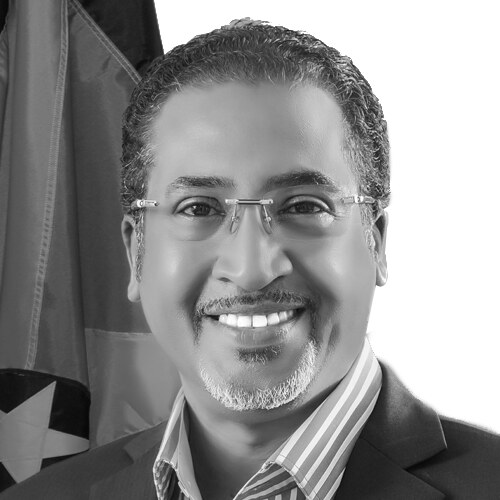
Photo 2 Richard A Nixon. IMRT speaker profile, source 18.
The published 21 September 2026 delegation announcement names Ambassador Richard Nixon among Grenada’s UNGA 81 representatives and identifies advancement of Project Polaris as one of the delegation’s objectives. That places the overlap in an official international setting, rather than solely in a private biography. The announcement describes development diplomacy. [59]
A 23 September published account describes a Polaris executive breakfast on the sidelines of UNGA 81. It identifies Andrea St Bernard as presenter of the project’s investment vision and Nixon, in his GIDC capacity, as presenter of Grenada’s investment case. The location and setting matter: a sidelines investment meeting is not an endorsement, financial guarantee or procurement approval by the United Nations. [60]

Photo 3 Project Polaris executive breakfast on the sidelines of UNGA 81, published 23 September 2026. Photo Prime Minister’s Office via NOW Grenada. Source 60.
The governance issue is the concentration of access. A person associated with a private citizenship-linked development also participates in public investment promotion before international audiences. Those activities may each have a lawful purpose, but the combination creates a foreseeable conflict risk around allocation of leads, preferential access and the appearance of state backing. The conflict risk arises from the documented capacities; personal enrichment is a separate allegation requiring financial investigation.
The distinction between projects also matters. NOW Grenada’s 24 August 2026 report identifies RIEAST Developments’ Hideaway Too as a 23-unit project that broke ground on 21 August. Nixon said it was not then being developed under CBI, although future use of the programme had not been ruled out. He described shareholder equity and Republic Bank financing; landowner Ernest Sanderson contributed land for an ownership stake. Hideaway True Blue was the earlier CBI development. These reported financing arrangements must not be collapsed into a claim that Hideaway Too already received CBI funding or ELDP concessions. [66]
Public office supplies access and credibility that can also benefit a private developer. The coexistence of those roles makes disclosure and independent allocation of investment opportunities essential.
NIXON ACROSS PUBLIC AND PRIVATE ROLES
Published capacities and event participation (Sources 18, 30, 59, 60, 66)
Connections indicate documented roles or published representations.
Diagram 1 Published public and private capacities. KLEPTIK analysis. Lines show roles and reported event participation.
KALYPSO AND THE REPORTED POWER OF ATTORNEY
Frontier Myanmar’s investigation of 14 May 2024 reports that Naing Htut Aung obtained Grenadian citizenship in June 2020 and granted Kalypso Marketing a power of attorney that December. It identifies Nixon as Kalypso’s CEO and director who accepted the appointment, with authority covering banking, utilities and business formation. Nixon denied through a Kalypso representative that the company helped obtain the citizenship. IMA described such mandates as an established form of concierge service. These are Frontier’s account of a document it reviewed and the responses it received, rather than a document newly authenticated by KLEPTIK. [77]
The sanctions connection is independently documented. On 25 March 2022, the U.S. Treasury designated Naing Htut Aung and described him as an arms dealer supplying Myanmar’s military. The cited record does not establish that Nixon supplied arms, evaded sanctions or continued the mandate after designation. The concern is the screening and monitoring of an agency relationship involving a client later designated for his defence-sector activity. [81]
IMI Daily’s 19 May 2024 roundup identifies Richard A. Nixon with Kalypso Marketing Corporation and reproduces Frontier’s account and his denial. It supports describing a public response through Kalypso’s representative. It is not a second investigation, a separate interview or evidence that Nixon made the new-Caribbean-programme forecast appearing in the roundup’s headline. [78]
A PRIVATE DEVELOPER ON THE PUBLIC POLICY PLATFORM
My Grenada Solutions’ 16 May 2025 account identifies Nixon, the Hideaway True Blue developer, as host of IMA’s 13 May symposium on enhanced local developer participation. It reports lower fees and an equity requirement reduced from 20 to 6 per cent. Those figures are the publisher’s description of the initiative, not a finding that Nixon or either Hideaway project received those concessions. [79]
An IMA press release reproduced by NOW Grenada also places Nixon on the symposium panel alongside IMA chief Thomas Anthony, GIDC chief Ronald Theodore and CBI chairman Richard Duncan. This is a documented public platform for explaining access to the citizenship-development market, involving a participant who also markets and develops private projects. [82]
That combination creates a specific potential conflict around investor introductions, access to officials and allocation of opportunities. Hosting a forum is not proof that Nixon assessed his own application or obtained preferential approval. The public-interest issue is whether the promoter’s private interest and the limits of his public mandate were made clear wherever those roles met.
THE ARCHITECTURAL FEES JUDGMENT
The court record is more precise than the newspaper shorthand “Erik Johnson versus Richard Nixon”. The claimant was Atlantic Partnership Architects Inc., whose director was Johnson. In GDAHCV2023/0412, decided on 11 January 2024, Justice Agnes Actie ordered Nixon to pay EC$115,000 in outstanding professional fees, with interest of 3 per cent from filing to judgment and 6 per cent afterwards. Nixon had maintained that the agreed fee was EC$32,200 and had been paid. The court rejected that fee position. The separate conversion claim concerning electronic drawings was not pursued and was dismissed. This was a civil fees judgment, not a criminal conviction or a finding of public corruption. The cited judgment does not establish today’s payment or appeal status. [80]
The judgment supplies a concrete adverse finding about Nixon’s private development obligations. It therefore belongs in his commercial profile, alongside the agency mandate and public promotional roles. Its significance should remain tied to the fees dispute the court decided, rather than being used to imply findings the court did not make.
9. MITCHELL CORNWALL AND THE RECUSAL POSITION
In June 2023, Mitchell was reported as saying that he and Cornwall no longer practised as local CBI agents. He denied practising law, described recusal from applications involving their former offices and recalled at least one recusal. He also said St Bernard could continue her agency business because she was an adviser rather than a ministerial public servant. [19]
The explanation addresses an important question, but there are several separate interests to assess. Day-to-day professional work, firm ownership, profit entitlement, an outstanding fee and participation in a public decision are different facts. Stopping practice does not alone establish the status of each financial interest; retaining an interest does not alone prove an improper public decision.
Mitchell & Co.’s website continues to present his professional biography. That establishes a public presentation, not that he currently takes instructions or controls a particular client matter. An undated biography can remain online after circumstances change. The current relationship should be established through accurate ownership, remuneration and governance information rather than inference from a webpage. [20]
A meaningful recusal account identifies the interest, the decision, who withdrew and who acted instead. An assurance that a person stopped practising does not answer whether a financial interest remained.
10. ADVISORY STATUS AND THE SUBSTANCE OF A CONFLICT
The reported distinction between a minister and a government adviser concerns the capacity to continue a private business. A separate governance question is whether an adviser participated in public work touching that business. Those questions should not be collapsed into a claim that all outside work is prohibited or a claim that advisory status removes every potential conflict.
For St Bernard, Sequence Two records party, diplomatic, banking and project roles from their separate sources. This sequence does not assume that each historical appointment remains current, that a bank chair personally approved a loan, or that a Polaris role gives authority over citizenship applications. Those would require different instruments and decision records. [2]
A conflict assessment turns on the private interest and the public decision it touches. Disclosure and withdrawal can manage some conflicts; an undisclosed interest in a decision in which the holder participates presents a different problem.
An updated register of outside interests and recorded recusals would make these distinctions visible to the public.
RAHAMAN AND THE DUBAI INVESTMENT CHANNEL
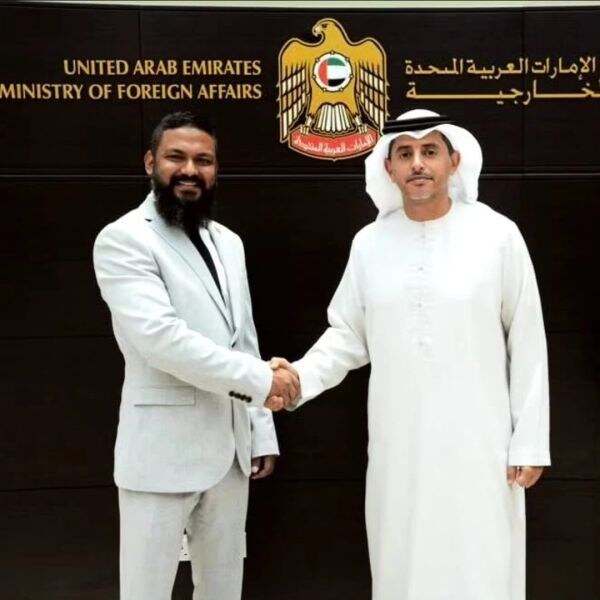
Photo 4 Ziya Rahaman at left, as pictured on the Dubai consulate’s profile page. Source 71. This consular meeting image does not establish a CBI transaction.
The Dubai consulate identifies Ziya Rahaman as Consul General for Dubai and the Northern Emirates and describes him as a businessman and investor. Its stated functions include trade and economic promotion. Those descriptions establish the public-facing combination of commercial experience and consular office; they do not identify a private CBI commission arrangement. [71]
The consulate’s VIP Invest Grenada page goes further than a general biography. It advertises an investment trip under Rahaman’s patronage, involving the diplomatic corps, GIDC, government, the tourism authority, hotel owners, IMA and the business community. It promises access to useful investment contacts. The page shows organised cooperation in promotion. [72]
The CBI connection is also visible in the Dubai visit record. The January 2025 report names Rahaman in Mitchell’s delegation during the trip associated with HSG’s company gathering. A separate My NEO Group account, dated 5 April 2025, publicises Rahaman’s meeting with its founder and representatives of a private club for ambassadors, business leaders, officials and family offices. These are published accounts of access and investment networking, not evidence of a completed contract or payment to Rahaman. [58, 73]
This is a channel in which an official introduction can carry commercial weight. A consulate can legitimately promote national investment, but private operators who appear beside it can gain credibility from the association. The reviewed sources do not identify a CBI project owned by Rahaman or establish that he earned private CBI fees. The supported criticism is that official facilitation needs an explicit boundary between national promotion, agency referrals and personal business interests.
Part Three — HSG, the Ambassador Title and the CBI Sales Network
11. AN AMBASSADOR TITLE IN A COMMERCIAL SETTING
A developer chairman appears in citizenship-investment promotion under the title of ambassador. A bilingual card bearing Grenada’s coat of arms names Yuanfa Li as Ambassador Extraordinary and Plenipotentiary and identifies an Embassy of Grenada in Singapore. Its Singapore street address and office number coincide with a contact address published on a Heng Sheng passport-marketing website. These are concrete points of overlap between the appearance of state representation and a private citizenship-investment business. [31, 36, 37]
The commercial connection extends beyond an address comparison. A public LinkedIn post by Vivian E. Davids describes Heng Sheng’s African team hosting Nigerian channels and clients, identifies Li Yuanfa as its chairman using the ambassador title, and promotes the Grenada National Resort’s CBI offering. It separately identifies David Wong as CEO. Another public post, by Ajay Malhotra, pairs Li’s ambassador designation with praise for Grenada’s citizenship programme and satisfied clients. These posts establish that the title was used in promotional accounts of CBI activity. They do not establish who approved their wording or what Li personally told an investor. [38, 39]
Introducing a project chairman as an ambassador can lead investors to infer official approval or privileged access. The commercial effect exists whether or not the speaker has legal authority to commit the State. The title’s validity and the limits of its use therefore matter.
KLEPTIK credits independent investigator Kenneth Rijock for his earlier reporting on the diplomatic-title issue, publication of the cards, and scrutiny of Heng Sheng’s marketing and financing practices. His reporting is an identified source of leads and allegations. The card comparison, promotional posts and later IMA circulars provide distinct evidence with which to assess those leads. [31-34, 35]
12. WHAT THE TWO CARDS SHOW
The English card names Yuanfa Li and describes the office as an embassy in Singapore. The Chinese reverse presents the corresponding diplomatic identity. Both sides display the national coat of arms. The supplied images are undated; their issuer, printing date and distribution history have not been independently authenticated. They establish the content of the representation shown in the images, rather than the legal validity or present duration of an appointment. [36]
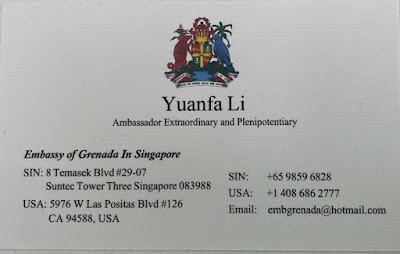
Documentary exhibit 1 English side Undated supplied card image Source 36
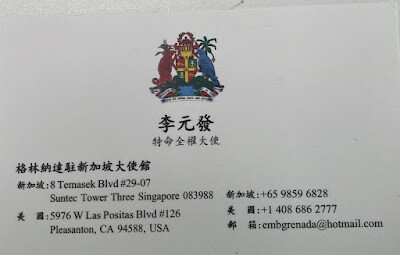
Documentary exhibit 2 Chinese side Undated supplied card image Source 36
The English side gives a Singapore location at 8 Temasek Blvd, unit 29-07, Suntec Tower Three. Heng Sheng’s published contact page gives the same street, building and unit, with Boulevard written in full. The postal codes differ: the card appears to print 083988, while the commercial page prints 038988. The finding is an exact street-and-unit overlap, with that discrepancy preserved. [36, 37]
The United States entries also share a street location in Pleasanton, California, but do not match in full. The card gives 5976 W Las Positas Blvd, number 126; the commercial page gives the same street number with suite 120. The card’s email is a Hotmail address. Rijock’s description of it as Gmail should not displace what the image actually shows. Neither a consumer email service nor shared premises alone proves a sham embassy. The issue is the combination of diplomatic presentation and the project’s commercial footprint. [31, 36, 37]
The commercial page identifies Singapore Heng Sheng (Grenada) Development Pte, Ltd. Other source documents use variants, including China Heng Sheng (Singapore) Development Pte. Ltd.; the names are retained as published.
13. THE TITLE DOES NOT ANSWER THE ACCREDITATION QUESTION
The cards and posts establish use of the ambassador title. They do not authenticate a current accredited posting to Singapore. The reviewed sources contain no appointment instrument, receiving-state acceptance or credentials record establishing that status.
Under the Vienna Convention on Diplomatic Relations, establishment of diplomatic missions rests on mutual consent; accreditation of a head of mission requires the receiving state’s agreement, and commencement of functions depends on the credentials process. A printed title does not by itself establish diplomatic immunity, unrestricted treaty-making authority or immunity in every jurisdiction. The Convention also prohibits a diplomatic agent from practising professional or commercial activity for personal profit in the receiving state. Whether that provision applies to Li requires verified status, location and activity; the cards alone cannot establish a breach. [40]
The evidence establishes promotional use of the title. It does not establish current receiving-state accreditation or the mandate governing commercial use. The overlap between apparent state representation and private promotion remains a documented governance concern.
14. PUBLIC ENDORSEMENT WITHOUT A PUBLIC EXPLANATION OF THE TITLE
Published meetings and appearances establish the prime minister’s support for the resort. The sources reviewed contain no specific public explanation of Li’s appointment, receiving-state accreditation or embassy-labelled card.
The cards are not evidence of a diplomatic passport. No passport copy or authenticated issuance record supports a conclusion about who issued or approved one. Appointment, passport issuance and receiving-state accreditation are separate acts.
There is nonetheless a serious political accountability issue. Public endorsement can give a private project an appearance of governmental confidence. If the public materials do not explain the boundary between that support and a promoter’s claimed diplomatic authority, investors are left to interpret official-looking signals themselves. The commercial value of those signals exists even without proof of a corrupt payment.
The imbalance is visible: political access is prominently advertised, while the mandate behind the diplomatic presentation remains unexplained in the reviewed record. This leaves private promotion benefiting from an official impression that the public cannot readily test.
HOW APPARENT AUTHORITY WORKS
Apparent authority concerns what a principal leads others to believe an agent may do. The Privy Council’s New Falmouth decision explains that representations can arise through conduct. The principal’s representation, the third party’s reliance and the transaction’s scope matter; a person cannot create authority merely by asserting a title. [68]
In New Falmouth, representations made after the transaction could not have induced the purchaser’s earlier reliance. The doctrine concerns authority in a particular transaction, not general prestige. Applying it to state conduct also requires attention to the governing public-law and statutory powers. [68]
For this investigation, the immediate issue is the impression given to investors. An ambassador card bearing the national arms, appearances with a prime minister, official delegation membership and presentations on UNGA’s sidelines can make a private promoter look institutionally trusted. Several signals together may be more persuasive than a disclaimer read separately. Whether they create legal authority to bind the State requires a particular representation and transaction; their potential commercial effect is wider.
Li’s card and the published HSG meetings illustrate that effect. Nixon’s combined profile and investment appearances show another route by which diplomatic and institutional standing can accompany private development interests. Hadeed’s public and business mandates and Rahaman’s consular networking add further points of contact. The evidence supports analysis of borrowed credibility. It does not show that every appearance promoted a personal project or authorised an investment guarantee.
Government silence can leave that impression uncorrected. Knowing acquiescence may be relevant where the facts establish who knew of a representation, had authority to address it and allowed others to rely on it. The reviewed record does not establish those elements for a particular transaction, or a conscious decision by an oversight body to permit private enrichment. Repeated visibility without a clear public boundary nevertheless creates a serious accountability problem: investors can mistake access to officials for approval of a product.
15. THE REGULATORY RECORD IS MORE SERIOUS THAN A RUMOUR
The controversy over owner financing cannot be assessed solely through Rijock’s descriptions. IMA itself issued disciplinary measures naming Heng Sheng and Grenada National Resort. Its Circular No. 3, dated 21 March 2025, suspended new intake and processing effective 18 March and described owner financing and illegal discounting as the reason. It set out conditional escalating sanctions and announced investigation. This was an official administrative action; it was not a criminal judgment against Li. Later circulars refer to the earlier measure as dated 19 March, so the circulars give different dates for the earlier measure. [41]
The June update recorded a more differentiated position. IMA reported no evidence of direct owner financing in its interim assessments, but identified post-approval financing and applicant financial irregularities. It allowed qualifying pending files to resume processing while keeping new intake suspended. It also reported removal of 25 sub-agents for offending marketing and sales conduct, investigation costs charged to Heng Sheng/GNR, and proceedings against one unnamed marketing agent’s licence. The circular did not name that agent. [42]
The July outcome materially limits any continuing accusation. On 16 July 2025, IMA concluded its review and lifted the new-application suspension. Its final assessment found no direct evidence of prohibited financing arrangements by either GNR or Heng Sheng. It treated identified issues as applicant-specific, retained remediation for financial anomalies and required additional checks. A previously identified post-approval financing case received a deadline to fund the full investment personally, with revocation proceedings conditional on failure. [43]
The regulatory history includes both the original intervention and the narrower final conclusion. HSG was not still suspended under the March measure after the July reinstatement. The distribution-channel problems reported by IMA remain part of that history.
16. RIJOCK REPORTING AND THE OFFICIAL RECORD
Rijock’s September diplomatic-title article raises the central question of a CBI business leader’s apparent state status. His August 2024 article alleges discounted citizenship sales and promotion of access to U.S. visas. The latter is a distinct commercial promise requiring its own evidence: Grenadian nationality does not guarantee an E-2 visa or create an automatic route to EB-5 residence. U.S. eligibility and application requirements remain separate. [27, 31, 35]
The article at the September 2024 URL concerning the resort alleges large-scale discounted sales and severe construction delay. The retrieved page displays an 8 May 2025 publication date while referring to September 2024 site conditions. Its pictures and descriptions cannot establish construction status in October 2026. Its assertions of fraud, bribery and kickbacks remain Rijock’s allegations, without a demonstrated transaction trail or adjudication in that article. [32]
On 6 March 2025, Rijock linked an unnamed-agent warning to Heng Sheng and alleged that Tisoro Global was an alternate identity. The later official notice independently names Heng Sheng and GNR in disciplinary action. It does not, by itself, verify his allegation about Tisoro’s ownership or a concealment purpose. Corporate records and contracts are required for that additional proposition. [33, 41]
His April article discusses a purported confidential IMA letter and challenges the adequacy of enforcement and revocations. The letter’s authentication and full administrative context remain separate from the article’s interpretation. The subsequently published June and July circulars answer part of the historical question: IMA publicly reported enforcement steps, remediation and an investigation outcome. A claim that the authorities never acted or never issued an outcome cannot be sustained from the earlier article alone. [34, 42, 43]
17. HSG HAS A PUBLISHED ANSWER
HSG’s 18 July 2025 press release says it was cleared of illegal-financing allegations and that applications were fully reinstated. It says the group cooperated with IMA, established an internal compliance task force and proposed independent compliance oversight. It also disputes the implication that construction had stopped, stating that work continued during suspension and directing readers to its construction updates. These are HSG’s stated positions, not an independent engineering audit. [44]
The regulatory wording is the appropriate anchor: no direct evidence of prohibited arrangements by the company or project, with applicant-specific remediation and ongoing controls. HSG’s broader language of clearance should be read alongside that scope. Neither the company release nor IMA’s financing conclusion authenticates Li’s diplomatic appointment or addresses the shared embassy and commercial contact location.
In August 2025, HSG’s own website described renewed cooperation between chairman Yuanfa Li and Prime Minister Dickon Mitchell and promoted a 2027 opening. That is evidence of the company’s public presentation of continued access and project ambition. It does not establish improper influence, guarantee delivery, or determine whether a diplomatic title was authorised for marketing. [45]
18. MITCHELL AND HSG THE DUBAI MEETING IS DOCUMENTED
HSG’s account of its January 2025 Dubai gathering describes a direct meeting between Prime Minister Dickon Mitchell and chairman Yuanfa Li on 17 January, followed by a company event the next day. It says Li sought continued government support for global market promotion and that Mitchell encouraged construction progress and promotion of Grenada’s citizenship programme. The account identifies members of the prime minister’s delegation and describes his participation before employees and agency partners. These are the company’s published representations of political access, rather than confidential-source speculation. [57]
Linda Straker’s contemporaneous NOW Grenada report independently recorded the Dubai visit through company and attendee posts and photographs. It also described the press secretary’s refusal to confirm the Dubai stop when asked, referring instead to the official London itinerary. This establishes a reporting discrepancy between the publicly described official itinerary and a developer’s advertised access to the prime minister. It does not establish the trip’s funding, an illicit payment or a secret agreement. [58]
The project is Grenada National Resort in Levera, northern Grenada. HSG’s later published account of August 2025 cooperation places Li and Mitchell together in the company’s promotion of the development. The prime minister’s engagement with the project is therefore part of the public record. Ownership by Mitchell, receipt of commissions, intervention in a particular regulatory decision and participation in the token issuance are different propositions; the cited material does not establish them. [45, 57, 58]
The combined record shows how official stature enters a private sales narrative: a chairman presented as an ambassador, an embassy-labelled card sharing a commercial street and unit, and the prime minister appearing in the developer’s account of market expansion. The resulting conflict concern is concrete. State authority has commercial value when it is presented alongside a product whose approval and financial performance are separate legal matters. This is the report’s finding about the presentation of access, without converting association into proof of conspiracy.
THE LEVERA SITE VISIT AND THE POLITICAL SIGNAL
An October 2025 account records Mitchell touring Grenada National Resort with senior officials, hosted by chairman Yuanfa Li. It reports his praise for progress and renewed government support, and identifies Finance Minister Dennis Cornwall and IMA chairman Richard Duncan among the accompanying officials. The photograph is credited to Heng Sheng International. The visit is a documented promotional signal; a report of it is not an independent construction certificate or an approval of the token. [61]

Photo 5 Mitchell’s Grenada National Resort tour, published 15 October 2025. Photo Heng Sheng International via NOW Grenada. Source 61. A historical visit image, not current construction certification.
The Dubai meeting, later cooperation announcements and site visit establish visible political backing for the development. They do not establish Mitchell’s ownership of HSG or participation in token proceeds. Investors nevertheless encounter the project through a promotional narrative reinforced by the prime minister’s presence.
Part Four — The GNR Crypto Token and the Claim to Public Approval
19. THE TOKEN OFFER BRINGS CITIZENSHIP INTO THE SALES PITCH
The GNR website markets a real world asset cryptocurrency token associated with Grenada National Resort and connects buying and holding it with citizenship and passport planning. It advertises backing by 50 per cent of future resort net operating income, alongside token acquisition, construction incentives and a later distribution framework. These are the website’s representations, not verified receipts or an audited valuation. Its roadmap expressly says earlier planned milestones remain unconfirmed. The public marketing is established; the amount actually subscribed and the date of completed issuance are not established by those statements. [46]
That is a significant extension of the commercial proposition. The investment narrative joins a physical resort, prospective financial returns and the attraction of citizenship. Each element engages different rights and safeguards. A buyer can be exposed to a development’s commercial risk without obtaining a qualifying citizenship investment, and can hold a digital instrument without owning the resort.
The homepage’s general disclaimer says it is not an offer of securities. The practical presentation nevertheless directs visitors towards participation. A disclaimer is relevant evidence of the promoter’s stated position; it is not a regulatory determination of the activity’s legal character. The report’s criticism concerns the gap between the confidence conveyed by the combined pitch and the separate authorisations that each component requires.
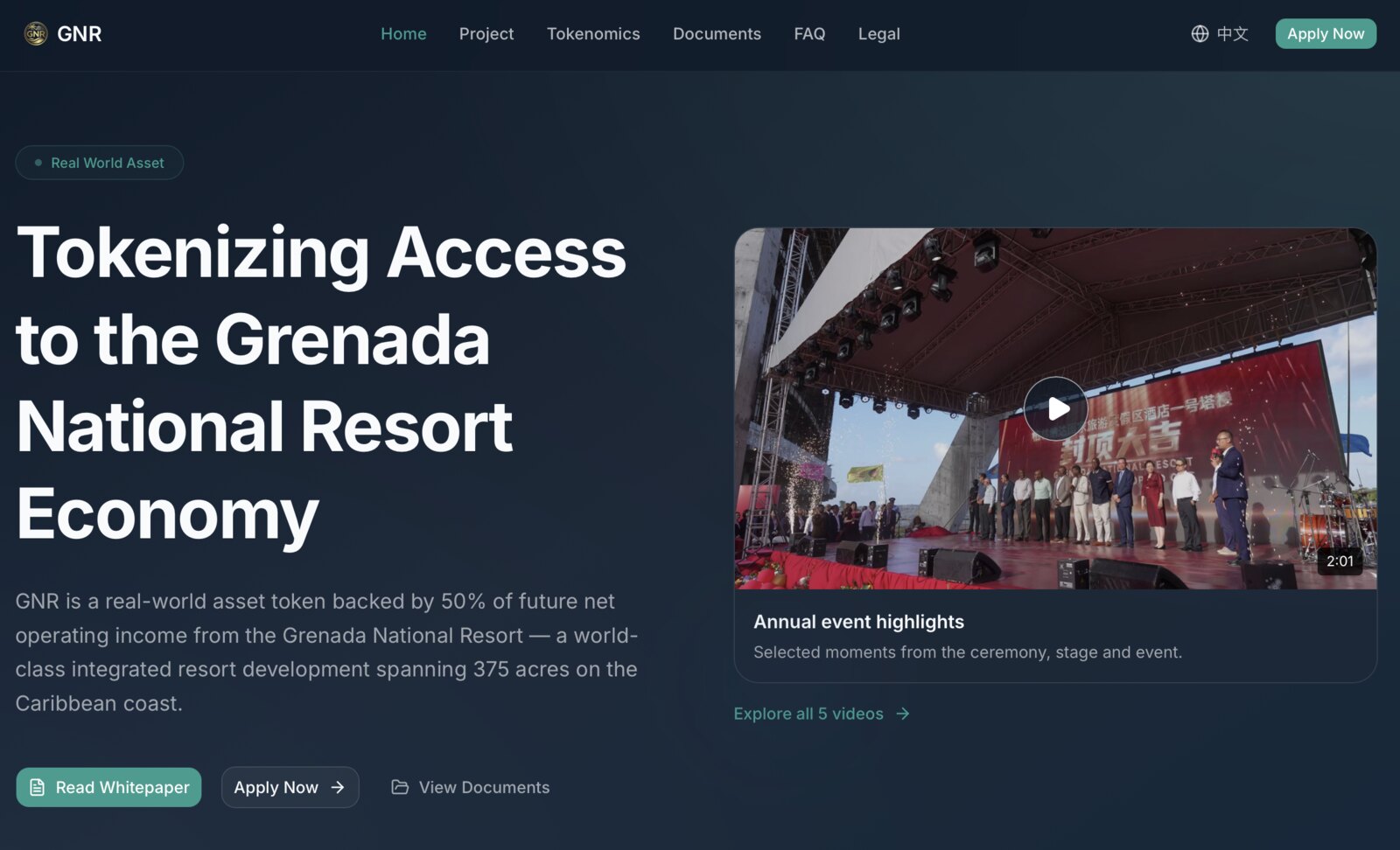
20. UTILITY LANGUAGE DOES NOT SETTLE SECURITIES CLASSIFICATION
The tokenomics page identifies a Base ERC-20 token, a supply of 500 million and a stated price of 1 USDT. Its allocations are 40 per cent public sale, 30 per cent ecosystem and incentives, 15 per cent team and advisers, and 15 per cent reserve and liquidity. It describes eligibility for operating-income distributions, construction-period staking incentives and potential resort uses. Those features make the proposal an investment-classification issue, rather than an ordinary prepaid hotel voucher. They do not demonstrate realised returns. [47]
The legal page calls GNR a utility token and denies security status, asset ownership, voting rights in operating entities and guaranteed claims on revenue or profits. It also warns of construction, liquidity and regulatory risks. The lack of a guaranteed return does not, by itself, establish that a product falls outside securities law. The legal label and the economic substance must be assessed together. [48]
Grenada’s published Securities Act 2021 includes investment contracts and interests in profit-sharing within its securities definition; its investment-contract concept addresses a common enterprise in which expected gains depend on others’ management or effort. The Act’s commencement is by ministerial notice. This report does not presume a commencement date or apply an unverified offence provision. The Eastern Caribbean Securities Regulatory Commission’s (ECSRC’s) current technology-neutral approach supplies a further, independent regulatory basis for looking at economic substance. [55, 56]
On the advertised features, there is a substantial basis for securities scrutiny. This is an analytical conclusion about classification risk, not a declaration that ECSRC has classified GNR or found a breach. A promoter cannot settle that issue simply by placing the word utility on an investment tied to a developer’s performance.
21. THE WHITEPAPER EXPOSES A GOVERNANCE CONTRADICTION
The token whitepaper names ALAN TURING LABS LLC and Hengsheng Digital Ventures Ltd. as issuers and also names ALAN TURING LABS LLC as security agent. It describes protection as independent. It models a combined return above 40 per cent including assumed appreciation, which is a projection rather than an achieved result. Its allocation differs from the website’s, and its legal summary invokes Regulation S. [49]
An issuer cannot be assumed to exercise independent oversight of itself. The overlap creates a structural conflict risk. Beneficial ownership, control and the agent’s enforceable duties remain distinct matters.
There is also a material tension between marketing future operating-income participation and denying guaranteed profit rights. The legal page’s qualification may limit what a buyer can enforce even where the financial narrative encourages an expectation of returns. The stated allocation differences prevent the two publications from being treated as one consistent account of token distribution. [47-49]
The published package contains contradictions in allocation, rights and independence. Its projected returns and protective structure therefore cannot be treated as verified assurances.
THE TOKEN STRUCTURE DESCRIBED BY ITS PROMOTERS
Proposed roles and economic rights
Source 49 whitepaper and source 47 tokenomics. Labels describe promoter claims.
Diagram 2 Promoter-described token structure. KLEPTIK analysis of sources 47 and 49. Proposed roles and rights are not authenticated transfers.
22. REGULATION S DOES NOT AUTHORISE A GRENADIAN OFFERING
The U.S. Securities and Exchange Commission describes Regulation S as governing qualifying offshore securities offers and sales outside U.S. registration requirements. It is a U.S. securities-law framework, subject to conditions. It is not an authorisation from Grenada, the Grenada Authority for the Regulation of Financial Institutions (GARFIN) or ECSRC; it does not establish that a product is not a security. Invoking it also does not establish that a particular offering satisfies its conditions. [54]
The regional CBI securities notice is explicit in substance. ECSRC requires compliance for securities issued or offered through public offers and private placements, addresses prospectus approval and private-placement assessment, and makes no distinction in its notice between overseas foreign investors and investors within member territories. Its reminder specifically includes securities offered in CBI products. The notice is a general regulatory warning, not a GNR enforcement finding and not a blanket prohibition of tokens. [53]
The 2026 securities-tokenisation pilot reinforces the point. It provides a controlled route for existing licensees, requires approval or no objection, directs new or unlicensed entities towards the regulatory sandbox, and retains existing legal obligations. Token-related advertisements under that plan require prior assessment. The existence of a pilot is not permission for every token using a Caribbean asset. No GNR-specific admission or approval is established by the material cited here. [55]
Offshore selling does not remove local oversight. The territorial connection, activity and any applicable exemption determine the requirements. Token-specific authorisation is not demonstrated by the cited public material.
23. THE U.S. AUDIENCE AND THE LIMITS OF THE OFFSHORE CLAIM
The generic legal page does not expressly name U.S. residents or citizens as an excluded class. It instead refers to jurisdictions in which participation is restricted or prohibited. However, the whitepaper’s legal table expressly limits its described investment audience to qualified investors in jurisdictions outside the United States. The wording does not establish whether effective screening, geographic controls or distribution restrictions were implemented. [48, 49]
The distinction between citizenship and residence is also material. Regulation S defines a natural-person U.S. person by residence in the United States; U.S. nationality alone is not the complete definition. Offshore-transaction requirements, directed selling efforts and any applicable category conditions must also be satisfied. A Grenadian passport application does not decide those securities-law questions, and a second nationality does not by itself remove a U.S. resident from that analysis. [63]
The Securities and Exchange Commission (SEC) states that securities offers and sales must be registered or conducted under an available exemption. Thus U.S. participation can raise registration and exemption issues, but it does not invariably require a registered public offering. Equally, merely invoking Regulation S is not evidence that an offering qualifies for it. Whether U.S. securities law was breached would depend on classification, the relevant offer or sale, jurisdictional facts and the availability and satisfaction of an exemption. [62]
The U.S. citizenship-marketing context is documented separately. Henley and Partners’ event page confirms a New York citizenship forum at the St. Regis on 17 June 2025. Its event listing on Qwoted identifies Thomas Anthony as an advertised speaker and IMA Grenada as a silver partner. These are published promotional listings, not a transcript establishing what was said or proof that GNR tokens were offered at that event. [64, 65]
An audience interested in Grenadian citizenship can include people whose eligibility for a particular token differs from their eligibility for the citizenship programme. Even accepting that a U.S. citizen may pursue citizenship under the applicable programme rules, that does not authorise a securities transaction or establish that the token was sold to that person. Conversely, a restriction in a whitepaper does not demonstrate compliance in the actual sales channel.
Citizenship promotion in the United States and permission to offer a token there are separate matters. The general legal page is less specific than the whitepaper. The reviewed record establishes neither an actual U.S. token sale nor a GNR-specific SEC enforcement determination.
FOUR PERMISSIONS THAT CANNOT SUBSTITUTE FOR ONE ANOTHER
A shared project name does not merge separate legal decisions
KLEPTIK analysis (Sources 3, 5, 40, 51, 53, 54, 55, 62, 63)
| Permission (granted under) | What it establishes — and what it does not | Sources |
|---|---|---|
| 01 · Resort / project approval (IMA) | Approved development status for Grenada National Resort — not approval of a token or a securities offer. | 3, 5, 40 |
| 02 · CBI citizenship qualification (statutory route) | Agent-led application and payment to an approved project — distinct from buying a token. | 3, 5 |
| 03 · Securities authorisation (ECSRC / Securities Act 2021) | Invoking Regulation S is not a Grenadian authorisation and does not establish compliance. | 53, 54, 55, 62, 63 |
| 04 · Virtual-asset registration (Virtual Asset Business Act 2021) | s.4 registration and s.13 prospectus with GARFIN no-objection before any offer. | 51 |
Diagram 3 Separate legal permissions. KLEPTIK analysis of sources 3, 5, 40, 51, 53-55, 62 and 63. Approval in one area does not automatically authorise another.
24. THE VIRTUAL ASSET LAW AND THE ZERO REGISTRATION DISPLAY
Grenada’s Virtual Asset Business Act 2021 applies to covered business offered or operated in or from Grenada. Its definition covers specified exchange, transfer, custody and issuance-related financial services carried out for others. It excludes securities from virtual assets, making classification essential. Section 4 requires registration for covered business. Section 13 requires a registrant providing covered issuance services to submit a prospectus for review at least fourteen days before proposed publication, obtain GARFIN’s no-objection statement and publish before the issue or offer. These conditions are not satisfied merely by publishing a privately prepared whitepaper. [51]
GARFIN’s public page displays zero registered virtual asset service providers. It therefore supplies no confirmation of a GNR provider’s registration. The counter alone cannot establish a breach without determining the activity, territorial connection and applicable classification. [52]
Classification determines the regulatory route. A security is excluded from the virtual-asset definition, but remains subject to the applicable securities framework. Covered virtual-asset services engage the registration regime instead.
The GNR document centre strengthens the disclosure concern. At review, it linked a whitepaper while marking the legal summary, tokenomics summary, risk-disclosure document, asset documents and audit reports as coming soon. This does not establish that no underlying documents exist. It does establish that those downloadable supporting materials were not supplied in the document centre despite the broader transparency claims. A technical audit, even if completed, would not itself amount to financial-services authorisation. [50]
25. RESORT APPROVAL DOES NOT APPROVE THE TOKEN
IMA describes statutory citizenship routes and an agent-led application and payment process. A payment towards an approved project is distinct from a private token purchase or secondary-market holding. The official route does not make every financial instrument referring to a resort a qualifying investment. [3, 5]
Approval of Grenada National Resort does not, by itself, demonstrate approval of its token as a qualifying citizenship investment. This is an inference from the difference between the advertised arrangement and IMA’s prescribed process. It is not a claim that IMA has issued a token-specific rejection. Nor is the developer’s July 2025 financing-review outcome an approval of a later digital instrument.
The central exposure is the transfer of credibility between separate propositions: an approved development, a politically connected promotional narrative, a diplomatic title and an investment product. The publications establish that these signals appear around the same commercial project. They do not establish that the prime minister approved, designed or profited from the token.
The cryptocurrency token is marketed alongside citizenship planning, its investment features warrant securities scrutiny, and its disclosures contain material inconsistencies. Resort approval and political endorsement do not resolve those defects or demonstrate token-specific authorisation.
Part Five — Capital Approvals and the One True Blue Beach Test
26. THE OFFICIAL CHECKLIST IS A SUBSTANTIVE STANDARD
The IMA new-project checklist requests development and financial material, land ownership, beneficial-owner information, funding evidence, past or ongoing litigation, planning approval and proposed investor contracts. It also requests audited financial statements and development cost and cash-flow information. The published requirements identify what an approval assessment should be capable of addressing. [4]
Published requirements do not show what a project submitted or how an exception was assessed. A claim of non-compliance needs the relevant approval file; absence from the public record does not establish that the agency never received a document.
The economic distinction is between a concept that appears viable and an execution plan that is funded. A hotel can have credible demand and still run short of construction liquidity. An asset valuation can support a business plan without paying contractors. A promoter’s experience can be relevant without replacing the capital stack for this development.
The public-interest conclusion is that project approval should be reported as a process with conditions and continuing obligations. The evidence for that conclusion is the agency’s own requested material. Whether a specific condition was breached must be determined against the applicable approval, dated facts and responsible authority.
27. SHAREHOLDER LOANS AND DEVELOPER EQUITY
A company can receive money from a shareholder through equity or debt. Both create cash, but the rights and repayment position differ. Equity ordinarily bears ownership risk; a loan creates a claim subject to its terms. A regulatory requirement can define qualifying capital differently from the company’s accounting presentation. The label on a bank transfer alone cannot settle that classification.
Equity classification depends on the executed subscription or loan, maturity, subordination, security, repayment restrictions and the regulator’s acceptance. The published account does not identify the agency’s precise reason for rejecting the contribution as developer equity. Rejection alone does not establish illicit funding.
A repayment can be lawful in corporate terms yet incompatible with a particular capital-maintenance condition; it can also be permitted if other funding replaced it or the applicable condition allowed it. The resulting conclusion depends on the contemporaneous capital position and approval terms. An equity warning is a reason to reconstruct that position, not an automatic finding of dishonest diversion.
This distinction controls the One True Blue account. The earlier investigation identifies a sequence of warnings and payments. Sequence Three examines what that sequence tests. It does not transform a described shareholder-loan repayment into a proven theft of investor funds merely because it followed a warning. [14]
28. THE ONE TRUE BLUE BEACH FINANCIAL CHRONOLOGY
KLEPTIK’s published investigation describes a 17 April 2026 IMA email refusing Cesario’s US$300,000 as developer equity and a 14 May shortfall of US$475,446. It reports a 26 May US$300,000 debit described as final payment of a shareholder loan and a 26 June US$400,000 debit described as a loan-agreement payment. Its evidence account identifies a 24 June board resolution for an unsecured loan and a 23 June agreement naming Goldberg Securitization S.A. and an instrument identifier. [14]
| Event described in the published investigation | Financial significance | What it does not establish |
|---|---|---|
| Refusal to count a contribution as developer equity | A classification issue for the capital requirement | An express prohibition on every repayment |
| Identified equity shortfall | Funding compliance needs examination at that date | The position after any subsequent replacement funding |
| US$300,000 shareholder-loan repayment debit | A recorded outflow with a stated description | Its ultimate source or whether it breached a condition |
| US$400,000 debit and unsecured-loan resolution | Authorisation and corporate benefit require assessment | A settled bond subscription or completed return of proceeds |
The two reported debits total US$700,000. That is transaction volume, not a calculation of loss. This chronology relies on the earlier investigation’s account of confidential exhibits; the final recipient credits and onward use are not traced here.
The shareholder advance raises a concrete corporate question: what benefit and enforceable rights did the company receive for the risk it assumed? A board resolution may authorise a transaction without establishing its prudence or compliance with funding restrictions.
29. THE GOLDBERG CONNECTION REQUIRES A COMPLETE CASH TRAIL
The earlier report names Goldberg Securitization S.A. and ISIN CH1108675757 in the agreement and distinguishes that company from CCM FINANCE S.A., in which it records Cesario’s historical corporate role. The report also describes a public instrument entry under Goldberg’s former Heisieh name. Those are specific identity connections. They do not prove Cesario owned Goldberg or that CCM issued the instrument. [14]
A completed financing loop would need several separately evidenced legs: project outflow, subscriber receipt, subscription settlement, issuer receipt and any onward financing back to the project. The published account identifies an initial debit, authorisation and agreement but does not establish the entire circuit. Describing that as completed circular financing would exceed its stated findings.
The financing’s economic effect also depends on rights and obligations. If existing project liquidity returned as borrowed money, cash could be restored while a new liability arose and a shareholder receivable remained. If genuinely external capital entered, the result could be different. Neither outcome should be inferred from similar amounts, a promotional issue size or an unrelated company’s older balance sheet.
The CSSF explains that public, continuous securities issuance is relevant to prudential authorisation. This makes the actual instrument, distribution basis and issuer status important. It does not establish that Goldberg was unlawfully operating, that every securitisation company requires the same authorisation, or that an ISIN certifies investor protection. Those are distinct legal and documentary questions. [21]
30. ESCROW PROTECTION DEPENDS ON RELEASE CONTROL
IMA’s local-developer flyer describes applicant investment funds going to a project escrow account after approval and being disbursed towards development. It also describes GIDC involvement in feasibility and incentives and an ELDP project-cost threshold of XCD2.5 million. The flyer is an administrative description of that programme, not proof of the release terms for every project. [22]
Escrow protection depends on release authority, supporting approvals, permitted uses and remedies when funding fails. The account’s label does not establish those restrictions or prevent a payment to a related party.
Escrow monitoring also needs a running reconciliation. Opening cash plus receipts less releases and charges should equal closing cash. Each release should reconcile to a permitted purpose and, where relevant, a physical milestone or certified cost. A bank confirmation of a balance is different from assurance that earlier releases were authorised.
No inference of bank wrongdoing follows from an alert showing a debit. A bank may act on a valid instruction while another party breaches a separate obligation. The institution’s role, knowledge and applicable mandate have to be established. This report identifies the control chain rather than allocating liability to everyone who processed money.
31. HILTON BRANDING AND THE LIMITS OF ASSURANCE
The One True Blue website advertises a Hilton Tapestry Collection development, describes proposed hotel rooms and branded residences and presents an operating target in 2028. Its disclaimer separates Hilton’s licensed brand from ownership, development, sale and project guarantees. These are the project’s statements, not certification of present construction condition or financial performance. [16]
The commercial effect of a familiar name can be substantial. An investor may assume it signals due diligence, operational discipline or completion support. The actual agreement determines which standards and remedies apply. The brand’s reputation is not a substitute for a developer’s obligation, a parent guarantee or an enforceable completion undertaking.
The earlier KLEPTIK account refers to engineering material and attributes a retrofit concern to Jules. It expressly does not establish the building’s current condition or that Hilton knowingly ignored defects. Current safety requires the complete engineering record, subsequent work and competent inspection, not a historical allegation or a promotional rendering. [14]
Responsibility follows the relevant contract and conduct. A developer, engineer, brand licensor and operator may have different duties, including different obligations after receiving notice of a problem.
32. THE WHISTLEBLOWER ACCOUNT AND ITS EVIDENTIARY LIMITS
The published investigation identifies Jules as a former Golden Coast investment manager and records his allegations of retaliation after financial and construction disclosures. It distinguishes his account of witnessing a Labour Ministry officer make a call, advice relayed to him afterwards and information reportedly supplied by a prosecution contact about the developer’s lawyers. Those are different kinds of evidence. [14]
The sequence warrants scrutiny without supplying its own verdict. Timing can be relevant to motive, but a firm’s founder relationship does not prove that the founder instructed a complaint. Nor does a dispute about company documents automatically invalidate a public-interest disclosure or automatically immunise every act involving confidential material.
The earlier investigation did not verify a complaint, charge or political instruction. Jules’s account remains an allegation of retaliation, not a confirmed prosecution or proof of police direction by Mitchell.
The public accountability interest is independent handling of both issues: the substantive financial concerns and any legitimate allegation concerning records. The report supports examination of the disclosures on their merits and does not treat an employment dispute as sufficient reason to dismiss them. Equally, whistleblower status is not proof of every alleged violation.
Part Six — Kawana Bay and the Cost of an Unfinished Investment
33. CITIZENSHIP AND PROPERTY RECOVERY CAN DIVERGE
IMA’s 20 August 2024 Kawana Bay notice invited compensation claims from people who acquired citizenship through an investment in the project. It directed claimants to supply their claim information and registered conveyances, with access to the process dependent on confirmation of a relevant interest. That is a concrete official record of a recovery route. [15]
The notice does not state that every claimant was accepted, every property interest had the same priority, or every investor received full repayment. The notice is not evidence that compensation was completed. Citizenship status, property title, a contractual refund right and a compensation award are different legal positions.
The significance extends beyond this project. An investor can achieve the migration objective while bearing unresolved asset risk. A programme outcome measured in citizens or applications may therefore coexist with a development outcome measured in incomplete works or contested recovery. Each requires its own reporting system and remedy.
Administration of compensation claims and actual payment are separate outcomes. A portal or settlement announcement does not establish the number paid, the sum recovered or the balance outstanding.
34. SETTLEMENT IS NOT A JUDGMENT ON EVERY ALLEGATION
Sequence Two records Kawana Bay’s negotiated resolution and the separate financial descriptions reported around it. The public arbitration register identified the case as settled or discontinued before a liability decision when reviewed for that sequence. That status is reported through Sequence Two; no merits decision is cited. [2,28]
A settlement can serve a sound public purpose by resolving litigation risk. It can also require scrutiny of valuation, authority, releases, title and continuing obligations. Those are compatible propositions. A critic should not treat compromise as proof the original claims were true; an administration should not treat a resolved dispute as eliminating the need to account for the price and rights exchanged.
The financial categories must remain distinct. A claimant’s demand is not a final judgment. A government settlement cost is not necessarily the investor compensation pool. Property value is not automatically the amount paid to a developer. A successor’s proposed investment is not a recovery already received by the State.
The appropriate reconciliation follows each instrument and recipient. It identifies who released which claim, who conveyed or acquired which title, who paid consideration and which residual obligation remained. Only that schedule can support a conclusion about savings, loss or public value. The chronology alone cannot prove a political bargain.
35. SUCCESSOR RIGHTS DESERVE THE SAME SCRUTINY
The transition from disputed development to successor opportunity can create a second transaction. A new investor may receive land, a lease, incentives, permits or operating rights. Those are potentially valuable even where the public interest strongly favours completion and jobs. Their allocation requires its own valuation and decision account.
The successor arrangement has its own selection process, assets, liabilities, budget and funding terms. The earlier investors’ losses do not independently establish the fairness of those later terms.
No improper grant of successor rights is established by the cited record. Selection, valuation and the transfer of obligations nevertheless deserve the same scrutiny as the original development.
The policy lesson is practical. A project register should retain its history through ownership change, settlement and redevelopment. Removing an old name or adding a new one should not erase the record of subscriptions, obligations or remedies attached to the previous phase. Historical traceability protects future investors as well as earlier claimants.
Part Seven — Reform Financial Dependence and the International Test
36. THE INDEPENDENT REVIEW AND ITS LIMITS
IMA’s 22 September 2026 announcement describes a September-October review administered through Caribbean Analytics, using questionnaires, interviews and focus groups with public and industry participants. It says IMA will receive combined findings and that a public summary will follow board reporting. This establishes an announced research process, not a completed transaction audit. [9]
A stakeholder review can identify confidence, experience and perceived weaknesses. It cannot, without additional work, reconcile a shareholder loan, establish a project's cost to complete or determine whether an approval condition was satisfied on a particular date. Public confidence and financial compliance are related but different subjects.
The review’s public summary should distinguish its methods and recommendations from findings about particular transactions. A survey of confidence cannot settle a disputed payment or approval.
The published record establishes the review announcement, rather than suppression of a final output or breach of an established publication deadline.
37. REGIONAL REGULATION HAS SEVERAL MILESTONES
ECCIRA’s official profile describes an agreement signed in September 2025, domestic enabling legislation later that year and operations anticipated in Grenada in late 2026, with executive recruitment ongoing. Those are separate institutional stages. It would be inaccurate to treat a signed agreement as evidence that every supervisory function was already operational. [10]
A regional authority can improve consistency, information sharing and complaints handling. Its effectiveness also depends on mandates, resources, access to national files and enforcement arrangements. Its powers and operational commencement must be distinguished from proposed standards.
IMA’s August 2026 residence communication is relevant to implementation timing. The agency’s published social communication says the anticipated requirement would await operationalisation and a common effective date agreed by participating states. That is an administrative statement. The legal effect and commencement position should be assessed against the applicable instruments rather than treating a circular as automatically amending legislation. [11]
For readers, the crucial distinction is between law adopted, administrative implementation announced and obligations actually applied to a named file. Marketing should identify which proposition it relies on. A historical no-residence brochure is not a permanent assurance that future conditions cannot change.
38. THE LOCAL DEVELOPER OPPORTUNITY ALSO NEEDS CONTROLS
The ELDP flyer gives local developers a public route involving GIDC feasibility engagement, project documentation, IMA submission and licensed marketing after approval. It also describes investment receipts moving through project escrow. That offers a mechanism for widening participation; it does not establish the outcome of any particular proposal. [22]
Local participation can strengthen domestic ownership and economic linkages. It does not eliminate development risk. A smaller or first-time promoter still needs credible cost estimates, title, funding, governance and capacity to complete. Administrative assistance should help meet those requirements rather than blur who independently assessed them.
The overlap is illustrated by Nixon’s participation in the May 2025 developer symposium alongside IMA, GIDC and CBI leadership while being identified as the Hideaway True Blue developer. A potential conflict arises where public promotion or decision-making touches a private project or marketing interest. Disclosure, independent allocation of enquiries and withdrawal from a decision affecting that interest are the relevant safeguards. The symposium evidence establishes the shared platform, not a preferential award or receipt of ELDP benefits. [79, 82]
A useful outcome report would distinguish applications assisted, projects approved, capital raised and developments operating. Each describes a different stage. Success should not be measured solely by the number of projects added to a list, just as misconduct should not be presumed from a project's need for assistance.
39. EUROPEAN PRESSURE ON THE CITIZENSHIP MODEL
The EU’s revised visa-suspension framework includes operation of investor citizenship schemes without a genuine link among suspension grounds. The Commission’s December 2025 monitoring report expressed continued concern about the Eastern Caribbean programmes while acknowledging regional reforms. These are EU policy and legal positions, not a finding that every Grenadian citizen or applicant presents a risk. [23,26]
Antigua and Barbuda’s July 2026 government statement described a Commission request to phase out its programme by 1 June 2028. Dominica’s 28 October statement described a broader OECS transition discussion and continued engagement. Those official statements strengthen the evidence of regional policy pressure. They do not establish the full text of a Grenada-specific instruction or a Grenadian decision to close its programme. [24,25]
The distinction is consequential. Improvements in due diligence may address some concerns without resolving an objection to citizenship without a genuine connection. Regional governments may contest the fairness or economic consequences of that position. The report does not assume a negotiated outcome before one is documented.
For development finance, the risk is not limited to passport demand. A change in eligibility, mobility value or application conditions can affect subscriptions and completion funding. Projects dependent on future sales should explain how they would continue under a weaker inflow scenario. That is a financial resilience question, not a prediction that every project will fail.
40. MOBILITY AND TAX CLAIMS REQUIRE SEPARATE QUALIFICATIONS
Citizenship, visa-free travel, permission to work abroad and tax residence are different legal positions. A passport does not grant an unconditional right of entry to every destination. A second nationality does not automatically terminate an investor’s obligations in another country. Marketing that places these benefits together should preserve the qualifications attached to each.
The United States lists Grenada among E-2 treaty countries. E-2 eligibility nevertheless involves a separate application and requirements relating to the U.S. enterprise, investment and applicant. A Grenadian property subscription is not a U.S. visa approval. [27]
The same principle applies to global-income language. A project's promotional tax statement is not a personalised assessment of residence, source income, treaty treatment or obligations elsewhere. The responsible representation identifies the relevant jurisdiction and conditions. This report does not infer that a specific investor relied on a misleading statement without the dated materials and circumstances.
These distinctions protect the credibility of the programme as well as the buyer. A benefit can be legitimate and commercially important while remaining conditional. Preserving that qualification is more useful than either dismissing every benefit or promoting it as guaranteed.
41. FISCAL BENEFIT DOES NOT REMOVE CONCENTRATION RISK
The IMF’s January 2026 assessment linked earlier CBI savings to fiscal resilience and warned about disruption to CBI and investment inflows. It also called for stronger management of CBI resources and attention to public-investment risks. These observations support scrutiny of the programme’s benefits and dependencies together. They are not a certification of a named transaction. [12]
A government can prudently save a volatile receipt, use it for recovery or development and still face a difficult transition if inflows weaken. The relevant questions concern buffers, recurrent commitments, unfinished public works and alternative funding. The gross historical receipt cannot answer the forward-looking expenditure question.
The Ministry of Finance’s medium-term framework identifies international scrutiny of CBI as a revenue risk. Lower receipts and delayed subscriptions could affect public spending and private completion finance differently; the two exposures should be reported separately. [29]
A credible resilience account should therefore show how public spending and private project completion respond to different inflow levels. It should identify obligations already incurred rather than assume future citizenship subscriptions will arrive indefinitely. The purpose is to test preparedness, not to manufacture a forecast of collapse.
Part Eight — Findings and the Public Account
42. OFFICIAL STATUS IS BEING TURNED INTO COMMERCIAL CREDIBILITY
The investigation establishes a serious accountability failure in the way investment opportunities are presented. Public office, diplomatic visibility and political endorsement supply credibility to private promotion, while the scope of that backing remains difficult to verify. The token disclosures contain their own inconsistencies. These are identifiable failings in the public presentation of authority and risk, rather than an accusation based only on who knows whom.
The public account can nevertheless be improved. A project-level record could identify the legal vehicle, approval milestones, investment rights, funding status, completion progress, material changes and complaint route. Sensitive applicant details can be excluded. The report recommends a structured disclosure because the current sources answer different parts of the process in different places.
Disclosure also makes criticism fairer. A cured funding shortfall, an authorised release or a recorded recusal can materially change the assessment and should be reported alongside the concern.
Without that account, the public sees the endorsement more readily than the safeguards behind it.
43. WHAT THE EVIDENCE ESTABLISHES
The GNR evidence adds a separate investment-marketing finding. Public materials connect token holding with citizenship planning, describe income-related participation and publish inconsistent allocations. The stated protective arrangement also overlaps with issuance functions. These are documentary findings about the representations made to potential participants. The cited record does not demonstrate a token-specific local authorisation, and the report does not treat that absence as an adjudicated breach. [46-56]
The public record establishes that Grenada's programme links state citizenship decisions to private development finance and licensed intermediary activity. The official checklist anticipates substantive scrutiny of ownership, funding, litigation and investor contracts. The compensation notice demonstrates a remedy process for a project whose investors had acquired citizenship. Regional reform and external policy pressure are documented developments. [3,4,10,15,23-25]
The named commercial sources establish publicly advertised roles and limits: the marketing chain on The View, the institutional and private capacities in Nixon’s profile and Hilton’s separation from project guarantees in the One True Blue disclaimer. Those records justify inquiry into capacity, referrals and contractual responsibility; they do not establish paid commissions, beneficial ownership or misconduct beyond their scope. [16-18]
The One True Blue investigation supplies an attributed chronology of a capital warning and shareholder-related payments. It makes capital classification, release authority and the use of liquidity concrete concerns, while leaving the complete financing circuit unproved. [14]
These findings support a strong conclusion about accountability: the citizenship decision and the project's financial performance must be reported separately. The same applies to an official's professional status and financial interests. One favourable answer cannot be used as automatic clearance for a different question.
44. EVIDENCE AND RESPONSIBILITY
Connections establish where interests meet. Findings of self-dealing require evidence that a public function was used to obtain a private benefit; findings of conspiracy require evidence of agreement. The cited material establishes overlapping roles and promotional access, but no common enrichment agreement, private referral payment or political instruction to police.
The same distinction applies to the financial and engineering allegations. The report attributes the earlier claims about One True Blue Beach and Jules’s account. It establishes neither a completed Goldberg financing circuit nor a present structural defect or knowing misconduct by Hilton.
The accountability case does not depend on treating every participant as culpable. It depends on identifying whose decision governed the money, the approval or the representation on which an investor was invited to rely.
45. THE PUBLIC AND PRIVATE BENEFITS ARE DISTINCT
The documented sales narrative combines sovereign citizenship eligibility with private development and investment products. State officials, developers and intermediaries perform different functions, but their public presentation can make those boundaries difficult for an investor to see. The report identifies that effect through specific marketing materials, titles, addresses and regulatory records.
The HSG financing review ended with a narrower conclusion than the original sanctions suggested. That outcome is part of the finding. It supplies neither a current diplomatic accreditation nor token-specific approval. The GNR investment presentation must therefore be assessed on its own representations and authorisation position.
The public deserves a direct account of these failings. Officials who promote investment while holding private commercial interests need visible safeguards and clear limits on their mandate. Leaving investors to infer approval from status and access is unacceptable. Political leadership carries responsibility for making those boundaries intelligible.
46. FROM THE NETWORK TO THE TRANSACTION
Citizenship eligibility, approved developments, professional services and official promotion meet in the same market. The recurring participants hold different powers and obligations. Accountability requires those responsibilities to remain visible when they work together.
The strongest supported criticism is that the public-facing signals of assurance do not themselves account for capital adequacy, release controls, retained interests or investor recovery. Those matters can be resolved through records. Until they are, a programme's success in processing applications should not be used as a complete answer to a project's financial controversy.
For an investor, the decisive facts remain the money received, the rights purchased, the restrictions on use and the remedy if performance fails.
Grenada’s citizenship is a sovereign status. Its use as an investment incentive deserves an account that is equally serious about public benefit, private risk and the exercise of authority. That is the public-interest finding of this sequence.
INVESTMENT PROMOTION AND THE CONDITIONS PEOPLE LIVE IN
Public investment promotion must ultimately be judged against public benefit. The World Bank’s Grenada profile records a national poverty rate of 25 per cent in 2018. This is a dated survey observation, not a finding that one quarter of Grenadians are poor in October 2026 or proof of starvation. It nevertheless establishes the depth of the social need against which promises of investment-led prosperity have been made. [74]
Sanitation is also a documented issue. The Central Statistical Office’s public page reports that 61.77 per cent of households had an indoor toilet in the 2011 census. An outdoor facility can still be usable, so that figure cannot be converted into a count of people with no toilet. More recently, the government’s 2026 budget statement described an inherited legacy of more than 8,000 pit latrines and open bathrooms and claimed that its WASH programme had delivered hundreds of modern indoor toilets and baths. The budget establishes the government’s own acknowledgement of need and its claimed response; it is not a current independent count of households still awaiting assistance. [75, 76]
Those conditions give the accountability issue its urgency. Citizens are entitled to see how citizenship-linked investment translates into completed developments, sustainable public revenue and better living conditions. They are equally entitled to know whether public representatives’ private interests influence which projects receive access and promotion. An administration cannot meet that obligation simply by displaying investor meetings abroad.
The political criticism is direct. Under Mitchell’s leadership, highly visible support for investment projects must be matched by equally visible safeguards against conflicts and private advantage. Basic sanitation and household welfare are part of the measure of success. The cited evidence establish why unexplained overlaps deserve scrutiny from the citizens in whose name public authority is exercised.
PUBLIC OFFICE IS NOT A PRIVATE INVESTMENT ASSET
Grenada belongs to its citizens. Public office, diplomatic representation and access to international forums are held for public purposes. When the same names recur across private development, citizenship promotion and state representation, the resulting concentration of influence deserves more than the reassurance of a title or a photograph.
The report documents a network in which official and commercial roles repeatedly meet. That concentration of access creates an advantage for the people inside it and a conflict risk that government cannot answer with silence. It is a failure of accountability when public promotion is visible but the boundaries protecting the public interest are not. The record does not establish a criminal cabal or a common enrichment agreement; the documented failures are serious without that unproved conclusion.
Political backing cannot replace financial due diligence. A diplomatic title cannot certify a private investment. Grenadians are entitled to know when public representatives promote the country, when they promote a private interest and what safeguards prevent one role from serving the other.
DOCUMENTARY APPENDICES
APPENDIX A THE APPROVAL AND PAYMENT CHAIN
| Stage | Actor or instrument | Accountability function |
|---|---|---|
| Investor recruitment | Marketing agent and any referring party | Dated representation, licence, project mandate and disclosed remuneration |
| Application submission | Local agent and application file | Identity of applicant route and applicable requirements |
| Project approval | Ministerial and committee record | Legal project entity, conditions, dates and amendments |
| Capital verification | Developer funding evidence | Equity, loans, security, subordination and qualifying status |
| Receipt of investment | Subscription and escrow records | Payer, amount, currency, recipient and rights acquired |
| Release of funds | Escrow mandate and authorisation | Permitted use, approving person and supporting certificate |
| Construction and operation | Contractor, engineer, developer and operator | Certified progress, remaining cost and remedial work |
| Investor exit or recovery | Contract, title, compensation or settlement | Entitlement, priority, actual payment and continuing obligations |
APPENDIX B CASE COMPARISON
| Case or record | Supported point | Unresolved proposition |
|---|---|---|
| One True Blue Beach | Earlier published account identifies an equity warning and shareholder-related payment records | Complete funding reconciliation, compliance of releases and onward use [14] |
| Kawana Bay | Official investor-compensation notice provides a claims route | Eligibility and actual recovery for each claimant [15] |
| The View | Website names marketing, local-agent and developer functions | Current mandates, ownership and any commission from an official referral [17] |
| Nixon public profile | Publisher presents investment, diplomatic and private capacities | Current legal tenure and safeguards at a particular decision [18] |
| Mitchell recusal explanation | Reported denial of practice and explanation of recusals | Current financial interests and the record of a specified decision [19,20] |
| IMA independent review | Announced stakeholder research and intended public summary | Final findings, scope and any separate transaction audit [9] |
| ECCIRA | Official establishment timeline and intended operations | Powers actually operational and applicable to a particular historical file [10,11] |
APPENDIX C CHRONOLOGY
| Date | Material record | Significance |
|---|---|---|
| August 2013 | CBI Act described in IMA legal overview | Statutory origin of the programme [3] |
| June 2023 | Mitchell practice and recusal statements reported | Public explanation of professional and official separation [19] |
| July to December 2024 | Parliamentary activity table | Files, decisions and persons are separate measures [8] |
| August 2024 | Kawana Bay compensation notice | Recovery process after citizenship acquisition [15] |
| January 2025 | HSG describes Mitchell meeting Li in Dubai and attending its gathering | Published political access and market-promotion narrative [57, 58] |
| March to July 2025 | IMA suspends HSG/GNR applications, publishes interim findings, then lifts suspension | Enforcement history and narrowed final conclusion [41-43] |
| September to November 2025 | Regional agreement and enabling legislation described by ECCIRA | Establishment differs from operational commencement [10] |
| November to December 2025 | EU framework and monitoring developments | Additional visa-suspension grounds and stated concerns [23,26] |
| January 2026 | IMF assessment published | Fiscal benefits and exposure to inflow disruption [12] |
| March 2026 | ECSRC adopts tokenisation pilot plan | Controlled authorisation route [55] |
| April to June 2026 | One True Blue warning and payment chronology in KLEPTIK account | Capital and use-of-funds questions [14] |
| July 2026 | Antigua and Barbuda statement on Commission request | Attributed regional policy pressure towards 2028 [24] |
| August 2026 | IMA residence implementation communication | Administrative timing depends on regional steps [11] |
| September 2026 | IMA programme review announced | Research exercise with public summary intended [9] |
| 26 October 2026 | One True Blue investigation published | Detailed case reporting distinct from this synthesis [14] |
| 28 October 2026 | Dominica government transition statement | Current regional position, not a Grenadian closure decision [25] |
| 30 October 2026 | Publication date of Sequence Three | Evidence cutoff for these published findings |
APPENDIX D SELECTED PROJECTS AND THE PUBLIC ROSTER
IMA’s public roster identifies the developments and contacts below. It records programme listings, not certified ownership, construction progress or financial standing. The source’s names and spelling are retained. [30]
| Project name in IMA material | Named contact or business | Investigative distinction |
|---|---|---|
| Grenada National Resort Project | Singapore Heng Sheng (Grenada) Development PTE, Ltd | Identify the exact project vehicle and any separate branded affiliates |
| Hideaway True Blue Condominium | Dr Richard A Nixon | This listed project differs from the later development |
| ONE True Blue Beach Hotel and Residences | Oleg Khomenko | Project eligibility differs from the capital and release questions in this report |
| The Legacy Project | Michelle Emmanuel Steele | The listing and the advertised developer and agent serve different functions |
| Intercontinental Hotel and Villas Grenada | Mohammed Asaria and Kamal Shehada, Range contact | Brand, developer, operator and investor rights are distinct |
| The Range Development Grenada Limited | Six Senses La Sagesse contact | A branded property and a legal project company are different identifiers |
| Hartman University Town and Hartman Resort | Separate Hartman project descriptions | Separate offerings can carry different liabilities |
The agency also publishes decertified project names. A historical listing and a current status notice are different records; the reasons, date and consequences of a particular decertification need the underlying notice. This report does not attribute misconduct to a listed project solely because its status changed. [30]
A useful oversight record would give each approved project a stable identifier, the exact contracting entity, approval and amendment dates, named responsible developer, current status and links to material notices. That would make brand changes and ownership changes easier to follow. It would also help prevent a similarly named company, a different phase or a new development being assigned the history of another entity.
SOURCE NOTES AND REFERENCES
Sources were reviewed to 30 October 2026 unless otherwise stated. Institutional records, commercial representations and attributed reporting are identified separately. The notes describe the scope of each source.
| Ref | Source and scope |
|---|---|
| 1 | KLEPTIK, The Grenada Files Sequence One The Architecture of Power, supplied 22 October 2026 edition. Series context and documentary roadmap, especially actual PDF pages 39-40. |
| 2 | KLEPTIK, The Grenada Files Sequence Two The Network, expanded final 28 October 2026 edition, 42 pages. Series continuity and attributed case history; not independent corroboration of its own underlying allegations. |
| 3 | IMA Grenada, Legal and Finance. Administrative overview of application route and project approval; not a consolidated legal opinion. https://imagrenada.gd/legal-and-finance/ |
| 4 | IMA Grenada, Approved Project Requirements New Projects, linked from its project page. Published requested documents, not a finding of compliance or breach. https://imagrenada.gd/wp-content/uploads/2024/03/Approved-Project-Requirements-New-11.8.23.pdf |
| 5 | IMA Grenada, Becoming a Citizen. Current published cost tables; applicable category and current instruments control any quotation. https://imagrenada.gd/becoming-a-citizen/ |
| 6 | IMA Grenada, Enquiries. Administrative descriptions of options, costs and process; not used as a universal fee quotation. https://imagrenada.gd/enquiries/ |
| 7 | IMA Grenada, Reports and Statistics, including linked Q1 2026 statistics. Used for reporting categories, not a newly reconstructed annual total. https://imagrenada.gd/reports-statistics/ |
| 8 | Grenada Parliament, CBI Report July-December 2024, Schedule 1 Table 1. Period-specific applications, decisions and citizenships. https://grenadaparliament.gd/wp-content/uploads/2025/07/CBI-Parliament-Report-Jul-Dec-2024-Final.pdf |
| 9 | IMA Grenada, Independent Review of the Citizenship by Investment Programme, 22 September 2026. Announced research scope and intended reporting. https://imagrenada.gd/news/ima-grenada-commissions-independent-review-of-the-citizenship-by-investment-programme/ |
| 10 | ECCIRA, About the Authority. Publisher’s establishment timeline, intended operational start and recruitment position at review. https://www.eccira.org/about |
| 11 | IMA Grenada, Circular No. 2 of 2026 landing page, 21 August 2026, and agency social announcement of implementation conditions. The full underlying circular and consolidated commencement law are not represented as independently read. https://imagrenada.gd/news/circular-no-2-of-2026-operationalization-of-the-regional-agreement-and-commencement-of-residence-requirements/ https://www.linkedin.com/posts/activity-7498392386868367360-iMUv |
| 12 | IMF, Executive Board Concludes 2025 Article IV Consultation with Grenada, January 2026. Fiscal benefits and risks, not certification of private projects. https://www.imf.org/en/news/articles/2026/01/20/pr-26011-grenada-imf-executive-board-concludes-2025-article-iv-consultation |
| 13 | IMA Grenada, Approved Agents. Distinct agent categories and licensing materials; no assertion of a complete historical register. https://imagrenada.gd/approved-agents/ |
| 14 | KLEPTIK, One True Blue Beach The Money Trail and the Whistleblower, 26 October 2026. Earlier published documentary and witness account; confidential underlying exhibits not freshly authenticated for Sequence Three. https://www.kleptik.com/investigations/grenada-files-one-true-blue-beach |
| 15 | IMA Grenada, Kawana Bay Project Compensation Notice, 20 August 2024. Claim process and interest verification, not a completed compensation audit. https://imagrenada.gd/wp-content/uploads/2024/08/Notice-Kawana-Bay-Project-Compensation.pdf |
| 16 | One True Blue Beach project website. Developer marketing, project description, operating target and Hilton disclaimer; not a current engineering certificate. https://www.onetbb.com/ |
| 17 | The View, Marketing Team. Advertised marketers, local agent, developer disclaimer and care-of contact address. https://theview.gd/marketing-team/ |
| 18 | IMRT, Dr Richard Nixon speaker profile. Publisher’s description of institutional, diplomatic and private roles. https://imrtgrenada.com/speakers/dr-richard-nixon/ |
| 19 | NOW Grenada, PM Mitchell Not practicing law so no CBI conflict, 26 June 2023. Reported denial, recusal account and advisory-status explanation. https://nowgrenada.com/2023/06/pm-mitchell-not-practicing-law-so-no-cbi-conflict/ |
| 20 | Mitchell and Co, Dickon Mitchell biography. Current public presentation; page does not prove current work, income or client instructions. https://mitchellsco.com/dickon-mitchell/ |
| 21 | CSSF, Authorisation of a securitisation undertaking, updated 31 July 2025. Authorisation framework; not a finding concerning a named issuer’s compliance. https://www.cssf.lu/en/authorisation-of-a-securitisation-undertaking/ |
| 22 | IMA Grenada, Enhancing Local Developers Participation flyer. Administrative route, project-cost threshold and described escrow process. https://imagrenada.gd/wp-content/uploads/2026/05/Enhancing-Local-Developers-Participation-ELDP-Program-Flyer.pdf |
| 23 | Council of the European Union, EU Visa Policy, suspension mechanism summary. Grounds and procedure; not evidence of a Grenada suspension decision. https://www.consilium.europa.eu/en/policies/eu-visa-policy/ |
| 24 | Government of Antigua and Barbuda, statement concerning Commission communication, July 2026. Describes a phase-out request to that government. https://ab.gov.ag/detail_template.php?page=press_release%2F2026%2Fjuly%2F2026_july_07-govt_responds_to+eu_communication_on_cip |
| 25 | Dominica Office of the Prime Minister, Status of Dominica’s CBI Programme and Engagement with the EU, 28 October 2026. Official regional-transition account; not a Grenadian closure instrument. https://pressroomopm.gov.dm/statement-status-of-dominicas-citizenship-by-investment-programme-and-engagement-with-the-european-union/ |
| 26 | European Commission, Visa Suspension Mechanism report, 19 December 2025. Eastern Caribbean assessment and recognition of reforms. https://eur-lex.europa.eu/legal-content/EN/TXT/PDF/?uri=celex%3A52025DC0792 |
| 27 | U.S. Department of State, Treaty Countries and E visa guidance. Treaty eligibility is distinct from approval of a particular visa application. https://travel.state.gov/content/travel/en/us-visas/visa-information-resources/fees/treaty.html https://travel.state.gov/content/travel/en/us-visas/employment/treaty-trader-investor-visa-e.html |
| 28 | UNCTAD, True Blue Development and others v Grenada, ICSID ARB/21/37. Settlement or discontinuance status recorded in the preceding sequence; current direct retrieval unsuccessful for this edition, so no fresh case-status certification is asserted. https://investmentpolicy.unctad.org/investment-dispute-settlement/cases/1115/true-blue-development-and-others-v-grenada |
| 29 | Grenada Ministry of Finance, Medium Term Fiscal Framework 2026-2028, fiscal-risk discussion. Official recognition of external scrutiny as a revenue risk. https://www.finance.gd/docs/2025/MTFF-2026-2028-Final.pdf |
| 30 | IMA Grenada, Approved Projects and decertified-project material, reviewed 30 October 2026. Selected published project and contact names; not a corporate ownership register or financial certification. https://imagrenada.gd/gov-approved-projects/ |
| 31 | Kenneth Rijock, diplomatic-title investigation, 8 September 2024. Earlier reporting and card reproduction; legal interpretations are independently qualified. https://rijock.blogspot.com/2024/09/grenada-makes-its-principal-citizenship.html |
| 32 | Kenneth Rijock, resort construction and discounting allegations. URL bears September 2024; retrieved page displays 8 May 2025. https://rijock.blogspot.com/2024/09/chinese-owned-heng-sheng-caribbean.html |
| 33 | Kenneth Rijock, Dubai-agent discounting allegations, 6 March 2025. Tisoro identity allegation not independently verified. https://rijock.blogspot.com/2025/03/government-of-grenada-admits-its-dubai.html |
| 34 | Kenneth Rijock, purported confidential letter and enforcement critique, 21 April 2025. https://rijock.blogspot.com/2025/04/read-confidential-letter-from-grenada.html |
| 35 | Kenneth Rijock, U.S. visa marketing allegations, 17 August 2024. https://rijock.blogspot.com/2024/08/chinese-company-in-spotlight-for.html |
| 36 | Two supplied images, sing1.jpeg and SING2.jpeg, English and Chinese business-card sides bearing Yuanfa Li’s name and diplomatic title. Undated and independently unauthenticated as to issuance and distribution. |
| 37 | Heng Sheng passport-marketing website, contact page and homepage. Published corporate contact representation, not a current registry extract. https://www.hengsheng.xin/intro/8.html https://www.hengsheng.xin/ |
| 38 | Vivian E. Davids, public LinkedIn post describing Heng Sheng client/channel event, chairman Ambassador Li Yuanfa, CEO David Wong and GNR CBI promotion. Relative date display is not treated as an exact publication date. https://www.linkedin.com/posts/vivian-e-davids-eyp-acipm-06661440_grenada-cbi-hengsheng-activity-6991122033845653504-YUa8 |
| 39 | Ajay Malhotra, public LinkedIn post using Li’s ambassador designation in citizenship-programme promotion. https://www.linkedin.com/posts/ajaym_grenada-immigration-activity-6985874922719895553-DrKP |
| 40 | United Nations, Vienna Convention on Diplomatic Relations 1961, especially Articles 2, 4, 13 and 42. Application to an individual requires established status and facts. https://untreaty.un.org/ilc/texts/instruments/english/conventions/9_1_1961.pdf |
| 41 | IMA, Circular No. 3 of 2025, PDF dated 21 March 2025, measures effective 18 March. Later notices describe earlier circular as dated 19 March. https://imagrenada.gd/wp-content/uploads/2025/03/Circular-No.-3-of-2025-Notification-of-Disciplinary-Actions.pdf |
| 42 | IMA, Circular No. 6, 4 June 2025. Interim findings, remediation, sub-agent removals and compliance requirements. https://imagrenada.gd/wp-content/uploads/2025/06/Circular-No-6.-Follow-up-to-Disciplinary-Measures-Related-to-Singapore-Heng-Sheng-Grenada-Development-Pte.-Ltd.-Heng-Sheng-and-Grenada-National-Resort-GNR-June-4-2025.pdf |
| 43 | IMA, Circular No. 9, 16 July 2025. Investigation conclusion, lifting of suspension and retained controls. https://imagrenada.gd/wp-content/uploads/2025/07/Circular-No-9.-Conclusion-of-Investigation-and-Resumption-of-Application-Acceptance-July-16-2025.pdf |
| 44 | Heng Sheng Group, press release, 18 July 2025, company response and construction position. https://www.imidaily.com/wp-content/uploads/2025/07/Heng-Sheng-Group-Press-Release-18-July-2025-1.pdf |
| 45 | HSG, Building Grenada’s Future, 4 August 2025. Corporate account of cooperation and opening target. https://www.hscbi.cn/En/News/Info/1390 |
| 46 | GNR token website homepage. Marketing, citizenship linkage and roadmap qualifications, reviewed 30 October 2026. https://gnrgnr.com/ |
| 47 | GNR Token Economics. Published token parameters, allocation and distribution descriptions. https://gnrgnr.com/tokenomics |
| 48 | GNR Legal and Risk Disclosure. Promoter’s utility classification and limitations on rights. https://gnrgnr.com/legal |
| 49 | GNR token whitepaper, linked filename V1.4-white-paper-en.pdf; internally V1.3 Base Edition, July 2026. PDF pages 2-3, 7-11 and 14. Issuer, security-agent and forecast claims are attributed, not authenticated appointments. https://gnrgnr.com/files/V1.4-white-paper-en.pdf |
| 50 | GNR Document Center. Availability labels at review, not proof of non-existence of underlying records. https://gnrgnr.com/documents |
| 51 | Grenada, Act No. 7 of 2021 Virtual Asset Business Act, sections 2-5 and 13. Classification, territorial scope and services determine application. https://grenadaparliament.gd/wp-content/uploads/2021/07/Act-No.-7-of-2021-Virtual-Asset-Business-Act-2021.pdf |
| 52 | GARFIN, Virtual Asset Service Providers public page. Counter displays zero; no GNR-specific determination inferred. https://www.garfin.gd/index.php/regulated-sectors/virtual-asset-service-providers |
| 53 | ECSRC, Citizenship by Investment and Securities Legislation Unauthorised Offer of Securities, archived 14 February 2023. General notice, not a GNR ruling. https://www.ecsrc.com/gallery/NewsItems/detail/164 |
| 54 | U.S. SEC, International Business Rules Regulations and Forms; foreign-issuer guidance on offshore sales. Regulation S scope. https://www.sec.gov/about/divisions-offices/division-corporation-finance/international-business-rules-regulations-forms https://www.sec.gov/divisions/corpfin/internatl/foreign-private-issuers-overview.shtml |
| 55 | ECSRC, Securities Tokenisation Pilot Plan, 31 March 2026, and release dated 2 April 2026. Controlled framework, not blanket authorisation. https://www.ecsrc.com/files/documents/ECSRC_pilot_testing_and_Implementation_plan_for_Tokenised_Securities_.pdf https://www.ecsrc.com/files/news/Press_release_-_ECSRC_Securities_Tokenisation_Pilot_Testing__Implementation_Plan.pdf |
| 56 | Grenada, Securities Act No. 8 of 2021, section 2 definitions and section 1 commencement provision; ECSRC lists the amended Act. Commencement date not certified in this report. https://grenadaparliament.gd/wp-content/uploads/2021/09/Act-No.-8-of-2021-Securities-Act-2021.pdf https://www.ecsrc.com/cms/Cmspages/details/313/category/securities-act |
| 57 | HSG, Ride The Crest Seek The Best, 7 February 2025. Corporate account of January Dubai meeting and event. https://www.hscbi.cn/En/News/Info/1345 |
| 58 | Linda Straker, NOW Grenada, Press Secretary silent on PM’s Dubai visit, 24 January 2025. Contemporaneous visit and press-office account. https://nowgrenada.com/2025/01/press-secretary-silent-on-pms-dubai-visit/ |
| 59 | Published Grenada delegation announcement, High-level delegation to 81st UN General Assembly, 21 September 2026, reproduced by NOW Grenada. https://nowgrenada.com/2026/09/high-level-delegation-to-81st-un-general-assembly/ |
| 60 | Published Project Polaris investor-breakfast account, 23 September 2026, reproduced by NOW Grenada. Photograph credited to the Prime Minister’s Office. Event was on the sidelines of UNGA 81. https://nowgrenada.com/2026/09/project-polaris-investment-vision-presented-to-global-partners-at-unga-81/ |
| 61 | NOW Grenada, PM Dickon Mitchell praises progress at Grenada National Resort, 15 October 2025. Attributed visit and endorsement account; photograph credited to Heng Sheng International. https://nowgrenada.com/2025/10/pm-dickon-mitchell-praises-progress-at-grenada-national-resort/ |
| 62 | U.S. SEC, Exempt Offerings. Registration or an available exemption; not a GNR determination. https://www.sec.gov/resources-small-businesses/exempt-offerings |
| 63 | eCFR, 17 CFR 230.902, especially paragraphs c, h and k. Regulation S definitions; residency, offshore transactions and directed selling efforts. https://www.ecfr.gov/current/title-17/chapter-II/part-230/section-230.902 |
| 64 | Henley and Partners, Global Citizenship Forum New York, 17 June 2025. Organiser’s date, location and event description. https://www.henleyglobal.com/events/global-citizenship-event-series-2025-new-york |
| 65 | Henley and Partners event listing on Qwoted, Global Citizenship Forum 2025 New York. Advertised Thomas Anthony speaker role and IMA Grenada silver partnership; not verified attendance or token sales. https://app.qwoted.com/opportunities/event-global-citizenship-forum-2025-new-york |
| 66 | Roxanne Thompson, NOW Grenada, Hideaway Too built on local landowner partnership, 24 August 2026. Nixon’s financing explanation and distinction between two projects. https://nowgrenada.com/2026/08/hideaway-too-built-on-local-landowner-partnership/ |
| 67 | Hideaway True Blue brochure, June 2020 file. Project’s commercial presentation and Nixon’s chairman and CEO designation. Historical developer material, not current financial assurance. https://hideawaytrueblue.com/wp-content/uploads/2020/06/Hideaway-Brochure-2020cpnc.pdf |
| 68 | Judicial Committee of the Privy Council, New Falmouth Resorts Ltd v International Hotels Jamaica Ltd [2013] UKPC 11, especially paragraphs 14 and 22-26. Apparent authority and reliance; not a ruling about Grenada. https://jcpc.uk/uploads/jcpc_2012_0031_judgment_45107a2e69.pdf |
| 69 | Embassy of Grenada in Caracas, The Ambassador. Published biography of Hassan Hadeed’s diplomatic, business and institutional roles; not a current corporate register extract. https://www.grenadaembassyve.com/the-ambassador |
| 70 | NOW Grenada, PM Kimpton Kawana Bay investors will be compensated, September 2023. Reports Mitchell’s identification of the settlement committee. https://nowgrenada.com/2023/09/pm-kimpton-kawana-bay-investors-will-be-compensated/ |
| 71 | Consulate General of Grenada in Dubai, Consulate in Dubai. Published description of Ziya Rahaman and consular functions. https://grenadaconsulatedubai.com/consulate-in-dubai |
| 72 | Consulate General of Grenada in Dubai, VIP Invest Grenada. Advertised investment trip and institutional partners; displayed June dates do not specify a year. https://grenadaconsulatedubai.com/vip-invest-grenada |
| 73 | My NEO Group, Dr Mickael Mosse Facilitates High-Level Meeting with Consul General of Grenada, 5 April 2025. Participant’s promotional meeting account, not proof of a contract or financial benefit. https://myneogroup.com/news/dr-mickael-mosse-facilitates-high-level-meeting-with-consul-general-of-grenada.html |
| 74 | World Bank, Poverty and Inequality Platform, Grenada country profile. National poverty observation of 25 per cent for 2018; not a 2026 estimate or a measure of starvation. https://pip.worldbank.org/country-profiles/GRD |
| 75 | Central Statistical Office Grenada, Living Conditions and Poverty. Indoor-toilet percentage explicitly refers to the 2011 census; indoor access is not the same measure as access to any usable toilet. https://stats.gov.gd/subjects/living-conditions-and-poverty/ |
| 76 | Government of Grenada, 2026 Budget Statement, housing section, reproduced by NOW Grenada, December 2025. Government account of inherited sanitation needs and claimed WASH delivery, not an independent current inventory. https://nowgrenada.com/2025/12/government-of-grenada-2026-budget-statement/ |
| 77 | Allegra Mendelson, Frontier Myanmar, The secret life of a Myanmar arms dealer in Dubai, 14 May 2024. Reports the 2020 mandate, Nixon’s denial and IMA’s explanation; the underlying mandate is not independently authenticated here. https://www.frontiermyanmar.net/en/the-secret-life-of-a-myanmar-arms-dealer-in-dubai/ |
| 78 | IMI Daily, Expects At Least One New Caribbean CIP By 2025, 19 May 2024. A roundup reproducing Frontier; not independent corroboration or a forecast attributed to Nixon. https://www.imidaily.com/im-people-in-the-news/expects-at-least-one-new-caribbean-cip-by-2025-investment-migration-people-in-the-news-this-week/ |
| 79 | My Grenada Solutions, Grenadian Developers Empowered by Government’s ELDP Initiative, 16 May 2025. Commercial publisher’s account of Nixon hosting the 13 May symposium and the advertised policy terms. https://mygrenadasolutions.com/grenadian-developers-empowered-by-governments-eldp-initiative/ |
| 80 | High Court of Grenada, Atlantic Partnership Architects Inc. v Richard Nixon, GDAHCV2023/0412, 11 January 2024, paragraphs 27 and 36-38; PDF reproduced by The New Today. Fees judgment; conversion dismissed. Paragraph 38(3) states a costs direction from claimant to defendant; that wording is not silently reversed here. https://www.thenewtodaygrenada.com/wp-content/uploads/2024/01/NixonvsErik-Johnson.pdf |
| 81 | U.S. Treasury and OFAC, 25 March 2022. Historical designation of Naing Htut Aung and Treasury’s stated grounds; no designation or misconduct finding concerning Nixon is asserted. https://home.treasury.gov/news/press-releases/jy0679 https://ofac.treasury.gov/recent-actions/20220325 |
| 82 | IMA Grenada press release reproduced by NOW Grenada, IMA Grenada 5th symposium to empower local developers, 15 May 2025. Panel identification and forum purpose. https://nowgrenada.com/2025/05/ima-grenada-5th-symposium-to-empower-local-developers/ |
ABOUT THE SERIES
The Grenada Files investigates public authority, citizenship investment and private interests. Sequence Three examines investment promotion, development finance and token marketing. Findings and sources are fixed to 30 October 2026.