One True Blue Beach - The Money Trail and the Whistleblower


- Golden Coast Limited, the company holding the One True Blue Beach project, shows an equity shortfall and recorded shareholder payments; the alleged return of proceeds to Golden Coast is not traced in the records reviewed.
- A financing agreement names a Luxembourg securitisation company (CCM Finance, with Goldberg/Heisah as issuer), raising the question of a bond-issuance route and whether investor-protection ‘compartment’ terms were actually in force.
- Former investment manager Jerelle Jules alleges retaliation after raising financial and construction concerns — an account that, if documented, engages Grenada's employment-protection and whistleblower safeguards.
- Prime Minister Dickon Mitchell's firm, Mitchell & Co., appears in the project's professional and public-identity record, making his current interests, practising status and any recusal a live conflict question.
- The project is marketed under Hilton's Tapestry Collection and an IMA Citizenship-by-Investment approval; the records support scrutiny of the approval basis, the construction-safety assurance and the handling of disclosure.
- The decisive records remain unreleased — account and board records, contribution and loan terms, the IMA due-diligence file, and contractual safety notices — the test of whether these are documentation gaps or something more.

Promotional architectural rendering of One True Blue Beach. This image illustrates the proposed design; it is not a photograph of completed construction. Source: onetbb.com [8]
Following Sequence One
Sequence One of The Grenada Files examined the relationships connecting political leadership, public appointments and private investment. This follow-up examines how those questions arise around one development: One True Blue Beach, marketed under Hilton’s Tapestry Collection brand. KLEPTIK’s review of the supporting records identifies an equity shortfall, shareholder payments and an agreement naming a Luxembourg securitisation company. Former investment manager Jerelle Jules separately alleges retaliation after raising financial and construction concerns. The records support scrutiny of specific company decisions; his account raises further questions about political access and the response to disclosure. [1, 8, 35-38]
Executive summary
For an investor looking at One True Blue Beach, the promise is easy to understand: a waterfront development in Grenada, an internationally recognised hotel brand and access to a citizenship investment programme. Behind that promise sits a more complicated chain of responsibilities. Golden Coast Limited (Golden Coast) holds the project, Goldblat Limited (Goldblat) markets its development credentials, the Investment Migration Agency (IMA) administers the citizenship programme and Hilton Worldwide Holdings Inc. (Hilton) supplies a licensed brand. This report follows what happened when a former employee challenged the safeguards underpinning that proposition. [1, 8]
The story and the findings
KLEPTIK has completed its editorial review and confirms that it has reviewed and verified the supporting records identified in the evidence schedule dated 20 October 2026. These include IMA emails, bank debit alerts, a board resolution and a loan agreement. The records support the financial chronology set out below. Verification of the records does not establish every allegation: the source and ultimate use of the money, alleged retaliation and any improper coordination involving public officials require separate evidence. This report distinguishes documented events, Jules’s firsthand observations, information relayed to him and conclusions that remain unproved. [1, 35]
Jules, a former Golden Coast investment manager and whistleblower, says he moved his family to Grenada in July 2024 to help build the project’s future. His responsibilities included regulatory submissions, although he says he had no authority over bank payments. By October 2026, he describes a grievance, the end of his employment, a reported police complaint concerning company documents and a departure from Grenada because he feared an unfair process and personal harassment. His account gives the financial investigation a human consequence without establishing every disputed event. [1]
The payments and the Luxembourg connection
The financial sequence begins with an important distinction. The evidence schedule identifies an IMA email of 17 April 2026 refusing Christian Cesario’s US$300,000 as developer equity and identifying him as a 20% shareholder. It then lists a US$475,446 equity shortfall on 14 May, a US$300,000 bank debit to Cesario on 26 May marked ‘Final payment of Shareholders loan’, and a US$400,000 debit on 26 June marked ‘Loan Agreement payment’. A 24 June board resolution identifies an unsecured loan to Cesario; a 23 June loan agreement names Goldberg Securitization S.A. and ISIN CH1108675757. These records raise questions about authorisation, corporate benefit and compliance. The two later debits total US$700,000 in transaction volume; they do not by themselves quantify investor loss or identify the source of the money. [1, 35]
The Luxembourg trail involves two separate companies. Cesario's founding stake and directorship in CCM FINANCE S.A. are recorded in the filings cited here. Goldberg Securitization S.A. is the entity named in the June loan agreement identified by KLEPTIK, with ISIN CH1108675757. Goldberg's LEI record identifies HEISIEH S.A. as its former name and RCS B158522 as its company number; Cbonds publishes an entry for the exact ISIN under Heisieh. CCM's EUR497,500 debt balance at December 2024 therefore cannot be treated as the balance of this Goldberg instrument or as proof of the June 2026 payment. [27-29, 35-38]
Political responsibility and private legal business
Dickon Mitchell founded Mitchell & Co. in 2017. Its public presentation of him as an attorney sits alongside his reported 2023 denial that he was practising law. Jules describes a Labour Ministry call to the Prime Minister, advice relayed afterwards to keep his dispute private, and a subsequent police approach attributed to the firm acting for Golden Coast. This sequence raises a concrete question about access to political authority and the separation of public duties from private representation. [1-5, 35]
Executive summary continued
The developer and the approval record
Oleg Khomenko is publicly associated with Goldblat and identified by Jules as Golden Coast’s founder and managing director. Supplied ownership information also connects him to HOMA Development Limited. Court lists name Khomenko and HOMA as defendants in Grenada High Court civil case GDAHCV2024/0361. The lists establish procedural steps, including an extension application and a report on mediation; they do not establish the substantive claim, liability or outcome. The reported ownership connection makes the proceedings relevant to background checks without transferring liability between companies. [1, 6-9]
The supporting evidence identifies a conditional approval letter dated 29 October 2024, effective 7 October 2024, and a full approval letter dated 14 February 2025. Those are separate milestones; neither should be collapsed into the Gazette publication date. The court listings reviewed are from 2025. The accountability question is what information the agency received before each approval, what conditions remained outstanding and how compliance was monitored afterwards. [6-7, 10, 35]
Construction and the limits of the Hilton assurance
The supporting evidence identifies Adams Consulting reports dated 20 May 2025, 25 June 2025 and 16 July 2026, together with a design analysis, a building permit and dated fifth-floor photographs. KLEPTIK confirms it has verified this evidence. Jules attributes cracking, deflection and localised structural distress to the reports and describes a US$450,000 retrofit recommendation outstanding at his departure. The dated reports give the safety inquiry an identifiable documentary basis. [1, 35]
The Hilton name strengthens the commercial proposition, but the project disclaimer says Hilton does not own, develop or sell it and provides no project guarantees. The practical issue is what the brand agreement requires the developer to disclose and repair before opening. There is no documented basis here to say Hilton authorised the disputed payments or knowingly ignored defects. [8]
The response to disclosure
On 7 October 2026, Jules says he watched a Labour Ministry officer telephone Mitchell and then received advice relayed by that officer to keep the dispute private. About a day later, an unnamed prosecution contact reportedly told him that Mitchell & Co. had approached police about company documents. Witnessing the call, hearing relayed advice and receiving an account of a complaint are different forms of evidence. [1]
The same care applies to Jules’s account of worker treatment and dismissal. A public interest disclosure may expose a worker to pressure while a dispute over records raises separate confidentiality questions. Establishing the employer’s instructions and the official complaint record is necessary to determine what action was taken and why.
The accountability conclusion
The central accountability issue is the intersection of money and institutional power. KLEPTIK's supporting evidence identifies an equity warning, shareholder payment records, a board-approved unsecured loan and a bond-related agreement. Jules separately describes an appeal through a public office followed by a reported complaint from the developer's lawyers. The financial records identify decisions to examine; the political chronology identifies an instruction trail to establish. A coordinated effort to suppress disclosure remains an allegation, rather than a conclusion supplied by the financial documents. [1-5, 27-31, 35]
The personal cost of speaking out
Jerelle Jules says he moved his family from London to Grenada believing he was helping build a development that would contribute to the island’s future. He is a husband and father of three young children. By the end of his employment in October 2026, the project that brought him to Grenada had become the subject of his disclosures, an employment dispute and an alleged attempt to silence him. [1]
From employee to complainant
His account is of a rapid change in circumstances. He submitted a formal grievance on 4 October, was signed off sick on 5 October and says shareholders were told on 6 October that he no longer represented the company. His employment was subsequently terminated. He alleges dismissal without cause and says he is pursuing an unfair dismissal claim. [1]
The next step, in his account, was an appeal to a public institution. At the Ministry of Labour on 7 October, he says he explained his concerns and intention to approach local media. He witnessed an officer call Prime Minister Dickon Mitchell. The officer then relayed advice to keep the matter private and a referral to a senior lawyer associated with the governing party. [1]
A reported complaint and a decision to leave
About a day later, Jules says a prosecution contact told him Mitchell & Co., acting for Golden Coast, had approached police concerning company documents and that charges were being laid. He says the documents supported his disclosures. [1]
Jules alleges that this sequence amounted to retaliation intended to prevent him from speaking publicly. He subsequently left Grenada, saying he feared he would not receive a fair process. For a father who had relocated his family to take the job, that departure makes the dispute a personal story as well as a corporate one. [1]
The pressure he describes
Jules presents himself as the target of retaliation and harassment after trying to raise matters of public interest. The alleged advice attributed to the Prime Minister, followed by the reported police approach by the firm he founded, is central to Jules’s account of pressure.
His disclosure deserves a hearing on its merits, with protection against unlawful retaliation and an independent assessment of any allegation about company records. Establishing the employer’s position and the official record is essential to determining whether he was victimised. His stated reason for leaving was fear that he would not receive a fair process.
Oleg Khomenko and the corporate trail

The distinction between Goldblat, the public facing development business, and Golden Coast Limited, the project company, matters. Investors need clarity about which entity received their money, which entity incurred liabilities and which individuals authorised payments. The project website identifies Golden Coast as the ownership and operating vehicle and Goldblat as the developer. [8]
The civil case that belongs in the background check
According to information supplied to this investigation, Khomenko owns both HOMA Development Limited and Golden Coast Limited. Official Grenada cause lists name Khomenko and HOMA as defendants in civil proceedings GDAHCV2024/0361 brought by Oleksandr Gektin, Maryna Tabachkovsky and Leonid Filshtinsky. A January 2025 listing concerns an extension application, and a June listing concerns a report on mediation. The substantive pleadings and outcome are not established by those lists. [6-7]
The reported common ownership makes the litigation relevant to scrutiny of the developer’s background. Golden Coast is not named as a defendant in the listing reviewed. A case against one company does not automatically impose liability on another company owned by the same person.
The IMA should establish whether the proceedings were disclosed and how it assessed them during approval and subsequent oversight. The listings establish procedural steps, not the substantive allegations or a judgment. Their 2025 dates do not establish what the agency knew when the approval notice was issued in October 2024. [6-7, 10]
Capital before confidence
Jules alleges that approval preceded the required minimum developer equity. The evidence schedule identifies an IMA email concerning approval without minimum equity and escrow account statements covering April 2025 to July 2026. Those statements establish that an escrow account existed during the period they cover. The questions are when it opened, which subscriptions it covered, who controlled releases and whether the applicable conditions were met. An account’s existence alone does not establish effective escrow protection. [1, 35]
What capital did the developer contribute? When did it arrive? What restrictions governed its use? Khomenko’s explanation and the company’s records are central to establishing the answers.
Christian Cesario and the money trail
Cesario has two distinct connections in this inquiry. The cited Luxembourg filings identify him as a founding one-third shareholder and director of CCM FINANCE S.A. The IMA email of 17 April 2026, as described in the supporting evidence confirmed by KLEPTIK, identifies him as a 20% shareholder of Golden Coast. The bank alerts identify payments to him; the resolution identifies an unsecured loan; the related agreement names Goldberg Securitization S.A. and ISIN CH1108675757. This links him to the described Goldberg financing transaction, without establishing an ownership, directorship or management role at Goldberg. Neither current Golden Coast ownership nor a completed bond subscription follows from the historic corporate roles. [27, 29, 35-38]
Cesario and the identified financial records
Sources: supporting evidence [35], Goldberg entity [36-37], public bond entry [38]
Financial chronology based on the supporting records KLEPTIK confirms it has reviewed. Each event is tied to an identified email, debit alert, resolution or agreement. The chart distinguishes a recorded debit from a completed bond subscription. The 17 April entry concerns refusal as developer equity; an express prohibition on repayment must be established from the full email and approval conditions. [35]
The bank alerts described by KLEPTIK identify a US$300,000 debit to Cesario on 26 May as final payment of a shareholder loan and a US$400,000 debit on 26 June as a loan agreement payment. The 24 June resolution identifies the latter as an unsecured loan to him; the 23 June agreement names Goldberg Securitization S.A. and ISIN CH1108675757. Jules says the purpose was a bond subscription. The agreement and the matching public identifier connect the inquiry to Goldberg's issuance activity under its former Heisieh name. They do not establish who legally issued the particular series, which compartment it used, or whether Cesario's subscription settled. The loan's alleged interest-free terms also require the executed clause. [1, 35-38]
Why did Golden Coast approve an unsecured advance to a shareholder after an identified equity shortfall, and what corporate benefit did it obtain? The 24 June resolution places authorisation at the centre of that question. KLEPTIK also identifies a Goldblat Business message attributed to Oleg discussing the 100k wire, a bond buyout and 'satisfy ima'. In context, those words may distinguish new funding from a buyout, refinancing or circulation of existing liquidity. The complete conversation and settlement records are needed to determine the purpose. [35]
CCM Finance and the verified securities record
The Luxembourg company is CCM FINANCE S.A., registered under B283965. Its incorporation deed is dated 1 February 2024 and publication followed on 23 February. A shareholder resolution of 26 June adopted a securitisation structure. The 2024 accounts, deposited on 5 August 2025, supply the first verified debt balance used in this analysis. [27-31]
Founding ownership and management
Christian Cesario, Umberto Cesario and Stefano Morosi each subscribed 110 shares at €100 per share, giving each one-third of the initial €33,000 capital. The deed appointed Christian Cesario, Gabriele Schneider and Jérôme Domange as directors. The accounts list Schneider as director and chief executive officer and Domange as director and chief financial officer. They identify DIRILOU S.à r.l. as statutory auditor. These are recorded roles at the relevant filing dates, not a certification of today’s ownership or management. [27-29]
What was actually outstanding
The 31 December 2024 balance sheet records €497,500 of nonconvertible debenture loans, all classified as payable after more than one year. It does not identify series names, issue dates, coupons, precise maturity dates, ISINs, holders, issue currency, compartments or security. The finding is decisive within that scope: the company recorded debenture liabilities. The filing does not establish one €497,500 issue or a complete cumulative issuance total. [28]
The loan agreement identifies Goldberg Securitization S.A. and ISIN CH1108675757. Goldberg’s LEI record establishes the former Heisieh name; Cbonds has a public entry for that ISIN under Heisieh. That is a transaction-specific lead, distinct from Cesario’s CCM role and from unrelated Spanish CCM Finance securities. A database entry is not the executed terms or a regulatory approval. [32, 35-38]
The balance comparison and the alleged circular financing
Why the amounts do not establish a match
The confirmed €497,500 debt balance is measured on 31 December 2024. Jules dates the alleged US$400,000 loan and subscription to 26 June 2026, roughly eighteen months later. The amounts differ, the currencies differ and the reporting periods differ. An exchange rate conversion alone could not connect the two. A 2024 liability could have remained outstanding, been repaid, been refinanced or formed part of later activity; the available filing does not establish which occurred. [1, 28]
Nor does the US$700,000 total match the CCM balance: it combines two alleged Golden Coast transactions of different descriptions. The first is a reported shareholder loan repayment; the second is a reported loan to fund a subscription. Combining them is useful for identifying total transaction volume, but does not turn them into one bond issue, one loss or one misappropriation. [1]
What the proposed funding loop would mean
The proposed funding loop is specific: Golden Coast advances US$400,000 to Cesario; he applies it to the Goldberg-linked bond; the proceeds return to Golden Coast. If the same liquidity completed that circuit, the development would not gain US$400,000 of new external capital and could incur a financing liability alongside a shareholder receivable. The supporting records identify the first debit, authorisation and an agreement referencing the bond. Public identification of that bond strengthens the issuer-name connection, but does not trace Cesario's settlement or an onward return to the development. Those two legs remain to be proved before the loop can be described as completed. [1, 35-38]
CCM FINANCE S.A. and Goldberg Securitization S.A. are separate companies. Cesario’s recorded CCM role is a corporate connection; his described loan and intended subscription are a transaction connection to Goldberg. No record reviewed establishes that he owned or directed Goldberg or that CCM arranged, issued or received proceeds from CH1108675757. Goldberg’s former name HEISIEH S.A. supplies the public identity link to the Heisieh bond entry. It does not supply the missing cash trail. [27-29, 35-38]
A defensible reconciliation
Reconciliation should begin with the 23 June agreement and 26 June debit, then identify the legal issuer, compartment, subscription account, receiving credit and instrument settlement. The issuer's opening balance, new subscriptions, redemptions and adjustments must reconcile to its closing debt. The public Heisieh entry's conflicting date fields must also be checked against executed terms and any extension or restructuring notice. Separately, the 19 March reference to a US$100,000 wire must be reconciled to the later US$300,000 final-payment request before treating it as an additional completed transfer. Neither the public US$5 million issue size nor CCM's older euro balance measures the alleged US$400,000 transaction or investor loss. [28, 35, 38]
Goldberg and the bond issuance trail
The issuer identity behind the agreement
The agreement identified by KLEPTIK names Goldberg Securitization S.A. and ISIN CH1108675757. Goldberg's own website describes bond-issuance services and gives RCS B158522; its LEI record identifies HEISIEH S.A. as the former legal name of the same company. Cbonds carries the exact ISIN under Heisieh. This creates a coherent issuer-name trail for the financing described by Jules. Cesario's role is that of the reported loan recipient and intended subscriber; the reviewed records do not make him Goldberg's owner, director or issuer. [35-38]
What is visible and what remains unresolved
The bond is visible in the public domain. Cbonds describes a US dollar issue of US$5 million at 11%, labelled matured. Its heading gives 5 January 2026 while its ticker displays 09/05/26. These fields require reconciliation and cannot establish the contractual maturity, redemption or default. In particular, the January date would precede the June 2026 agreement. Any extension, restructuring, secondary purchase, buyout or mistaken identifier needs documentary explanation. The public entry does not establish a Golden Coast-specific issue or Cesario's holding. [38]
The investor protection flag
The unresolved issue is the level of oversight and disclosure behind the described transaction. The issue terms, any applicable prospectus or exemption basis, and Goldberg’s prudential status have not been established in the material supporting this report. That does not prove the documents or approvals do not exist. The issuer and distributor should identify the legal issuer, compartment, terms and applicable regulatory basis before the Luxembourg connection is treated as an assurance of investor protection. [33, 35-39]
The CSSF states that securitisation undertakings issuing securities to the public on a continuous basis require its prudential supervision. Prospectus obligations are a separate inquiry, with applicable exemptions. The material reviewed does not establish Goldberg’s status or an unlawful issue. Company registration, a central-bank registration claim or an ISIN does not itself demonstrate CSSF authorisation, prospectus approval or investor protection. [33, 36, 39]
Cesario and the described financing route
The diagram separates the company-payment evidence, the intended subscription and the public issuer identity. Dashed links require settlement or onward-payment records; no line implies criminal coordination. [27-29, 35-38]
Cesario and the described Goldberg financial route
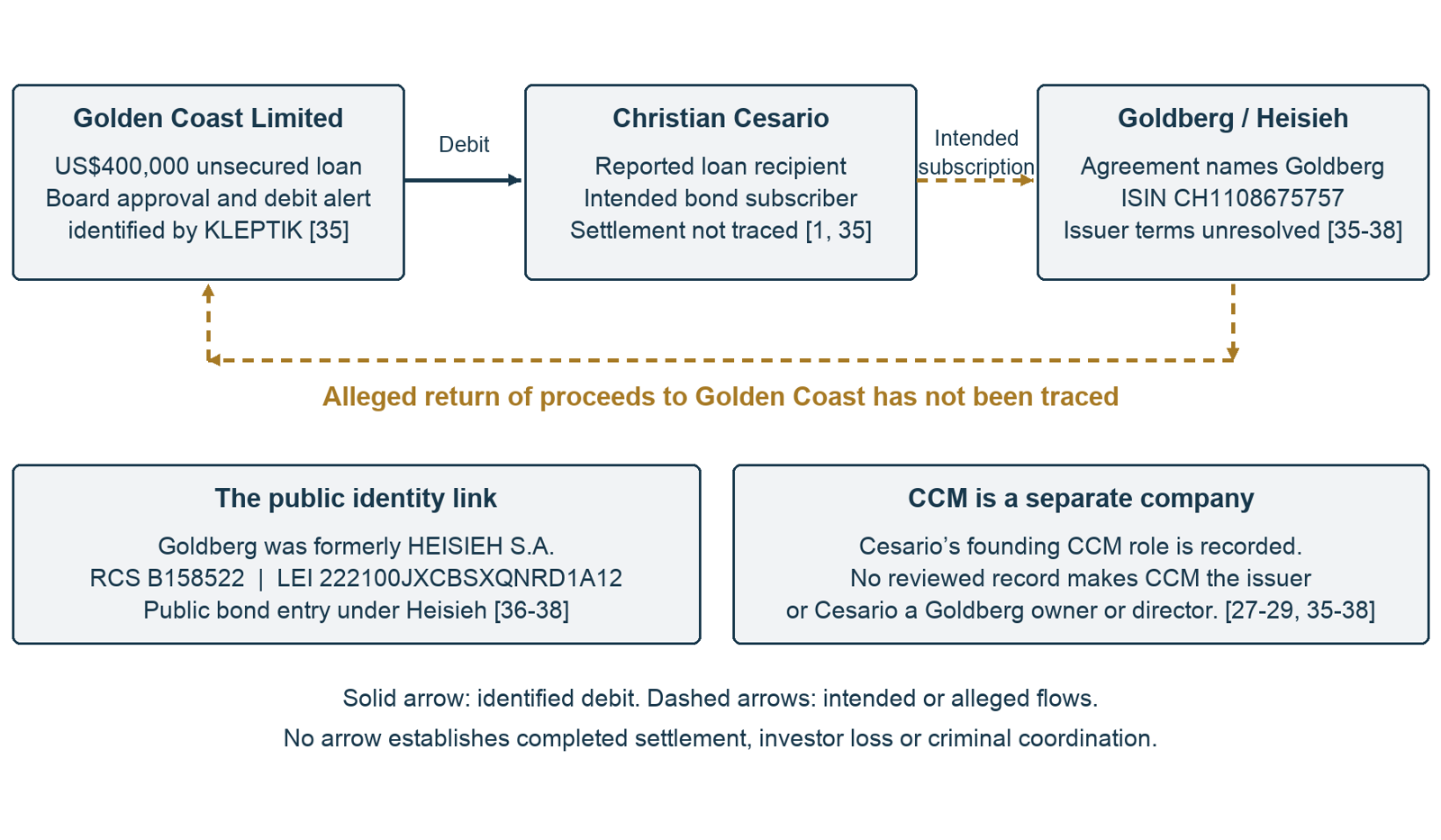
The financial structure and investor protection
The 2024 financial position
CCM reported total assets of €671,912.17, including €175,160 of participating interests and €488,081.03 of loans to undertakings linked by participating interests. Cash was €8,671.14. Total creditors were €666,615.04, comprising €497,500 in debenture debt and €169,115.04 in other creditors. Capital and reserves were €5,297.13 after a €27,702.87 annual loss. These are company-wide accounting figures; the accounts do not identify the underlying companies or allocate these balances to a Grenada project. [28]
The structure permits debt issuance and lending
The June 2024 articles permit multiple issuance programmes and compartments, with proceeds capable of being lent to subsidiaries, affiliates and other companies. They restrict subscriptions to professional clients within the meaning of Annex II of Directive 2014/65/EU, MiFID II, and prohibit continuous public securities issuance. Those provisions establish contractual capacity and restrictions, not proof that a particular offering complied or breached them. [30-31]
Compartment protections require the actual terms
Article 22 allocates assets and claims among compartments and contains limited recourse provisions. It also contemplates certain general creditors having proportionate recourse where the issue documentation expressly permits it. Article 23 contains restrictions on seeking bankruptcy or attachment, subject to express written agreement. Investors therefore need the particular instrument’s priority, collateral, recourse and enforcement terms; the existence of a compartment is not a repayment guarantee. [31]
Conflicts and the chronology discrepancy
Article 16 requires disclosure and nonparticipation where a director has a personal interest contrary to the company’s. A shareholder-linked subscription calls for the actual authorisation and conflict record; a common director alone does not establish breach. Separately, the June amendment recites a December 2003 incorporation while the incorporation deed and accounts identify February 2024. The conflict in the filed wording needs clarification. [27-31]
The regulator and the approval trail
The evidence schedule makes the regulatory question more precise. Its 17 April IMA entry says Cesario's US$300,000 was refused as developer equity; its 14 May entry identifies a US$475,446 equity shortfall. These are different findings from classifying his contribution as qualifying equity or expressly prohibiting a particular repayment. The complete emails and applicable approval conditions must establish the agency's reasoning, any funding restriction and whether it was later satisfied. [1, 35]
KLEPTIK confirms that it has reviewed and verified these records. Their significance lies in the sequence: a documented shortfall followed by the identified shareholder repayment and unsecured loan. The agency and developer should explain the intervening capital position, the basis for each release and whether the payments were disclosed and permitted. The sequence supports scrutiny of the controls. [35]
Approval milestones and the civil proceedings
Sources: approval records [35], court lists [6-7], public approval reporting [10].
Approval chronology reviewed against the supplied evidence schedule. The conditional letter date, its effective date, the full approval date and Gazette publication are distinct events. Court listings establish procedural steps rather than liability. [6-7, 10, 35]
The supporting evidence identifies conditional approval dated 29 October 2024 with effect from 7 October 2024 and full approval dated 14 February 2025. Earlier public reporting separately associates 14 February 2025 with Gazette publication and 7 October 2024 with the notice. The actual letters should govern the account of conditions and their discharge. Publication, conditional approval and full approval must not be used interchangeably. [10, 35]
The approval file should identify the conditions, evidence of compliance, due diligence and responsible decision makers. Separate claims about marketing agent or developer licences require the actual licences and their dates; project approval does not establish that every alleged licence was personally issued to Khomenko by the Prime Minister.
Dickon Mitchell and the private firm connection

A Prime Minister’s public identity appearing in a commercial law firm’s presentation warrants a precise account of his current relationship to it. The public should be able to establish whether any financial interest, client work or decision-making role remains. The website establishes the presentation; it does not establish current ownership, legal practice or instructions in this dispute. [2-5]
A June 2023 report records his denial that he was practising law, including the words “I do not work in my law firm” and “I do not practice”. That denial belongs beside the current website presentation. The site’s 2017–2026 copyright footer does not prove that the biography or photograph was updated in 2026; its latest displayed news entries date from 2017. [2, 5]
What a conflict inquiry must establish
The issue is whether public office and private representation were separated in practice. Current ownership, profit entitlement, remuneration, client instructions and official decisions or recusals would establish whether Mitchell retained a financial or decision-making interest. Political access can confer a practical advantage on a private party; an allegation of abuse requires evidence connecting that access to an improper act. No recusal record is identified in the evidence schedule; that absence does not establish that a recusal was required or did not occur. The founder relationship establishes the reason for scrutiny, rather than the answer. [2-5, 35]
Claims that Mitchell represented Khomenko before or after becoming Prime Minister need their own documentary basis. No retainer, fee record or instruction proving that personal relationship has been examined for this report. The alleged role of the firm and the alleged role of the Prime Minister must be assessed separately.
The disclosure and the alleged retaliation
On 7 October 2026, Jules says he met a senior Ministry of Labour officer and described his concerns, including an intention to speak to the media. He says the officer telephoned Mitchell in his presence. According to Jules, the officer then relayed advice to keep the matter private and referred him to a senior lawyer associated with the governing party. Jules witnessed the call; the alleged advice was relayed to him. [1]
Documents and the attributed disclosure account
Sources: Jules account [1], supporting evidence [35]. Distinguish records from relayed allegations.
Disclosure chronology distinguishes the grievance, medical certificate and shareholder letter identified by KLEPTIK from Jules's account of the ministry call and information relayed about a police approach. The latter is not a verified complaint or charge. [1, 35]
Approximately a day later, Jules says, a prosecution contact told him Mitchell & Co., acting for Golden Coast, had approached the Royal Grenada Police Force about alleged theft of company documents. If corroborated, the timing would require an explanation of whether the complaint was independently justified or intended to deter disclosure. Timing alone cannot establish coordination, an improper motive or interference by the Prime Minister. [1]
The instruction trail is decisive: who sought advice after the Labour Ministry meeting, who instructed the firm, what supported any complaint and what decisions police or prosecutors made independently. The evidence schedule lists no complaint, charge, prosecution decision, retainer or communication connecting Mitchell to the reported approach. Communications between the relevant actors could establish a connection; an independently initiated complaint could support a different explanation. No complaint, charge or prosecution decision has been verified in the material available for this report. [1, 35]
Political access and the question of coordination
The sequence that requires an explanation
Jules’s account moves through three settings: the project company, a government ministry and a reported approach to police by the developer’s lawyers. The question is whether decisions in those settings were connected. His financial disclosures preceded the Labour Ministry meeting; he says an officer called Mitchell, relayed advice to keep matters private and referred him to a politically associated lawyer. He then heard that Mitchell & Co. had approached police. Those are the events alleged. The record must establish the communications between them before they can be described as a coordinated operation. [1]
How official authority could become private pressure
A government office is where an employee may seek a remedy. If an official instead used that encounter to shield an employer from scrutiny, it would raise a serious abuse-of-office question. A legal complaint can likewise protect legitimate rights or become a means of pressure, depending on its basis and purpose. Here, the ministry officer is unidentified, the alleged advice was relayed to Jules and the reported complaint has not been examined. The report therefore identifies the potential mechanism of pressure without finding that Mitchell or the firm used it. [1-5]
What the relationships establish
The relationships identified here justify scrutiny of access, conflicts and decision making. They do not establish a criminal agreement. The records and attributed account do not establish that Mitchell directed the shareholder payments, benefited from them or instructed the reported police approach. Those are questions requiring evidence of particular acts and communications, rather than conclusions that follow from political office or the founding of a law firm. [1-5, 35]
What would establish an improper common purpose
The supporting records strengthen the examination of company-level knowledge and financial purpose: they identify the board resolution and a message attributed to Khomenko about a wire, a bond buyout and ‘satisfy ima’. Neither item, as described, connects Mitchell to an agreement to suppress disclosure or to a payment. Evidence of an improper common purpose would need to identify the objective, the communications or conduct linking participants, and each participant’s knowledge. The financial decisions and the reported political intervention warrant examination together; proof of one does not establish the other. [1, 35]
Hilton and the assurance of a familiar name

Promotional architectural rendering published by One True Blue Beach. This is an illustration of the proposed development, not a photograph of completed construction or evidence of repair work. Source: onetbb.com and its Sanity image host [8]
Hilton’s name is a major commercial asset in the project’s presentation. The project website nevertheless states that Hilton does not own, develop or sell the development, gives no project representations or guarantees and licenses the Tapestry brand on limited terms. That boundary matters to investors assessing what the brand actually assures. [8]
The evidence schedule identifies three Adams Consulting reports dated 20 May 2025, 25 June 2025 and 16 July 2026, plus an undated design analysis, a building permit and dated fifth-floor photographs. KLEPTIK confirms that it has reviewed and verified those records. Jules attributes slab cracking, downward deflection and localised structural distress to the engineering material and says a US$450,000 retrofit remained outstanding when he left. That description and estimate are attributed to him here. The dated reports provide a basis for testing notice, continued construction and remedial decisions; they do not establish the condition of the building today. Present structural safety requires assessment against the complete reports and subsequent inspection and repair records. [1, 35]
Hilton should explain when it learned of any concerns, what assurances it sought and what standards apply before the property can operate under its brand. There is no established evidence here that Hilton authorised the disputed transactions or knowingly disregarded engineering findings.
The project description also needs reconciliation
The website describes 50 hotel rooms, 17 branded residences, 126 equity shares and operations in the third quarter of 2028. The supplied account uses different project figures and timing. Changing plans can have legitimate explanations. Investors need dated offering materials showing what was sold, when it changed and what they were told. [1, 8]
The workers and the insider

Billboard posted on the site of One True Blue Beach development. [8]
The people behind the luxury proposition
The evidence schedule identifies hire and permit dates, invoices, pay records, the June 2024 offer chain and WhatsApp chats involving Oleg, Jannel and Claudine. KLEPTIK confirms that it has reviewed and verified those records. They provide contemporaneous evidence of dates, payments and recorded communications within their scope. Jules’s wider allegations of bullying, unlawful work, unpaid tax and dismissal without cause remain distinct claims; verification of the records does not establish each alleged violation. [1, 35]
The employment benefits used to justify investment led development should be visible in the conditions experienced by the people building it. These claims deserve their own examination rather than being lost inside the dispute over investment funds.
Jerelle Jules and the limits of an insider account
Jules is a former Golden Coast investment manager and a whistleblower whose account forms the basis of the allegations in this report. He describes himself as British born, of Grenadian heritage, and says he moved his family from London to Grenada in July 2024. The supplied account describes him as a husband and father of three young children. It also says he studied surveying at the University of Westminster. [1]
He says his responsibilities included preparing regulatory submissions, placing him close to the reporting process. He also says he was neither a bank signatory nor authorised to approve or stop payments. That distinction defines both the relevance and the limits of his knowledge.
His employment dispute is relevant: he alleges dismissal without cause and says he is pursuing an unfair dismissal claim. An employment dispute does not invalidate a disclosure. Whistleblower status does not establish that every allegation is correct.
The supporting evidence provides contemporaneous anchors for Jules's employment chronology: his 4 October grievance, 5 October medical certificate and Golden Coast's 6 October letter to shareholders. KLEPTIK confirms it has verified those records. They should be read with the offer chain, pay records and chats to distinguish documented employment events from the disputed reason for dismissal. Jules says he subsequently left Grenada fearing an unfair process. [1, 35]
Documents and the allegation of retaliation
A dispute over company records can involve legitimate ownership and confidentiality concerns. It can also raise public interest questions when the records allegedly reveal misconduct. The substance and timing of any complaint therefore both matter.
The available account does not establish whether a complaint concerned a specific offence, which records it covered or whether Jules was charged or told charges were forthcoming. Golden Coast’s explanation and the official police record are needed to establish what occurred.
The relationships behind the project
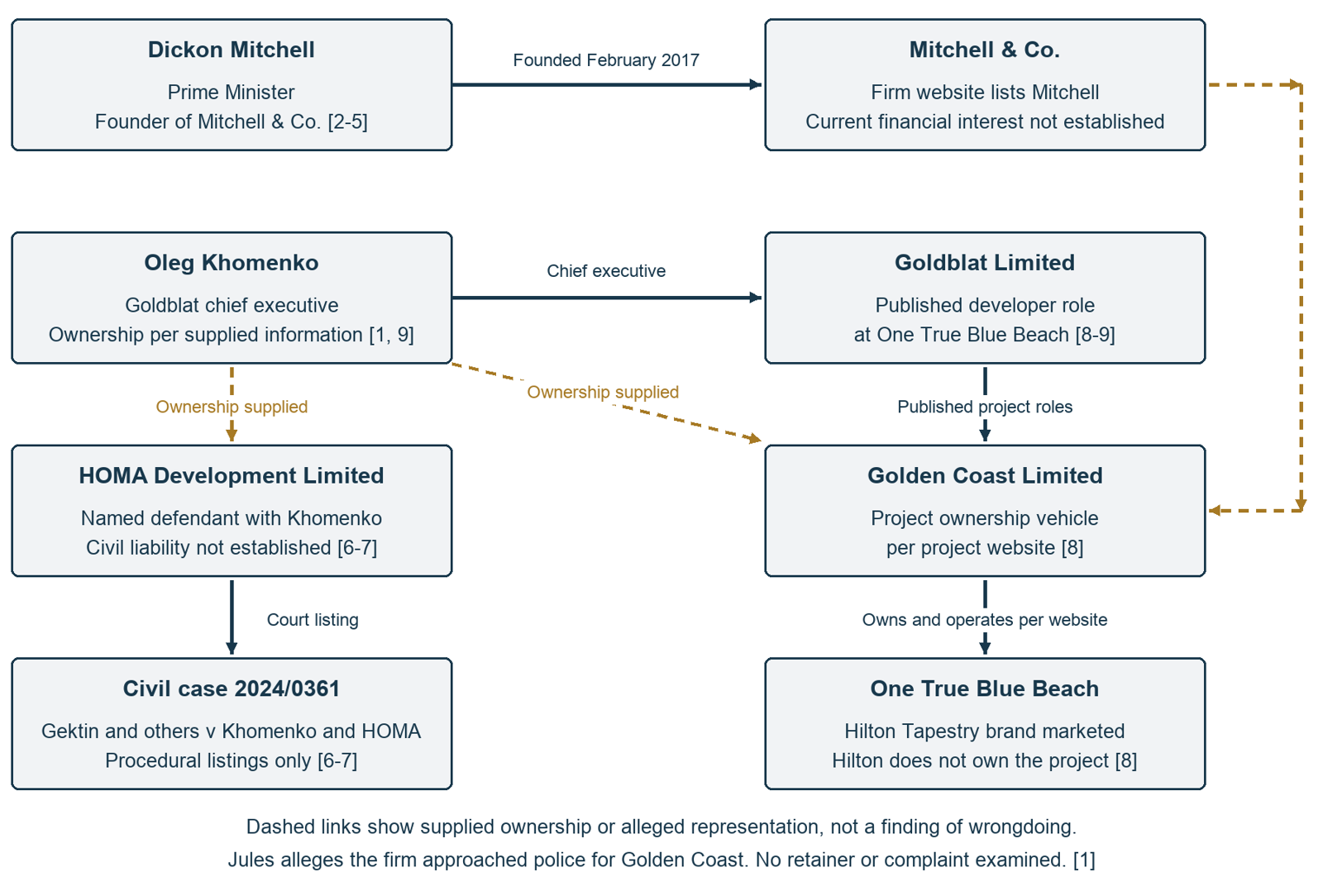
Solid connections reflect published roles or court listings. Dashed ownership links reflect information supplied to the investigation; the dashed firm connection reflects Jules’s allegation. The chart distinguishes those relationships and does not imply a criminal network. [1-8]
HOMA and Goldblat are company names rather than abbreviations expanded in the reviewed sources. Common ownership, legal representation and government office are different relationships. None should be treated as proof of concerted wrongdoing.
Background profiles of the principal people
Jerelle Jules
Jules is the former Golden Coast investment manager and principal source of the financial, construction and retaliation allegations. His supplied account describes a British born professional of Grenadian heritage who studied surveying at the University of Westminster and moved his family from London in July 2024. He says his responsibilities included regulatory submissions, but not control over bank accounts or payments. His employment ended in October 2026. He alleges unfair dismissal and retaliation and says he left Grenada fearing an unfair process. [1]
His knowledge is most directly relevant to submissions he prepared, communications he received and events he witnessed. His account of the Prime Minister’s advice and the subsequent police approach includes information relayed by others. That distinction should remain visible when assessing his allegations.
Oleg Khomenko
Khomenko is publicly identified as Goldblat’s chief executive officer and is described by Jules as Golden Coast’s founder and managing director. Promotional material associates Goldblat with the site acquisition in 2018 and construction beginning in 2024. Information supplied to the investigation attributes ownership of Golden Coast and HOMA Development Limited to him. The civil listings establish that Khomenko and HOMA were defendants, without establishing the merits or outcome. [1, 6-9]
Christian Cesario
Christian Cesario is recorded in the cited filings as a founding shareholder and director of CCM FINANCE S.A., register B283965, with 110 initial shares, one-third of its initial capital. The IMA email described by KLEPTIK identifies a separate 20% Golden Coast shareholding at April 2026. KLEPTIK's supporting records identify payments to him, an unsecured US$400,000 loan and an agreement naming Goldberg Securitization S.A. and ISIN CH1108675757. The Goldberg/Heisieh public identity trail supports investigating the intended subscription. It establishes neither Cesario's corporate control of Goldberg nor completed settlement, lawful entitlement to the payments, or their ultimate funding source. [27-29, 35-38]
Dickon Mitchell
Mitchell became Grenada’s Prime Minister in June 2022. Before entering office he had a legal career: his firm biography records practice from 2002, partnership at Grant, Joseph & Co. and the establishment of Mitchell & Co. in February 2017. He publicly denied practising law in June 2023, while the firm’s website continues to list him. His political office and founder relationship explain the public interest in clarifying any current professional or financial involvement; they do not establish that he directed a client matter, payment or prosecution. [2-5, 26]
Background profiles of companies and advisers
Golden Coast Limited and Goldblat
The project website identifies Golden Coast Limited as the Grenada incorporated ownership and operating vehicle for One True Blue Beach and Goldblat Limited as the developer. Those roles should be kept separate when tracing investor subscriptions, liabilities and payment authority. Promotional claims about experience or development history do not replace incorporation records, ownership registers and executed investor agreements. The ownership attributed to Khomenko is information supplied to this investigation rather than independently obtained registry evidence. [1, 8-9]
HOMA Development Limited
HOMA is a separate company named with Khomenko in case GDAHCV2024/0361. The claimants listed are Oleksandr Gektin, Maryna Tabachkovsky and Leonid Filshtinsky. The listings examined concern an extension application and a report on mediation. They do not identify a finding against the defendants. The earlier budget reference to “Homa Limited” requires corporate identity checks before it can be treated as the same company. The listed claimants’ backgrounds and the substantive pleadings have not been established in this report. [6-7, 13]
Mitchell and Co
Mitchell & Co. is a Grenadian legal practice whose website identifies Dickon Mitchell as its founder. Its public presentation includes commercial, company, property, employment and litigation services. Jules alleges that it acted for Golden Coast in approaching police about documents. No retainer or complaint has been independently examined. The firm’s professional representation, any current role of its founder and any official political involvement are separate questions. The report does not attribute the alleged instructions to another named attorney without evidence. [1-4]
Hilton and Tapestry Collection
Tapestry Collection is a Hilton hotel brand presented by Hilton as a collection of individually distinctive properties. In this project’s marketing, the international brand adds commercial recognition. The developer’s disclaimer says Hilton does not own, develop or sell the project and gives no project guarantees; the brand rights are licensed on limited terms. Hilton’s role must therefore be examined through its actual agreement and brand standards, rather than an assumption that it received or controlled investor subscriptions. [8, 25]
Other project professionals
The project website names Hotel Equities as hotel operator, HVS Global Hospitality as advisory and consulting firm and JK Lab as interior designer. These are published project roles, not evidence that any of them authorised payments, certified structural repairs or knew about Jules’s disclosures. HVS and JK Lab are the published business names; no expansion of their names is asserted. No individual engineer, planning officer or adviser has been identified as responsible for a specific disputed decision. [8]
Background profiles of the public institutions
The Investment Migration Agency
The Investment Migration Agency administers Grenada’s Citizenship by Investment programme. Its website describes a management team responsible for daily administration and implementing policies and procedures, alongside the Citizenship by Investment Committee’s oversight role in processing applications. Project approval, agent licensing, application processing and ongoing compliance should be traced to the officials and legal instruments responsible for each function. [24]
Thomas Anthony
The agency’s official website identifies Thomas Anthony as chief executive officer. He is relevant in that institutional capacity and was identified in the approval reporting used in this report. His position makes the agency’s explanation of conditions and enforcement material; it is not evidence that he personally authorised a disputed payment, knew of any alleged misuse or received Jules’s concerns. The decision trail should identify who assessed and approved each relevant step. [10, 24]
The Ministry of Labour and the unnamed officer
The Ministry of Labour is the institution Jules says he approached about his employment situation. The senior officer described in his account has not been named or independently identified. That officer is material because Jules attributes the call and the relaying of advice to them. Without a verified identity, contemporaneous note or response, the report cannot establish the officer’s authority, the full conversation or what the Prime Minister actually said. [1]
Police and prosecution authorities
The Royal Grenada Police Force is the police body allegedly approached by the developer’s lawyers. The unnamed prosecution contact is Jules’s source for that account. The report has not independently established a complaint number, charge or prosecution decision. Grenada’s Director of Public Prosecutions has constitutional independence in the functions covered by section 71(6). Any assertion of improper political direction requires evidence of an instruction or influence, rather than inference from the law firm’s founder alone. [1, 20]
Residents and the earlier consultation record
Sandra Ferguson appears in reproduced evidence concerning requests for environmental assessments and consultation information about coastal projects in 2019 and 2020. Her documented requests provide a public participation background, but the passage reviewed does not name Khomenko, HOMA or Golden Coast. It does not establish that she complained about this particular development. [12]
Earlier community concerns
Information supplied to this investigation says residents objected under the previous administration to Khomenko-associated development. A separate documented trail records Sandra Ferguson seeking environmental reports and consultation information about coastal projects in True Blue and Grand Anse. The reproduced passage does not name Khomenko, HOMA or Golden Coast. [12]
| Date | Recorded event |
|---|---|
| 23 November 2019 | Ferguson wrote raising concerns and requesting assessments and consultation information. |
| 27 December 2019 | She renewed the request after no response. |
| 27 January 2020 | Authority response supplied basic information; her evidence says it did not address access or consultation. |
| 27 February 2020 | She again requested the environmental reports. |
| 18 March 2020 | She visited the planning office seeking access. |
Correspondence and visit dates reported in reproduced evidence, not contemporary news-publication dates. Project identity remains unestablished. [12]
The previous administration’s 2019 Budget Statement also promoted a “Homa Limited” 240-room resort across three True Blue properties. Its identity with HOMA Development Limited and connection to the later One True Blue plan require confirmation. It demonstrates that the area’s large-scale development agenda predated this controversy; it is not a record of objections. [13]
The critical missing evidence is the correspondence identifying the True Blue project and the authority’s response. There is no basis in the records reviewed to say Mitchell knowingly ignored those particular representations, or that Khomenko removed links. Missing search results are not proof of removal by a named person.
Public approval must have a traceable basis
The IMA should explain which approval conditions applied, what information was required from the developer, what checks were performed and how continuing compliance was monitored. An approval file can distinguish a properly assessed risk from an overlooked warning. Neither political connections nor public controversy answers that question by itself.
The legal tests behind the allegations
Employment protection
Section 74(2)(h) of Grenada’s Employment Act 1999 identifies as an invalid dismissal or disciplinary reason “the filing of a complaint or the participation in proceedings against an employer involving alleged violations of any enactment.” Section 76 addresses unfair dismissal through section 74; section 81 assigns the employer the burden of proving the reason. The grievance, decision and employer’s explanation determine application. The label whistleblower does not confer blanket immunity concerning documents. [14]
Planning and construction
Section 16(1) of the Physical Planning and Development Control Act 2016 requires prior written permission, subject to permitted development. Section 20(3) says approval in principle “is not permission to commence development.” Enforcement and stop notices appear in sections 31 and 33; section 36 concerns injunctions. These powers do not establish that a notice was issued here. [15]
Company duties and investor funds
Grenada’s Financial Regulatory Commission describes directors’ obligations of honesty, care and addressing conflicts. The alleged loan’s corporate benefit, authorisation, financial impact and restrictions need examination. Developer equity and escrow obligations must be traced to the rules and approval agreements applicable on the relevant dates. An equity warning is not itself a conviction or proof of dishonest diversion. [16]
Overseas securities sales
Jules alleges American purchasers and overseas intermediaries. Section 5 of the United States Securities Act of 1933 requires registration or an available exemption for transactions within scope. Nationality alone is insufficient. Broker registration under section 15(a) of the Securities Exchange Act of 1934 is separate; Rule 15a-6 supplies conditional foreign-broker exemptions. The United States Securities and Exchange Commission explains those requirements. Rule 10b-5 concerns deception and materially misleading statements or omissions within its scope; registration exemptions do not erase applicable antifraud duties. [17-19]
Independent prosecution and the corruption question
Section 71(6) of Grenada’s Constitution protects specified functions of the Director of Public Prosecutions from outside direction or control. The account of a call and the firm’s founder relationship do not establish a breach. Any allegation of conspiracy must identify the proposed unlawful objective, agreement and knowing participation of each alleged member under the applicable law. This record establishes no payment to Mitchell, agreement by him to defraud investors or instruction by him directing a prosecution. [20]
The questions the records should answer
KLEPTIK’s review identifies a specific financial trail: an equity shortfall, two bank debit alerts, a board-approved unsecured loan, a named agreement and an instrument identifier. That trail warrants answers about who authorised the use of project liquidity and what shareholders and investors were told. The political question is equally precise: whether access through a public office influenced a private legal response to disclosure. The financial records establish transactions and authorisation within their scope; the communications and instructions needed to establish improper political involvement remain unverified. [1, 35]
| Actor | Material question | Record that can resolve it |
|---|---|---|
| Khomenko and Golden Coast | Who controlled money and authorised shareholder transactions? | Account records, board decisions and executed agreements |
| Cesario | What entitlement and knowledge accompanied the payments? | Contribution agreements, loan terms and correspondence |
| IMA and approval authorities | Which requirements were met and what litigation was assessed? | Application, due-diligence assessment and approval conditions |
| Mitchell and Mitchell & Co. | What current interests, work and decision safeguards exist? | Ownership, practising status, retainer and recusal records |
| Hilton and project professionals | When were safety concerns notified and corrected? | Contractual notices, reports, inspections and repair certification |
| Police and prosecutors | Was a complaint made or a charge brought and on whose instructions? | Complaint, decisions, charges and court record |
| Jules | Which allegations are supported by complete contemporaneous records? | Original communications, submissions and supporting documents |
As of publication on 26 October 2026, no responses from the principal subjects have been received for inclusion in this report. No inference of wrongdoing is drawn from the absence of a response. Jules’s account, supplied ownership information and alleged personal associations are attributed to their evidential basis. Civil listings establish proceedings, not findings of liability.
The public deserves a documented account of the decisions behind this development: the money released, the conditions enforced, the interests disclosed and the instructions that preceded any complaint. If the evidence connects those decisions to an improper shared purpose, it should identify the actors and their acts. Until then, the documented network and the allegation of coordinated pressure remain different findings.
Sources and evidence notes
Final editorial review completed on 26 October 2026. KLEPTIK confirms that it has reviewed and verified the supporting records identified in the evidence schedule supplied by Jules. That statement concerns verification of the source records, not a blanket finding that every allegation is proved. Numbered references identify public records, company statements, the witness account and the supporting evidence schedule. Earlier website observations retain their recorded review dates; the project website, the firm’s Mitchell biography, the Goldberg website and LEI entry, the public bond entry and CSSF guidance were checked again on 26 October 2026. [1, 35-39]
[1] Jerelle Jules account dated 19 October 2026, as recorded in the supplied report. KLEPTIK confirms review and verification of the supporting records identified in [35]. Firsthand observations, information relayed to Jules and editorial conclusions are distinguished throughout.
[2] Mitchell & Co. homepage. https://mitchellsco.com/
[3] Mitchell & Co. Dickon Mitchell biography. https://mitchellsco.com/dickon-mitchell/
[4] Mitchell & Co. About Us. https://mitchellsco.com/info/
[5] NOW Grenada 26 June 2023 PM Mitchell Not practicing law so no CBI conflict. https://nowgrenada.com/2023/06/pm-mitchell-not-practicing-law-so-no-cbi-conflict/
[6] Grenada court cause list 21 to 23 January 2025. https://cms.eccourts.org/wp-content/uploads/2025/01/Cause-List-21st-to-23rd-January-2025-for-Master-Carlos-C.-Michel.pdf | case GDAHCV2024/0361, PDF page 4.
[7] Grenada court cause list 16 to 18 June 2025. https://cms.eccourts.org/wp-content/uploads/2025/06/Cause-List-16th-to-18th-June-2025-for-Master-Carlos-Michel.pdf | same case, PDF page 6.
[8] One True Blue project website. https://www.onetbb.com/ | developer and ownership roles, investment description, brand disclaimer and project figures.
[9] My Grenada Solutions 25 March 2025 project promotion. https://mygrenadasolutions.com/one-true-blue-beach-grenadas-latest-cbi-opportunity/
[10] NOW Grenada 19 February 2025 approval reporting. https://nowgrenada.com/2025/02/70-room-hotel-is-latest-cbi-approved-project/
[11] Monaco Hebdo 21 April 2026 Christian Cesario interview. https://monaco-hebdo.com/dossier/lor-nest-pas-destine-a-la-speculation-a-court-terme/
[12] The New Today 13 to 14 February 2026 reproduced evidence. https://www.thenewtodaygrenada.com/local-news/victory-for-land-actors-over-planning-authority-part-ii/ | paragraphs 33–36. No Khomenko project attribution established.
[13] Government of Grenada 2019 Budget Statement. https://cdn.eccb-centralbank.org/documents/2023-02-03-11-10-26-33.pdf | printed page 44, Homa Limited.
[14] Grenada Employment Act 14 of 1999. https://oig.cepal.org/sites/default/files/1999_act14_grd_0.pdf | sections 74, 76 and 81–83.
[15] Grenada Physical Planning and Development Control Act 23 of 2016. https://grenadaparliament.gd/wp-content/uploads/2021/08/Act-No.-23-of-2016-Physical-Planning-and-Development-Control-Act.pdf
Sources and terminology continued
[16] Grenada Financial Regulatory Commission company guidance. https://www.gfrc.cc/how-to-register-a-company/learn-what-a-company-is/
[17] SEC foreign issuer overview. https://www.sec.gov/divisions/corpfin/internatl/foreign-private-issuers-overview.shtml
[18] SEC Rule 15a-6 foreign broker guidance. https://www.sec.gov/rules-regulations/staff-guidance/trading-markets-frequently-asked-questions/divisionsmarketregfaq-2
[19] SEC Staff Legal Bulletin 21 on antifraud requirements. Read the SEC guidance
[20] Grenada Constitution. https://www.gov.gd/government/the-constitution | section 71(6).
[22] Mitchell photograph and reuse licence. https://commons.wikimedia.org/wiki/File:Prime_Minister_of_Grenada_Mr._Dickon_Mitchell.jpg | Prime Minister’s Office, Government of India; 20 November 2024; Government Open Data License India; cropped portrait.
[23] Khomenko supplied profile photograph. https://www.linkedin.com/in/oleg-khomenko-07066113/ | Image supplied as his profile portrait; digitally enhanced for clarity.
Additional background sources
[24] IMA institutional structure and management. https://imagrenada.gd/about-us/
[25] Hilton Tapestry Collection brand. https://www.hilton.com/en/brands/tapestry-collection/
[26] Government of Grenada Dickon Mitchell biography. https://cabinetoffice.weboffice.gd/bio/Dickon%20Mitchell.pdf
[27] CCM FINANCE S.A. incorporation deed dated 1 February 2024, published 23 February 2024. Founders, subscriptions and initial directors. https://gd.lu/resa/43qqrn
[28] CCM FINANCE S.A. accounts for 1 February to 31 December 2024, filing L250267505, deposited 5 August 2025. https://gd.lu/rcsl/9b4HMQ
[29] CCM FINANCE S.A. corrective registry filing L240039781, deposited 6 March 2024. Christian Cesario directorship. https://gd.lu/rcsl/fG8mH
[30] CCM FINANCE S.A. extraordinary shareholder resolution of 26 June 2024, published 5 July 2024. https://gd.lu/resa/4KpK1f
[31] CCM FINANCE S.A. coordinated articles filed 22 July 2024, L240155520. https://gd.lu/rcsl/b6JH61
[32] Spanish official corporate bulletin, 18 June 2008, Caja Castilla-La Mancha Finance, S.A., Sociedad Unipersonal. Separate issuer excluded from this review. https://www.boe.es/diario_borme/txt.php?id=BORME-C-2008-115017
[33] Commission de Surveillance du Secteur Financier, Authorisation of a securitisation undertaking, updated 31 July 2025. Authorisation and prudential supervision depend on the applicable statutory criteria; Luxembourg incorporation does not establish authorisation. https://www.cssf.lu/en/authorisation-of-a-securitisation-undertaking/
[34] United Nations Office on Drugs and Crime, Organized Crime Module 1, Definition in the Convention, discussing Article 2 of the United Nations Convention against Transnational Organized Crime. International reference point rather than a finding under Grenadian criminal law. https://www.unodc.org/e4j/en/organized-crime/module-1/key-issues/definition-in-convention.html
[35] Evidence held by Jerelle Jules, evidence schedule dated 20 October 2026 and supplied as Jules-report.pdf. The schedule identifies 30 supporting evidence entries. KLEPTIK confirms that it has reviewed and verified the listed underlying records; the schedule is an index, rather than a reproduction of those exhibits.
[36] Goldberg Securitization S.A., corporate website, reviewed 21 October 2026. Issuance-services description and stated RCS B158522. Company claims are attributed. https://goldberg-securitization.com/
[37] LEI record for Goldberg Securitization S.A., LEI 222100JXCBSXQNRD1A12, reviewed 21 October 2026. Former name HEISIEH S.A.; RCS B158522; name-change effective date 19 June 2023. https://lei.bloomberg.com/leis/view/222100JXCBSXQNRD1A12
[38] Cbonds public entry 1587313, reviewed 21 October 2026. Heisieh, ISIN CH1108675757. Secondary market-data lead, not executed terms or an official approval. Date fields conflict; primary confirmation is required. https://cbonds.com/bonds/1587313/
[39] CSSF, Prospectus. Separate public-offer and regulated-market admission regime and applicable exemptions. Read with the securitisation authorisation guidance in [33]. https://www.cssf.lu/en/prospectus/
Terminology
CBI means Citizenship by Investment. IMA means Investment Migration Agency. EIA means Environmental Impact Assessment. SEC means United States Securities and Exchange Commission. US$ denotes United States dollars; € denotes euros. S.A. means société anonyme, a public limited company form; S.à r.l. means société à responsabilité limitée, a private limited liability company form. RCS means Registre de commerce et des sociétés, Luxembourg’s company register. ISIN means International Securities Identification Number. MiFID II means Markets in Financial Instruments Directive II. CEO means chief executive officer and CFO means chief financial officer. HOMA, Goldblat and CCM are business names whose initials are not expanded in the cited records.
About KLEPTIK
KLEPTIK is an investigative intelligence newsroom covering corruption, kleptocracy, illicit finance, sanctions evasion and market fraud. Its website identifies the publisher as the Global Corruption Investigative Reporting Project (GCIRP). [21]
Its stated mission is to trace money and power across borders through public records, court filings, corporate information and original reporting. Its published editorial standards distinguish established facts from allegations, call for corroboration and provide for a meaningful opportunity for named subjects to respond. [21]
Final editorial review completed on 26 October 2026. KLEPTIK confirms that it has reviewed and verified the supporting source records identified in the evidence schedule. Each substantive conclusion remains limited to what the identified record or attributed account supports. A corporate connection, an accounting balance, a civil listing and a witness account establish different matters. Alleged retaliation and improper political coordination remain attributed allegations. [1, 35]
Read more
Corrections and responses
KLEPTIK’s website lists newsroom@kleptik.com for general contact and corrections@kleptik.com for corrections. Its published policy provides for transparent updates as facts develop. [21]
As of publication on 26 October 2026, no responses from the principal subjects have been received for inclusion. No inference of wrongdoing is drawn from the absence of a response. Responses and material new evidence will be assessed for publication and, where appropriate, reflected in transparent updates.