The FBI Anti-Corruption Squad Was Circling Susan Collins — Until Trump Got in the Way
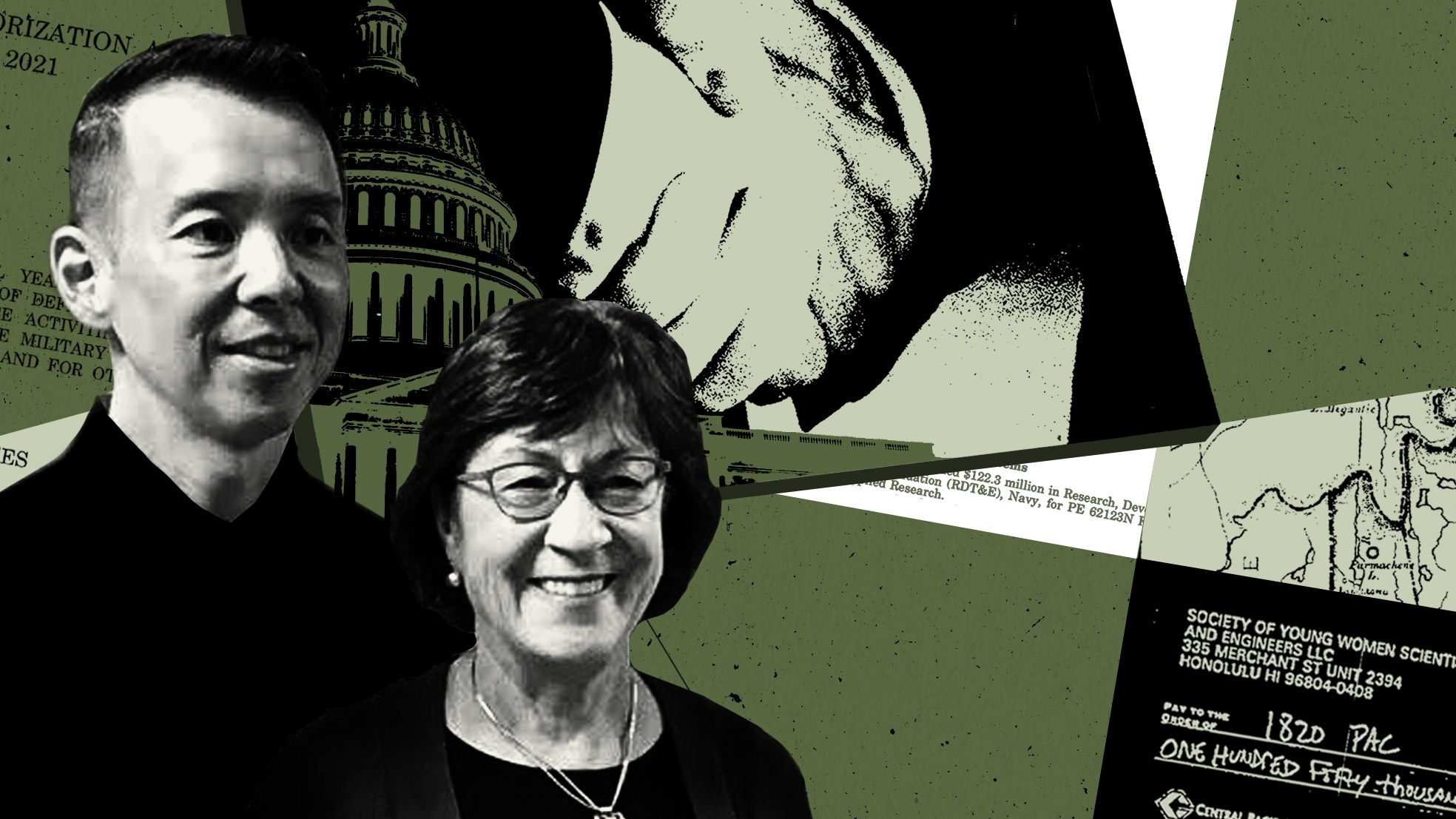
In the final weeks of 2019, a top fundraiser for Sen. Susan Collins walked into a perilous meeting at a Corner Bakery in Washington, D.C.
For the first time in her two-decade Senate career, the Republican lawmaker from Maine was in danger of losing her seat. President Donald Trump’s dismal approval ratings were dragging her down in the polls, and she was falling behind her likely 2020 Democratic challenger in fundraising.
Scott Reed, head of the Collins super PAC, was on a mission to close that gap. Reed was meeting that day with three executives from a Hawaiian defense contractor, Navatek. A year earlier, Collins had helped their company land a multimillion-dollar Navy research contract in Maine. Now, seated at a coffee shop not far from the U.S. Capitol, Reed asked them for a $500,000 donation.
Government contractors are banned from making political contributions. More consequentially, for the company to offer donations to Collins in exchange for an official action, or for Collins to accept, would constitute criminal bribery.
But the company did have such a proposal: Navatek was hungry for more government contracts in Maine. If they cut a big check, the CEO told Reed, Navatek wanted Collins to guarantee tens of millions of dollars in additional federal funding.
To skirt campaign finance laws and conceal the source of the funds, Navatek planned to funnel the donation through a shell company. The CEO wanted assurance that Collins would know where the money came from. Reed confirmed that she would, the executive said — and that Navatek would get its government contracts.
After the Corner Bakery meeting, Navatek’s CEO, Martin Kao, sent an initial $150,000 to the Collins super PAC using the shell company. Two months later, he told Navatek executives that Collins committed to getting the company $32 million in naval contracts, according to an internal company email reviewed by ProPublica.
Three years later, Kao holed up in a conference room to recount the Corner Bakery meeting to a group of four FBI agents and federal prosecutors. The FBI had seen through his shell company ruse, and in 2022 a grand jury indicted him for making illegal campaign contributions. No one working for Collins was charged.
Facing years in prison, Kao hoped to do less time by revealing the entire scheme.
What he told them has never before become public. The Corner Bakery meeting, he asserted, was just one episode in a sprawling pay-to-play operation that embroiled some of the most powerful figures in Congress.
Over three days at the U.S. attorney’s office in Honolulu, Kao laid out in devastating detail how his operation worked. He gave agents a 50-page document naming dozens of lobbyists, congressional staffers and members of Congress who he said helped him trade cash for contracts. Kao and his close associates had donated nearly $900,000 to dozens of politicians, allowing Navatek to establish operations in half a dozen states with over $40 million a year in government funding.
We’re still reporting on pay-for-play arrangements between powerful companies and elected officials.
I want to hear from you. Please feel free to send tips or story ideas. The best way to reach me is on Signal at 804-295-7201.
Most damningly, Kao told FBI agents and prosecutors, the company’s work for the government was of no real value. Navatek’s research under his stewardship never resulted in products the military wanted to buy, ProPublica found.
Kao’s tell-all interviews with the FBI lasted into late 2024. His confessions opened up an entirely new phase of the investigation. Agents sifted through hundreds of thousands of records seized during Kao’s arrest and found that many were consistent with his account of widespread influence peddling.
Kao had credibility issues. He was now a felon trying to avoid a lengthy prison sentence. And there were other challenges. Building a corruption case against elected officials requires extraordinary proof of a quid pro quo arrangement, in part because the Supreme Court has narrowed what counts as bribery.
Even so, by the end of 2024, the agents had enough evidence to pursue a sweeping bribery probe that could ensnare top lawmakers of both political parties. They asked their supervisors to approve a new investigation and contemplated using undercover operatives to gather more evidence. Although their effort was in its early stages, and it was unclear where it would lead, FBI agents asked Kao extensive questions about his dealings with Collins and her office.
Then Trump returned to the White House. Consumed by a campaign of vengeance , he stacked the Department of Justice with his personal lawyers and demanded a purge of anyone who had ever investigated him.
The specialized FBI and DOJ teams handling public corruption investigations, some of which were involved in Trump-related cases, were eviscerated. One of the agents who had taken Kao’s confession was pushed out as retribution for her role in investigating Trump’s attempt to overturn the 2020 election. Dozens of agents and prosecutors quit amid the department’s destruction, including the career attorney assigned to Kao’s case.
Trump’s Justice Department no longer takes on public corruption in any meaningful fashion , former officials said. The investigation sparked by Kao’s revelations is dead. And the government is no longer talking to an informant who had offered a road map to corruption in Congress.
The White House referred ProPublica to the FBI.
FBI spokesperson Ben Williamson said the agency had investigated claims against Collins years ago “and ultimately found nothing implicating Senator Collins or Senator Collins’ campaign. Any suggestion otherwise is totally false.” Williamson said the Trump administration has removed agents only “if they have been found to have acted unethically, undermined the mission, or engaged in weaponization of law enforcement.”
Williamson did not respond to questions about the new investigation launched in 2024 based on Kao’s previously unreported cooperation with the FBI.
ProPublica is revealing the existence of the case for the first time. We reviewed a trove of evidence gathered by the FBI and thousands of pages of legal records, and interviewed dozens of people familiar with Navatek, its Washington operations, and the FBI inquiry to conduct our own investigation. We independently corroborated much of Kao’s account. Whether or not Kao’s dealings with politicians amount to criminal bribery, the Trump Justice Department has little interest in finding out, and his sheer success reveals how easily influence is purchased in Washington today. This is the first in a series of stories drawn from our reporting.
Of all the politicians Navatek courted under Kao’s leadership, Collins was its most important patron. The senator’s office steered government contracts worth millions toward the company while her campaign was pumping Kao and his network for donations, according to emails seen by ProPublica. Sometimes they cut checks within 24 hours of the annual defense spending bill, which funds military contracts, clearing a key Senate hurdle.
Collins’ office did not specifically address questions about the Corner Bakery meeting, the senator’s relationship with Kao and the millions she helped appropriate for Navatek.
Annie Clark, Collins’ deputy chief of staff, told ProPublica in an email that Collins’ office “vigorously” denies allegations of bribery and pay-for-play made by Kao, calling his claims “outlandish.” Collins’ campaign was not part of the discussions between Kao and the super PAC, and her office “fully cooperated” with the FBI investigation, Clark said.
“The fact that the FBI and Biden-led Department of Justice thoroughly examined the Navatek matter demonstrates this,” Clark wrote. “These issues were resolved in 2021 and concluded when the Collins campaign disgorged the illegal contributions that Martin Kao had made without our knowledge.”
Collins is once again fighting to keep her seat, in a race that could determine control of the Senate. On the campaign trail, she spotlights the funding she directs to Maine while leading the appropriations committee, which she calls “the most powerful committee in the Senate.”
She demonstrated that power with Navatek. After the budgets became law, Collins’ office pushed the Navy to award specific contracts to Navatek, emails seen by ProPublica show, even though awards are supposed to be competitive.