Ken Paxton Says He’s Tough on Crime. His Trust Invested $600,000 in a Convicted Fraudster’s Company.
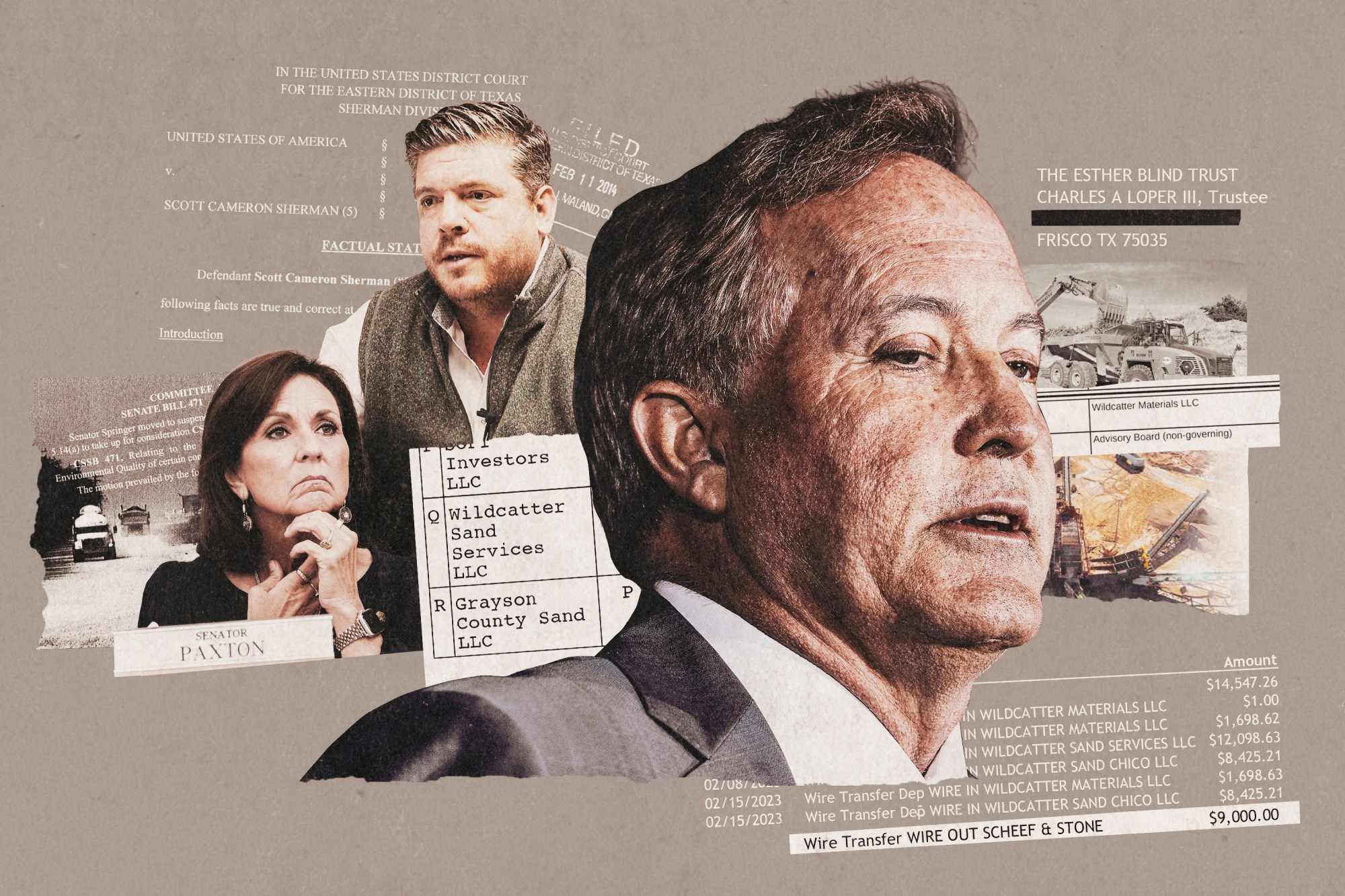
Four years after North Texas home builder Scott Sherman completed a federal prison sentence for mortgage fraud, his new construction materials business received a $600,000 cash infusion.
The financial boost came from a blind trust set up to prevent Texas Attorney General Ken Paxton and his wife, state Sen. Angela Paxton , from any overlap in their personal investments and their actions as elected officials. But previously unreleased records from the attorney general’s 2023 impeachment investigation show the trust was far from blind and did not shield the Paxtons from its business dealings, including the investment in Sherman’s business.
Before long, Wildcatter Sand Services and Grayson County Sand and Gravel, which Sherman built with his father, grew into a vast enterprise with various locations and subsidiaries. And along the way, some of those businesses stopped paying taxes to local governments, including school districts.
But as their tax debts stacked up, Wildcatter companies wired the Paxtons tens of thousands of dollars in the months leading up to and during the attorney general’s impeachment on charges of corruption and bribery. Paxton was eventually acquitted by the Legislature and is now in an expensive and tight race for a U.S. Senate seat against Democrat James Talarico , a state lawmaker.
While Paxton has been in public office for more than two decades, the blind trust he established upon becoming attorney general has largely obscured his business dealings. The Paxtons’ investment in Wildcatter through that trust offers a new, previously unreported look at both the limits of that trust and the attorney general’s financial association with the very type of business executives whose prosecutions he typically celebrates.
“In Texas, we fight fraud head-on and will not rest until every last corrupt actor is brought to justice,” Paxton said in a news release last year. In a recent social media post linking to a newly released campaign ad, he wrote, “As Attorney General, I’ve made big pharma and fraudsters pay billions.”
Doing business with a recently convicted felon undermines that narrative and erodes public trust in his role as the state’s top anti-fraud watchdog, ethics experts told ProPublica and The Texas Tribune.
Richard Painter, who served as the chief ethics lawyer for President George W. Bush, said he would have thought “the attorney general of Texas would have the good sense not to be dealing with a convicted felon.”
“They’ll pay out their friends while they’re not paying their taxes, run up debt,” said Painter, who has been critical of staunch Paxton ally President Donald Trump. “But the question is, why is the attorney general of Texas dealing with those kinds of people?”
Ken Paxton did not answer detailed questions from the news organizations about the Wildcatter investment or whether he knew of Sherman’s conviction. He has previously defended his business dealings, saying he follows ethics laws. A spokesperson for Angela Paxton, who filed for divorce last year, said that she was not aware of Sherman’s criminal history.
Sherman ran a homebuilding firm, Artisan Operating LP, when he pleaded guilty in 2014 for his role in a mortgage fraud conspiracy . The scheme involved artificially inflating home prices to obtain larger loans for more than two dozen properties in cities across the Dallas-Fort Worth area. Sherman did not respond to calls made to his cellphone and company or to emailed questions.
Paxton’s connection to Sherman is the second revelation in recent weeks of the attorney general engaging with people charged with federal crimes. Last week, The Wall Street Journal reported that Paxton celebrated New Year’s Eve 2024 in Dubai with two Americans who failed to return to the U.S. after being indicted months before on federal healthcare-fraud charges . A spokesperson for Paxton didn’t address his association with the defendants but said in a statement to the Journal that the attorney general has been “politically persecuted for years.”
ProPublica and the Tribune found the Paxtons’ investment in Wildcatter by reviewing records collected by impeachment investigators.
The records show that Ken Paxton had at least some knowledge of the blind trust’s investments, which could violate terms the Paxtons set when establishing the trust.
It would also run afoul of U.S. Senate rules , which Paxton would be bound by if elected, said Donald Kettl, an ethics expert and former dean of the University of Maryland’s School of Public Policy. Those rules, Kettl said, require senators with a blind trust to have no knowledge of its investments.
“It’s reasonable to ask whether a candidate for the U.S. Senate has followed the ethics rules for financial reporting of blind trusts that would be required if the candidate became a senator,” he said.
In setting up the blind trust, the Paxtons agreed that their friend Chip Loper would manage the assets without consulting with them or taking “any instructions regarding investment matters,” according to incorporation documents. Loper did not respond to a request for an interview and did not answer questions about the Paxtons’ involvement in selecting investments.
Text messages that emerged during the impeachment probe, however, showed he and Ken Paxton discussed certain investments. Mortgage and deed records show that Paxton purchased eight properties between 2015 and 2026 and then transferred them into the trust.
The Wildcatter investment also appears to have slipped past the required firewall.
Angela Paxton served for years on a Wildcatter advisory board beginning in 2022. ProPublica and the Tribune could not find any documents describing her responsibilities in the role, which she described as “non-governing” on her personal financial disclosures. While on the board, she voted for legislation that shielded a subsidiary from certain environmental complaints.
The Paxtons also claimed more than $93,000 in itemized losses from Wildcatter Sand Services and Grayson County Sand and Gravel on their 2020 federal joint income tax return.
“That is proof positive that there’s nothing blind about this trust,” said Kathleen Clark, a law professor at Washington University in St. Louis who specializes in legal and government ethics. If Ken Paxton “can report on his tax return a transaction, then he is not blind to the transaction.”
After Wildcatter received the cash injection from the Paxtons’ blind trust, Sherman went on a shopping spree.
He purchased a sand mine in the North Texas town of Denison and a concrete plant 40 miles down the road in Gunter, a city of about 2,000 residents. Both are in Grayson County near the Oklahoma border.
Neighbors complained to Texas environmental regulators about clouds of dust from Wildcatter and other companies located at the Gunter site that they said coated their properties for up to 12 hours a day.
In 2021 and 2022, the Texas Commission on Environmental Quality issued violation notices to Wildcatter Redi-Mix, the company that runs the Gunter plant. At least one dust-related violation was resolved when a road leading to the plant was paved in 2022, according to TCEQ documents. TCEQ did not respond to a request for comment.
Neighbors continued to raise concerns about the plant.
Angela Paxton joined the advisory board of Wildcatter Materials, which owns Wildcatter Redi-Mix, a year later. The IRS defines advisory boards as lacking legal and financial authority over companies. She was still serving on the board in 2025 as of her last financial disclosure.
Complaints against the company continued. At one point, Gunter resident Deirdre Diamond, a respiratory therapist and lead advocate for a local group created to fight pollution from concrete batch plants, reached out to her representative in the Legislature, then state Sen. Drew Springer.
Despite the TCEQ’s previous violation notices, Springer concluded that the neighbors’ complaints were “abusive” and filed a bill that he said at the time would prevent efforts to “weaponize the system.” He made similar comments in a recent interview with the news organizations. Springer’s bill allowed the TCEQ to ignore residents after more than five unsubstantiated complaints in seven years.