THE PRIME MINISTER, THE PENSION FUND AND THE RM42 MILLION

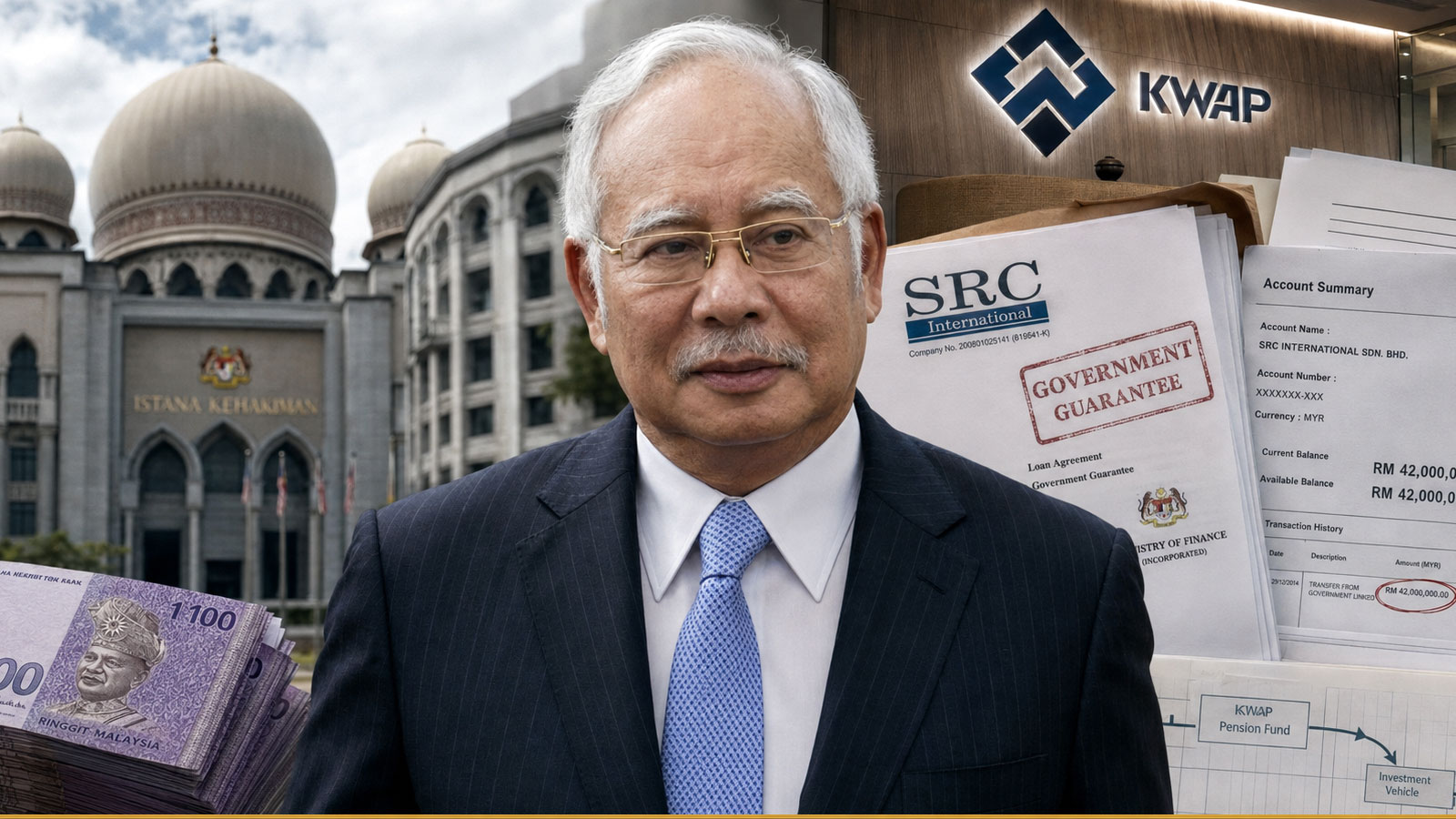
- On 23 August 2022, Malaysia’s Federal Court dismissed former Prime Minister Najib Razak’s final appeal in the SRC International case.
- The five-judge panel unanimously upheld his conviction on all seven charges: one count of abuse of power, three counts of criminal breach of trust and three counts of money laundering.
- The aggregate sentence was twelve years in prison and a RM210 million fine, with five additional years in default of payment of the fine.
- The case concerned RM42 million belonging to SRC International that entered Najib’s personal bank accounts.
- SRC had originally been a subsidiary of 1Malaysia Development Berhad — 1MDB — before being transferred to direct ownership of Malaysia’s Ministry of Finance in 2012.
EXECUTIVE FINDING
On 23 August 2022, Malaysia’s Federal Court dismissed former Prime Minister Najib Razak’s final appeal in the SRC International case.
The five-judge panel unanimously upheld his conviction on all seven charges: one count of abuse of power, three counts of criminal breach of trust and three counts of money laundering.
The aggregate sentence was twelve years in prison and a RM210 million fine, with five additional years in default of payment of the fine.
The case concerned RM42 million belonging to SRC International that entered Najib’s personal bank accounts.
SRC had originally been a subsidiary of 1Malaysia Development Berhad — 1MDB — before being transferred to direct ownership of Malaysia’s Ministry of Finance in 2012.
Its financing came from Kumpulan Wang Persaraan, or KWAP, Malaysia’s public-sector pension fund.
KWAP advanced RM2 billion in 2011 and another RM2 billion in 2012, a total of RM4 billion, principally on the strength of Malaysian government guarantees approved by Cabinet.
The appellate record described unusual features in the financing process: the application came from the top down through the prime minister and finance minister, supporting documents were difficult to obtain, and the process was rushed.
Najib was simultaneously Prime Minister, Minister of Finance and, later, Adviser Emeritus to SRC.
The prosecution case — accepted by the trial court, Court of Appeal and Federal Court — was that he used his public position in decisions connected to the government guarantees while holding a private interest in SRC that ultimately produced gratification of RM42 million.
The RM42 million later moved into his personal AmBank accounts through intermediary corporate accounts.
Najib did not dispute that the RM42 million reached his accounts. His defence centred on knowledge and intent: he maintained that he did not know the funds came from SRC and said he had been misled or framed by others, including Jho Low and SRC executives.
The Federal Court rejected that defence and affirmed the findings of guilt.
The case is narrower than the wider 1MDB scandal, but institutionally it is just as important.
It shows how public pension capital, government guarantees, executive control and personal banking can become connected through one state-owned corporate vehicle.
PUBLIC MONEY WAS BORROWED IN THE NAME OF DEVELOPMENT. PUBLIC POWER GUARANTEED IT. PRIVATE ACCOUNTS RECEIVED THE BENEFIT.
The central Kleptik question is therefore:
WHAT HAPPENS WHEN THE SAME POLITICAL OFFICE CAN CREATE THE COMPANY, INFLUENCE THE FINANCING, GUARANTEE THE DEBT AND ULTIMATELY BENEFIT FROM THE MONEY?
THE FINDING
The SRC case is an architecture-of-control case.
It is not merely about a suspicious bank transfer.
The corruption began much earlier in the decision chain.
A new state company needed billions in financing.
A public pension institution supplied the money.
The federal government guaranteed repayment.
The prime minister and finance minister exercised extraordinary influence over the public bodies involved.
Only later did RM42 million reach the politician’s personal accounts.
PUBLIC POLICY / STATE COMPANY
↓
KWAP PENSION MONEY
↓
RM4 BILLION FINANCING
↓
GOVERNMENT GUARANTEES
↓
SRC CONTROL
↓
INTERMEDIARY COMPANIES
↓
RM42 MILLION
↓
PRIME MINISTER’S PERSONAL ACCOUNTS
SRC INTERNATIONAL
SRC International was established in 2011 as a strategic-resource investment company and initially sat within 1MDB.
It was later transferred to the Minister of Finance Incorporated, placing it under direct federal ownership.
That corporate history matters because SRC was not an ordinary private borrower.
Its access to financing depended on the state and on the political authority controlling the state.
ONE-TIME 1MDB SUBSIDIARY
SRC is often described as “1MDB-linked,” but the distinction must remain precise.
SRC was once a subsidiary of 1MDB and was transferred to Ministry of Finance ownership in 2012.
Najib’s final 2022 conviction concerned SRC funds, not a final conviction in the separate principal 1MDB prosecution.
Kleptik therefore treats 1MDB as institutional context, not as a substitute charge.
THE RM4 BILLION
KWAP approved RM2 billion of financing in 2011 and another RM2 billion in 2012.
The total RM4 billion came from a retirement fund serving Malaysia’s public-sector pension system.
The Court of Appeal record says the loans were principally granted on the strength of two government guarantees approved by Cabinet.
THE PENSION-FUND QUESTION
Pension capital is public-trust money.
It exists to meet long-term obligations to retirees.
When a politically connected state company seeks billions from a pension institution, the underwriting standard should become more independent, not less.
THE TOP-DOWN APPLICATION
The Court of Appeal recorded testimony that the SRC financing application contained unusual features.
It came top-down through Najib as Prime Minister and Finance Minister directly to the KWAP chief executive.
The normal model would be a borrower submitting an application that moved upward through the institution.
THE DIRECTION OF PRESSURE
Ordinary credit process flows from analyst to committee to decision-maker.
Political-credit risk can flow in the opposite direction.
When the highest political authority signals a desired outcome first, lower levels may perform analysis inside a decision environment already shaped by power.
THE MISSING-DOCUMENT PROBLEM
The appellate record says supporting information was difficult to obtain and the application process was rushed.
A rushed transaction with incomplete support is a conventional credit red flag.
When the counterparty is state-owned and the request is politically promoted, the governance risk is even greater.
THE GOVERNMENT GUARANTEES
Cabinet approved guarantees securing the RM4 billion KWAP financing.
That transformed SRC’s credit risk into a contingent liability of the Malaysian government.
The pension fund’s exposure was therefore backed by taxpayers.
THE SOVEREIGN-GUARANTEE LEVER
A government guarantee is a public asset.
It substitutes the state’s balance sheet for the borrower’s own credit quality.
Politically directed use of that guarantee can unlock financing that the borrower might not obtain on ordinary commercial terms.
THE PUBLIC RISK TRANSFER
SRC receives capital.
KWAP supplies cash.
Government assumes repayment risk.
If SRC cannot pay, taxpayers ultimately stand behind the guarantee.
THE RM42 MILLION
The criminal case concerned RM42 million of SRC funds that moved into Najib’s personal accounts.
The money entered through three transfers routed via Ihsan Perdana Sdn Bhd, a company associated with SRC’s corporate-social-responsibility activities.
The use of an intermediary company created distance between SRC and the final personal accounts.
THE THREE-TRANSFER STRUCTURE
The prosecution divided the RM42 million into the transfers underlying the three criminal-breach-of-trust and three money-laundering counts.
Multiple transfers do not necessarily imply laundering by themselves.
Here they became legally significant because the court found the funds were proceeds of unlawful activity and were received into Najib’s personal accounts.
THE PERSONAL ACCOUNT
A personal bank account is the point where institutional abstraction disappears.
State company.
Pension financing.
Government guarantee.
Intermediary entity.
Then personal money.
THE KNOWLEDGE DEFENCE
Najib did not dispute that RM42 million entered his accounts.
His defence challenged mens rea — knowledge and criminal intent.
He said he believed funds entering his accounts came from other legitimate or donated sources and argued that Jho Low, SRC executives and bankers had deceived him.
THE COURTS REJECTED THE DEFENCE
The trial judge rejected the explanation.
The Court of Appeal affirmed the conviction.
The Federal Court then rejected the final appeal and said the lower courts’ findings were correct.
ABUSE OF POWER
The abuse-of-power count concerned Najib’s use of his office in the governmental decisions connected to guarantees that enabled SRC to obtain the RM4 billion KWAP financing.
The court found that his relationship with SRC created the private interest necessary for the offence.
CRIMINAL BREACH OF TRUST
The three CBT counts concerned dominion over SRC property and the wrongful dealing with the RM42 million.
The legal theory treated Najib as an agent entrusted with company property in his relevant capacities.
MONEY LAUNDERING
The three money-laundering counts concerned receipt of the RM42 million as proceeds of unlawful activity into personal accounts.
The laundering analysis therefore sits downstream from the abuse-of-power and trust offences.
SEVEN COUNTS, ONE SYSTEM
One abuse-of-power count.
Three criminal-breach-of-trust counts.
Three money-laundering counts.
The charges separate different legal stages of the same financial architecture.
PUBLIC OFFICE
↓
CONTROL / INFLUENCE OVER SRC
↓
GOVERNMENT GUARANTEES
↓
KWAP FINANCING
↓
SRC FUNDS
↓
INTERMEDIARY ACCOUNT
↓
PERSONAL ACCOUNT
↓
MONEY-LAUNDERING OFFENCES
THE RM210 MILLION FINE
For the abuse-of-power offence, the High Court imposed twelve years’ imprisonment and a RM210 million fine.
The fine carried an additional five years’ imprisonment in default.
The Court of Appeal and Federal Court left the sentence intact.
WHY THE FINE WAS FIVE TIMES THE GRATIFICATION
Malaysia’s anti-corruption sentencing framework can calculate fines by reference to multiples of the gratification involved.
The RM210 million figure is exactly five times RM42 million.
The structure directly links punishment to economic benefit.
THE CONCURRENT SENTENCE
Najib received ten years for each CBT count and ten years for each money-laundering count.
Those custodial terms run concurrently with the twelve-year abuse-of-power sentence.
The aggregate custodial term was therefore twelve years.
THE PRIME-MINISTER / FINANCE-MINISTER PROBLEM
Najib simultaneously occupied the offices of Prime Minister and Minister of Finance.
That concentrated political and financial authority.
The same political leader could influence Cabinet policy, public guarantees and the ministry that owned SRC.
CONCENTRATION OF FUNCTIONS
Good governance separates sponsorship, ownership, financing and oversight.
When those functions converge under one political office, checks become structurally weaker.
THE ADVISER EMERITUS ROLE
Najib also held an advisory role in SRC.
The courts examined that role together with his governmental positions when determining control and interest.
Titles matter less than actual power.
CONTROL WITHOUT SHARE OWNERSHIP
A politician does not need to own shares personally to exert controlling influence over a state company.
Appointments, financing decisions, government guarantees and senior management access can create functional control.
THE KWAP UNDERWRITING QUESTION
The key institutional question is whether KWAP would have extended RM4 billion to SRC without political pressure and sovereign guarantees.
The appellate record’s description of top-down initiation, rushed processing and incomplete support makes that question unavoidable.
THE GUARANTEE CAN HIDE CREDIT QUALITY
Once the sovereign guarantees repayment, a lender may focus on the government’s ability to pay rather than the borrower’s commercial strength.
This can allow a weak or untested state company to obtain enormous financing.
THE NEW-COMPANY RISK
The trial reasoning emphasised that SRC was newly established and lacked a track record in the natural-resource activities for which it sought financing.
Large state funding to a new vehicle requires exceptional independent diligence.
THE RUSHED-CABINET PAPER
The appellate judgment noted that Cabinet and finance-ministry materials were prepared quickly and relied on information that had not been fully verified.
A sovereign guarantee should be treated as a credit decision of national consequence, not an administrative formality.
WHERE DID THE RM4 BILLION GO?
The Court of Appeal noted that large portions of the RM4 billion were rapidly transferred overseas and that the status of much of the investment was unclear in the SRC record.
This broader disappearance is not the same as the RM42 million for which Najib was convicted.
It remains an essential governance context.
THE RM42 MILLION IS SMALLER THAN THE SYSTEM
RM42 million is approximately one percent of RM4 billion.
The criminal conviction therefore proves a specific personal-benefit channel inside a much larger state-financing structure.
Investigators should never confuse the convicted amount with total economic loss.
THE 1MDB CONTEXT
The wider 1MDB affair involved allegations that more than US$4.5 billion was misappropriated between 2009 and 2015 through international money laundering, embezzlement and bribery.
By August 2022, U.S. authorities had pursued extensive forfeiture and repatriation efforts tied to 1MDB assets.
Those U.S. allegations and forfeitures provide context for the ecosystem, but they are legally separate from Najib’s final SRC conviction.
DO NOT MERGE SRC AND 1MDB
The names overlap.
The people overlap.
The political system overlaps.
The legal cases do not automatically merge.
Kleptik keeps offence, defendant, company and procedural status separate.
JHO LOW
Low Taek Jho — Jho Low — became the central alleged architect in the international 1MDB money-laundering cases.
Najib’s SRC defence also invoked Low as part of the explanation for funds and account management.
As of the archive date, Low remained a fugitive and had not been tried alongside Najib in the SRC appeal.
THE “I WAS MISLED” DEFENCE
Complex financial structures often create a plausible delegation defence.
The senior official says bankers, advisers or subordinates handled details.
Courts then examine whether the official’s actions, communications, account activity and institutional power are consistent with genuine ignorance.
WILFUL BLINDNESS VERSUS ACTUAL KNOWLEDGE
A politically exposed customer may not personally process transfers.
The legal question is still what the person knew, intended or deliberately ignored.
The Federal Court found the prosecution had established the required mental element.
THE BANKER / INTERMEDIARY PROBLEM
The SRC route passed through banks and corporate intermediaries.
Their presence does not establish knowing complicity.
Each institution or individual must be assessed against their own evidence and legal status.
THE PEP ACCOUNT SIGNAL
A sitting prime minister receiving large corporate transfers is an extreme PEP event.
Banks should understand source of funds, source of wealth, beneficial purpose and relationship to state entities.
Where money originates from a company under the official’s influence, enhanced scrutiny is mandatory in principle.
SOURCE OF FUNDS
- Where did the RM42 million immediately come from?
- Which entities transmitted it?
- What documentary purpose was recorded?
Those are source-of-funds questions.
SOURCE OF WEALTH
Could Najib’s legitimate income and declared wealth explain the overall activity in his personal accounts?
That is a separate source-of-wealth question.
Both analyses are needed in high-level PEP cases.
THE STATE-OWNED-ENTERPRISE PROBLEM
State-owned companies occupy an uncomfortable zone between commercial enterprise and public administration.
They can borrow, invest and contract like companies while relying on government support.
That hybrid status creates opportunities for political influence to masquerade as business judgment.
THE POLITICAL BENEFICIAL OWNER
A state company may be legally owned by government.
But if one political figure exercises overwhelming influence over financing, appointments and direction, investigators should ask who functionally controls the decision-making process.
THE STATE BALANCE SHEET
The guarantees turned SRC debt into potential government debt.
Later defaults forced the Ministry of Finance to provide additional short-term loans to service KWAP obligations.
That is how private or political misuse can migrate into the public balance sheet.
THE PUBLIC PAYS TWICE
First through pension capital placed at risk.
Then through government support when the borrower cannot meet obligations.
State-company corruption can therefore transfer loss across multiple public institutions.
THE RECOVERY CASES
By 2021, Malaysia’s Ministry of Finance confirmed extensive civil recovery actions by 1MDB and SRC against institutions and individuals.
Asset recovery asks a different question from criminal conviction: where did the money go and who still holds value derived from it?
THE INTERNATIONAL ASSET TRAIL
The wider 1MDB network moved funds through major financial centres including the United States, Switzerland, Singapore and Luxembourg, according to U.S. forfeiture filings.
The SRC conviction demonstrates the domestic political endpoint while the broader cases demonstrate the global laundering infrastructure.
THE GOLDMAN SACHS CONTEXT
In April 2022, former Goldman Sachs banker Roger Ng was convicted in the United States of conspiracy offences tied to 1MDB bribery and money laundering.
That conviction belongs to the wider 1MDB case, not the SRC charges.
It nevertheless shows how state-fund corruption can recruit global professional infrastructure.
PROFESSIONAL ENABLERS
Large state-fund schemes require banks, bond arrangers, lawyers, corporate-service providers and accountants.
Professional participation is not automatically criminal.
The key question is what each participant knew and what controls were bypassed.
THE “DEVELOPMENT FUND” LABEL
Names can create legitimacy.
Development fund.
Strategic resource company.
Corporate social responsibility.
None of those labels proves the underlying economic substance.
PROFESSIONAL FORM DOES NOT PROVE ECONOMIC SUBSTANCE
A Cabinet paper can exist.
A loan agreement can exist.
A government guarantee can exist.
A CSR company can exist.
The investigative question remains: what actually happened to the money?
THE MONEY MAP
Kleptik would reconstruct every SRC dollar from KWAP disbursement through offshore investments, domestic transfers, intermediary entities, personal accounts and later recovery.
The RM42 million route is only one branch of that map.
THE POWER MAP
Prime Minister.
Finance Minister.
Cabinet.
Ministry of Finance Incorporated.
SRC management.
KWAP leadership.
The case becomes intelligible when authority is mapped alongside money.
THE MONEY-AND-POWER MATRIX
| Node | Public / financial function | Integrity question |
|---|---|---|
| Najib Razak | Prime Minister + Finance Minister | Did concentrated authority undermine independent decision-making? |
| KWAP | Public pension lender | Would RM4bn have been approved on ordinary commercial terms? |
| Cabinet | Approves sovereign guarantees | Was borrower risk independently verified? |
| SRC International | State-owned investment vehicle | Who exercised actual control over financing and funds? |
| Ihsan Perdana | Intermediary / CSR-linked entity | Why did SRC-origin funds move through this company before personal accounts? |
| Personal bank accounts | Final recipient of RM42m | What source and purpose were understood by the account holder? |
THE LEGAL-STATUS MATRIX
IssueStatus on 23 August 2022Kleptik treatmentSRC RM42m caseFinal Federal Court convictionESTABLISHED — FINAL CONVICTIONSeven SRC chargesAll upheldAdjudicatedWider 1MDB US$4.5bn schemeInternational criminal/civil cases ongoingSeparate allegations / convictions by defendantJho LowFugitive| Do not treat as convicted in Najib SRC case | 1MDB asset forfeiture |
|---|---|
| Substantial U.S. recovery already underway | Civil forfeiture / repatriation record |
CHRONOLOGY
2011
SRC International is established within the 1MDB structure. KWAP approves RM2 billion of financing after a process later described in court as unusual and politically driven.
August 2011
Cabinet approves the first government guarantee supporting SRC’s KWAP financing.
2012
KWAP approves a second RM2 billion financing, bringing total exposure to RM4 billion. A second government guarantee follows.
2012
SRC is transferred from 1MDB to direct ownership by the Minister of Finance Incorporated.
December 2014
The first of the RM42 million transfers later forming part of the criminal case reaches Najib-linked personal banking channels.
February 2015
Further transfers complete the RM42 million flow into Najib’s personal accounts.
2015–2017
SRC defaults create additional government funding pressure and Ministry of Finance support to service KWAP obligations.
2016
Malaysian and international scrutiny of 1MDB and SRC intensifies.
9 May 2018
Najib’s Barisan Nasional coalition loses Malaysia’s general election, ending his premiership.
4 July 2018
Najib is first charged in connection with SRC International.
8 August 2018
Three money-laundering charges involving the same RM42 million are added.
3 April 2019
The SRC trial begins in the Kuala Lumpur High Court.
11 November 2019
The High Court orders Najib to enter his defence on all seven charges.
28 July 2020
The High Court convicts Najib on all seven counts and imposes an aggregate 12-year sentence and RM210 million fine.
8 December 2021
The Court of Appeal unanimously dismisses Najib’s appeal and upholds conviction and sentence.
8 April 2022
Former Goldman Sachs banker Roger Ng is convicted in the United States in the separate wider 1MDB bribery and money-laundering case.
23 August 2022
Malaysia’s Federal Court unanimously dismisses Najib’s final SRC appeal. He begins serving the prison sentence that day.
DOCUMENTARY RECORD
MALAYSIA FEDERAL COURT — 23 AUGUST 2022
The apex-court judgment confirms seven convictions: one abuse-of-power charge, three criminal-breach-of-trust charges and three money-laundering charges. It affirms the aggregate twelve-year custodial sentence and RM210 million fine.
MALAYSIA COURT OF APPEAL — SRC JUDGMENT
The appellate judgment reconstructs the KWAP financing, government guarantees, Najib’s roles and influence, the RM42 million transfers and the defence arguments. It records the unusual top-down and rushed characteristics of the RM4 billion financing process.
BERNAMA — 23 AUGUST 2022
Malaysia’s national news agency contemporaneously recorded the Federal Court decision and that Najib began serving the upheld twelve-year sentence immediately.
U.S. DEPARTMENT OF JUSTICE — 1MDB ASSET RECOVERY
U.S. forfeiture records existing before the archive date alleged that more than US$4.5 billion in 1MDB funds had been misappropriated from 2009 through 2015 and laundered through global financial institutions. These materials provide wider-system context but are not the basis of Najib’s SRC conviction.
MALAYSIA MINISTRY OF FINANCE — RECOVERY RECORD
By 2021, Malaysia had announced extensive civil suits by 1MDB and SRC and substantial recovery efforts against financial institutions, companies and individuals.
WHAT THE FEDERAL COURT DECIDED
The Federal Court dismissed Najib’s final appeal and affirmed all seven convictions and the sentence.
It found no basis to disturb the lower courts’ factual and legal conclusions.
The result made the SRC conviction final within Malaysia’s ordinary appellate structure on the archive date.
WHAT NAJIB SAID
Najib denied criminal wrongdoing.
His defence maintained that he did not know the RM42 million was derived from SRC and that he had been misled by others managing the financial arrangements.
He challenged the proceedings, evidentiary conclusions and fairness of the final appeal process.
Those arguments were rejected by the Federal Court on 23 August 2022.
WHAT THIS DOSSIER DOES NOT ESTABLISH
This dossier does not state that Najib had been finally convicted in the separate principal 1MDB prosecution as of 23 August 2022.
It does not equate the RM42 million SRC amount with the more-than-US$4.5-billion misappropriation alleged in U.S. 1MDB forfeiture cases.
It does not treat every SRC director, KWAP official, banker or intermediary as criminally complicit.
It does not state that every government guarantee or state-company financing is improper.
It does not infer wrongdoing by a financial institution merely because funds passed through an account it maintained.
It does not incorporate later pardons, sentence reductions, later court rulings or later political developments after 23 August 2022.
RIGHT OF REPLY
Before publication, Kleptik should seek current comment from Najib Razak and his legal representatives while preserving the historical status fixed to 23 August 2022.
KWAP, SRC and the Malaysian Ministry of Finance should be offered an opportunity to address institutional-control reforms arising from the case.
Any bank, adviser, director or intermediary criticised beyond established findings should receive transaction-specific questions and the evidence relied upon.
UNANSWERED QUESTIONS
1. THE FULL RM4 BILLION MAP
Where did every ringgit of the two KWAP loans ultimately move?
2. THE OVERSEAS INVESTMENTS
Which overseas assets or counterparties received the largest SRC transfers?
3. RECOVERY
How much of the RM4 billion has actually been recovered for the Malaysian public?
4. KWAP UNDERWRITING
Which internal credit concerns were documented before each RM2 billion approval?
5. POLITICAL PRESSURE
Which officials believed the financing outcome had effectively been predetermined?
6. CABINET
What independent verification did Cabinet receive before approving the guarantees?
7. MOF INC
How did ownership transfer from 1MDB to the Ministry of Finance change SRC oversight?
8. SRC BOARD
Which board members challenged financing, investments or transfers?
9. NIK FAISAL
What was the complete role of SRC management in connecting political instructions to company actions?
10. IHSAN PERDANA
Why did the RM42 million pass through a CSR-linked company before entering Najib’s accounts?
11. BANK CONTROLS
Which PEP alerts or source-of-funds questions were triggered by the personal-account transfers?
12. ACCOUNT PURPOSE
What descriptions or payment references accompanied the RM42 million transfers?
13. JHO LOW
What documentary evidence connects Jho Low to account management or explanations given to Najib in the SRC matter?
14. GOVERNMENT GUARANTEES
What is the final taxpayer cost of servicing or supporting the guaranteed KWAP financing?
15. ASSET RECOVERY
Which jurisdictions hold unrecovered SRC assets?
16. PROFESSIONALS
Which legal, accounting and banking professionals had visibility over the SRC transaction chain?
17. 1MDB INTERFACE
Which personnel, systems and bank relationships were shared between 1MDB and SRC after the ownership transfer?
18. CONTROL REFORMS
What institutional rules changed to prevent a prime minister from simultaneously sponsoring, owning and influencing a state investment vehicle?
19. PENSION GOVERNANCE
Can politically sensitive pension-fund lending now be vetoed by independent risk committees?
20. THE CENTRAL QUESTION
Was the RM42 million the endpoint of one corrupt diversion — or the visible personal-account trace of a much larger failure in how Malaysia combined state companies, pension capital, sovereign guarantees and concentrated political power?
KLEPTIK INTELLIGENCE ASSESSMENT
ASSESSMENT: ESTABLISHED — FINAL CONVICTION
On 23 August 2022, Malaysia’s Federal Court unanimously upheld Najib Razak’s convictions on all seven SRC International charges.
ASSESSMENT: ESTABLISHED — SENTENCE
The operative aggregate sentence was twelve years in prison and a RM210 million fine, with five years in default of the fine.
ASSESSMENT: ESTABLISHED — RM42 MILLION
The case established that RM42 million of SRC funds entered Najib’s personal bank accounts and supported the CBT and money-laundering convictions.
ASSESSMENT: ESTABLISHED — RM4 BILLION FINANCING
KWAP extended RM4 billion to SRC in two tranches backed principally by government guarantees approved by Cabinet.
ASSESSMENT: ESTABLISHED — GOVERNANCE RED FLAGS
The appellate record described the financing process as top-down, rushed and affected by difficulties obtaining supporting documentation.
ASSESSMENT: HIGH CONFIDENCE
The SRC case demonstrates the danger of concentrating political sponsorship, public-company control, sovereign guarantees and finance-ministry authority around one officeholder.
ASSESSMENT: HIGH CONFIDENCE
The most important systemic lesson is that state-company corruption can transfer risk simultaneously to pension beneficiaries, taxpayers and the integrity of the banking system.
ASSESSMENT: HIGH CONFIDENCE
SRC and 1MDB should be analytically linked as part of a wider state-fund ecosystem but legally separated by charge, defendant and procedural status.
THE KLEPTIK VIEW
The RM42 million is the easy number.
It fits in a headline.
It can be traced into a personal account.
It produced seven criminal convictions.
But the real story begins four billion ringgit earlier.
A state company with little track record needed money.
The public pension fund supplied it.
The government guaranteed it.
The prime minister was also finance minister.
The finance ministry ultimately owned the company.
The same political centre sat close to every critical decision.
That is the governance architecture that made the personal transfer possible.
Corruption rarely begins when money reaches the politician.
It begins when independent controls stop being independent.
The lender stops asking only credit questions.
The Cabinet stops asking only public-interest questions.
The state company stops behaving like a company.
The guarantee stops being treated like taxpayer money.
Then, eventually, the money reaches somewhere it was never supposed to go.
THE RM42 MILLION WAS THE PERSONAL BENEFIT.
THE RM4 BILLION WAS THE PUBLIC RISK.
Those numbers must not be confused.
But they must be read together.
The scandal is not that a prime minister had a bank account.
The scandal is that a political system with concentrated control over a pension-funded, government-guaranteed company produced money that ended up in that account.
That is why the SRC conviction belongs in the Kleptik archive as more than a Malaysian political story.
It is a case study in how sovereign balance sheets become corruption infrastructure when governance collapses around a powerful PEP.
FOLLOW THE GUARANTEE.
FOLLOW THE PENSION MONEY.
THEN FOLLOW THE RM42 MILLION INTO THE PERSONAL ACCOUNT.
KLEPTIK METHODOLOGY
This dossier is dated 23 August 2022 and is intentionally fixed to the legal and evidentiary position existing on that date.
The principal sources are the Malaysian Federal Court judgment of 23 August 2022, the Court of Appeal judgment in the SRC matter, contemporaneous Bernama reporting, Malaysian Ministry of Finance recovery statements and U.S. Department of Justice 1MDB forfeiture records existing by the archive date.
Kleptik strictly separates the SRC criminal case from the wider 1MDB proceedings.
SRC FINAL CONVICTION
The seven charges upheld against Najib concerning abuse of power, criminal breach of trust and laundering of RM42 million.
WIDER 1MDB ALLEGATIONS
Separate international allegations and prosecutions concerning more than US$4.5 billion allegedly misappropriated from 1MDB.
PUBLIC FINANCING
The RM4 billion KWAP loans and government guarantees are analysed as governance and public-risk architecture, not as personal proceeds proved against Najib in their entirety.
PERSONAL BENEFIT
The RM42 million established in the final SRC conviction.
For PEP analysis, Kleptik maps actual institutional control rather than relying only on formal titles.
For public-finance analysis, sovereign guarantees are treated as contingent taxpayer liabilities and therefore public assets.
For banking analysis, account usage alone does not establish institutional knowledge or complicity.
For wider 1MDB context, U.S. civil-forfeiture allegations are labelled separately from criminal convictions.
Later pardons, sentence adjustments, retrials or political developments after 23 August 2022 are excluded from this historical dossier.
EVIDENTIARY LABELS
ESTABLISHED — FINAL CONVICTION
Conduct upheld by Malaysia’s Federal Court after final ordinary appeal.
ESTABLISHED — COURT FINDING
Specific factual conclusion established in the SRC trial and appellate record.
ESTABLISHED — PUBLIC FINANCING
Documented KWAP financing and Malaysian government guarantees.
WIDER 1MDB ALLEGATION
Claim from separate 1MDB civil or criminal proceedings not automatically part of the SRC conviction.
CIVIL ASSET-RECOVERY RECORD
Forfeiture or recovery action concerning allegedly misappropriated funds under separate legal standards.
PEP-CONTROL INDICATOR
Evidence relevant to the officeholder’s actual influence over state companies, financing or public decisions.
STATE-BALANCE-SHEET INDICATOR
Use of guarantees, public lending or fiscal support that transfers risk to taxpayers.
KLEPTIK VERIFIED
Fact independently corroborated through primary judicial or official records.
KLEPTIK ASSESSMENT
Analytical conclusion derived from identified evidence.
INVESTIGATIVE LEAD
Matter requiring additional financial, institutional or asset-level verification.
DOCUMENT STATUS
KLTK-2022-028
Subject: Najib Razak / SRC International / KWAP / RM42 Million / Malaysia
Archive date: 23 August 2022
Status at archive date: Federal Court final conviction on all seven SRC charges; 12-year aggregate sentence and RM210 million fine operative
Historical treatment: Fixed to report date
© KLEPTIK — Investigations into Power, Money and the Systems Designed to Hide Both