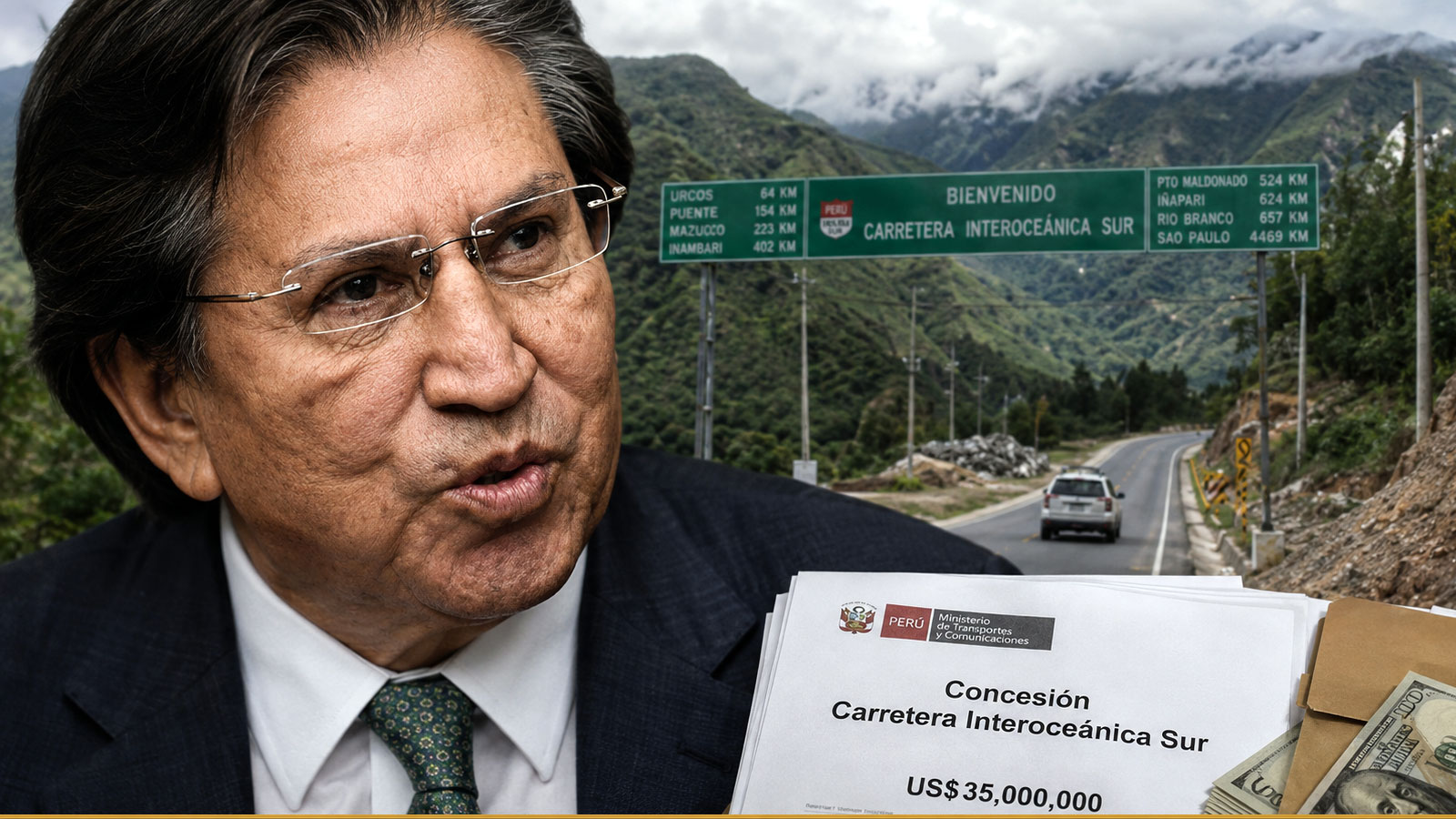
THE PRESIDENT, THE HIGHWAY AND THE $35 MILLION DEAL

- The court further found that Toledo used his close friend, Israeli businessman Josef Maiman, as an intermediary through whose companies Odebrecht payments could be received.
- Former Odebrecht Peru executive Jorge Barata and Maiman were central witnesses.
- The court said their testimony was corroborated by financial transfers, expert reports and other documentary evidence.
- The sentence divided Toledo’s punishment into nine years for collusion and eleven years and six months for money laundering.
- The court established civil reparation of 1.375 billion Peruvian soles and $463 million to be paid by the persons found liable in the proceeding.
EXECUTIVE FINDING
On 21 October 2024, Peru’s Second National Collegiate Criminal Court sentenced former President Alejandro Toledo Manrique to 20 years and six months in prison in the Southern Interoceanic Highway case.
The court convicted Toledo of collusion and money laundering after a trial that the Peruvian judiciary said involved 175 hearings, testimony from more than 100 witnesses and more than 1,000 documentary exhibits.
The judicial finding was that Toledo colluded with interested private parties associated with Odebrecht so that the Brazilian construction group would obtain the concession for sections 2 and 3 of the Peru-Brazil Southern Interoceanic Highway in exchange for a bribe agreement valued at approximately $35 million.
The court further found that Toledo used his close friend, Israeli businessman Josef Maiman, as an intermediary through whose companies Odebrecht payments could be received.
Former Odebrecht Peru executive Jorge Barata and Maiman were central witnesses. The court said their testimony was corroborated by financial transfers, expert reports and other documentary evidence.
The sentence divided Toledo’s punishment into nine years for collusion and eleven years and six months for money laundering.
Peru’s judiciary also imposed nine-year prison terms on former ProInversion infrastructure committee members Sergio Bravo Orellana and Alberto Pasco-Font, and fourteen years and six months on businessman José Fernando Castillo Dibós for collusion and money laundering.
The court established civil reparation of 1.375 billion Peruvian soles and $463 million to be paid by the persons found liable in the proceeding.
Toledo had denied the charges and told the court that he had never made an arrangement with Barata or Maiman.
The case matters beyond Peru because it shows how a corrupt infrastructure transaction can operate through an apparently legitimate public tender, a global construction company, politically connected intermediaries, offshore entities, private banking channels and real estate in another country.
THE BRIBE WAS PRIVATE. THE ROAD WAS PUBLIC. THE LIABILITY BELONGED TO THE STATE.
The central Kleptik question is therefore:
HOW DOES A PRESIDENTIAL DECISION BECOME A PRIVATE ASSET — AND HOW DOES THE MONEY THEN TRAVEL FAR ENOUGH FROM THE CONTRACT TO LOOK UNRELATED TO THE POLITICS?
THE FINDING
The Toledo case is a study in leverage.
A private company wanted a major public infrastructure concession.
A president possessed extraordinary influence over the political environment in which that concession would be awarded.
An intermediary network could receive money outside the government transaction itself.
The public contract remained formally documented.
The corrupt exchange sat behind it.
PUBLIC INFRASTRUCTURE PROJECT
↓
POLITICAL POWER
↓
ODEBRECHT COMMERCIAL INTEREST
↓
BRIBE AGREEMENT
↓
INTERMEDIARY COMPANIES
↓
OFFSHORE / CROSS-BORDER PAYMENTS
↓
PRIVATE ASSETS
↓
PUBLIC COST
The corruption mechanism is therefore not visible by looking only at the road contract. It becomes visible only when the procurement map and the money map are placed on top of each other.
THE SOUTHERN INTEROCEANIC HIGHWAY
The project connected Peru to Brazil through a major cross-border road corridor and represented one of the most ambitious infrastructure undertakings of Toledo’s presidency.
Sections 2 and 3 became the focus of the criminal case.
A large infrastructure concession creates multiple sources of economic value: construction revenue, financing, change orders, long-term political prestige and future commercial relationships.
That makes infrastructure procurement a high-value corruption target.
ALEJANDRO TOLEDO
Toledo served as President of Peru from 2001 to 2006.
At the relevant time he was the highest political authority in the country and therefore an archetypal high-risk PEP.
The court concluded that he used that position in a corrupt agreement connected to the concession process.
The importance of his role is not that a president personally signs every technical procurement document.
It is that presidential influence can alter the environment in which subordinate institutions make decisions.
THE $35 MILLION AGREEMENT
Peru’s judiciary said the trial established a corrupt agreement under which Toledo would receive approximately $35 million in exchange for Odebrecht obtaining the concession for sections 2 and 3.
The amount is significant, but the economic significance is larger than the bribe itself.
A bribe buys access to a revenue stream created by public authority.
The correct denominator is therefore not the politician’s payment. It is the commercial value unlocked by that payment.
THE CORRUPTION LEVERAGE MODEL
Kleptik treats large procurement bribery as a leverage transaction.
Private benefit paid to official.
Public decision creates commercial value.
The company’s return may be many multiples of the bribe.
That is why anti-corruption penalties that target only the payment amount can fail to alter economic incentives.
JOSEF MAIMAN
The court found that Toledo persuaded his close friend Josef Maiman to act as an intermediary and receive Odebrecht money through companies associated with him.
This is a recurring corruption architecture.
The public official does not need to receive money directly.
A trusted private person can create distance between payer and ultimate beneficiary.
Friendship becomes financial infrastructure.
THE TRUSTED-INTERMEDIARY PROBLEM
Intermediaries can provide legitimate services.
But in corruption cases their value may be confidentiality, account access and plausible deniability.
Investigators should ask why this person was necessary, what legitimate commercial service was performed, and who controlled the funds after they arrived.
THE OFFSHORE COMPANIES
Peruvian judicial records in the Toledo proceedings identified companies associated with Maiman that received Odebrecht-related payments, including Trailbridge Ltd, Merhav Overseas Limited and Warbury and Co.
An offshore company is not inherently unlawful.
Its relevance lies in whether it creates distance between the public official and the economic benefit.
Legal title and beneficial ownership must be separated.
THE BENEFICIAL-OWNERSHIP QUESTION
- Who owns the company on paper?
- Who instructs the bank?
- Who decides where the money goes?
- Who ultimately buys the property?
These questions can identify the economic owner even where the legal holder is an intermediary.
THE MONEY TRAIL
United States forfeiture proceedings later documented part of the cross-border movement of Toledo-related corruption proceeds.
The U.S. Department of Justice alleged that approximately $1.2 million of Odebrecht bribe money was used by Toledo and his family to purchase real estate in Maryland in 2007 through a structure designed to conceal Toledo’s ownership and the funds’ connection to Odebrecht.
The proceeds from the sale of that real estate were subsequently moved through the Havenell Trust and a Bank of America account controlled by Toledo, according to the U.S. forfeiture case.
In 2022, the United States returned approximately $686,000 in forfeited proceeds to Peru.
FROM BRIBE TO REAL ESTATE
A corruption payment is only the first financial event.
The recipient then faces a second problem: how to hold, use or invest the money without revealing its origin.
Real estate can convert liquid criminal proceeds into an apparently conventional family asset.
ODEBRECHT PAYMENT
↓
MAIMAN-LINKED COMPANY
↓
CROSS-BORDER ACCOUNT
↓
PROPERTY ACQUISITION
↓
SALE PROCEEDS
↓
TRUST / BANK ACCOUNT
↓
ASSET RECOVERY
The structure illustrates a recurring Kleptik principle:
FRAUD CREATES THE MONEY. LAUNDERING CREATES THE EXPLANATION.
THE MARYLAND PROPERTY
The United States civil-forfeiture case is valuable because it independently connects a portion of the bribery proceeds to a tangible asset outside Peru.
Property produces a documentary trail: deed, seller, escrow, bank transfer, mortgage records, tax records and sale proceeds.
That can make real estate easier to recover than cash held through multiple jurisdictions.
ASSET RECOVERY IS A SEPARATE CASE
A criminal conviction answers whether the defendant committed the offence.
Asset recovery answers where the proceeds went.
The two processes can occur in different countries and under different legal standards.
The Toledo matter demonstrates how U.S. civil forfeiture can recover proceeds of foreign corruption when those proceeds enter the American financial or property system.
THE PROINVERSION GATE
The highway concession moved through Peru’s investment-promotion and infrastructure decision-making apparatus.
The court also convicted former ProInversion infrastructure committee members Sergio Bravo Orellana and Alberto Pasco-Font.
This is institutionally important because a president’s political power still requires administrative nodes through which a concession becomes legally effective.
POLITICAL POWER NEEDS ADMINISTRATIVE EXECUTION
A president can create pressure or direction.
A procurement committee creates the formal decision.
Lawyers create the contract.
Banks move the money.
Engineers certify performance.
Corruption scales when multiple systems convert political intent into legitimate-looking documentation.
THE PROCUREMENT FILE
A complete investigation should reconstruct the concession file from beginning to end.
Qualification criteria.
Bidder eligibility.
Technical scoring.
Legal opinions.
Committee minutes.
Changes to deadlines or conditions.
Every deviation should be compared against the treatment of other bidders.
THE SINGLE-BIDDER RISK
Judicial records associated with the case raised issues about bidder eligibility and the concession process.
A procurement with limited genuine competition deserves enhanced scrutiny because the state loses a key price and integrity control.
One bidder does not automatically mean corruption.
It means the justification should be especially strong.
THE ODEBRECHT SYSTEM
Odebrecht’s wider Latin American bribery scandal demonstrated that corrupt payments were not confined to one country or one project.
The company became associated with a systematic approach to obtaining public business through illicit payments across multiple jurisdictions.
The Toledo conviction should nevertheless be analysed transaction by transaction rather than using the company’s broader history as substitute proof.
A COMPANY CAN INDUSTRIALISE CORRUPTION
When a company repeatedly operates in politically controlled procurement markets, bribery can become operational infrastructure rather than isolated employee misconduct.
Payment channels, intermediaries, coded communications and internal approval mechanisms can become repeatable.
The relevant governance question is whether corruption was exceptional or institutionalised.
THE JORGE BARATA TESTIMONY
Former Odebrecht Peru executive Jorge Barata was a central witness in the Toledo trial.
The Peruvian judiciary said his testimony was corroborated by Maiman’s evidence and documentary financial records.
Cooperating insiders can explain intent and hidden agreements, but their testimony should always be tested against independent documents.
CORROBORATION
Strong corruption cases combine people and paper.
Witness testimony explains the agreement.
Bank records show payment.
Corporate records show the vehicle.
Procurement records show the official decision.
Asset records show the benefit.
THE CALLS FOR 'HIS MONEY'
The Peruvian judiciary said Barata testified that after Toledo had left office, Toledo called him demanding that 'his money' be paid.
That evidence is powerful because it addresses beneficial ownership of the expected bribe rather than merely showing payments to an intermediary.
It also shows how a corrupt obligation can survive the official’s departure from office.
FORMER OFFICE DOES NOT END THE TRANSACTION
Political power may create the deal while the money arrives later.
That means investigators must follow financial activity beyond the official term.
An officeholder can leave government before receiving the economic benefit.
THE EXTRADITION DIMENSION
Toledo spent years in the United States before being extradited to Peru in April 2023.
Extradition is the jurisdictional bridge that converts a foreign-resident former president into a domestic criminal defendant.
The case demonstrates that relocation abroad may delay prosecution but does not necessarily defeat it.
TRANSNATIONAL EVIDENCE
The investigation depended on evidence spanning Peru, Brazil, Israel-linked corporate relationships and the United States.
Modern corruption prosecutions therefore require mutual legal assistance, financial intelligence and cross-border asset tracing.
National political corruption increasingly creates international evidentiary cases.
THE DEFENCE
Toledo denied having made an agreement with Barata or Maiman.
Before sentence he maintained his innocence and asked the court to do justice, while also referring to serious health problems.
Those denials form part of the historical record and should be stated alongside the conviction.
FIRST-INSTANCE STATUS
As of 21 October 2024, the court had announced Toledo’s first-instance conviction and sentence.
The complete reading of the judgment was scheduled for 31 October 2024.
Kleptik therefore fixes this dossier to the status existing on the archive date and does not incorporate later appellate or separate-case developments.
THE 20 YEARS AND SIX MONTHS
The court imposed nine years for collusion and eleven years and six months for money laundering.
The combination matters because it treats the case as both corruption in the acquisition of a public concession and financial concealment of the proceeds.
The corrupt act and the post-corruption financial architecture were legally distinct.
THE CIVIL REPARATION
The court established 1.375 billion soles and $463 million as civil reparation payable by persons found liable in the proceeding.
Those amounts should not be described as Toledo’s personal bribe or as money already recovered.
They represent the court’s civil-reparation order within the case.
PUBLIC LOSS VERSUS BRIBE
A $35 million bribe is measurable.
The public cost of corrupt infrastructure is harder.
It can include overpricing, distorted competition, financing costs, weak project selection and loss of confidence in procurement.
A responsible dossier should distinguish proven payment amounts from broader estimates of social loss.
THE HIGHWAY CAN STILL BE REAL
Corruption does not mean the road did not exist.
A real public project can be corruptly awarded.
That distinction matters because tangible infrastructure can create political legitimacy around a transaction even while the concession process is compromised.
CORRUPTION INSIDE A LEGITIMATE NEED
Peru genuinely needed infrastructure and regional connectivity.
That public need can make the underlying project politically compelling.
The investigative question is not whether the highway was useful.
It is whether the public decision was honestly procured.
THE COST OF POLITICAL PRESTIGE
Megaprojects are attractive to political leaders because they create visible legacy.
That urgency can weaken scepticism.
Projects associated with presidential prestige therefore require stronger independent financial and procurement review, not less.
THE BANKS
Cross-border corruption cannot operate at scale without financial infrastructure.
Banks may process transactions without knowing their corrupt origin.
Therefore any criticism of a specific institution requires evidence of knowledge, ignored red flags or regulatory findings.
Processing a transaction alone does not establish complicity.
THE TRUST STRUCTURE
The Havenell Trust appeared in U.S. asset-recovery proceedings connected to the Maryland property proceeds.
Trusts can serve legitimate estate-planning purposes.
They become relevant to corruption analysis when they obscure the person who economically controls assets derived from public corruption.
LEGAL OWNER VERSUS ECONOMIC OWNER
A trust may hold title.
A company may own the property.
An intermediary may control the account.
The investigation asks who can ultimately use, direct or benefit from the asset.
THE U.S. FORFEITURE SIGNAL
The United States returned approximately $686,000 to Peru in 2022 from forfeited assets linked to the Toledo corruption proceeds.
That recovery predates the 2024 Peruvian conviction and demonstrates how asset proceedings can move on a separate evidentiary timeline.
It also provides independent cross-border corroboration for part of the money trail.
FOLLOW THE ROAD, THEN FOLLOW THE PROPERTY
Procurement records identify how the concession was awarded.
Financial records identify how the benefit moved.
Property records identify how the proceeds were integrated.
All three datasets are necessary to understand the full corruption architecture.
THE EVIDENCE ARCHITECTURE
| Evidence layer | What it establishes | What it does NOT establish alone |
|---|---|---|
| Procurement record | How the public concession was awarded | Who received a bribe |
| Barata / Maiman testimony | Hidden agreement and payment context | Every transaction without corroboration |
| Bank transfers | Movement of value through intermediaries | Ultimate beneficial ownership by themselves |
| Corporate records | Legal vehicles receiving funds | Criminal purpose of the company |
| Property / trust records | Integration and later control of proceeds | Source crime unless linked to the bribe |
THE PEP NETWORK
Toledo’s risk did not stop with his personal accounts.
The relevant network included friends, advisers, intermediaries, procurement officials and private companies.
PEP screening that identifies only the politician’s name would miss the operational architecture.
PEP RISK IS A NETWORK, NOT A NAME
- Who can hold assets for the official?
- Who can receive payments?
- Who can make introductions to bidders?
- Who can influence the procurement institution?
These relationships determine how political power becomes monetisable.
THE FRIEND AS NOMINEE RISK
A trusted friend may be less visible than a relative.
That makes long-standing personal associates important in enhanced due diligence.
Relationship is not guilt.
It is context for understanding why one person would receive money economically linked to another.
THE CONTRACTOR-PEP TIMING TEST
Investigators should compare meetings, tender milestones and payment dates.
A payment after a tender can still be part of a pre-existing corrupt agreement.
Temporal distance does not break causation if the underlying obligation is documented.
THE CHANGE-ORDER QUESTION
Large infrastructure contracts can create additional value after award through amendments, extensions and cost changes.
A complete Toledo/Odebrecht audit should therefore examine not only the initial concession but every material modification.
Corruption risk continues throughout contract life.
THE POLITICAL BENEFICIAL OWNER
The apparent beneficiary of a highway concession is the construction company.
The political beneficiary may receive private money.
The public beneficiary is supposed to be the citizen using the road.
A corruption investigation asks whether those interests were reordered.
THE ODEBRECHT LESSON FOR GOVERNMENTS
Know the bidder.
Know the beneficial owners.
Know the intermediaries.
Know who communicated with political leadership.
Know where success fees go.
Procurement due diligence should be as rigorous as bank KYC for a high-risk customer.
PROCUREMENT KYC
Corporate ownership.
Political exposure.
Enforcement history.
Consultants.
Local agents.
Financing.
Related parties.
A state awarding billion-dollar infrastructure should understand the counterparty at least as deeply as a bank opening a high-risk account.
THE PRESIDENTIAL CONTACT LOG
Presidential visitor logs, calls and meetings can establish opportunity and chronology.
They should be preserved as governance records.
When procurement decisions concern enormous public assets, political contact with bidders should be transparent.
THE NO-SIDE-DEAL RULE
All commitments affecting a public tender should appear in official procurement records.
Any separate understanding between political leadership and a bidder is a major integrity risk.
Public procurement should have one documentary reality.
THE PUBLIC CONTRACT AS A LAUNDERING COVER
Once a corruptly obtained concession is awarded, the construction company receives legitimate government-linked revenue.
That revenue can look perfectly ordinary in accounting systems.
The corruption is embedded in how the contract was obtained, not necessarily in the form of every later payment.
THE DIFFERENCE BETWEEN REVENUE AND PROCEEDS
Odebrecht’s project revenue is not automatically criminal money.
The bribe payment is the corrupt benefit.
Public loss, contractor revenue and personal proceeds are separate financial categories and should not be collapsed.
THE INVESTOR / LENDER QUESTION
- Which financial institutions financed the project?
- What anti-corruption representations were included?
- Did lenders assess political-risk and procurement integrity?
Large infrastructure finance can provide another external control layer.
THE AUDITOR QUESTION
- What did corporate auditors see concerning payments to intermediary entities?
- Were contracts or invoices used?
- Were payments classified consistently with their economic purpose?
Accounting systems can preserve the documentary shadow of corruption.
THE PROFESSIONAL-ENABLER TEST
Lawyers, accountants and bankers may legitimately serve controversial clients.
The relevant question is knowledge.
Did a professional know that a transaction lacked economic substance or was designed to conceal the public official’s interest?
THE REGIONAL LAVA JATO EFFECT
The Toledo conviction was Peru’s first major former-president conviction directly tied to Odebrecht’s bribery system.
The wider Lava Jato scandal affected political leadership across Latin America.
Kleptik should use the regional pattern to identify investigative leads, but each individual case must remain evidence-specific.
THE SYSTEMIC QUESTION
Was Toledo a single corrupt political node interacting with a corrupt company?
Or did the concession succeed because several public and private control functions were simultaneously compromised?
The conviction identifies individual criminal responsibility.
The governance investigation must identify the failed system.
THE MONEY-AND-POWER MATRIX
| Node | Power / function | Investigative question |
|---|---|---|
| President | Political authority and influence | What changed in the concession process after political contact? |
| Odebrecht | Commercial bidder | What economic value did winning create? |
| Intermediary | Receives / moves funds | Who controlled the money after transfer? |
| Offshore company | Legal payment vehicle | What genuine business purpose existed? |
| Bank / trust | Custody and transfer | Who was beneficial owner and source of funds? |
| Property | Integration of proceeds | Which funds paid purchase price and who benefited? |
CHRONOLOGY
2001
Alejandro Toledo begins his presidency of Peru.
Late 2004
Peruvian prosecutors and the later judgment place the corrupt agreement with Odebrecht around the period leading into the Southern Interoceanic Highway concession.
2005
Odebrecht-led interests obtain the concession for sections 2 and 3 of the Southern Interoceanic Highway.
2006
Toledo leaves the presidency. The corruption-payment obligation, according to trial evidence, continues beyond his term.
2007
Approximately $1.2 million later identified by U.S. authorities as connected to Odebrecht bribery proceeds is used to purchase Maryland real estate through a concealment structure.
2016–2017
Odebrecht’s regional corruption admissions transform the company’s Latin American public-contract relationships into major criminal investigations.
2017
Peru issues legal proceedings seeking Toledo in connection with the Odebrecht case.
2019–2022
Financial and testimonial evidence concerning intermediary companies and asset flows continues to be developed across jurisdictions.
31 August 2022
The U.S. Department of Justice announces the return of approximately $686,000 in forfeited Toledo-linked corruption proceeds to Peru.
April 2023
Toledo is extradited from the United States to Peru.
16 October 2023
The Interoceanic Highway trial begins.
10–11 October 2024
The prosecution reaches the final evidentiary stage and Toledo is questioned.
21 October 2024
The court announces Toledo’s conviction for collusion and money laundering and sentences him to 20 years and six months.
31 October 2024
Complete reading of the judgment is scheduled. This event falls after the archive date and is not incorporated into the evidentiary status of this dossier.
DOCUMENTARY RECORD
PERUVIAN JUDICIARY — 21 OCTOBER 2024
The official judiciary announcement records the 20-year-six-month sentence, the convictions for collusion and money laundering, the $35 million bribe agreement, the use of Josef Maiman as intermediary, the evidentiary role of Jorge Barata and Maiman, and the civil-reparation orders.
PERUVIAN PUBLIC PROSECUTOR — OCTOBER 2024
The prosecution’s final-stage announcement states that Toledo was accused of receiving more than $30 million in Odebrecht bribes and records the structure of the Interoceanic Highway trial.
U.S. DEPARTMENT OF JUSTICE — 31 AUGUST 2022
The U.S. asset-recovery record documents the Maryland property, the use of approximately $1.2 million in bribery proceeds, the Havenell Trust and the return of approximately $686,000 in forfeited proceeds to Peru.
PERUVIAN COURT RECORDS
Judicial materials identify Maiman-linked companies used in the alleged payment architecture and contain testimony and documentary evidence concerning the corrupt agreement.
WHAT THE COURT FOUND
The first-instance court found Toledo guilty of collusion and money laundering.
It accepted the prosecution case that a $35 million corrupt agreement was connected to Odebrecht obtaining sections 2 and 3 of the Southern Interoceanic Highway concession.
It found that Maiman was used as intermediary to receive bribery payments.
It relied upon testimony and extensive documentary evidence.
WHAT TOLEDO SAID
Toledo denied wrongdoing and denied having reached a corrupt agreement with Barata or Maiman.
He maintained his innocence through the final stage of trial.
His defence position must remain part of the historical record even after the first-instance conviction.
WHAT THIS DOSSIER DOES NOT ESTABLISH
This dossier does not establish that every contract awarded during Toledo’s presidency was corrupt.
It does not establish that every employee or executive of Odebrecht participated in the Toledo scheme.
It does not establish that every bank or professional processing a relevant transaction knew its illicit origin.
It does not treat all offshore companies as suspicious.
It does not equate the $35 million bribe agreement with the total public loss from the highway.
It does not incorporate later appellate decisions or separate later convictions because the dossier is fixed to 21 October 2024.
RIGHT OF REPLY
Before publication, Kleptik should seek current comment from Alejandro Toledo and counsel.
Where living witnesses or business participants are criticised beyond the judicial findings, they should receive transaction-specific questions.
Any financial institution, professional adviser or company identified through original reporting should be asked about the precise account, payment, contract or control issue involved.
UNANSWERED QUESTIONS
1. THE FULL $35 MILLION
How much of the agreed $35 million can be traced transaction by transaction?
2. THE PAYMENT VEHICLES
Which entities received every Odebrecht transfer associated with the agreement?
3. MAIMAN CONTROL
Which accounts did Josef Maiman legally and economically control?
4. BENEFICIAL OWNERSHIP
Which funds were held for Toledo rather than for Maiman or another party?
5. CASH
Were any portions of the corrupt payments delivered outside the banking system?
6. THE CONCESSION
Which precise tender decisions materially benefited Odebrecht?
7. PRESIDENTIAL CONTACT
What meetings or communications occurred between Toledo’s circle and Odebrecht before award?
8. PROINVERSION
Which internal objections were raised and how were they resolved?
9. COMPETITION
Would Odebrecht have won sections 2 and 3 absent the corrupt agreement?
10. PROJECT ECONOMICS
What was the concession’s original expected cost and final public cost?
11. CHANGE ORDERS
How much additional value was created after the original award?
12. BANKS
Which institutions processed the largest intermediary flows and what did they know?
13. PROFESSIONALS
Which advisers structured the companies, trusts and property transactions?
14. MARYLAND
What is the complete provenance of every dollar used for the U.S. property purchases?
15. HAVENELL TRUST
Who created it, who controlled it and who was the intended beneficiary?
16. OTHER ASSETS
What additional properties or investments were acquired with Odebrecht-related proceeds?
17. RECOVERY
What percentage of the total criminal proceeds has actually been returned to Peru?
18. ODEBRECHT INTERNALS
Which internal corporate systems authorised or concealed the Toledo-related payments?
19. INSTITUTIONAL FAILURE
Which Peruvian control should have prevented the concession from being corrupted?
20. THE CENTRAL QUESTION
Was the Interoceanic Highway case principally the corruption of one president, or the successful capture of an entire procurement chain by a company and political network operating across multiple jurisdictions?
KLEPTIK INTELLIGENCE ASSESSMENT
ASSESSMENT: ESTABLISHED — FIRST-INSTANCE CONVICTION
Alejandro Toledo was convicted on 21 October 2024 of collusion and money laundering and sentenced to 20 years and six months.
ASSESSMENT: ESTABLISHED — COURT FINDING
The court found that a corrupt agreement of approximately $35 million was connected to Odebrecht obtaining the concession for sections 2 and 3 of the Southern Interoceanic Highway.
ASSESSMENT: ESTABLISHED — INTERMEDIARY ROLE
The court found that Toledo used Josef Maiman as an intermediary to receive Odebrecht payments through companies associated with him.
ASSESSMENT: ESTABLISHED — U.S. ASSET RECOVERY
U.S. authorities forfeited and returned approximately $686,000 in proceeds connected to the Toledo corruption case and documented the use of approximately $1.2 million in bribery proceeds for Maryland real estate.
ASSESSMENT: HIGH CONFIDENCE
The case demonstrates that presidential corruption risk must be analysed as a network involving procurement officials, private intermediaries, companies, financial institutions and assets.
ASSESSMENT: HIGH CONFIDENCE
The most important forensic method is to overlay the public-contract timeline with the cross-border payment and asset timeline.
ASSESSMENT: HIGH CONFIDENCE
Offshore entities functioned as distance-creating financial vehicles in the scheme established by the court; offshore status itself is not evidence of wrongdoing in unrelated transactions.
ASSESSMENT: OPEN AS OF REPORT DATE
The first-instance judgment remained subject to further procedural steps and review; this dossier does not incorporate developments after 21 October 2024.
THE KLEPTIK VIEW
The road is the distraction.
It is large, physical and politically impressive.
You can photograph it.
You can drive on it.
You can point to it and say that public money created something real.
That is exactly why infrastructure corruption can be difficult to understand.
The project may exist.
The corruption can still be real.
Toledo’s case shows that the decisive transaction can happen one layer behind the concrete.
Odebrecht wanted the concession.
Political power could help create the conditions for winning it.
The benefit to the politician did not need to appear in the government contract.
It could move through a friend.
Then through companies.
Then through accounts.
Then into property.
At every step, the money becomes further removed from the public decision that created its value.
That distance is the architecture.
Public corruption creates private money.
Money laundering creates a private story for that money.
The friend says he owns the account.
The company says it received a payment.
The trust says it owns the proceeds.
The property deed says the house belongs to a legal owner.
But beneficial ownership asks a different question:
WHO COULD ACTUALLY USE THE MONEY?
That is why the Toledo dossier cannot be reduced to a bribery number.
The $35 million figure describes the corrupt agreement.
The real story is how presidential power, a public concession and cross-border finance were connected.
Follow the highway and you see the state.
Follow the companies and you see the intermediaries.
Follow the property and you see the proceeds.
Put the three maps together and the political transaction becomes visible.
FOLLOW THE CONTRACT.
FOLLOW THE INTERMEDIARY.
FOLLOW THE MONEY AFTER THE PRESIDENT LEAVES OFFICE.
KLEPTIK METHODOLOGY
This dossier is dated 21 October 2024 and is intentionally fixed to the legal and evidentiary position existing on that date.
The principal evidentiary sources are the official Peruvian judiciary announcement of Toledo’s conviction and sentence, Peruvian judicial records concerning the Interoceanic Highway proceedings, the Peruvian Public Prosecutor’s trial materials, and the United States Department of Justice asset-recovery record.
Kleptik distinguishes between first-instance conviction, witness testimony, civil forfeiture, corporate association and analytical assessment.
For corruption cases, Kleptik builds two independent timelines before combining them: the public-power timeline and the money timeline.
PUBLIC-POWER TIMELINE
Procurement milestones, government meetings, political contacts, tender decisions, contract award and amendments.
MONEY TIMELINE
Bribe agreement, transfers, intermediary accounts, offshore entities, property purchases, trusts and recovered assets.
Only after both are independently verified should a causal corruption theory be drawn.
For intermediary companies, legal ownership is not treated as proof of beneficial ownership.
For banks and professional advisers, transaction processing or client representation alone does not establish knowledge of corruption.
For public-loss calculations, Kleptik separates the amount of the corrupt payment from the value of the contract, civil reparation, alleged overpricing and broader social cost.
For historical dossiers, later appeals, later convictions and later factual developments are excluded unless they are the subject of a separate dossier.
EVIDENTIARY LABELS
ESTABLISHED — FIRST-INSTANCE CONVICTION
Conduct determined by the trial court as of the archive date.
ESTABLISHED — COURT FINDING
Specific factual conclusion stated by the sentencing court.
CIVIL FORFEITURE RECORD
Asset-tracing fact established or alleged in a civil asset-recovery proceeding; not automatically a separate criminal conviction.
INTERMEDIARY INDICATOR
Person or company receiving or moving value on behalf of another economic beneficiary.
BENEFICIAL-OWNERSHIP INDICATOR
Evidence relevant to who ultimately controls or benefits from an asset.
PROCUREMENT-INTEGRITY INDICATOR
Decision or relationship requiring scrutiny in the public-award process.
KLEPTIK VERIFIED
Fact independently corroborated through primary documentary records.
KLEPTIK ASSESSMENT
Analytical conclusion derived from identified evidence.
INVESTIGATIVE LEAD
Matter requiring further financial, procurement or ownership verification.
UNVERIFIED
Information insufficiently corroborated for factual publication.
DOCUMENT STATUS
KLTK-2024-023
Subject: Alejandro Toledo / Odebrecht / Southern Interoceanic Highway / Bribery / Money Laundering
Archive date: 21 October 2024
Status at archive date: First-instance conviction and 20-year-six-month sentence announced; complete judgment reading scheduled for 31 October 2024
Historical treatment: Fixed to report date
© KLEPTIK — Investigations into Power, Money and the Systems Designed to Hide Both