THE PRESIDENT, THE GUPTAS AND THE STATE THEY CAPTURED

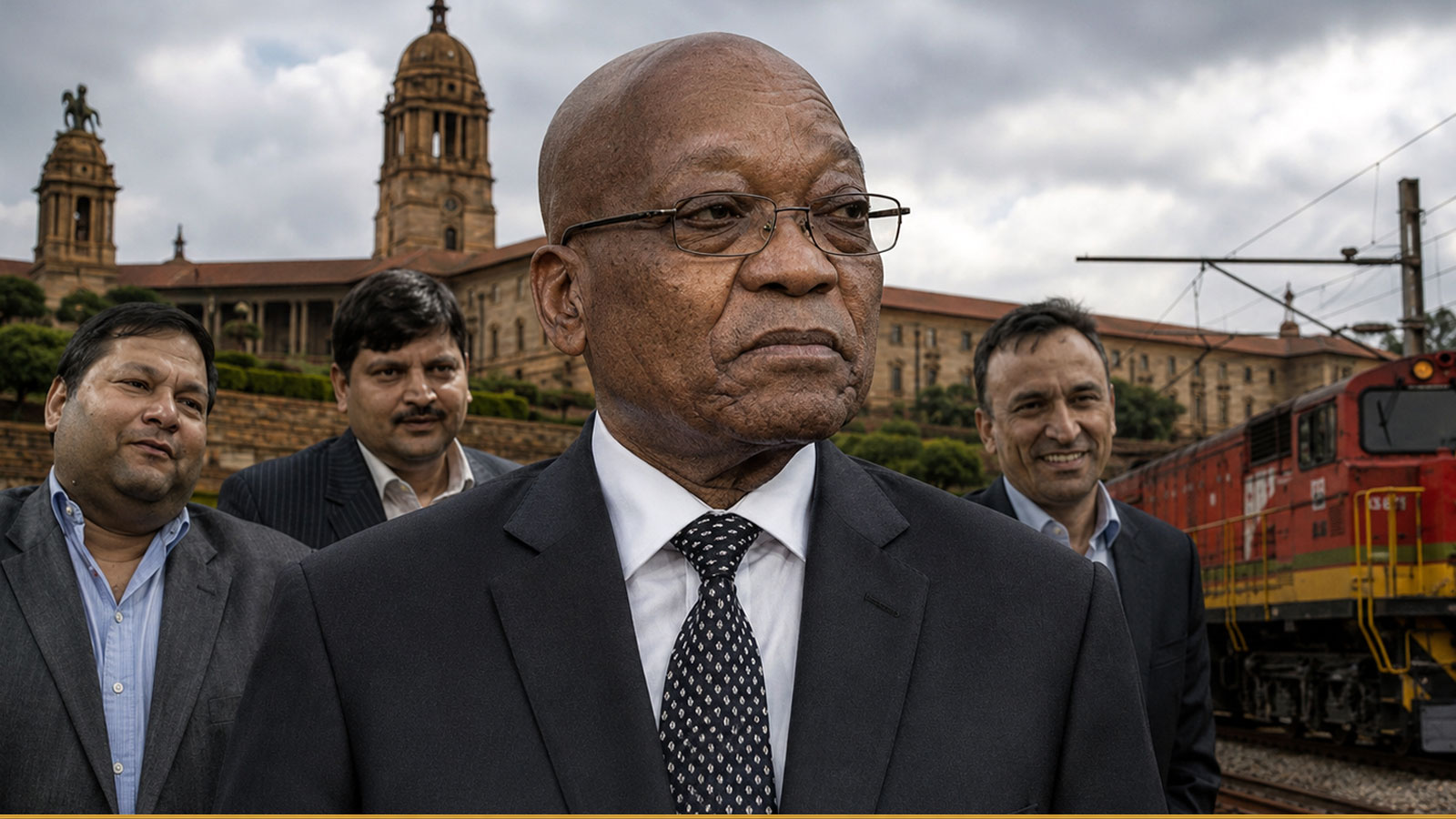
- The Commission’s overall conclusion was unambiguous: state capture occurred in South Africa on an extensive scale.
- It described a project in which a relatively small group of actors, supported by collaborators inside and outside the state, systematically redirected state resources for private gain.
- The Gupta family and associated business network occupied a central place in the Commission’s findings.
- The Commission concluded convincingly that state capture occurred at Transnet between 2009 and 2018.
- Its recommendations record at least R7.34 billion in alleged kickbacks connected to Transnet locomotive-related contracts requiring further criminal investigation.
EXECUTIVE FINDING
On 22 June 2022, Chief Justice Raymond Zondo delivered the final parts of South Africa’s Judicial Commission of Inquiry into Allegations of State Capture, Corruption and Fraud in the Public Sector.
The Commission’s overall conclusion was unambiguous: state capture occurred in South Africa on an extensive scale.
It described a project in which a relatively small group of actors, supported by collaborators inside and outside the state, systematically redirected state resources for private gain.
The mechanism was broader than bribery.
It included strategic appointments and dismissals, weakened oversight, redesigned procurement, compromised state-owned companies, manipulation of law-enforcement and intelligence institutions, and efforts to shape the public narrative.
The Gupta family and associated business network occupied a central place in the Commission’s findings.
The Commission concluded convincingly that state capture occurred at Transnet between 2009 and 2018.
It identified appointments of Gupta associates to key positions, kickback agreements, Gupta-linked supplier-development structures, money-laundering arrangements and cash bribes as central elements of the Transnet capture.
Its recommendations record at least R7.34 billion in alleged kickbacks connected to Transnet locomotive-related contracts requiring further criminal investigation.
Across the wider state-capture system, official government summaries later put state spending tainted by capture at about R57 billion, with more than 97% linked to Transnet and Eskom, and estimated that the Gupta enterprise received at least R15 billion.
The Commission also examined Eskom, Denel, South African Airways, PRASA, the South African Revenue Service, the State Security Agency, SABC, National Treasury, Free State projects, Bosasa and other institutions.
This was not one corrupt contract.
It was an argument about whether private interests could redesign the state itself.
THE CONTRACT WAS NOT THE ASSET. THE STATE WAS.
The central Kleptik question is therefore:
WHEN PRIVATE ACTORS CAN INFLUENCE WHO RUNS PUBLIC INSTITUTIONS, WHICH COMPANIES WIN CONTRACTS AND WHICH OVERSIGHT SYSTEMS ARE WEAKENED, IS THE CORRUPTION STILL A SERIES OF BRIBES — OR HAS THE GOVERNMENT ITSELF BECOME THE PRODUCT?
THE FINDING
State capture is corruption at a different scale.
A bribe purchases a decision.
State capture purchases the environment in which decisions are made.
If the right minister, board, chief executive, procurement officer and intelligence official are in place, individual corrupt transactions become easier and safer.
PRIVATE BUSINESS NETWORK
↓
POLITICAL ACCESS
↓
STRATEGIC APPOINTMENTS
↓
SOE / AGENCY CONTROL
↓
PROCUREMENT REDESIGN
↓
KICKBACKS + MONEY LAUNDERING
↓
WEAKENED OVERSIGHT
↓
PRIVATE GAIN + DURABLE POWER
THE ZONDO COMMISSION
The Commission was established in 2018 after former Public Protector Thuli Madonsela’s State of Capture report called for a judicial inquiry.
It sat for more than four years.
Official summaries record more than 400 days of proceedings, over 300 witnesses and more than 1.7 million pages of documentary evidence.
1,438 PERSONS AND ENTITIES
Government summaries say the evidence implicated approximately 1,438 persons and entities.
Being implicated is not equivalent to conviction.
The figure demonstrates the scale of the network the Commission examined.
A COMMISSION, NOT A CRIMINAL COURT
The Commission could compel testimony and documents and make findings and recommendations.
It could not convict defendants of crimes.
Where it recommended investigation or prosecution, ordinary law-enforcement and court processes remained necessary.
THE LEGAL-STATUS RULE
OFFICIAL FINDING is not CONVICTION.
REFERRAL FOR INVESTIGATION is not CHARGE.
RECOMMENDATION FOR PROSECUTION is not GUILT.
Kleptik preserves those distinctions throughout this dossier.
THE DEFINITION OF STATE CAPTURE
The Commission described state capture as a systematic project by a small group and collaborators to redirect state resources for private gain while weakening institutions, oversight, law enforcement and intelligence.
It also emphasised that capture sought future political power, not only immediate extraction.
EXTRACTION + CONTROL
Ordinary corruption extracts value.
State capture also seeks control over the institutions that generate future value.
That is why appointments are as important as payments.
THE GUPTA ENTERPRISE
The Commission used 'Gupta enterprise' to describe the family-linked business network and associated entities that appeared across multiple workstreams.
The network’s influence was alleged and found through relationships with political figures, public officials, SOE executives, suppliers and intermediaries.
JACOB ZUMA
Jacob Zuma was President of South Africa from 2009 to 2018.
The Commission examined his relationships with the Gupta family, appointments, state-owned enterprises and the extent to which presidential power enabled the capture project.
This dossier treats those as Commission findings and does not describe Zuma as criminally convicted of state capture as of the archive date.
THE PRESIDENTIAL ACCESS PREMIUM
A private family connected to a president has a form of economic capital that does not appear on a balance sheet.
Access.
The perception of access can influence officials even before the president personally issues an instruction.
DUDUZANE ZUMA
The Commission examined the role of Jacob Zuma’s son Duduzane, who held directorships in Gupta-linked businesses.
Part VI recorded evidence suggesting his presence could signal the Gupta family’s access to the president and thereby reinforce influence over public officials.
ACCESS AS IMPLIED THREAT
An official does not need to receive an explicit presidential order if he believes non-cooperation will be reported to the president.
Perceived access can therefore function as pressure.
TRANSNET
Transnet was one of the most important state-capture sites.
The Commission concluded convincingly that state capture occurred there between 2009 and 2018.
THE TRANSNET MODEL
The Commission identified five central elements: appointment of Gupta associates to key positions; kickback agreements around locomotive suppliers; Gupta-linked supplier-development partners; money-laundering arrangements; and cash bribes to officials and employees.
THE APPOINTMENT CHAIN
The Commission examined how changes in ministerial and board leadership affected Transnet’s senior appointments.
Appointments are not administrative trivia.
Who controls the board can determine who controls procurement.
THE LOCOMOTIVE PROCUREMENT
Transnet’s locomotive procurement became one of the largest financial centres of the Commission’s work.
Supplier arrangements, advisory fees, development-partner structures and offshore payments created multiple layers through which public procurement could generate private value.
THE R7.34 BILLION KICKBACK RECOMMENDATION
The Commission recommended further criminal investigation into contracts and arrangements that it said led to at least R7.34 billion in kickbacks to companies controlled by Salim Essa and the Gupta enterprise.
This is a Commission recommendation for investigation, not a final criminal-court finding against every named party.
THE SUPPLIER-DEVELOPMENT LOOP
Supplier development can be legitimate industrial policy.
In the Commission’s Transnet findings, supplier-development structures became vehicles through which large fee streams could be redirected.
THE KICKBACK PERCENTAGE
The Commission’s recommendations described arrangements in which substantial percentages of fees were allegedly paid onward to associated companies.
Percentage kickbacks scale automatically with contract value.
ESKOM
Eskom, South Africa’s electricity utility, was another central institution in the state-capture findings.
The Commission dedicated multiple volumes to how procurement, coal supply, board changes and executive appointments were affected.
THE POWER UTILITY AS STRATEGIC ASSET
Capturing an electricity monopoly does more than unlock contracts.
It creates influence over a system on which the entire economy depends.
OPTIMUM COAL
The Commission examined the Gupta-linked acquisition of Optimum Coal Mine and the role of Eskom-related decisions and financing in the transaction.
The episode became a central example of how state institutions could be used to support private acquisition strategy.
DENEL
Denel, the state-owned defence company, was also examined for Gupta-linked relationships and procurement structures.
Defence companies create heightened risks because secrecy and national-security justifications can weaken transparency.
SOUTH AFRICAN AIRWAYS
The Commission’s first part examined SAA and related companies.
It described governance failures, procurement problems and institutional damage that preceded and overlapped with the wider state-capture era.
PRASA
Passenger Rail Agency of South Africa appeared in the Commission’s work on procurement corruption and institutional weakening.
Rail infrastructure combines enormous capital expenditure with technical complexity, making oversight especially difficult.
SARS
The South African Revenue Service was examined for institutional weakening.
A captured revenue authority can reduce the state’s ability to collect tax, investigate financial crime and enforce economic rules.
STATE SECURITY AGENCY
The Commission examined the State Security Agency and Crime Intelligence.
Capture of intelligence institutions is qualitatively different from procurement corruption because secrecy itself can become a protective shield.
LAW ENFORCEMENT AND INTELLIGENCE
The Commission’s definition of state capture explicitly included deliberate weakening of law-enforcement institutions and intelligence services.
If the investigators are compromised, the extraction network becomes harder to stop.
THE NATIONAL TREASURY
The Commission examined an attempted capture of National Treasury.
Treasury is a choke point because it can approve, block or shape public expenditure across government.
THE WATERKLOOF LANDING
The Gupta wedding-party landing at Waterkloof Air Force Base became a symbol of private access to state privileges.
The Commission examined how an air-force facility came to serve a private event.
SYMBOLIC CAPTURE
Not every abuse produces a large direct financial loss.
Some events reveal something more consequential: who believes the State will bend for them.
APPOINT THE GATEKEEPER
↓
CONTROL THE BOARD
↓
CONTROL PROCUREMENT
↓
REWARD THE NETWORK
↓
WEAKEN INVESTIGATION
↓
REPEAT AT THE NEXT INSTITUTION
THE R57 BILLION TAINTED-SPEND ESTIMATE
Government summaries of the Commission later stated that approximately R57 billion in State spending was tainted by state capture.
More than 97% was attributed to Transnet and Eskom.
This is an official summary estimate, not a single criminal-loss judgment.
THE R15 BILLION GUPTA-ENTERPRISE ESTIMATE
The same official summary says the Commission estimated that the Gupta enterprise received at least R15 billion.
This figure should not be described as money finally confiscated or criminally adjudicated against every Gupta entity.
THE R500 BILLION ECONOMIC-IMPACT TESTIMONY
Public Enterprises Minister Pravin Gordhan testified that the total economic impact of state capture could reach R500 billion.
That was testimony and an economic-impact estimate, not the Commission’s direct tainted-spend total.
DO NOT COLLAPSE THE NUMBERS
R57 billion tainted spending.
R15 billion estimated Gupta-enterprise receipt.
R7.34 billion kickbacks recommended for investigation at Transnet.
R500 billion possible wider economic impact.
Each number answers a different question.
THE PUBLIC-PROCUREMENT MACHINE
State capture relied heavily on procurement because contracts convert public authority into cash.
Once boards and executives are aligned, procurement rules can be rewritten, bypassed or manipulated from inside.
PROCUREMENT CAPTURE
Tender design.
supplier qualification.
price approval.
contract amendments.
advisory appointments.
Every stage can transfer value.
THE BOARD-CAPTURE MODEL
A board appoints executives.
executives approve procurement.
procurement selects suppliers.
suppliers generate payments.
Control upstream reduces the need to bribe downstream repeatedly.
THE CADRE-DEPLOYMENT QUESTION
The Commission examined the governing ANC’s role and cadre-deployment practices.
Political appointment systems can be lawful party governance tools.
They become dangerous where loyalty overrides competence or enables private networks to influence public appointments.
PARTY POWER VERSUS STATE POWER
A governing party legitimately influences policy through elected office.
The constitutional problem arises when party or private interests override the legal duties of public institutions.
PARLIAMENTARY OVERSIGHT
The Commission criticised weaknesses in parliamentary oversight during the state-capture era.
A captured executive becomes more dangerous when Parliament does not investigate or constrain it effectively.
THE OVERSIGHT FAILURE
Committees can request documents.
summon officials.
question ministers.
If those tools are not used, formal accountability exists without practical accountability.
THE PUBLIC-NARRATIVE LAYER
The Commission’s definition of state capture included manipulation of the public narrative.
Private media interests and communication structures can help legitimise captured decisions.
THE NEW AGE
The Gupta-owned New Age newspaper appeared repeatedly in evidence concerning political relationships, SOE advertising and influence.
Media ownership can serve commercial and narrative functions simultaneously.
ANN7
Gupta-linked television operations also became part of the wider influence ecosystem.
The investigative question is not whether media outlets hold political views.
It is whether public money and state influence were used to sustain private narrative infrastructure.
INFORMATION AS INFRASTRUCTURE
Capture requires public acceptance or confusion.
A network that can influence the message can reduce scrutiny of the money.
THE BANK-ACCOUNT CLOSURES
South African banks eventually closed accounts associated with Gupta-linked businesses because of risk concerns.
The Commission examined political attempts and pressure connected to those closures.
BANKS AS PRIVATE GATEKEEPERS
Banks can become an anti-corruption control when public institutions fail.
They can also face extraordinary political pressure when terminating powerful clients.
THE CORRESPONDENT-RISK QUESTION
Once domestic banks exit, funds may move through international institutions and offshore networks.
That is where state capture becomes a cross-border AML problem.
THE DISSIPATION OF FUNDS
Part VI Volume 3 explicitly addressed dissipation of state-capture-derived funds through local and international money-laundering networks.
The extraction therefore did not end at the South African procurement contract.
FROM SOE CONTRACT TO OFFSHORE ACCOUNT
Public payment.
supplier.
advisory company.
kickback.
offshore entity.
foreign bank.
The money trail can leave the public institution almost immediately.
THE DUBAI DIMENSION
Gupta-linked individuals and companies developed substantial connections to the United Arab Emirates.
The UAE became relevant to later extradition and asset-tracing efforts.
As of 22 June 2022, this dossier treats those issues as part of the cross-border investigation landscape, not as final convictions.
THE INTERNATIONAL-DIMENSION RULE
State capture can be domestic in political origin and international in financial execution.
That makes mutual legal assistance, beneficial-ownership data and correspondent banking essential.
THE CONSULTANT PROBLEM
The Commission implicated private advisers and consultants in multiple workstreams.
Prestigious professional branding does not protect a transaction from corruption risk.
PROFESSIONAL FORM DOES NOT PROVE ECONOMIC SUBSTANCE
Consulting contract.
advisory mandate.
supplier-development agreement.
If the economic purpose is kickback or influence, the formal document becomes camouflage.
AUDITORS
The Commission scrutinised auditors and professional firms for failures of independence, due diligence or active participation in questionable arrangements.
Each firm’s liability must be established from its own record.
BANKERS
Banks saw transactions and client risk.
Some terminated relationships.
Others became part of later questions about money flows.
Account activity alone does not prove knowledge.
LAWYERS
Lawyers can create or defend structures used by captured networks.
Professional representation remains lawful.
The key distinction is knowledge and participation in wrongdoing.
THE PRIVATE-SECTOR HALF OF STATE CAPTURE
A state cannot be captured by public officials alone.
Private firms need contracts.
intermediaries need fees.
banks move money.
consultants structure deals.
State capture is a public-private system.
THE WHISTLE-BLOWER ROLE
The Commission relied heavily on insiders, whistle-blowers, journalists and documentary evidence.
Complex capture networks are rarely exposed by one control system.
THE COST OF SPEAKING
Whistle-blowers in state-capture matters faced career, security and financial risks.
The Commission recommended stronger whistle-blower protection.
THE 25 PROCUREMENT-REFORM RECOMMENDATIONS
Government’s implementation summary classifies 25 Commission recommendations as procurement-system reforms.
That concentration reflects how central public contracting was to the capture architecture.
THE 16 INTELLIGENCE-REFORM RECOMMENDATIONS
The implementation framework also identifies 16 recommendations concerning intelligence agencies.
Capture of secret institutions required structural reform, not only prosecutions.
THE 12 PARLIAMENTARY REFORMS
The Commission’s recommendations extended to how Parliament works.
Executive corruption is easier when legislative oversight is weak.
THE PERMANENT COMMISSION PROPOSAL
The Commission recommended creation of a permanent Anti-State Capture and Corruption Commission.
The idea reflects a concern that ordinary institutions did not detect systemic capture early enough.
ANTI-CAPTURE DESIGN
A state needs controls against individual corruption.
It also needs controls against coordinated takeover of the controls themselves.
THE APPOINTMENT FIREWALL
Independent appointment processes for SOE boards, prosecutors, intelligence leaders and regulators reduce the ability of one political network to place loyalists across multiple institutions.
THE BENEFICIAL-OWNERSHIP FIREWALL
Public procurement should identify ultimate owners of bidders, subcontractors, advisers and supplier-development partners.
Hidden related parties make kickback networks easier to build.
THE CONFLICT-OF-INTEREST FIREWALL
Executives and board members should disclose political, family and business relationships before participating in major procurement decisions.
THE CONTRACT-DATA FIREWALL
Public contracts, amendments, consultant fees and supplier-development payments should be machine-readable and comparable across SOEs.
State capture benefits from fragmented data.
THE BANKING-DATA FIREWALL
Financial intelligence should aggregate payments across SOE suppliers and politically exposed networks.
One suspicious transaction may look ordinary until it is linked to ten related contracts.
THE MEDIA-FUNDING FIREWALL
State-owned enterprises should disclose advertising and sponsorship spending by media outlet.
Public money should not quietly subsidise narrative control.
THE PROCUREMENT-TO-POLITICS LOOP
Contract produces profit.
profit funds influence.
influence shapes appointment.
appointment produces more contracts.
That is the self-financing logic of capture.
THE CAPTURE COMPOUNDING EFFECT
Each successful captured appointment reduces the cost of the next corrupt transaction.
The system becomes more efficient for the network and less effective for the public.
THE CONVICTION GAP
By the final report date, many Commission findings had not yet resulted in criminal convictions.
That gap is not evidence that the findings were false.
It demonstrates the difference between public inquiry and criminal prosecution.
THE STANDARD-OF-PROOF GAP
A Commission can make findings on the evidence before it under inquiry standards.
A criminal court must determine guilt under criminal procedure and the applicable burden of proof.
REFERRAL IS THE BEGINNING
When the Commission recommends investigation, law enforcement still must gather admissible evidence, charge the proper offence and prove it in court.
THE STATE-CAPTURE MATRIX
| Control node | Capture mechanism | Private value created |
|---|---|---|
| Appointments | Place aligned board/executive officials | Control over future decisions |
| Procurement | Shape tender / supplier / advisory structures | Contract revenue and kickbacks |
| SOE finance | Redirect capital and supplier payments | Liquidity for private network |
| Law enforcement | Delay or weaken investigation | Reduced prosecution risk |
| Intelligence | Control secrecy and information | Protection / leverage |
| Media / narrative | Use public or private channels to shape perception | Political durability |
THE EVIDENTIARY-STATUS MATRIX
| Issue | Status at 22 Jun 2022 | Kleptik treatment |
|---|---|---|
| State capture occurred extensively | Commission conclusion | OFFICIAL FINDING |
| State capture at Transnet | Commission said evidence established it convincingly | OFFICIAL FINDING |
| R7.34bn Transnet kickbacks | Commission recommendation for further investigation | OFFICIAL FINDING / REFERRED FOR INVESTIGATION |
| R57bn tainted State spending | Commission/government summary estimate | OFFICIAL ESTIMATE |
| R15bn Gupta-enterprise receipt | Commission estimate in official summary | OFFICIAL ESTIMATE |
| Criminal guilt of implicated persons | Requires separate court process | DO NOT INFER |
CHRONOLOGY
2009
Jacob Zuma becomes President; the Commission later identifies this period as the beginning of state capture at Transnet.
2009–2011
Senior SOE and ministerial appointments become central to the later Commission findings.
2010–2016
Transnet, Eskom and other SOEs enter major procurement and advisory arrangements later examined by the Commission.
2013
A Gupta wedding party lands at Waterkloof Air Force Base, becoming a public symbol of extraordinary private access to the state.
December 2015
Finance Minister Nhlanhla Nene is removed; the episode becomes part of the inquiry into attempted influence over National Treasury.
2016
Public Protector Thuli Madonsela publishes State of Capture and recommends a judicial commission of inquiry.
January 2018
President Zuma appoints the Judicial Commission of Inquiry into Allegations of State Capture, Corruption and Fraud in the Public Sector.
20 August 2018
The Commission begins public hearings.
2018–2021
Hundreds of witnesses testify concerning SOEs, procurement, intelligence, law enforcement, political appointments and the Gupta enterprise.
4 January 2022
Part One of the Commission report is handed to President Cyril Ramaphosa.
1 February 2022
Part Two is delivered, including Transnet and Denel findings.
1 March 2022
Part Three is delivered, focusing on Bosasa.
29 April 2022
Part Four is delivered, including Eskom and National Treasury-related findings.
22 June 2022
Chief Justice Zondo hands over Parts Five and Six, completing the Commission and publishing the final state-capture findings and recommendations.
DOCUMENTARY RECORD
STATE CAPTURE COMMISSION — PART VI VOLUME 2
The Commission’s final synthesis concludes that state capture occurred and sets out how capture involved collaborators inside and outside the state, strategic appointments, weakened institutions, oversight failure and political control.
STATE CAPTURE COMMISSION — PART VI VOLUME 3
This volume addresses public funds diverted to the Gupta enterprise, dissipation of state-capture-derived funds through local and international money-laundering networks and the Optimum Coal acquisition.
STATE CAPTURE COMMISSION — TRANSNET FINDINGS
The Commission concluded convincingly that state capture occurred at Transnet between 2009 and 2018 and identified appointments, kickbacks, supplier-development arrangements, laundering and bribery as central features.
STATE CAPTURE COMMISSION — PART VI VOLUME 4
The recommendations volume calls for further criminal investigations and major reforms to procurement, intelligence, Parliament, the political system and anti-corruption institutions.
PRESIDENCY — 22 JUNE 2022
President Cyril Ramaphosa publicly received the final report and described state capture as an assault on South Africa’s democracy.
WHAT THE COMMISSION FOUND
The Commission found that state capture occurred in South Africa on an extensive scale.
It found that public institutions were deliberately weakened or exploited to redirect resources toward private interests.
It identified strategic appointments, procurement manipulation, law-enforcement weakness, intelligence abuse and narrative control as mechanisms of capture.
It concluded convincingly that state capture occurred at Transnet.
WHAT THE COMMISSION DID NOT DO
The Commission did not convict Jacob Zuma, members of the Gupta family, SOE executives, consultants or other implicated persons of criminal offences.
It did not itself impose prison sentences.
Its recommendations for prosecution or further investigation required action by law-enforcement agencies and courts.
Its policy recommendations were not self-executing law.
WHAT ZUMA AND OTHERS SAID
Jacob Zuma and various implicated individuals rejected, disputed or challenged significant allegations made during the Commission process.
Some refused or limited participation; others challenged evidence or described the inquiry as politically motivated.
Those positions should be reflected in any person-specific follow-up dossier rather than erased by the Commission’s institutional conclusions.
WHAT THIS DOSSIER DOES NOT ESTABLISH
This dossier does not state that every person named in the Zondo reports committed a crime.
It does not state that all R57 billion in tainted State spending was stolen or received by the Gupta enterprise.
It does not equate the R7.34 billion kickback figure recommended for investigation with a final criminal forfeiture judgment.
It does not state that every private firm, bank, auditor, lawyer or consultant mentioned in Commission evidence knowingly participated in state capture.
It does not treat political association with Jacob Zuma or the Gupta family as proof of corruption.
It does not incorporate prosecutions, extradition developments or later implementation actions after 22 June 2022.
RIGHT OF REPLY
Any publication naming a specific individual or company beyond the Commission’s established wording should provide the relevant finding and seek a transaction-specific response.
Jacob Zuma and members of the Gupta family should be described according to Commission findings and their responses, not as criminally convicted of state capture on the archive date.
Companies and professionals should be distinguished between Commission implication, recommendation for investigation, civil settlement, disciplinary sanction and criminal conviction.
UNANSWERED QUESTIONS
1. THE FULL MONEY MAP
What is the transaction-by-transaction path of the estimated R15 billion received by the Gupta enterprise?
2. THE R57 BILLION
Which specific State contracts make up the full tainted-spend estimate?
3. TRANSNET
Which portions of the alleged R7.34 billion kickbacks can be traced to final beneficial owners?
4. ESKOM
Which contracts created the largest private economic benefit for captured networks?
5. OPTIMUM
What exact State decisions made the Optimum Coal acquisition financially possible?
6. APPOINTMENTS
Which senior appointments produced the greatest measurable procurement consequences?
7. PRESIDENTIAL ACCESS
Which decisions can be directly linked to presidential intervention rather than perceived influence?
8. DUDUZANE ZUMA
What transaction-specific financial benefits flowed to businesses in which the president’s son had interests?
9. BANK ACCOUNTS
Which international banks processed the largest state-capture-derived transfers?
10. UAE
What Gupta-linked assets or companies were located in the UAE by the archive date?
11. MONEY LAUNDERING
Which offshore structures were used to dissipate Transnet and Eskom-derived funds?
12. PRIVATE CONSULTANTS
Which advisory firms earned the largest fees from captured procurement structures?
13. AUDITORS
Which audit failures materially delayed detection?
14. LAWYERS
Which corporate or legal structures were created to facilitate payments or conceal ownership?
15. MEDIA
How much State or SOE money flowed into Gupta-linked media entities?
16. INTELLIGENCE
What specific intelligence resources were diverted to protect political or private interests?
17. PARLIAMENT
Which oversight failures allowed the capture architecture to persist longest?
18. ASSET RECOVERY
What proportion of identified state-capture proceeds had been restrained or recovered by 22 June 2022?
19. PROSECUTION GAP
Which major Commission referrals had sufficient admissible evidence for criminal charges?
20. THE CENTRAL QUESTION
Was South Africa’s state capture primarily a corruption network exploiting institutions — or a temporary parallel system of government in which private actors could influence appointments, procurement, enforcement and information at the same time?
KLEPTIK INTELLIGENCE ASSESSMENT
ASSESSMENT: OFFICIAL FINDING
The State Capture Commission concluded that state capture occurred in South Africa on an extensive scale.
ASSESSMENT: OFFICIAL FINDING
The Commission concluded convincingly that state capture occurred at Transnet between 2009 and 2018.
ASSESSMENT: OFFICIAL FINDING
The Commission identified strategic appointments, procurement manipulation, kickbacks, money laundering, bribery and institutional weakening as core state-capture mechanisms.
ASSESSMENT: OFFICIAL ESTIMATE
Government summaries of the Commission report place tainted State spending at approximately R57 billion and estimated Gupta-enterprise receipts at at least R15 billion.
ASSESSMENT: REFERRED FOR INVESTIGATION
The Commission recommended further criminal investigation concerning at least R7.34 billion in alleged Transnet-related kickbacks.
ASSESSMENT: HIGH CONFIDENCE
The central innovation of state capture was upstream control: influence over appointments and institutions reduced the need to bribe each procurement decision individually.
ASSESSMENT: HIGH CONFIDENCE
State capture requires both public and private participants because public authority must be converted into private economic value through contracts, advisers, banks, suppliers and intermediaries.
ASSESSMENT: HIGH CONFIDENCE
The durability of capture depended partly on weakened oversight and enforcement; procurement reform alone cannot prevent recurrence if appointments, intelligence and legislative accountability remain vulnerable.
ASSESSMENT: OPEN
On 22 June 2022, many Commission findings and referrals had not yet been resolved through criminal courts.
THE KLEPTIK VIEW
A corrupt government official can steal from the state.
A captured state is different.
The state begins helping with the theft.
Not because every civil servant is corrupt.
Not because every institution is controlled.
Because enough choke points are.
The minister.
The board.
The chief executive.
The procurement adviser.
The security official.
The person who decides whether the complaint becomes a case.
Once those positions align, corruption becomes cheaper.
The network no longer needs to buy every decision.
It buys the people who make the decisions.
That is the significance of the Zondo Commission.
It did not describe one bad contract.
It described a system in which private actors could influence the architecture that produced contracts.
That is why the numbers are so large.
R7.34 billion in alleged kickbacks requiring investigation at one major SOE.
R57 billion in tainted State spending across the capture system.
At least R15 billion estimated to have reached the Gupta enterprise.
But even those numbers may understate the damage.
A captured electricity company affects growth.
A weakened tax authority affects revenue.
A compromised intelligence service affects accountability.
A compliant Parliament affects everything.
BRIBERY BUYS A DECISION.
STATE CAPTURE BUYS THE DECISION-MAKING SYSTEM.
And that changes how an investigator should work.
Do not only follow the payment.
Follow the appointment that came before it.
Follow the board change.
Follow the procurement rule that changed.
Follow the bank account that received the fee.
Follow the investigator who stopped asking questions.
The money trail tells you who benefited.
The power trail tells you why it was possible.
FOLLOW THE MONEY.
THEN FOLLOW WHO CONTROLLED THE STATE BEFORE THE MONEY MOVED.
KLEPTIK METHODOLOGY
This dossier is dated 22 June 2022 and is intentionally fixed to the evidentiary and procedural position existing when the final State Capture Commission report was delivered.
The principal sources are the State Capture Commission reports, especially Part VI Volumes 2, 3 and 4, the Commission’s Transnet and Eskom volumes, official Presidency material and government summaries of the Commission’s findings.
Kleptik distinguishes among Commission findings, Commission estimates, recommendations for investigation or prosecution, criminal charges and criminal convictions.
OFFICIAL FINDING
Conclusion reached by the Judicial Commission of Inquiry on the evidence before it.
OFFICIAL ESTIMATE
Financial amount attributed in the Commission or official implementation summaries; not automatically a criminal-loss or confiscation judgment.
REFERRED FOR INVESTIGATION
Conduct the Commission recommended be investigated further by law enforcement.
RECOMMENDED FOR PROSECUTION
Commission recommendation that prosecutors consider criminal proceedings; not guilt.
CRIMINAL CONVICTION
Finding of guilt by a competent criminal court; not supplied by the Commission itself.
For person-specific allegations, Kleptik uses the exact legal status of each subject and does not convert association with the Gupta enterprise into criminal liability.
For financial analysis, the R57 billion tainted-spend estimate, R15 billion Gupta-enterprise estimate, R7.34 billion Transnet kickback figure and R500 billion wider economic-impact testimony remain separate.
For state-capture analysis, Kleptik builds two maps: money and power.
MONEY MAP
Contracts, supplier fees, kickbacks, bank transfers, offshore entities and beneficial owners.
POWER MAP
Appointments, boards, ministers, executives, intelligence, law enforcement and parliamentary oversight.
Only where the two maps intersect should a capture mechanism be asserted.
Later criminal, extradition and asset-recovery developments after 22 June 2022 are excluded from the archive-date status.
EVIDENTIARY LABELS
OFFICIAL FINDING
Conclusion of the Judicial Commission of Inquiry; not itself a criminal conviction.
OFFICIAL ESTIMATE
Financial estimate contained in or derived from official Commission reporting.
REFERRED FOR INVESTIGATION
Matter the Commission recommended for further law-enforcement investigation.
RECOMMENDED FOR PROSECUTION
Matter the Commission recommended prosecutors consider; guilt remains for courts.
PEP / PATRONAGE INDICATOR
Political, family or appointment relationship relevant to capture analysis; not guilt by association.
PROCUREMENT-CAPTURE INDICATOR
Evidence of tender, board, supplier or advisory structures potentially redirecting public value.
MONEY-LAUNDERING INDICATOR
Transaction or structure relevant to dissipation of state-capture-derived funds.
KLEPTIK VERIFIED
Fact independently corroborated through Commission or authoritative official records.
KLEPTIK ASSESSMENT
Analytical conclusion derived from identified evidence.
INVESTIGATIVE LEAD
Matter requiring additional criminal, financial, corporate or asset-level verification.
DOCUMENT STATUS
KLTK-2022-041
Subject: South Africa / Jacob Zuma / Gupta Enterprise / Transnet / Eskom / State Capture Commission
Archive date: 22 June 2022
Status at archive date: Final State Capture Commission report delivered; official findings and recommendations published; criminal liability remained subject to separate law-enforcement and court processes
Historical treatment: Fixed to report date
© KLEPTIK — Investigations into Power, Money and the Systems Designed to Hide Both