THE PRESIDENT, THE CONFIDANTE AND THE CHAEBOL MONEY

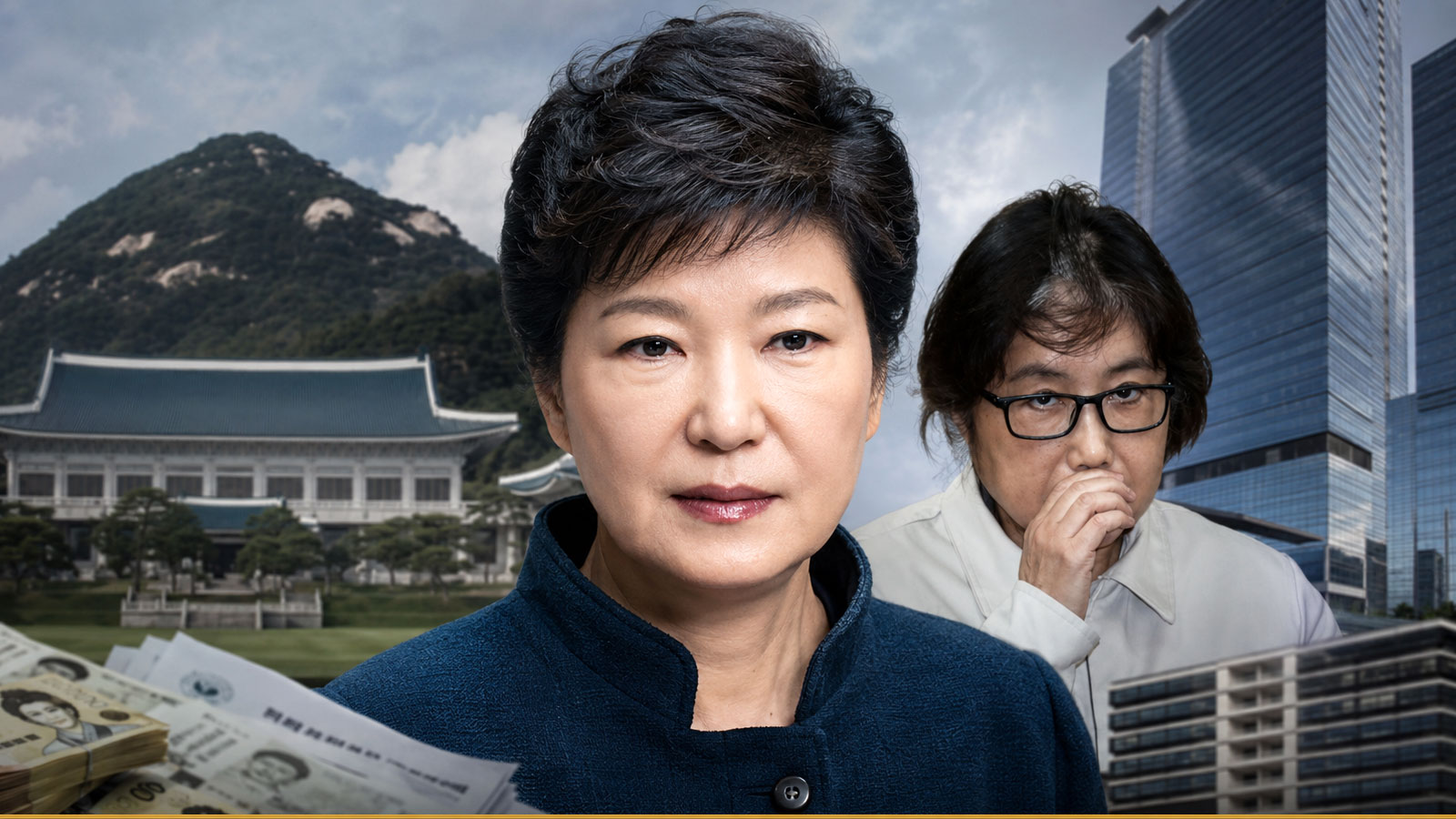
- Park was also convicted on bribery charges involving benefits connected to Samsung and Lotte.
- The case exposed a distinctive corruption architecture.
- Corporate groups did not simply seek one contract.
- They operated in an economy where government decisions could affect succession, licensing, regulatory approvals, tax exposure and strategic restructuring.
- Presidential access therefore carried enormous commercial value.
EXECUTIVE FINDING
On 14 January 2021, South Korea’s Supreme Court upheld a 20-year prison sentence for former President Park Geun-hye, closing the central criminal case arising from the corruption scandal that had already removed her from office.
The final ruling maintained an 18 billion won fine and left Park with a total prison exposure of 22 years when combined with a separate two-year sentence for illegal intervention in ruling-party nominations.
The scandal had begun publicly in 2016 with revelations that Park’s longtime confidante Choi Soon-sil — later Choi Seo-won — exercised extraordinary informal influence despite holding no elected or formal government office.
Prosecutors and courts established that Park and Choi used presidential power to pressure major Korean conglomerates to contribute tens of billions of won to the Mir and K-Sports foundations associated with Choi.
Park was also convicted on bribery charges involving benefits connected to Samsung and Lotte.
The case exposed a distinctive corruption architecture.
Corporate groups did not simply seek one contract.
They operated in an economy where government decisions could affect succession, licensing, regulatory approvals, tax exposure and strategic restructuring.
Presidential access therefore carried enormous commercial value.
At the centre stood an unelected confidante who could influence the president, shape demands placed on corporations and direct benefits toward foundations, sports entities and private interests.
The legal record did not treat every corporate payment in the scandal as a bribe.
That distinction matters.
The approximately 77.4 billion won raised from major companies for the Mir and K-Sports foundations was central to the abuse-of-power scandal, but the final bribery findings were narrower and transaction-specific.
THE CORPORATIONS HAD THE MONEY. THE PRESIDENT HAD THE POWER. THE CONFIDANTE CONTROLLED THE ACCESS.
The central Kleptik question is therefore:
WHAT HAPPENS WHEN INFORMAL ACCESS TO THE HEAD OF STATE BECOMES A COMMERCIAL ASSET?
THE FINDING
South Korea’s scandal was not simply a story about a president taking cash.
It was a story about an unofficial person becoming a gatekeeper to presidential power.
That distinction changes how corruption must be investigated.
The economic benefit may flow to a foundation, a family member, a sports programme or another intermediary.
The corporate benefit may appear later through government support, approvals or regulatory treatment.
The corrupt relationship can therefore exist even when payer and president never exchange money directly.
CHAEBOL / CORPORATE INTEREST
↓
ACCESS TO PRESIDENCY
↓
UNELECTED CONFIDANTE
↓
FOUNDATION / PRIVATE BENEFIT
↓
PRESIDENTIAL OR GOVERNMENTAL SUPPORT
↓
CORPORATE ECONOMIC ADVANTAGE
PARK GEUN-HYE
Park became South Korea’s first female president in February 2013.
She was the daughter of former president Park Chung-hee and entered office with exceptional political symbolism.
Her presidency ended before term after the Constitutional Court upheld her impeachment in March 2017.
The criminal proceedings that followed converted a constitutional crisis into a corruption judgment.
CHOI SOON-SIL
Choi Soon-sil, later legally named Choi Seo-won, was Park’s longtime personal confidante.
She held no elected office and no formal governmental position comparable to her actual access.
Yet evidence showed that she participated in or influenced matters far beyond an ordinary private friendship.
That made her a classic informal-power intermediary.
INFORMAL POWER
Official organisation charts show legal authority.
They do not always show actual influence.
An unelected adviser, family member or confidante can sometimes shape decisions without appearing in formal records.
Kleptik therefore treats informal access as a separate PEP-network risk.
THE GATEKEEPER MODEL
A corporation may not need direct access to the president.
It needs access to someone the president trusts.
That intermediary can transmit requests, preferences and pressure in both directions.
The gatekeeper becomes economically valuable because access itself is scarce.
THE MIR AND K-SPORTS FOUNDATIONS
Mir and K-Sports were nonprofit foundations created during Park’s presidency.
Prosecutors said Choi and presidential aides used state authority to pressure major conglomerates into contributing a total of approximately 77.4 billion won.
The foundations sat at the intersection of public influence and ostensibly private nonprofit structures.
FOUNDATION FORM
A foundation can pursue legitimate cultural, sporting or charitable objectives.
It can also receive corporate money outside ordinary political-donation channels.
That makes governance, donor intent, control and use of funds essential to corruption analysis.
77.4 BILLION WON
The 77.4 billion won figure became one of the defining numbers of the scandal.
It represented contributions from dozens of major companies to Mir and K-Sports.
But the courts did not ultimately classify every won contributed to those foundations as bribery.
Some conduct was treated through abuse-of-power theories rather than as a proved quid pro quo.
DO NOT COLLAPSE COERCION INTO BRIBERY
A company can pay because it fears government retaliation.
A company can pay because it expects a favour.
Those are different criminal theories.
Both can corrupt governance, but evidentiary labels must remain precise.
THE CHAEBOL ENVIRONMENT
South Korea’s economy is dominated by large family-controlled conglomerates known as chaebol.
These groups can have enormous private economic power while also remaining deeply affected by government policy and regulation.
That combination creates recurring pressure points between corporate succession and political authority.
WHY CORPORATE SUCCESSION MATTERS
Control of a chaebol can depend on mergers, shareholdings, regulatory decisions, pension-fund votes and court outcomes.
A succession plan worth billions can therefore create intense incentives to cultivate political support.
That is why corporate-governance events must be mapped against political benefits and payments.
SAMSUNG
Samsung became the most consequential corporate node in the scandal.
Samsung heir Lee Jae-yong was accused and later convicted of providing benefits connected to Choi and her family in exchange for government support relevant to his control and succession interests.
His own retrial sentence followed days after Park’s final judgment.
THE HORSE
Some of the clearest bribery findings concerned support connected to Choi’s daughter Chung Yoo-ra and her equestrian activities.
Benefits included horses and training support.
The apparent object was sporting.
The legal significance came from who ultimately benefited and what governmental support was sought in return.
PRIVATE BENEFIT THROUGH THIRD PARTY
A bribe need not be paid to the official personally.
It can benefit a family member, confidante, company, charity or favoured project.
The economic beneficiary may sit one or more steps away from the public official.
THE THIRD-PARTY BRIBE
Payer gives value.
Value goes to confidante or related interest.
Official acts or is expected to act.
The absence of money in the official’s own bank account does not eliminate bribery.
CORPORATE PAYMENT
↓
FOUNDATION / SPORTS SUPPORT / THIRD PARTY
↓
CHOI NETWORK
↓
PRESIDENTIAL ACCESS
↓
GOVERNMENT SUPPORT
↓
CORPORATE BENEFIT
LOTTE
Lotte was another major corporate group drawn into the case.
A 7 billion won contribution connected to K-Sports was treated as bribery in relation to Lotte’s duty-free business interests.
The Lotte strand demonstrated how a foundation contribution can become a bribe when tied to a specific governmental advantage.
SK
SK was also scrutinised over requests for support connected to K-Sports.
Not every requested or discussed payment produced the same final bribery outcome.
This reinforces the need to analyse each corporate relationship separately.
CORPORATION BY CORPORATION
The scandal involved many conglomerates.
That does not mean all companies had the same intent, pressure or quid pro quo.
A serious investigation should build a separate file for every payer.
THE CORPORATE BENEFIT LEDGER
For each conglomerate, record the payment or requested payment.
Then record every material government matter pending at the same time.
Merger.
Licence.
Tax dispute.
Succession issue.
Pardon.
Regulatory approval.
Only then test for causal connection.
THE CORPORATE FEAR PROBLEM
A company may comply with a presidential request because refusal appears dangerous.
Regulatory retaliation can be subtle.
Tax inspections, permits, approvals, public contracts and policy access can all matter.
That makes presidential fundraising inherently sensitive.
THE PRESIDENTIAL ASK
When a president asks a heavily regulated company for money, the request carries more weight than an ordinary fundraising solicitation.
The power imbalance is structural.
Even absent an explicit threat, the recipient may understand that government relations are at stake.
COERCION WITHOUT WORDS
Power can communicate without an explicit threat.
A corporation may infer consequences from the office, history and surrounding circumstances.
That is why abuse-of-power cases often depend on context rather than a single incriminating sentence.
THE AHN JONG-BEOM NOTEBOOKS
Former presidential policy coordination chief Ahn Jong-beom kept extensive notebooks documenting meetings and presidential directions.
Those records became important evidence in reconstructing demands placed on companies.
Contemporaneous notes can turn informal influence into a documentary timeline.
THE DOCUMENTARY SHADOW
Corruption often leaves records indirectly.
Calendars.
Meeting notes.
Foundation ledgers.
Corporate approval documents.
Travel records.
These can connect informal instructions to financial events.
THE TABLET PC
The scandal accelerated after media reporting concerning a tablet computer associated with Choi revealed drafts and presidential materials.
The device became a symbol of the informal access Choi enjoyed.
Digital evidence can expose power relationships that formal government records conceal.
THE DIGITAL ACCESS TEST
- Who received presidential speeches before delivery?
- Who edited policy documents?
- Who had access to confidential materials?
Access records can reveal effective authority.
STATE DOCUMENTS AS PRIVATE ACCESS
Confidential state information is a public asset.
If an unelected private person receives it because of personal proximity to the president, the issue is not merely secrecy.
It is evidence of institutional bypass.
THE BYPASS STATE
Formal ministries and advisers can be bypassed when the president relies on a private confidante.
That weakens accountability because the influential person is not subject to ordinary appointment, ethics, disclosure or recordkeeping rules.
THE UNELECTED OFFICE
Kleptik defines an unelected office as a private relationship that performs functions normally associated with public authority.
It has no legal charter.
No parliamentary confirmation.
No formal accountability.
Yet it can shape public decisions.
IMPEACHMENT
South Korea’s National Assembly impeached Park in December 2016.
On 10 March 2017, the Constitutional Court upheld the impeachment and removed her from office.
The constitutional proceeding and criminal proceeding served different functions.
One protected the state from continued abuse of presidential authority.
The other determined criminal liability.
IMPEACHMENT ≠ CRIMINAL CONVICTION
Removal from office is a constitutional remedy.
A prison sentence is a criminal judgment.
They can arise from overlapping facts but use different legal standards and procedures.
THE 2019 SUPREME COURT REMAND
In 2019, South Korea’s Supreme Court sent parts of the Park, Choi and Lee Jae-yong cases back for retrial.
The ruling clarified the treatment of bribery counts involving a president.
The remand changed sentence structure without erasing the central corruption findings.
CHOI’S FINAL SENTENCE
In June 2020, the Supreme Court upheld Choi Seo-won’s 18-year prison term.
She was also ordered to pay a 20 billion won fine and forfeit approximately 6.3 billion won.
Her case reached finality before Park’s.
PARK’S 2020 RETRIAL
In July 2020, the Seoul High Court imposed a combined 20-year sentence in the main corruption case.
That included 15 years for bribery and five years for abuse of power and other offences.
The Supreme Court upheld that judgment in January 2021.
THE 18 BILLION WON FINE
The final ruling maintained an 18 billion won fine.
Financial penalties complement imprisonment.
They recognise that corruption produces economic benefits and harms that are not fully addressed by incarceration alone.
THE 22-YEAR TOTAL
Park’s final total imprisonment exposure was 22 years because a separate two-year election-law sentence had already become final.
Kleptik separates that case from the 20-year core corruption sentence.
FINALITY
By 14 January 2021, the years-long legal process in the principal corruption case had reached final Supreme Court resolution.
That allows the dossier to use ESTABLISHED — FINAL CONVICTION for the core adjudicated conduct.
THE POWER-AND-MONEY MATRIX
| Node | What it controlled | Why it mattered |
|---|---|---|
| President Park | Executive authority and political influence | Could affect regulatory and governmental outcomes |
| Choi Soon-sil | Informal access to Park | Could transmit requests outside formal government |
| Mir / K-Sports | Foundation structures | Received corporate contributions |
| Samsung | Chaebol / succession interests | Had major exposure to governmental decisions |
| Lotte | Chaebol / duty-free interests | Sought favourable regulatory outcomes |
| Corporate donors | Capital | Could fund foundations or third-party benefits |
THE FOUNDATION MATRIX
| Foundations can hide several different legal realities. | Donation. | Coercive extraction. |
|---|---|---|
| Bribery. | Legitimate philanthropy. | The institution receiving money can be identical while the legal meaning differs by donor and transaction. |
| Payment type | Possible legal character | Key question |
| Voluntary public donation | Legitimate philanthropy | Was there independent charitable intent? |
| Donation after presidential pressure | Abuse-of-power issue | Did the company feel compelled by state power? |
| Donation tied to official favour | Bribery | Was value exchanged for governmental action? |
| Third-party private benefit | Bribery / influence | Who ultimately benefited? |
| Foundation payment with hidden control | Governance risk | Who actually directed use of funds? |
THE COMPLIANCE FAILURE
Corporate compliance departments should treat requests from senior political offices as high risk.
A president’s request for charitable money is not an ordinary CSR decision.
It requires independent legal review and board-level documentation.
PRESIDENTIAL FUNDRAISING CONTROLS
- Who initiated the request?
- Was the amount suggested by government?
- Did the company have pending government business?
- Who approved the contribution?
- Was the foundation independently governed?
These questions should be mandatory.
CHAEBOL GOVERNANCE
Family-controlled conglomerates can concentrate decision-making in a small number of executives.
That may make rapid political transactions easier.
Strong independent boards and compliance committees can provide counterweight.
THE SUCCESSION VULNERABILITY
When a controlling family is restructuring ownership, the company may be unusually dependent on government, regulators or institutional investors.
That period deserves enhanced anti-bribery monitoring.
THE QUID-PRO-QUO TIMELINE
Investigators should synchronise corporate benefits, meetings, payments and government decisions.
Timing cannot prove bribery alone.
But repeated sequences can strengthen or weaken the theory.
THE CORPORATE-PRESIDENTIAL LEDGER
Meeting date.
Corporate issue pending.
Payment or pledge.
Government action.
Private benefit.
Each track should be built independently before comparison.
FOLLOW THE REQUEST
In public-corruption cases, a payment may be obvious while the original request is hidden.
- Who first asked for the money?
- Who selected the amount?
- Who named the recipient entity?
That chain reveals power.
FOLLOW THE BENEFICIARY
A foundation may legally receive money.
A confidante or family member may practically control the benefit.
Beneficial-use analysis matters as much as legal ownership.
BENEFICIAL OWNERSHIP OF INFLUENCE
Kleptik extends beneficial-ownership logic beyond companies.
Who ultimately controls access to the president?
Who decides which private request reaches the office?
That person may be the beneficial owner of political access.
THE PRESIDENTIAL OFFICE AS AN ASSET
Public office belongs to the state.
Yet access to that office can acquire market value when gatekeepers ration it.
Corruption monetises a public asset without formally selling it.
THE FOUNDATION AS BUFFER
A foundation can create distance between corporate payer and private beneficiary.
The company can describe philanthropy.
The intermediary can control programme spending.
The political office can avoid direct receipt.
NO PERSONAL DEPOSIT REQUIRED
Classic bribery imagery focuses on envelopes and private bank accounts.
The Park scandal demonstrates a more complex structure.
Value can flow to organisations and third parties while the official supplies power.
CORPORATE VICTIM OR CORPORATE BRIBER?
Some companies may feel coerced.
Others may actively seek advantage.
The same scandal can contain both dynamics.
Corporate status must be transaction-specific.
THE POWER IMBALANCE
South Korea’s largest conglomerates are economically powerful.
The presidency is politically powerful.
Neither is a simple victim or master in every interaction.
Corruption emerges from the exchange of different forms of power.
THE MEDIA ROLE
Investigative journalism was central to exposing Choi’s hidden role.
Media reports about internal documents transformed public understanding of presidential governance.
Independent press can function as an anti-corruption control when formal oversight fails.
THE STREET
Mass public demonstrations followed the scandal.
Public mobilisation did not determine criminal guilt.
It created political pressure for constitutional accountability.
PUBLIC ANGER IS NOT EVIDENCE
Large protests can show legitimacy crisis.
They do not substitute for proof.
Courts must separate public outrage from admissible evidence.
THE CONSTITUTIONAL COURT
The Constitutional Court’s impeachment decision protected constitutional order.
The criminal courts later addressed individual offences.
Using both tracks allowed South Korea to remove a compromised president before the criminal process concluded.
THE INSTITUTIONAL RESILIENCE TEST
A corruption scandal becomes a state failure only if institutions cannot respond.
South Korea’s legislature, Constitutional Court, prosecutors, ordinary courts, media and civil society all played different roles.
The scandal therefore illustrates both capture risk and institutional recovery.
THE INFORMAL-ADVISER REGISTER
Kleptik proposes that heads of government disclose recurring private advisers who receive sensitive state information or regularly participate in policy discussions.
The objective is not to prohibit private advice.
It is to make durable influence auditable.
THE ACCESS LOG
- Who enters the presidential residence or office?
- How often?
- For what purpose?
Visitor logs can expose relationships before they become scandals.
THE FOUNDATION DONOR REGISTER
Foundations linked to public leaders should disclose major corporate donors, beneficial owners, amounts and pending government interests.
Political proximity creates conflict even where the foundation is legally private.
COMPLIANCE CANNOT BE CEREMONIAL
A compliance committee created after indictment is not the same as an empowered control that could stop the original transaction.
Effective compliance must be able to say no to controlling shareholders and top executives.
CORPORATE NEED
↓
PRIVATE ACCESS CHANNEL
↓
PRESIDENTIAL REQUEST
↓
FOUNDATION / THIRD-PARTY BENEFIT
↓
GOVERNMENTAL SUPPORT
↓
CORPORATE RETURN
CHRONOLOGY
February 2013
Park Geun-hye takes office as president of South Korea.
2015
Mir Foundation is established with large corporate contributions.
2016
K-Sports Foundation is established and additional corporate fundraising occurs.
October 2016
Media reporting and the Choi tablet-PC revelations expose Choi’s informal access to presidential materials and state affairs.
November 2016
Choi is indicted as prosecutors expand the influence-peddling investigation.
9 December 2016
The National Assembly votes to impeach Park.
10 March 2017
The Constitutional Court upholds impeachment and removes Park from office.
31 March 2017
Park is arrested after losing presidential immunity.
April 2017
Park is indicted on corruption and abuse-of-power charges.
February 2018
Choi receives a 20-year sentence at first instance.
April 2018
Park receives a lengthy first-instance sentence in the main corruption case.
29 August 2019
The Supreme Court orders retrials in key parts of the Park, Choi and Lee cases.
14 February 2020
Choi’s retrial sentence is reduced to 18 years.
11 June 2020
The Supreme Court finalises Choi’s 18-year sentence.
July 2020
The Seoul High Court sentences Park to 20 years in the consolidated corruption retrial.
14 January 2021
The Supreme Court upholds Park’s 20-year sentence and 18 billion won fine.
DOCUMENTARY RECORD
SUPREME COURT — 14 JANUARY 2021
The final ruling upheld the 20-year sentence in Park’s main corruption case and the 18 billion won fine.
SUPREME COURT — CHOI SEO-WON — 11 JUNE 2020
The Court upheld Choi’s 18-year sentence, 20 billion won fine and forfeiture of approximately 6.3 billion won.
CONSTITUTIONAL COURT — 10 MARCH 2017
The impeachment decision removed Park from office and established the constitutional gravity of the abuses surrounding the Choi relationship.
PROSECUTION / TRIAL RECORD
The criminal record documents corporate fundraising for Mir and K-Sports, third-party benefits, presidential pressure and transaction-specific corporate quid-pro-quo allegations.
WHAT THE COURTS ESTABLISHED
Park was criminally liable for bribery, abuse of power and related misconduct in the scandal involving Choi and major corporate groups.
Choi exercised improper influence through her personal relationship with the president.
Corporate benefits and foundation contributions were not all treated identically; some formed part of bribery findings while others were handled under abuse-of-authority theories.
The final 20-year sentence in the principal case was upheld on 14 January 2021.
WHAT PARK SAID
Park denied criminal wrongdoing and rejected the prosecution’s characterisation of her relationship with Choi and the corporate payments.
She and her supporters argued that the proceedings were politically driven.
Those arguments did not overturn the final judgment.
WHAT THIS DOSSIER DOES NOT ESTABLISH
This dossier does not state that every contribution to Mir or K-Sports was a bribe.
It does not state that every Korean conglomerate involved in foundation fundraising acted with corrupt intent.
It does not equate Choi’s informal influence with a formal governmental appointment.
It does not treat every corporate request for governmental support as corrupt.
It does not merge Park’s separate election-law conviction into the legal basis for the 20-year core corruption sentence.
It does not incorporate later pardon or post-2021 political developments.
RIGHT OF REPLY
Before publication, Kleptik should seek current comment from Park Geun-hye or her representatives where practicable.
Choi Seo-won should be offered comment if new allegations extend beyond her final adjudicated conduct.
Samsung, Lotte, SK and other corporations should receive transaction-specific questions before criticism beyond established court findings.
Any foundation executive, presidential aide or corporate officer named through original reporting should be approached with the underlying evidence.
UNANSWERED QUESTIONS
1. THE FULL ACCESS MAP
Who besides Choi had recurring informal access to Park outside formal presidential structures?
2. FOUNDATION CONTROL
Who actually decided how Mir and K-Sports funds were spent?
3. CORPORATE INTENT
Which companies paid primarily from fear and which expected affirmative government benefit?
4. PRESIDENTIAL REQUESTS
What exact words were used when Park or aides asked corporate groups for contributions?
5. SAMSUNG TIMELINE
How closely did Samsung-linked benefits track government actions relevant to succession and control?
6. LOTTE
Which duty-free or regulatory decisions formed the strongest quid-pro-quo evidence?
7. SK
Why did the SK strand produce different final bribery outcomes from Samsung and Lotte?
8. FOUNDATION GOVERNANCE
What independent board oversight existed at Mir and K-Sports?
9. BENEFICIAL USE
Which individuals or entities ultimately benefited from foundation spending?
10. PRESIDENTIAL DOCUMENTS
How much sensitive state material did Choi receive, edit or influence?
11. AHN NOTEBOOKS
What other corporate-government exchanges can be reconstructed from contemporaneous notes?
12. CORPORATE BOARDS
How did major chaebol boards document and approve politically sensitive contributions?
13. COMPLIANCE
Which internal compliance officers objected or raised concerns?
14. FKI ROLE
How did the Federation of Korean Industries coordinate fundraising and what discretion did member firms have?
15. CORPORATE GOVERNANCE
What institutional decisions most directly affected Samsung succession interests?
16. INFORMAL ADVISERS
What reforms now prevent unelected confidantes from exercising comparable access?
17. FOUNDATION DISCLOSURE
Would modern donor-transparency rules expose the same relationships sooner?
18. RETALIATION FEAR
What evidence existed that firms anticipated tax, regulatory or licensing consequences if they refused?
19. SYSTEMIC OR PERSONAL
Was the scandal mainly the product of Park and Choi’s relationship or of broader structural dependence between chaebol and government?
20. THE CENTRAL QUESTION
Can a democracy control corruption if the most valuable political asset — private access to the head of state — exists outside every formal register?
KLEPTIK INTELLIGENCE ASSESSMENT
ASSESSMENT: ESTABLISHED — FINAL CONVICTION
On 14 January 2021, South Korea’s Supreme Court upheld Park Geun-hye’s 20-year sentence in the principal corruption case.
ASSESSMENT: ESTABLISHED — CONFIDANTE ROLE
Choi Seo-won’s own final conviction established her central role in the influence-peddling and bribery scandal.
ASSESSMENT: ESTABLISHED — CORPORATE FUNDRAISING
Major Korean companies contributed approximately 77.4 billion won to the Mir and K-Sports foundations under presidential pressure; not all of those contributions were finally treated as bribery.
ASSESSMENT: ESTABLISHED — BRIBERY
Specific third-party benefits and corporate payments, including adjudicated Samsung- and Lotte-linked conduct, formed part of the bribery case.
ASSESSMENT: HIGH CONFIDENCE
Informal access to a head of state can function as a monetisable political asset even without formal office.
ASSESSMENT: HIGH CONFIDENCE
Corporate compliance must analyse pending governmental interests at the time of major donations or third-party benefits.
ASSESSMENT: HIGH CONFIDENCE
Foundation structures can obscure the line between philanthropy, coercive fundraising and bribery unless donor purpose and beneficial use are transparent.
ASSESSMENT: HIGH CONFIDENCE
The institutional response shows that severe executive corruption can coexist with resilient constitutional, judicial and media institutions capable of removing and prosecuting a president.
THE KLEPTIK VIEW
Most corruption maps begin with money.
This one should begin with access.
Choi did not need a ministry.
She did not need a parliamentary seat.
She did not need a formal title.
She needed the president’s trust.
That trust created a private channel into the state.
Corporations understood that the presidency mattered.
They also understood that the people around the president mattered.
Once an unelected intermediary can transmit requests, review documents and influence priorities, the official organisation chart stops describing the real government.
That is when informal power becomes compliance risk.
Corporate donations then become difficult to classify.
- Is the company supporting culture?
- Is it obeying pressure?
- Is it buying access?
- Is it seeking a favour?
The answer may differ company by company.
That is why the courts’ distinctions matter.
Not every foundation contribution became a bribe.
But the system exposed how public authority and private corporate need could converge outside ordinary transparent channels.
The deeper lesson is universal.
Whenever a leader has a trusted private gatekeeper, investigators should ask who uses that gatekeeper and what moves through the relationship.
THE MOST VALUABLE ASSET WAS NOT THE FOUNDATION.
IT WAS ACCESS TO THE PRESIDENT.
THE KLEPTIK VIEW — CONTINUED
Chaebol supplied money.
Choi supplied access.
Park supplied state power.
That triangle is the architecture.
And it demonstrates why beneficial ownership should be applied to influence itself.
- Who legally holds office?
- Who economically benefits?
- Who practically controls access?
Those can be three different people.
FOLLOW THE MONEY.
THEN FOLLOW WHO COULD REACH THE PRESIDENT WITHOUT LEAVING A FORMAL TRACE.
KLEPTIK METHODOLOGY
This dossier is dated 14 January 2021 and is intentionally fixed to the legal and evidentiary position existing on that date.
The principal evidentiary sources are the final Supreme Court judgment concerning Park Geun-hye, the final Supreme Court judgment concerning Choi Seo-won, the Constitutional Court impeachment decision and contemporaneous Korean judicial and prosecutorial records.
Kleptik distinguishes strictly among final bribery findings, abuse-of-power findings, coerced corporate contributions, separate election-law offences and broader political allegations.
The approximately 77.4 billion won raised for Mir and K-Sports is not presented as if every contribution were finally adjudicated as bribery.
For each corporate group, the payment or benefit must be matched independently against the governmental matter allegedly sought.
For informal-power analysis, Kleptik maps access, documents, meeting frequency, communications and decision influence rather than relying solely on formal job titles.
For foundations, legal ownership does not determine beneficial use. Governance, donor restrictions and expenditure control must be examined.
For corporate compliance, political pressure and voluntary quid pro quo are treated as different risk paths.
For historical treatment, later pardon decisions and later political developments are excluded.
EVIDENTIARY LABELS
ESTABLISHED — FINAL CONVICTION
Conduct upheld after final Supreme Court review.
ESTABLISHED — CONSTITUTIONAL REMOVAL
Finding arising from the impeachment process rather than criminal adjudication.
ESTABLISHED — THIRD-PARTY BRIBERY
Value directed to a third party or related interest and adjudicated as corrupt benefit.
ABUSE-OF-POWER FINDING
Use of public authority to compel or pressure conduct outside lawful purpose.
CORPORATE-DONATION INDICATOR
Payment requiring separate analysis of voluntariness, pressure and expected government benefit.
INFORMAL-POWER INDICATOR
Private access or influence outside formal governmental office.
CHAEBOL-GOVERNANCE INDICATOR
Corporate-control or succession interest capable of creating heightened government-dependence risk.
KLEPTIK VERIFIED
Fact independently corroborated through primary judicial or official records.
KLEPTIK ASSESSMENT
Analytical conclusion derived from identified evidence.
INVESTIGATIVE LEAD
Matter requiring further corporate, foundation, governmental or communications evidence.
DOCUMENT STATUS
KLTK-2021-029
Subject: Park Geun-hye / Choi Soon-sil / Mir and K-Sports / Samsung / Lotte / Political Corruption
Archive date: 14 January 2021
Status at archive date: Core corruption conviction final; 20-year sentence and 18 billion won fine upheld; separate election-law sentence brings total imprisonment to 22 years
Historical treatment: Fixed to report date
© KLEPTIK — Investigations into Power, Money and the Systems Designed to Hide Both