THE PREMIER, THE PORTS AND THE COCAINE ROUTE

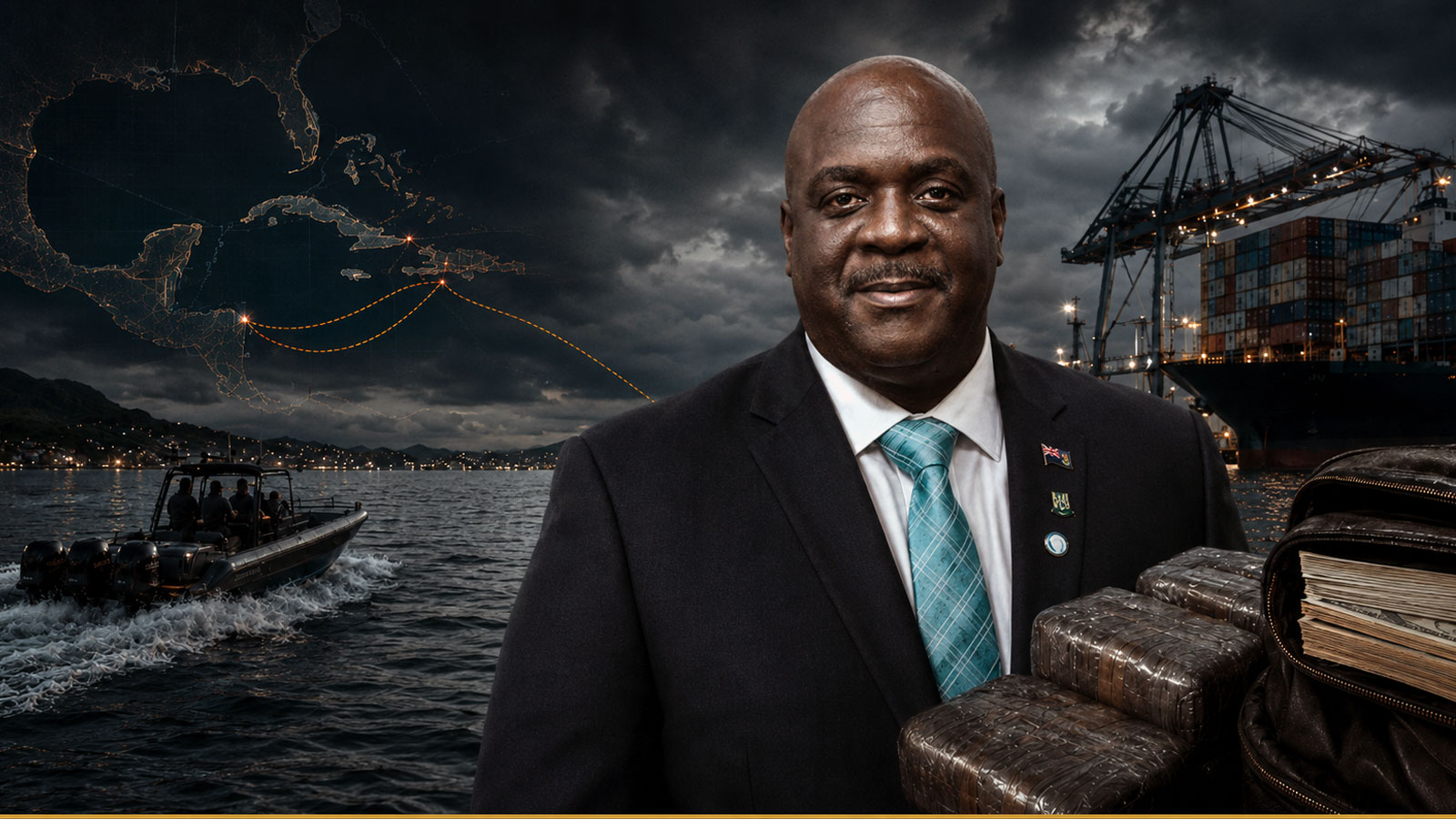
- On 28 April 2022, Andrew Alturo Fahie, then Premier and Minister of Finance of the British Virgin Islands, was arrested in Miami by U.S. authorities.
- Also arrested was Oleanvine Pickering Maynard, Managing Director of the British Virgin Islands Ports Authority.
- Her son, Kadeem Stephan Maynard, was arrested in the U.S. Virgin Islands.
- What made the case exceptional was not simply the quantity of narcotics contemplated by the conspiracy.
- It was who controlled the infrastructure allegedly being offered to the traffickers.
EXECUTIVE FINDING
On 28 April 2022, Andrew Alturo Fahie, then Premier and Minister of Finance of the British Virgin Islands, was arrested in Miami by U.S. authorities.
Also arrested was Oleanvine Pickering Maynard, Managing Director of the British Virgin Islands Ports Authority. Her son, Kadeem Stephan Maynard, was arrested in the U.S. Virgin Islands.
Federal prosecutors alleged that the three had agreed to facilitate the passage of thousands of kilograms of Colombian cocaine through British Virgin Islands ports on its way to the United States and to conceal the resulting proceeds through businesses and financial accounts.
What made the case exceptional was not simply the quantity of narcotics contemplated by the conspiracy.
It was who controlled the infrastructure allegedly being offered to the traffickers.
One defendant headed the government.
Another headed the Ports Authority.
Together, according to evidence subsequently accepted by a federal jury, they were prepared to use governmental authority and strategic port infrastructure to enable an international trafficking operation.
Fahie was convicted at trial in February 2024 and sentenced in August 2024 to 135 months in federal prison. Oleanvine and Kadeem Maynard pleaded guilty and received sentences of 112 months and 57 months respectively.
Fahie continues to challenge his conviction. As of August 2026, his appeal remains before the United States Court of Appeals for the Eleventh Circuit.
But Fahie’s criminal case tells only half the story.
Just weeks before his arrest, a separate British Virgin Islands Commission of Inquiry had delivered a report examining governance across the Territory. That inquiry identified serious systemic weaknesses in areas including procurement, assistance grants, appointments to statutory boards, Crown land disposals, and residence and belonger status.
The two processes were independent.
There is no basis for treating every governance deficiency identified by the Commission as connected to Fahie’s criminal conspiracy.
Yet their convergence exposed something more significant than either investigation considered alone:
A jurisdiction internationally associated with administering sophisticated offshore structures had simultaneously developed weaknesses in the systems governing the exercise of public power at home.
For Kleptik, that is the real investigation.
THE FINDING
The Fahie case is frequently characterised as an extraordinary narcotics sting involving a Caribbean premier.
That description is accurate but incomplete.
The case demonstrates the potential value of institutional access to organised crime.
International traffickers do not merely need boats.
They need routes.
They need predictable ports.
They need information.
They need protection from inspection.
They need government licences.
They need people capable of influencing officials who might otherwise interfere.
And, once narcotics have been converted into revenue, they need mechanisms capable of separating illicit proceeds from their criminal origin.
According to U.S. prosecutors, the proposed arrangement involved precisely this convergence of political authority, port infrastructure and financial concealment.
At the time charges were announced, prosecutors alleged that Fahie and Oleanvine Maynard would secure necessary licences, protect cocaine-bearing vessels while they were in BVI ports and arrange payments to officials whose interference might create a problem.
Evidence presented at Fahie’s eventual trial concerned a proposed initial movement of 3,000 kilograms of cocaine through a BVI port, followed by further 3,000-kilogram shipments once or twice per month over a four-month period. The arrangement contemplated Fahie and Oleanvine Maynard receiving a percentage of the resulting sales.
This was therefore not an allegation that a politician passively accepted money from an outside criminal organisation.
The proposition accepted by the jury was substantially more serious:
- public authority itself was to become part of the logistics chain.
THE PEOPLE
ANDREW ALTURO FAHIE
Position at time of arrest: Premier of the British Virgin Islands and Minister of Finance.
PEP classification: Highest-level domestic politically exposed person within the Territory.
Role established at trial: Convicted of participating in cocaine-trafficking and money-laundering conspiracies and related offences.
Sentence: 135 months’ imprisonment.
Current position: Conviction under appellate challenge as of August 2026.
OLEANVINE PICKERING MAYNARD
Position: Managing Director, British Virgin Islands Ports Authority.
The position is significant because a ports authority sits at the intersection of government, customs processes, maritime infrastructure, cargo movement and commercial operators.
Maynard pleaded guilty to conspiracy to import cocaine and was sentenced to 112 months’ imprisonment.
KADEEM STEPHAN MAYNARD
Relationship: Son of Oleanvine Maynard.
He pleaded guilty to conspiracy to import cocaine and received a 57-month federal sentence.
THE PROPOSED CRIMINAL ARCHITECTURE
The conspiracy, as described by prosecutors and supported by evidence at trial, can be reduced to five operational components.
1. PRODUCT
Cocaine originating in Colombia.
2. TRANSIT
Movement through British Virgin Islands territorial infrastructure.
3. PROTECTION
Use or promised use of access to prevent interference with cocaine-bearing vessels while in BVI ports.
4. POLITICAL FACILITATION
Governmental influence, licences and anticipated management of potentially problematic officials.
5. MONEY
Payment to participants from anticipated narcotics proceeds, with money intended to move through businesses and bank accounts in a manner concealing its source.
The structure can therefore be visualised as:
The last stage is essential.
Drug trafficking produces cash.
Money laundering converts that cash into usable wealth.
FOLLOW THE MONEY
When charges were initially announced, U.S. prosecutors alleged that the participants expected to make millions of dollars and that proceeds would be funnelled through businesses and bank accounts to disguise their origin.
Fahie and Oleanvine Maynard were arrested in Miami as they prepared to collect a $700,000 cash advance associated with the proposed arrangement.
For Kleptik, this raises a second investigation distinct from the criminal prosecution.
The prosecution’s task was to prove the charged offences.
Kleptik’s task should be to understand the financial ecosystem capable of absorbing the proceeds had the scheme become real.
That requires asking:
- What businesses were available to the participants?
- What accounts did they control?
- Which companies were owned directly?
- Which were controlled indirectly?
- Were entities incorporated outside the BVI?
- Which professional advisers serviced them?
- What banks maintained relationships with those businesses?
- What source-of-wealth information existed for the relevant politically exposed persons?
- Were any unusual transactions reported before the 2022 arrest?
- Did financial institutions terminate or review relationships after the arrests?
None of these questions should be interpreted as an allegation against any business, bank, lawyer, accountant or service provider.
They are the questions necessary to determine whether a criminal conspiracy involving senior public officials could have been financially operationalised beyond the undercover transaction constructed by law enforcement.
THE POWER TRAIL
Money laundering analysis asks:
Where would the money go?
Political-corruption analysis asks another question:
What could the official provide in exchange?
That distinction is important.
The value of a politically exposed person to organised crime does not necessarily arise from the PEP’s personal bank account.
It arises from access to government.
That access may include:
- licensing
- procurement
- law enforcement
- immigration
- customs
- ports
- land
- regulation
- appointments
- government intelligence
and influence over subordinate officials.
In the Fahie prosecution, authorities said the contemplated arrangement included securing licences, shielding cocaine-bearing vessels and making payments intended for officials and employees.
This produces a critical Kleptik analytical principle:
PEP risk should be measured by the public powers a person can mobilise, not simply by the money flowing through that person’s accounts.
THE PORTS
The presence of the Managing Director of the BVI Ports Authority fundamentally changes the significance of the case.
Ports are economic infrastructure.
They are also security infrastructure.
In an island jurisdiction, port authorities influence the physical gateways through which goods, people and commercial activity enter and leave the country.
A corrupt individual positioned inside that system can potentially provide something more valuable than political introductions:
- predictability.
For a legitimate shipping company, predictability means efficient logistics.
For organised crime, predictability can mean knowing:
- when a vessel will arrive
- where it will berth
- who will inspect it
- what documentation will be required
- whether cargo will be searched
- who controls access
and whether an enforcement intervention can be prevented.
The involvement of both a head of government and the Ports Authority’s managing director therefore created an unusual concentration of alleged capacity.
Political authority sat on one side.
Operational port authority sat on the other.
THE PARALLEL GOVERNANCE CRISIS
The most remarkable aspect of the timing was that Fahie’s arrest did not create the BVI’s governance crisis.
A governance investigation was already underway.
The independent Commission of Inquiry had been established before the U.S. operation became public and delivered its report to Governor John Rankin in April 2022.
Following Fahie’s arrest on 28 April, then-British Foreign Secretary Liz Truss explicitly linked the gravity of the arrest to the importance of the recently completed inquiry and said the report would be urgently published.
The Commission subsequently identified concerns affecting multiple spheres of public administration.
Its executive summary stated that important discretionary decisions were being made in areas including:
- procurement of government contracts
- grants of assistance
- appointments to statutory boards
- disposals of Crown land
- residence status
- and
belonger status.
The Commission found that such decisions were in significant instances being taken against absent, inadequate, unpublished or inconsistently applied criteria.
This is the crucial connection.
Not evidence of a common conspiracy.
Not evidence that every governance failure involved criminal conduct.
But evidence that institutional discretion had become a material governance risk independently of the Fahie prosecution.
PROCUREMENT
Procurement is particularly important to financial-crime investigators because government contracts can provide an apparently legitimate mechanism through which public money reaches private companies.
The Commission recommended independent audits of major government contracts valued above $100,000, including circumstances involving contract splitting or sequential contracts.
Kleptik should create a standalone procurement database covering the relevant period.
For each major contract:
- Contracting ministry
- Contractor
- Beneficial owner
- Contract amount
- Tender method
- Competing bids
- Ministerial approval
- Variations
- Final value
- PEP relationships
- Subcontractors
The objective is not to label contract recipients corrupt.
The objective is to identify patterns.
Repeated awards.
Concentrated ownership.
Newly formed companies.
Contract splitting.
Unusual variations.
Companies sharing addresses.
Directors linked to public officials.
Those patterns create investigative leads.
They are not conclusions.
CROWN LAND
Land is another potential mechanism through which political discretion becomes economic value.
The Commission recommended a comprehensive review of Crown land disposal processes and questioned the extent to which executive discretion should continue without clearly expressed criteria and controls.
It also recommended auditing Crown land disposals from the preceding three years.
Land transactions are particularly valuable for investigative analysis because they create identifiable assets.
Kleptik should establish:
- Who received Crown land?
- At what valuation?
- Under what process?
- Who approved the transaction?
- Was the recipient connected to a PEP?
- Was the land subsequently transferred?
- Was it developed?
- Was it pledged as security?
- Did its value materially increase following governmental action?
- A land grant can become the first node in a far larger money trail.
STATUTORY BOARDS
The Commission also scrutinised appointments to statutory boards and recommended consideration of whether appointments made since 2019 should be revisited so that future appointments could occur through more open and transparent processes.
This matters because statutory bodies often exercise substantial economic power while receiving considerably less public attention than ministries.
They may control:
- ports
- airports
- utilities
- licensing
- tourism assets
- development bodies
and other public enterprises.
For investigators, board membership should therefore form part of the PEP network, not sit outside it.
THE OFFSHORE PARADOX
The British Virgin Islands is internationally synonymous with offshore corporate structures.
That does not make the jurisdiction inherently corrupt.
BVI companies are used worldwide for legitimate investments, joint ventures, asset holding and cross-border commerce.
The relevant contradiction is more subtle.
Private financial institutions operating within the international AML system are expected to:
- identify beneficial owners
- understand source of funds
- establish source of wealth
- screen politically exposed persons
- monitor transactions
and escalate suspicious activity.
Yet the 2022 Commission of Inquiry identified serious weaknesses in public decision-making systems involving some of the people who themselves represented the jurisdiction’s highest political authority.
That leads to the central question of this dossier:
Who performs enhanced due diligence on the government of an offshore financial centre?
A bank can reject a PEP.
A corporate-service provider can terminate a client.
A government cannot terminate itself.
Its controls must therefore come from institutions:
- auditors
- procurement rules
- legislatures
- independent regulators
- courts
- governors
- law-enforcement agencies
- media
and public disclosure.
When those controls become weak, political discretion itself becomes a financial-crime vulnerability.
THE REFORM RESPONSE
The events of 2022 produced an extensive reform programme.
This deserves acknowledgement because an investigation that describes the institutional weaknesses without describing subsequent remediation would provide an incomplete picture.
By 30 August 2024, the BVI government reported that 45 of 48 key Commission of Inquiry recommendations had been completed, representing 94% according to the government’s own assessment.
The reform process was overseen through periodic implementation reviews and included work touching procurement, governance, public assistance and other areas.
The political stakes were exceptionally high.
In 2022, the United Kingdom had prepared an Order in Council capable, if activated, of temporarily suspending significant elements of the Territory’s constitution and transferring greater governing authority to the Governor.
It was held in reserve while reforms proceeded.
Following the reform programme and subsequent assessments, the reserved Order was ultimately revoked effective 13 March 2026.
That does not mean every underlying governance issue has necessarily disappeared.
It does mean that the institutional position of the BVI in 2026 is materially different from that which existed when Fahie was arrested in April 2022.
Kleptik should reflect both realities.
CHRONOLOGY
4 April 2022
The BVI Commission of Inquiry report is delivered to Governor John Rankin.
March–April 2022
According to evidence later presented by U.S. authorities, Fahie and the Maynards participate in meetings concerning the proposed cocaine-trafficking arrangement.
28 April 2022
Andrew Fahie and Oleanvine Maynard are arrested in Miami. Kadeem Maynard is arrested in St. Thomas.
29 April 2022
U.S. prosecutors publicly announce cocaine-trafficking and money-laundering charges.
8 June 2022
The UK government formally publishes the BVI Commission of Inquiry report and recommendations.
2022–2023
Oleanvine and Kadeem Maynard plead guilty.
8 February 2024
A federal jury convicts Fahie following trial.
5 August 2024
Fahie is sentenced to 135 months in federal prison; DOJ publicly announces the sentence the following day.
30 August 2024
The BVI government states that 45 of 48 key COI recommendations have been completed.
2025–2026
The BVI reform assessment continues.
13 March 2026
The reserved UK Order in Council is revoked.
August 2026
Fahie’s appellate challenge remains pending before the U.S. Court of Appeals for the Eleventh Circuit.
DOCUMENTARY RECORD
The evidentiary foundation for this dossier is divided into three categories.
CRIMINAL RECORD
U.S. Attorney’s Office, Southern District of Florida — 29 April 2022
Initial public announcement of charges against Fahie and the Maynards. It establishes the government’s original allegations concerning cocaine movement, licensing, port protection and laundering.
U.S. Attorney’s Office, Southern District of Florida — 6 August 2024
Sentencing announcement following Fahie’s jury conviction. It provides the post-trial description of evidence, proposed shipment volumes, the $700,000 advance and sentences imposed on all three defendants.
GOVERNANCE RECORD
British Virgin Islands Commission of Inquiry — 2022
The inquiry provides the principal independent public record concerning systemic governance deficiencies contemporaneous with the Fahie prosecution.
REFORM RECORD
BVI government implementation reports and statements document the Territory’s subsequent response and claimed completion of the overwhelming majority of key recommendations.
WHAT THE AUTHORITIES SAY
U.S. authorities successfully prosecuted Fahie before a federal jury and obtained guilty pleas from both Oleanvine and Kadeem Maynard. The government maintains that Fahie’s convictions were supported by the trial evidence.
The UK government treated the 2022 Commission of Inquiry findings as sufficiently serious to require extensive governance reforms and held extraordinary constitutional intervention powers in reserve while implementation proceeded.
The BVI government, for its part, implemented an extensive reform programme and maintains that substantial institutional progress has occurred since 2022. By 2026 the constitutional contingency measure had been removed.
These positions are not mutually exclusive.
A jurisdiction can suffer a serious governance crisis and subsequently undertake meaningful reform.
WHAT FAHIE SAYS
Fahie’s conviction is not legally final while his direct appeal remains unresolved.
His appellate lawyers are seeking reversal of the conviction and have challenged aspects of the prosecution and trial proceedings. The U.S. government has opposed that effort and argues that the guilty verdicts should stand.
Kleptik therefore describes Fahie as:
- convicted and sentenced, with his conviction under appeal.
- It should not describe him simply as an alleged participant, because a jury has convicted him.
- It should equally not state that all appellate proceedings have concluded.
- They have not.
RIGHT OF REPLY
Before publication, Kleptik should seek comment from:
- Andrew Fahie or his appellate counsel
- Oleanvine Maynard or counsel
- Kadeem Maynard or counsel
- Government of the Virgin Islands
- BVI Ports Authority
Office of the Governor of the Virgin Islands
For any additional individual or company identified during Kleptik’s original corporate-record investigation, that party should receive a specific description of the material concerning them and a reasonable opportunity to respond.
Responses should be reproduced fairly.
A refusal to comment should be recorded as a refusal to comment.
No response should be described simply as “no comment” unless the subject actually gave that response.
WHAT THIS DOSSIER DOES NOT ESTABLISH
Kleptik has found no basis to conclude from the materials reviewed for this dossier that every governance weakness identified by the BVI Commission of Inquiry was connected to Fahie’s criminal conduct.
The Commission of Inquiry and the U.S. criminal prosecution were separate processes.
The report does not establish that:
- every BVI public official was corrupt
- every Ports Authority employee knew of the conspiracy
- BVI corporate-service providers participated in the conspiracy
- the BVI financial-services industry facilitated Fahie’s conduct
- every government contract identified by the Commission was corrupt
or every exercise of ministerial discretion was improper.
Those distinctions are essential.
An investigation becomes stronger, not weaker, when it identifies the boundary between evidence and inference.
UNANSWERED QUESTIONS
The criminal convictions resolve important questions about the conspiracy.
They do not resolve all questions concerning the environment surrounding it.
Kleptik identifies the following areas for further investigation:
1. CORPORATE NETWORK
What companies, partnerships, trusts or other entities were beneficially owned or effectively controlled by Fahie and the other central participants?
2. BANKING NETWORK
Which financial institutions maintained relationships with those entities, and what enhanced PEP due diligence was performed?
3. SOURCE OF WEALTH
How was the legitimate wealth of relevant PEPs documented before April 2022?
4. PROCUREMENT
Did companies connected to close associates of senior political officials receive significant public contracts during the relevant period?
5. PORTS AUTHORITY
What internal controls existed concerning executive authority within the Ports Authority?
6. STATUTORY BOARDS
How concentrated was political influence over appointments to economically significant statutory bodies?
7. CROSS-BORDER ENTITIES
Were companies associated with any central participants incorporated in other Caribbean, U.S., UK or offshore jurisdictions?
8. ASSET POSITION
What assets were held by principal participants before arrest, and how did those holdings compare with declared or reasonably identifiable legitimate income?
9. AML RESPONSE
Did any regulated entity submit suspicious transaction reports before the arrests?
Such reports are ordinarily confidential, meaning absence of public information should not be interpreted as evidence that no reports were made.
10. REFORM EFFECTIVENESS
The BVI government implemented extensive formal reforms.
The remaining question is whether those reforms changed actual administrative behaviour.
That requires a 2022 versus 2026 procurement and governance comparison, not simply a count of completed recommendations.
KLEPTIK INTELLIGENCE ASSESSMENT
ASSESSMENT: HIGH CONFIDENCE
The Fahie prosecution demonstrates that individuals occupying the highest levels of BVI political and port authority were prepared to participate in a large-scale narcotics arrangement.
This conclusion is supported not merely by allegations but by a federal jury conviction and guilty pleas by Fahie’s co-defendants.
ASSESSMENT: HIGH CONFIDENCE
The BVI simultaneously suffered material governance deficiencies extending beyond the individual conduct prosecuted in Miami.
This assessment rests upon the independent findings of the Commission of Inquiry.
ASSESSMENT: MODERATE-TO-HIGH CONFIDENCE
Concentrated discretionary authority materially increases corruption vulnerability in small jurisdictions where political, commercial and regulatory networks substantially overlap.
This is an analytical conclusion based on the institutional conditions identified by the Commission rather than an allegation that particular uncharged persons engaged in criminal activity.
ASSESSMENT: HIGH CONFIDENCE
The Territory undertook significant institutional remediation after the 2022 crisis.
The eventual revocation of the reserved constitutional Order in March 2026 provides material evidence that the reform environment had changed sufficiently for the UK government not to maintain that extraordinary contingency.
ASSESSMENT: OPEN
Whether the reforms have permanently changed informal political behaviour cannot yet be established merely by legislative implementation statistics.
That question requires continuing scrutiny of procurement outcomes, appointments, public asset disposals and government decision-making.
THE KLEPTIK VIEW
Andrew Fahie’s arrest became global news because a sitting premier was detained in a U.S. narcotics operation.
But focusing exclusively on the spectacle misses the significance.
The most valuable commodity the alleged traffickers sought was not cocaine.
They already had access to cocaine.
What they needed was institutional passage.
A port that would work.
Licences that could be obtained.
Officials who would not interfere.
Political power capable of solving problems.
And a mechanism for turning the proceeds into wealth that could eventually appear legitimate.
That is why this case belongs on Kleptik.
It sits precisely where the publication’s investigations should operate:
- money meets power
- power meets infrastructure
- infrastructure meets secrecy
- and
secrecy meets the international financial system.
The British Virgin Islands emerged from 2022 with a former premier facing prosecution and its system of government under extraordinary scrutiny.
Four years later, the constitutional threat created by the crisis has been lifted and substantial reforms have been implemented.
But the central lesson remains.
Offshore financial centres spend enormous resources asking customers:
- Who owns the company?
- Where did the money come from?
- Is the person politically exposed?
- What is the source of wealth?
Fahie’s case suggests one additional question belongs on that list:
WHO WATCHES THE PEOPLE WHO CONTROL THE JURISDICTION?
KLEPTIK METHODOLOGY
Kleptik investigations distinguish between established fact, judicial finding, allegation, source information and analytical assessment.
For this dossier, Kleptik relied principally upon:
U.S. federal prosecution records and Department of Justice statements;
the British Virgin Islands Commission of Inquiry and its published recommendations;
- official BVI government reform and implementation records
- UK government statements and constitutional measures
- and
current reporting concerning the status of Fahie’s appellate proceedings.
Where a criminal allegation subsequently resulted in conviction, the dossier identifies the conviction.
Where an appeal remains outstanding, the dossier states that status.
Where government reports describe reforms as completed, Kleptik attributes that assessment to the relevant government rather than treating administrative completion as independent proof of practical effectiveness.
Kleptik does not infer criminality from:
- association
- family relationship
- political proximity
- shared corporate addresses
- PEP status
- membership of a statutory body
or appearance in an investigative database.
Such information may establish a lead.
It does not establish wrongdoing.
Corporate ownership should, wherever possible, be verified against original registry material.
Court findings should be distinguished from allegations contained in pleadings.
Financial relationships should not be described as suspicious merely because they involve an offshore jurisdiction.
Where information cannot be independently verified, Kleptik should identify its limitations.
Subjects facing material criticism are offered an opportunity to respond before publication.
Kleptik will correct material factual errors when identified and will update dossiers when subsequent judicial, regulatory or documentary developments materially alter their conclusions.
EVIDENTIARY LABELS
ESTABLISHED
Supported by a final or presently operative judicial finding, guilty plea, official record or independently verified documentary evidence.
ALLEGED
Asserted by prosecutors, regulators, litigants or identified sources but not adjudicated as fact.
KLEPTIK VERIFIED
Independently corroborated by Kleptik from primary documentary evidence.
KLEPTIK ASSESSMENT
An analytical conclusion drawn from identified evidence.
INVESTIGATIVE LEAD
Information warranting further examination but insufficient to support a conclusion.
UNVERIFIED
Information Kleptik has been unable to independently corroborate and which should not be presented as established fact.
The Sentences
The federal prison terms imposed in the case:
DOCUMENT STATUS
KLTK-2022-001
Original event date: 29 April 2022
Current dossier status: Updated
Last substantive review: 19 August 2026
Next review trigger: Decision in United States v. Andrew Alturo Fahie appellate proceedings / material new BVI governance disclosures
© KLEPTIK — Investigations into Power, Money and the Systems Designed to Hide Both