THE MINISTER, THE PROPERTY EMPIRE AND THE PEP GATEKEEPERS

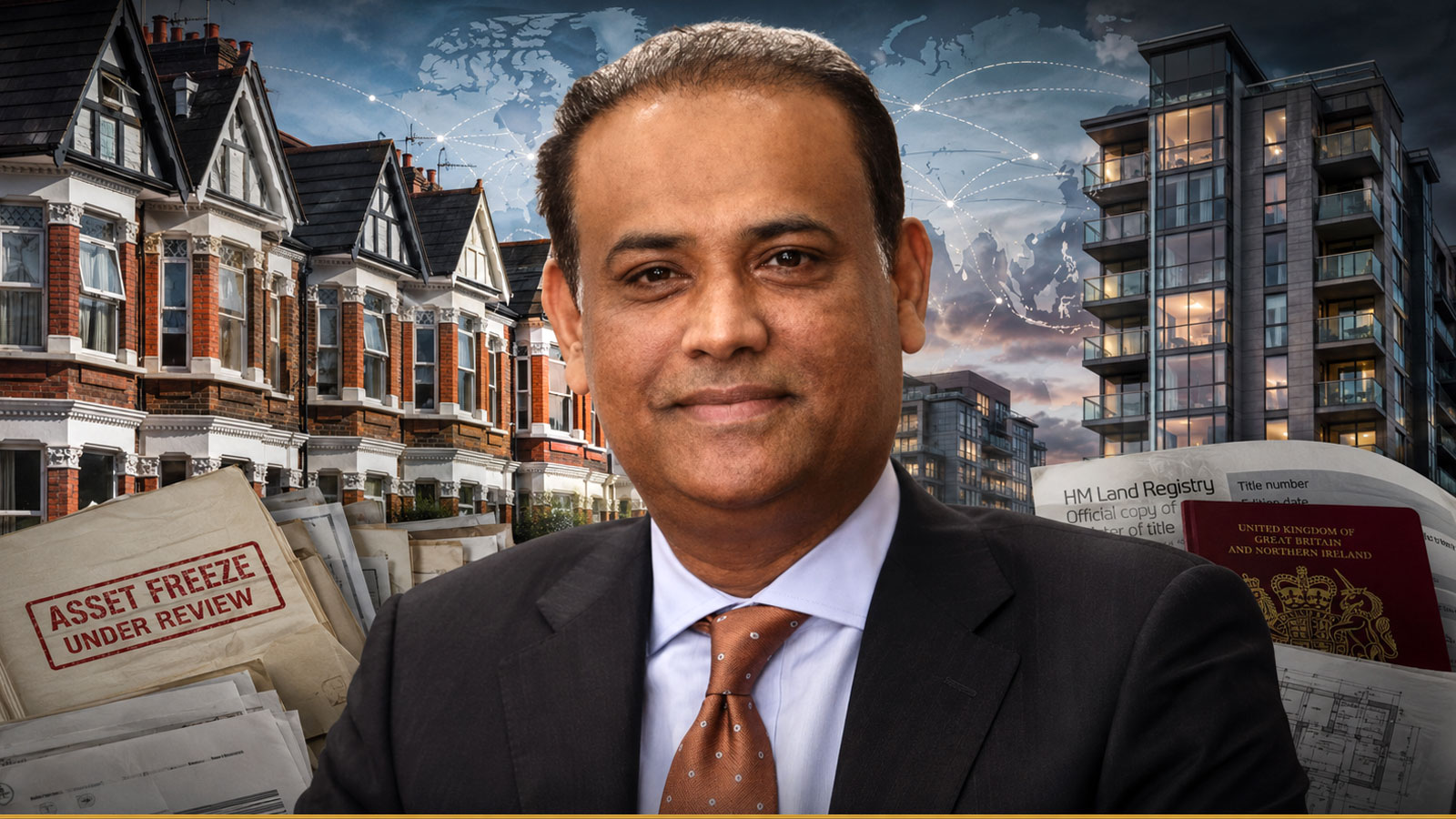
- That order followed a year of expanding asset restraints in Bangladesh and the United Kingdom.
- In June 2025, Britain’s National Crime Agency obtained civil freezing orders over hundreds of UK properties linked to Chowdhury as part of an ongoing civil investigation.
- A court order preventing disposal of property preserves assets while allegations are investigated.
- The Bangladesh proceedings involved allegations of corruption, money laundering, illicit wealth and bank-loan misconduct.
- As of 14 January 2026, those allegations had not matured into a final conviction of Chowdhury on the property-empire theory.
EXECUTIVE FINDING
On 13 January 2026, a Dhaka court ordered the seizure of 330 foreign properties linked by Bangladesh’s Anti-Corruption Commission to former land minister Saifuzzaman Chowdhury and related persons and entities.
The properties identified in the court applications were spread across eight countries: Cambodia, the United Arab Emirates, Malaysia, the United States, Vietnam, Thailand, India and the Philippines.
That order followed a year of expanding asset restraints in Bangladesh and the United Kingdom.
In June 2025, Britain’s National Crime Agency obtained civil freezing orders over hundreds of UK properties linked to Chowdhury as part of an ongoing civil investigation.
Bloomberg had previously identified more than 350 UK properties connected to companies owned by Chowdhury and his wife, with an estimated value of about £200 million, plus at least five Manhattan properties.
Al Jazeera later reported an even broader international property network and said Chowdhury had acknowledged owning large overseas business interests while insisting the wealth came from legitimate businesses outside Bangladesh.
The central legal point is critical:
asset freezing is not conviction.
A court order preventing disposal of property preserves assets while allegations are investigated.
The Bangladesh proceedings involved allegations of corruption, money laundering, illicit wealth and bank-loan misconduct.
As of 14 January 2026, those allegations had not matured into a final conviction of Chowdhury on the property-empire theory.
The deeper investigative question is therefore not whether a politician owned foreign property.
It is whether the scale, financing, disclosure and source of that property can be reconciled with legitimate wealth and applicable foreign-exchange, tax, banking and public-disclosure rules.
THE PROPERTY IS VISIBLE. THE SOURCE OF WEALTH IS THE INVESTIGATION.
The central Kleptik question is:
HOW CAN A POLITICALLY EXPOSED PERSON BUILD A PROPERTY NETWORK WORTH HUNDREDS OF MILLIONS ACROSS MULTIPLE COUNTRIES WITHOUT EVERY BANK, LAWYER, LENDER AND ESTATE AGENT ASKING THE SAME QUESTION: WHERE DID THE MONEY ORIGINALLY COME FROM?
THE FINDING
Real estate is one of the easiest assets to see and one of the hardest assets to understand.
A title register can show ownership.
A mortgage filing can show debt.
A company filing can show legal control.
None of those records, by themselves, proves the lawful origin of the equity.
That is the difference between asset mapping and source-of-wealth analysis.
PUBLIC OFFICE / PEP STATUS
↓
PRIVATE COMPANIES
↓
FOREIGN PROPERTY VEHICLES
↓
BANK / NON-BANK LENDERS
↓
PROPERTY ACQUISITIONS
↓
RENT / REFINANCING / EQUITY
↓
SOURCE-OF-WEALTH QUESTION
SAIFUZZAMAN CHOWDHURY
Saifuzzaman Chowdhury served as Bangladesh’s land minister from 2019 until January 2024 after previously serving as state minister.
He came from a prominent political and business family and held interests connected to companies including Aramit and United Commercial Bank through family structures.
As a cabinet minister responsible for land, he was a high-risk politically exposed person for international financial institutions.
THE BLOOMBERG PROPERTY MAP
In February 2024, Bloomberg reported that companies owned by Chowdhury and his wife had accumulated more than 350 UK properties worth about £200 million.
The investigation used Companies House records, HM Land Registry data and mortgage filings.
The properties ranged from luxury London homes to rental and student accommodation.
Bloomberg also identified at least five Manhattan properties purchased for about US$6 million.
THE AL JAZEERA EXPANSION
In September 2024, Al Jazeera’s Investigative Unit reported that Chowdhury’s overseas real-estate holdings exceeded US$500 million across the United Kingdom, Dubai and New York.
Chowdhury told Al Jazeera that the funds came from legitimate overseas businesses built over many years.
He characterised subsequent proceedings against him as politically motivated.
THE DEFENCE MATTERS
A large foreign portfolio is not itself proof of corruption.
Entrepreneurs can accumulate substantial wealth outside government.
The investigative burden is to test the provenance of the capital, not to infer guilt from scale.
THE PUBLIC-DISCLOSURE GAP
Bloomberg reported that Chowdhury’s pre-election asset declaration in Bangladesh did not include the UK property holdings identified through British records.
The reported disclosure listed much smaller total assets in Bangladesh.
The mismatch created an immediate integrity question even before criminal proceedings began.
DISCLOSURE ≠ OWNERSHIP REGISTER
A political declaration and a corporate register serve different purposes.
A company may lawfully hold property while the politician discloses an interest through corporate ownership rather than listing each asset individually.
The exact legal disclosure requirement therefore matters.
The relevant question is whether the beneficial economic interest was required to be declared and, if so, whether it was.
BANGLADESH FOREIGN-EXCHANGE CONTROLS
Bangladesh maintains extensive foreign-exchange controls over residents and corporations.
Bangladesh Bank rules limit ordinary personal foreign-currency remittances and require approvals for many forms of capital movement.
The existence of hundreds of millions in overseas property therefore creates an obvious source-and-transfer question.
It does not, by itself, answer it.
THE SOURCE-OF-FUNDS QUESTION
For each property acquisition, investigators should identify the specific funds used for deposit, acquisition costs and debt service.
Bank account.
Transfer date.
Lender.
Borrower.
Source jurisdiction.
That is source of funds.
THE SOURCE-OF-WEALTH QUESTION
The larger inquiry asks how the family or company became wealthy enough to supply the equity across hundreds of transactions.
Business dividends.
Share sales.
Foreign operating companies.
Borrowing.
Inherited wealth.
Each explanation should reconcile to audited or independently verifiable records.
SOURCE OF FUNDS IS NOT SOURCE OF WEALTH
A lender can show where today’s deposit came from.
That does not explain how the borrower accumulated the money originally.
PEP due diligence requires both.
THE UK COMPANY NETWORK
Bloomberg identified multiple UK companies owned by Chowdhury and his wife that were used to hold real estate.
Corporate ownership made the portfolio visible in Companies House.
The use of companies is normal in property investment.
The risk question is who beneficially owns, funds and controls them.
THE MORTGAGE ENGINE
The portfolio was heavily financed.
Mortgage charges show that lenders provided substantial credit across numerous properties.
Debt can legitimately accelerate portfolio growth.
It can also make source-of-wealth analysis more complex because equity and leverage must be separated.
LEVERAGE CAN HIDE THE EQUITY QUESTION
A £1 million property financed with an £800,000 mortgage does not require £1 million of unexplained cash.
It still requires £200,000 plus fees and ongoing debt service.
The correct analysis is transaction-specific.
THE REFINANCING LOOP
Property investors often recycle equity by refinancing appreciating assets.
That can produce rapid portfolio growth without repeated external capital injections.
Investigators should therefore reconstruct acquisition value, mortgage balance, refinancing proceeds and rental income over time.
THE GATEKEEPER NETWORK
A large property empire cannot be built by the beneficial owner alone.
Estate agents identify properties.
Lawyers execute transactions.
Lenders provide debt.
Banks move funds.
Accountants structure companies.
Every participant becomes a potential compliance gatekeeper.
PEP STATUS
UK anti-money-laundering rules require enhanced measures for politically exposed persons and their family members and known close associates.
PEP status does not prohibit transactions.
It requires stronger scrutiny, including appropriate measures to establish source of wealth and source of funds.
THE PEP-GATEKEEPER TEST
- Did the professional identify the political role?
- Did they identify the beneficial owner?
- Did they establish source of wealth?
- Did the explanation remain plausible as the portfolio scaled?
- Did the risk assessment evolve over time?
THE REPEAT-TRANSACTION PROBLEM
One transaction may appear plausible.
A hundred transactions create a different risk profile.
Compliance should aggregate a client’s entire relationship, not assess each mortgage or property in isolation.
THE SAME-PROFESSIONAL EFFECT
Bloomberg reported that a number of the same lenders, lawyers and property professionals appeared repeatedly across the UK portfolio.
Repeated involvement can improve institutional knowledge.
It can also normalise a high-risk client and reduce the sense that each new transaction deserves fresh scrutiny.
NORMALISATION OF RISK
The first transaction may receive intensive review.
The fiftieth may feel routine.
But rapid portfolio expansion should increase scrutiny, not reduce it.
PEP IDENTIFICATION
↓
SOURCE OF WEALTH
↓
SOURCE OF FUNDS
↓
BENEFICIAL OWNERSHIP
↓
TRANSACTION PURPOSE
↓
ONGOING MONITORING
↓
SAR / ESCALATION IF SUSPICION ARISES
THE UK NCA FREEZING ORDERS
In June 2025, the UK National Crime Agency confirmed that it had secured freezing orders over a number of properties linked to Chowdhury as part of an ongoing civil investigation.
Later reporting placed the number at 342 properties worth around £185 million.
A freezing order prevents disposal while the investigation proceeds.
It is not a final forfeiture judgment.
FREEZE ≠ FORFEITURE
Freeze preserves.
Forfeiture transfers or extinguishes rights after the relevant legal process.
The distinction is essential to accurate reporting.
CIVIL INVESTIGATION ≠ CRIMINAL CONVICTION
The NCA’s action was civil.
Civil asset tools may operate under different legal standards from criminal prosecution.
Kleptik therefore labels the UK property restraints as civil freezing orders, not confiscation after conviction.
THE BANGLADESH ACC INVESTIGATION
Bangladesh’s Anti-Corruption Commission opened investigations into alleged illicit wealth, money laundering and related conduct.
Courts subsequently authorised freezes and attachments over bank accounts, shares, land and foreign property.
These orders were based on ACC applications during ongoing investigations.
THE MARCH 2025 DOMESTIC FREEZE
In March 2025, a Dhaka court ordered 39 bank accounts frozen and later ordered seizure or attachment of shares and hundreds of bighas of land connected to Chowdhury and related persons and organisations.
The orders were preventive asset-preservation measures.
THE JULY 2025 BO ACCOUNTS
In July 2025, a court froze 26 beneficiary-owner securities accounts linked to Chowdhury, family members and associates.
The ACC said those accounts contained approximately Tk 576 crore.
Again, the freeze preserved assets while allegations were investigated.
THE AUGUST 2025 BANK ACCOUNTS
In August 2025, a court froze 120 additional bank accounts associated with Chowdhury, family members and beneficiaries.
The ACC cited a risk that funds could be moved and thereby obstruct the investigation.
THE SEPTEMBER 2025 FOREIGN-ASSET MAP
By September 2025, court and ACC materials referenced properties in the United Kingdom, the United Arab Emirates, the United States and additional countries.
The investigation had moved from a UK-property story to a global asset-tracing exercise.
THE JANUARY 2026 ORDER
On 13 January 2026, a Dhaka court ordered seizure of 330 foreign properties identified by the ACC.
The distribution cited in the court applications was 117 in Cambodia, 59 in the UAE, 47 in Malaysia, 40 in the United States, 33 in Vietnam, 23 in Thailand, nine in India and two in the Philippines.
The properties were said to have been acquired between January 2011 and September 2023.
MULTI-JURISDICTION ASSET RECOVERY
A Bangladesh court order cannot simply transfer title to a foreign apartment.
Foreign enforcement requires mutual legal assistance, recognition and action under the law of the country where the asset sits.
That is why the ACC said the orders would be transmitted through mutual legal assistance channels.
THE MLAR BOTTLENECK
Asset recovery is slow because every jurisdiction has its own evidence, procedure and property law.
The political headline can be immediate.
The legal transfer of the asset can take years.
THE UK LAND-REGISTRY ADVANTAGE
Britain’s property and corporate registers make asset mapping comparatively accessible.
That transparency allowed journalists to reconstruct hundreds of acquisitions before enforcement agencies publicly acted.
OPEN-SOURCE INTELLIGENCE AS FINANCIAL INTELLIGENCE
Corporate registries.
Land records.
Mortgage charges.
Director appointments.
A substantial part of modern corruption investigation can begin with public data.
THE JOURNALISM-TO-ENFORCEMENT PIPELINE
Bloomberg’s 2024 investigation publicly mapped the UK portfolio.
Al Jazeera later expanded the story internationally.
Bangladesh authorities and the UK NCA subsequently pursued asset restraints.
Journalistic evidence is not a court finding, but it can identify leads that official institutions later test.
THE PROFESSIONAL-ENABLER QUESTION
The existence of a large PEP property network inevitably raises questions about professional intermediaries.
But 'worked on the transaction' is not equivalent to 'enabled crime.'
Knowledge, red flags, regulatory duties and actual conduct must be established firm by firm.
LAWYERS
Conveyancing lawyers can see client identity, company ownership, funding sources, lenders and property transfers.
They are therefore central anti-money-laundering gatekeepers.
Legal privilege does not erase statutory compliance obligations in regulated transactional work.
ESTATE AGENTS
Estate agents may be the first professional to interact with the buyer.
They should identify PEP risk and verify beneficial ownership.
A luxury-property market that relies heavily on foreign capital is particularly exposed to source-of-wealth risk.
LENDERS
Mortgage and bridging lenders can finance rapid expansion.
They also receive detailed borrower information.
A lender should understand how equity, deposit and debt service are funded.
BANKS
Banks see incoming transfers and outgoing completions.
They may not see the entire property network if multiple institutions are used.
Group-level and relationship-level monitoring is therefore critical.
THE SAR QUESTION
Suspicious Activity Reports are confidential.
Kleptik should never assert that a firm did or did not file a SAR unless lawfully disclosed.
The proper question is whether the circumstances should have triggered escalation under applicable rules.
DO NOT GUESS THE SAR
A professional can file a SAR and still complete a transaction if legally permitted.
Absence of public enforcement does not prove absence of reporting.
THE DECLARED-INCOME QUESTION
The public controversy intensified because reported official income and declared domestic assets appeared small relative to the overseas portfolio.
That mismatch is a classic source-of-wealth trigger.
It is not, by itself, proof that the wealth is illicit.
BUSINESS WEALTH
Chowdhury’s defence is that legitimate businesses outside Bangladesh generated the wealth.
A proper investigation therefore needs the accounts of those businesses.
Revenue.
Profit.
Dividend capacity.
Ownership history.
Capital contributions.
THE OVERSEAS-BUSINESS CLAIM
If the wealth originated outside Bangladesh before or independently of public office, foreign-exchange restrictions on remitting Bangladeshi capital may have different relevance.
The timeline of business formation and asset accumulation is therefore decisive.
THE TIMELINE TEST
- Which companies existed before public office?
- When did they become profitable?
- When did the first foreign property purchase occur?
- Did portfolio growth accelerate after political promotion?
Chronology can support or weaken competing explanations.
THE 2011-2023 WINDOW
The January 2026 ACC application said the 330 foreign properties were acquired between 2011 and 2023.
That period overlaps substantially with Chowdhury’s political career.
Overlap is context, not proof.
LAND MINISTER / PROPERTY INVESTOR
The optics are unusually sensitive because Chowdhury’s government portfolio concerned land while his private interests included substantial property holdings.
That does not establish conflict in any specific official decision.
It heightens the need for disclosure and recusal controls.
THE CONFLICT-OF-INTEREST TEST
Did any public decision affect companies, counterparties or sectors in which the minister had a private economic interest?
Did family-linked banks, companies or developers interact with government agencies under his portfolio?
Those questions require transaction-specific evidence.
UNITED COMMERCIAL BANK
Chowdhury’s family has longstanding connections to United Commercial Bank.
Later Bangladesh investigations included allegations concerning bank-loan misconduct.
As of the archive date, those matters remained allegations and proceedings, not final convictions.
THE FAMILY NETWORK
Large PEP portfolios often involve spouses, siblings, children, companies and beneficiaries.
That does not make family members presumptively culpable.
It means source-of-wealth and beneficial-ownership analysis must map the household and corporate network rather than one individual.
BENEFICIARIES
Bangladesh court orders repeatedly referred to family members, associates and beneficiaries.
The term matters because economic ownership can differ from nominal account ownership.
THE PROPERTY-VEHICLE QUESTION
Why was each property held personally, by a spouse, or through a company?
Tax planning.
Financing.
Asset protection.
Privacy.
Each can be legitimate.
The investigative question is whether the structure had economic substance and transparent beneficial ownership.
THE RENTAL-INCOME LOOP
A large rental portfolio can generate substantial legitimate cash flow.
That income can fund later acquisitions and debt service.
Investigators should therefore avoid assuming every later purchase required new unexplained capital.
THE PORTFOLIO CASH-FLOW MODEL
Initial equity.
Mortgage leverage.
Rental income.
Refinancing.
Capital appreciation.
Portfolio growth can compound rapidly.
THE INITIAL-CAPITAL QUESTION
The most important point may be the beginning.
What legitimate capital seeded the first wave of acquisitions?
Once that is established, later leverage becomes easier to evaluate.
THE £11 MILLION HOME
Bloomberg highlighted a high-value London residence associated with the network, purchased through related companies and financed through commercial lending.
Luxury personal-use property is analytically different from income-producing rental assets.
Source and beneficial use should be examined separately.
THE MANHATTAN PROPERTIES
Bloomberg identified at least five Manhattan properties acquired between 2018 and 2020 for about US$6 million in total.
U.S. property records create another jurisdiction in which beneficial ownership, financing and source of funds can be reconstructed.
THE UAE PROPERTY QUESTION
Later Bangladesh court records identified substantial property holdings in the UAE.
Dubai’s international property market is a major destination for cross-border wealth.
The same PEP and source-of-wealth questions apply.
THE ASIA PROPERTY MAP
The January 2026 order expanded the network to Cambodia, Malaysia, Vietnam, Thailand, India and the Philippines.
This geographic spread turns a bilateral Bangladesh-UK story into a regional asset-tracing challenge.
WHY PROPERTY?
Real estate can preserve wealth.
Generate rent.
Provide collateral.
Store value in stable jurisdictions.
And appear legitimate once acquisition is complete.
PROPERTY AS INTEGRATION
If illicit money enters real estate, the asset can later produce clean-looking rent, refinancing proceeds and sale proceeds.
This is why property is a classic laundering concern.
The existence of property does not prove laundering; provenance determines significance.
THE REFINANCING PROBLEM FOR INVESTIGATORS
Once a property is refinanced, later funds may come from a reputable lender rather than the original source.
Investigators must trace backward to the equity that first entered the asset.
MORTGAGE ≠ CLEAN SOURCE
A bank mortgage explains the debt portion.
It does not automatically validate the borrower’s equity.
THE UK PEP RULE
UK regulation does not say PEPs are criminals.
It recognises that public power can create elevated corruption risk.
The control is enhanced due diligence, senior approval and source-of-wealth/source-of-funds measures.
THE PEP DE-RISKING PROBLEM
Overly broad PEP controls can unfairly deny services to legitimate officials and families.
The answer is not automatic refusal.
It is proportionate, evidence-based scrutiny.
THE CROSS-BORDER REGULATORY GAP
A Bangladesh official can be a high-risk PEP in Britain, borrower in one jurisdiction, landlord in another and company owner in a third.
No single regulator owns the whole picture.
DATA FUSION
Land registry sees property.
Companies House sees corporate ownership.
Lender sees debt.
Bank sees transfers.
Bangladesh authorities see political disclosures.
Only combined data reveal inconsistency.
THE ASSET-DECLARATION OVERLAY
Kleptik’s preferred method is to overlay political declarations with foreign corporate and property registries.
Any unexplained mismatch becomes an investigative lead, not an automatic conclusion.
THE COURT-ORDER STANDARD
A freezing or attachment order generally reflects judicial acceptance that preservation is justified on the material presented.
It does not prove the underlying allegations beyond a reasonable doubt.
THE DUE-PROCESS RULE
Property owners must be able to challenge restraint and establish lawful origin through the applicable legal process.
Asset recovery without procedural safeguards risks becoming political confiscation.
THE POLITICAL-TRANSITION RISK
The Bangladesh investigations accelerated after the fall of the Sheikh Hasina government in August 2024.
That political context makes evidentiary discipline essential.
A change of government can uncover previously protected misconduct.
It can also create incentives for politically motivated enforcement.
THE WITCH-HUNT DEFENCE
Chowdhury has characterised proceedings as politically motivated.
That claim should be reported fairly.
The correct response is not to accept or dismiss it automatically.
It is to test the asset evidence independently.
PROPERTY RECORDS ARE POLITICALLY NEUTRAL
A title deed does not care which party is in power.
A mortgage filing does not care who won the election.
That makes external documentary evidence particularly valuable in politically contested investigations.
THE PEP GATEKEEPER MATRIX
| Gatekeeper | What it can see | What it should test |
|---|---|---|
| Estate agent | Buyer identity + property + price | PEP status / beneficial owner / transaction purpose |
| Lawyer | Structure + funds + title + lender | Source of funds / source of wealth / corporate control |
| Mortgage lender | Borrower finances + collateral | Equity source / debt service / portfolio exposure |
| Bank | Transfers + account history | Unusual flows / PEP profile / counterparties |
| Accountant / corporate agent | Companies + ownership + accounts | Economic substance / beneficial ownership / consistency |
THE EVIDENTIARY-STATUS MATRIX
| Fact category | Status at 14 Jan 2026 | Kleptik treatment |
|---|---|---|
| UK property ownership mapped in public records | Documented / journalistic analysis | KLEPTIK VERIFIED where registry-backed |
| NCA property freezing orders | Official civil restraint | ESTABLISHED — CIVIL FREEZE |
| Bangladesh court attachments/freezes | Official judicial orders | ESTABLISHED — ASSET RESTRAINT |
| Money-laundering / illicit-wealth allegations | Investigation / charges | OFFICIAL ALLEGATION |
| Legitimate overseas-business explanation | Subject’s stated defence | SUBJECT POSITION |
| Final criminal guilt on property-empire theory | Not established | OPEN |
CHRONOLOGY
2011–2023
Bangladesh ACC later says many of the foreign properties identified in its January 2026 applications were acquired during this period.
2013
Saifuzzaman Chowdhury enters national politics as an MP.
2014
He becomes state minister for land.
2016 onward
Companies linked to Chowdhury and his wife expand substantially in the UK property market, according to Bloomberg’s registry analysis.
2019
Chowdhury becomes land minister.
2018–2020
At least five Manhattan properties are acquired, according to New York property records analysed by Bloomberg.
March 2021
A high-value London residence later highlighted by Bloomberg is acquired through the property-company network.
January 2024
Chowdhury leaves the land-minister portfolio following the national election.
18 February 2024
Bloomberg publishes its investigation identifying more than 350 UK properties worth roughly £200 million.
August 2024
The Sheikh Hasina government falls; Chowdhury leaves Bangladesh and later describes subsequent proceedings as politically motivated.
20 September 2024
Al Jazeera publishes The Minister’s Millions, alleging a global property network exceeding US$500 million; Chowdhury says the wealth came from legitimate overseas businesses.
7 October 2024
A Bangladesh court imposes a travel ban on Chowdhury and his wife, according to later court reporting.
March 2025
Bangladesh courts order freezes and attachments over bank accounts, shares and land during ACC investigations.
June 2025
The UK National Crime Agency obtains civil freezing orders over UK properties linked to Chowdhury.
July–August 2025
Bangladesh courts freeze securities accounts and additional bank accounts linked to Chowdhury, family members and beneficiaries.
September 2025
Bangladesh authorities expand the foreign-asset map and pursue additional criminal and asset-recovery steps.
13 January 2026
A Dhaka court orders seizure of 330 foreign properties in eight countries based on ACC applications.
14 January 2026
Archive date: multi-jurisdiction asset restraints are in place; investigations remain ongoing; no final conviction on the property-empire allegations has been established.
DOCUMENTARY RECORD
BLOOMBERG — FEBRUARY 2024 REGISTRY INVESTIGATION
Bloomberg analysed Companies House, HM Land Registry, mortgage charges and New York property records to reconstruct the UK and U.S. property network and identify the scale of the portfolio.
AL JAZEERA INVESTIGATIVE UNIT — SEPTEMBER 2024
Al Jazeera expanded the public reporting on the international property empire and recorded Chowdhury’s position that the wealth came from legitimate businesses outside Bangladesh.
UK NATIONAL CRIME AGENCY — JUNE 2025
The NCA confirmed that it had obtained freezing orders over properties as part of an ongoing civil investigation.
BANGLADESH ANTI-CORRUPTION COMMISSION / DHAKA COURTS — 2025
ACC applications led to multiple orders freezing or attaching bank accounts, securities, land and other assets while corruption and money-laundering allegations were investigated.
DHAKA COURT — 13 JANUARY 2026
The court ordered seizure of 330 foreign properties identified by the ACC across Cambodia, the UAE, Malaysia, the United States, Vietnam, Thailand, India and the Philippines.
BANGLADESH BANK FOREIGN-EXCHANGE RULES
Bangladesh maintains controlled foreign-exchange rules governing resident remittances and foreign-currency transactions, making the lawful funding path of large overseas acquisitions a central evidentiary question.
WHAT THE AUTHORITIES ALLEGE
Bangladesh authorities allege corruption, illicit wealth, money laundering and related financial misconduct in connection with Chowdhury, family members, companies and beneficiaries.
The ACC has sought asset restraints on the theory that property or funds could be transferred before the investigation is completed.
Those allegations had not been finally adjudicated as of the archive date.
WHAT CHOWDHURY SAYS
Chowdhury has said his foreign wealth derives from legitimate businesses outside Bangladesh.
He has denied wrongdoing and characterised the post-2024 investigations as politically motivated.
Any final Kleptik publication should reproduce the substance of that defence and seek current comment from counsel.
WHAT THIS DOSSIER DOES NOT ESTABLISH
This dossier does not establish that Saifuzzaman Chowdhury has been criminally convicted of money laundering, illicit enrichment or corruption in connection with the property network.
It does not establish that every property identified by journalists or authorities was purchased with unlawful money.
It does not establish wrongdoing by every bank, lender, lawyer, estate agent, accountant or corporate-service provider that worked on the transactions.
It does not assume that foreign ownership by a Bangladeshi citizen necessarily violated exchange-control law without examining residence, approvals and source jurisdiction.
It does not equate an NCA freezing order with forfeiture.
It does not equate a Bangladesh attachment order with proof of criminal ownership.
RIGHT OF REPLY
Kleptik should seek current comment from Saifuzzaman Chowdhury and Rukhmila Zaman or their legal representatives before publication.
Every professional firm subjected to material criticism should receive transaction-specific questions identifying the relevant property, client, date and compliance issue.
The Bangladesh ACC should be asked to identify the legal basis and evidentiary status of each major foreign-asset category.
The UK NCA should be asked to confirm the scope and current status of the civil freezing orders where legally permissible.
UNANSWERED QUESTIONS
1. THE ORIGINAL CAPITAL
What legitimate capital seeded the first major overseas property acquisitions?
2. THE BUSINESS PROFITS
Which overseas businesses generated the equity and what audited accounts support that explanation?
3. THE UK PORTFOLIO
What is the definitive number, value and beneficial ownership of the UK properties?
4. THE UAE PORTFOLIO
Which Dubai and other UAE properties are beneficially connected to the family, and how were they financed?
5. THE ASIA PORTFOLIO
What companies and nominees hold the properties identified in Cambodia, Malaysia, Vietnam, Thailand, India and the Philippines?
6. THE UNITED STATES
What are the acquisition and financing histories of the Manhattan and other U.S. properties?
7. FOREIGN-EXCHANGE APPROVAL
Which transfers from Bangladesh, if any, had Bangladesh Bank approval?
8. OFFSHORE REVENUE
What foreign-source income existed independently of Bangladesh and where was it taxed?
9. THE DECLARATIONS
What exactly were Chowdhury’s legal disclosure obligations as minister and election candidate, and were they satisfied?
10. THE MORTGAGE EQUITY
How much of the total portfolio value was debt and how much was family equity?
11. REFINANCING
How much later portfolio growth was funded through refinancing rather than new external capital?
12. RENTAL CASH FLOW
What annual rental income did the foreign portfolio generate?
13. BENEFICIAL OWNERS
Which relatives, companies, trusts or beneficiaries ultimately control each property vehicle?
14. GATEKEEPERS
Which law firms, lenders, estate agents and banks handled the largest volume of transactions?
15. PEP CHECKS
When did each major professional identify Chowdhury as a PEP and what source-of-wealth evidence was obtained?
16. SARs
Were suspicious activity reports filed where required? The answer should only be stated if lawfully disclosed.
17. UCB
What is the evidentiary relationship, if any, between family banking interests and acquisition finance for foreign property?
18. ASSET RECOVERY
Which foreign courts have recognised or acted on Bangladesh asset-restraint requests?
19. POLITICAL MOTIVATION
What evidence would distinguish legitimate anti-corruption enforcement from selective post-transition prosecution?
20. THE CENTRAL QUESTION
Did international property and finance systems adequately test the source of a PEP’s wealth as his portfolio grew from individual purchases into a cross-border real-estate empire?
KLEPTIK INTELLIGENCE ASSESSMENT
ASSESSMENT: ESTABLISHED — PUBLIC ASSET RECORD
Public UK corporate, land and mortgage records document a substantial property network linked to companies owned by Chowdhury and his wife.
ASSESSMENT: ESTABLISHED — CIVIL FREEZE
The UK National Crime Agency obtained freezing orders over properties linked to Chowdhury as part of an ongoing civil investigation in 2025.
ASSESSMENT: ESTABLISHED — BANGLADESH ASSET RESTRAINT
Bangladesh courts issued multiple freezing and attachment orders over domestic and foreign assets during ACC investigations.
ASSESSMENT: ESTABLISHED — 13 JANUARY 2026 ORDER
A Dhaka court ordered seizure of 330 foreign properties identified by the ACC across eight countries.
ASSESSMENT: OFFICIAL ALLEGATION
Bangladesh authorities allege money laundering, illicit wealth, corruption and related misconduct; those allegations were not finally adjudicated on the archive date.
ASSESSMENT: SUBJECT POSITION
Chowdhury says his wealth derives from legitimate overseas businesses and that the investigations are politically motivated.
ASSESSMENT: HIGH CONFIDENCE
The scale of the property portfolio, PEP status and cross-border financing create a textbook enhanced-due-diligence scenario for lenders, banks, lawyers and estate agents.
ASSESSMENT: HIGH CONFIDENCE
The most important unresolved issue is source of wealth, not title ownership: public records show who owns assets, but not necessarily where the equity originated.
ASSESSMENT: OPEN
No final criminal conviction on the core international-property allegations had been established as of 14 January 2026.
THE KLEPTIK VIEW
Real estate has one great advantage for investigators.
It does not disappear easily.
A bank transfer can move in seconds.
A company can change directors.
A passport can expire.
A building remains on a street.
That permanence makes property one of the best entry points into unexplained-wealth investigations.
But the building is only the endpoint.
The real story begins with the deposit.
- Where did the equity come from?
- Who financed the mortgage?
- Who repaid the debt?
- Who received the rent?
- Who benefited from refinancing?
Those questions are especially important when the beneficial owner is a politically exposed person.
A PEP is not presumed corrupt.
But a PEP with a portfolio worth hundreds of millions across multiple countries creates a compliance obligation far beyond checking a passport and utility bill.
The professional must understand the wealth.
Not just today's bank transfer.
The wealth.
That is where property markets often fail.
They inspect the transaction.
They do not always reconstruct the person.
And when the same client returns for the twentieth, fiftieth or hundredth acquisition, repetition can create comfort when it should create escalation.
A CLEAN CLOSING STATEMENT DOES NOT PROVE A CLEAN FORTUNE.
The Bangladesh case is also a warning about politics.
Asset freezes after a change of government can be evidence of accountability.
They can also be accused of retaliation.
That is why the best evidence sits outside politics.
Land Registry.
Companies House.
Mortgage filings.
Bank records.
Audited accounts.
Tax filings.
The documents should decide the story.
Not the government of the day.
FOLLOW THE TITLE.
FOLLOW THE MORTGAGE.
THEN FOLLOW THE FIRST DOLLAR OF EQUITY BACK TO ITS SOURCE.
KLEPTIK METHODOLOGY
This dossier is dated 14 January 2026 and is intentionally fixed to the evidentiary and procedural position existing on that date.
The principal sources are UK Companies House and Land Registry-derived reporting, Bloomberg’s February 2024 property investigation, Al Jazeera’s September 2024 investigation and subject response, UK NCA confirmation of 2025 civil freezing orders, Bangladesh court and ACC asset-restraint records, and Bangladesh Bank foreign-exchange rules.
Kleptik distinguishes among public asset records, journalistic reconstruction, civil asset freezes, judicial asset-preservation orders, official criminal allegations and final criminal convictions.
PUBLIC ASSET RECORD
Registry-backed ownership, directorship, mortgage or property information.
CIVIL FREEZE
An order preserving property during civil investigation; not forfeiture and not criminal conviction.
JUDICIAL ASSET RESTRAINT
A Bangladesh court order freezing or attaching assets while allegations are investigated.
OFFICIAL ALLEGATION
Claim made by ACC, CID or prosecutors that remains to be adjudicated.
SUBJECT POSITION
Explanation or denial provided by Chowdhury or representatives.
For PEP analysis, Kleptik separates source of funds from source of wealth.
For mortgage portfolios, gross property value is separated from debt and equity.
For professional-enabler analysis, participation in a transaction is not evidence of knowing facilitation; knowledge, red flags, regulatory obligations and response must be established.
For politically contested enforcement, external documentary records receive greater evidentiary weight than partisan characterisation.
Later events after 14 January 2026 are excluded from this dossier.
EVIDENTIARY LABELS
ESTABLISHED — PUBLIC RECORD
Fact supported by authoritative company, property, mortgage or court records.
ESTABLISHED — CIVIL FREEZE
Property restraint obtained by the UK NCA in an ongoing civil investigation.
ESTABLISHED — ASSET RESTRAINT
Freeze or attachment ordered by a Bangladesh court.
OFFICIAL ALLEGATION
Corruption, money-laundering, illicit-wealth or related claim advanced by Bangladesh authorities but not finally adjudicated.
SUBJECT POSITION
Chowdhury’s stated explanation or denial.
PEP RISK INDICATOR
Fact relevant to enhanced due diligence because of public office or close relationship.
SOURCE-OF-WEALTH INDICATOR
Fact relevant to explaining how total wealth was created.
PROFESSIONAL-ENABLER INDICATOR
Gatekeeper relationship requiring evidence-specific compliance review; not wrongdoing by itself.
KLEPTIK VERIFIED
Fact independently corroborated through primary or registry-based evidence.
KLEPTIK ASSESSMENT
Analytical conclusion derived from identified evidence.
INVESTIGATIVE LEAD
Matter requiring further banking, tax, company, property or mutual-assistance verification.
DOCUMENT STATUS
KLTK-2026-032
Subject: Saifuzzaman Chowdhury / Bangladesh / International Property / PEP / Asset Freezing / Source of Wealth
Archive date: 14 January 2026
Status at archive date: Bangladesh ACC investigations and asset restraints ongoing; UK NCA civil freezing orders in force; no final criminal conviction established on the international-property allegations
Historical treatment: Fixed to report date
© KLEPTIK — Investigations into Power, Money and the Systems Designed to Hide Both