THE MINISTER, THE BILLIONAIRE AND THE F1 TICKETS

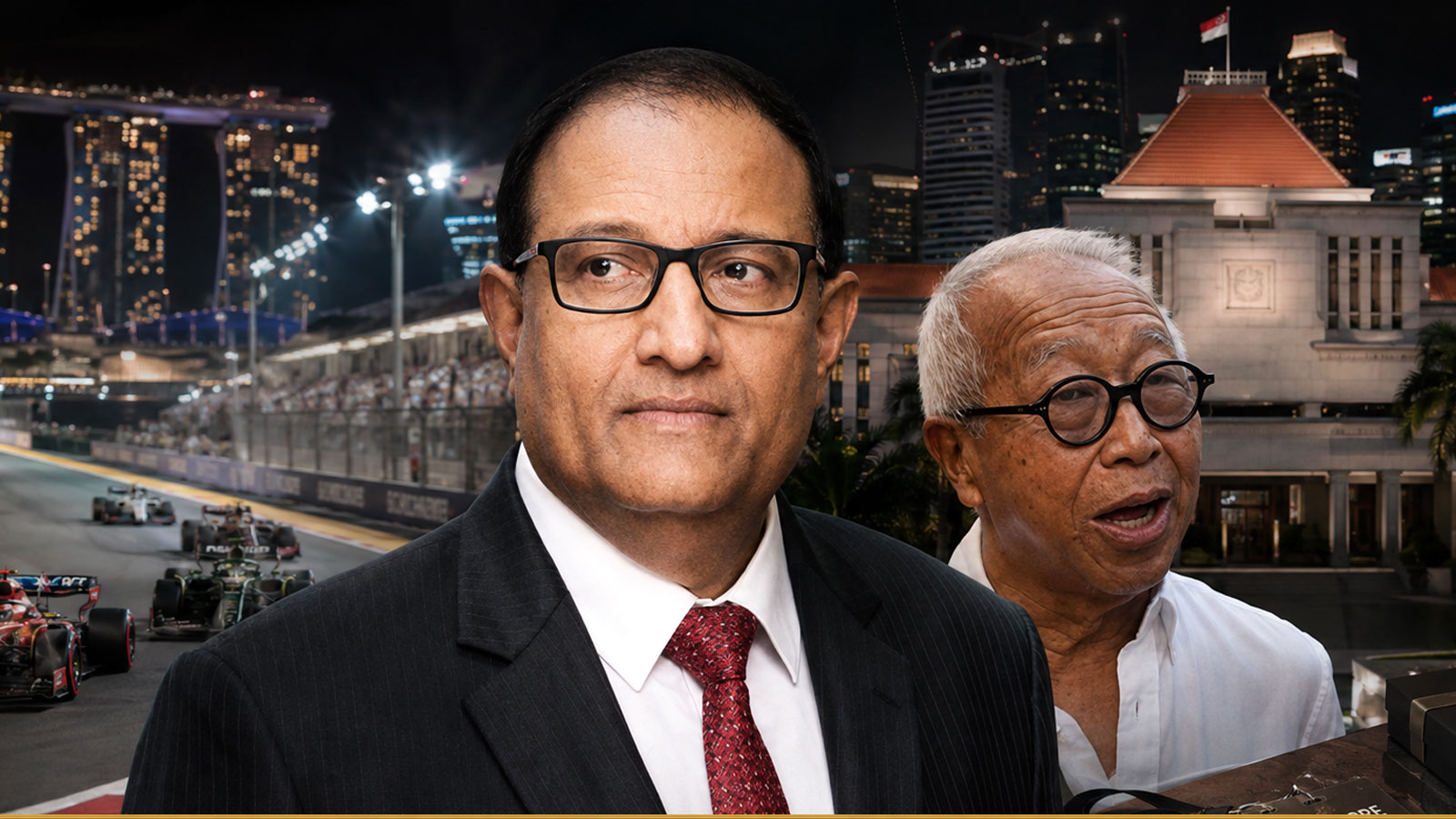
- On 3 October 2024, Singapore’s High Court sentenced former Transport Minister S.
- Another 30 charges under the same public-servant gifts provision were taken into consideration for sentencing.
- Across the proceeded and taken-into-consideration charges, the Attorney-General’s Chambers placed the total value of gifts at S$403,297.92.
- The gifts included Formula 1 tickets, overseas event tickets, hotel accommodation, a private-jet journey, wine, whisky, golf clubs and a high-end folding bicycle.
- The principal giver was Malaysian billionaire hotel and property businessman Ong Beng Seng, chairman of Singapore GP, the company that promoted the Singapore Formula 1 Grand Prix.
EXECUTIVE FINDING
On 3 October 2024, Singapore’s High Court sentenced former Transport Minister S. Iswaran to 12 months’ imprisonment.
Nine days earlier, on 24 September, Iswaran had pleaded guilty to four charges of obtaining valuable things as a public servant from businessmen with whom he had official dealings, and one charge of obstructing the course of justice.
Another 30 charges under the same public-servant gifts provision were taken into consideration for sentencing.
Across the proceeded and taken-into-consideration charges, the Attorney-General’s Chambers placed the total value of gifts at S$403,297.92.
The gifts included Formula 1 tickets, overseas event tickets, hotel accommodation, a private-jet journey, wine, whisky, golf clubs and a high-end folding bicycle.
The principal giver was Malaysian billionaire hotel and property businessman Ong Beng Seng, chairman of Singapore GP, the company that promoted the Singapore Formula 1 Grand Prix.
A second giver was Lum Kok Seng, managing director of Lum Chang Holdings.
Iswaran knew both men were concerned in business connected with his official functions.
The case is unusual because the final convictions did not require the prosecution to prove a traditional quid pro quo bribe.
Singapore’s Penal Code section 165 targets something more preventive: a public servant obtaining valuable things without consideration from a person connected to business transacted by that public servant.
The law attacks the conflict before the gift has to be proven as payment for a specific official act.
THE VALUE WAS NOT ONLY THE TICKET. IT WAS ACCESS TO THE MINISTER WHO COULD NEVER BE SEEN AS OWING THE GIVER ANYTHING.
The central Kleptik question is therefore:
HOW MUCH HOSPITALITY CAN A PUBLIC OFFICIAL ACCEPT BEFORE FRIENDSHIP, ACCESS AND COMMERCIAL INTEREST BECOME IMPOSSIBLE TO SEPARATE?
THE FINDING
The Iswaran case is not best understood as a luxury-gifts story.
It is a conflict-of-interest story.
The gifts were valuable because they moved through relationships between a minister and businessmen whose companies interacted with the state.
No single ticket had to purchase a government decision for the risk to become real.
Repeated hospitality can create familiarity, reciprocity and perceived obligation long before anyone writes down a quid pro quo.
BUSINESSMAN
↓
VALUABLE HOSPITALITY
↓
MINISTER
↓
ONGOING OFFICIAL RELATIONSHIP
↓
ACCESS + FAMILIARITY
↓
CONFLICT / PERCEIVED OBLIGATION
↓
PUBLIC-TRUST RISK
S. ISWARAN
Iswaran was a senior Singapore politician who served in Cabinet for many years and became Minister for Transport.
His portfolios also included trade and industry responsibilities relevant to tourism, investment and major events.
That placed him at the intersection of government, infrastructure, international business and Singapore’s Formula 1 project.
ONG BENG SENG
Ong Beng Seng is a Malaysian billionaire businessman associated with hotels, property and the promotion of Formula 1 in Singapore.
Singapore GP, chaired by Ong, had contractual and commercial relationships involving the Singapore Tourism Board.
That made the relationship with a Cabinet minister unusually sensitive from a public-integrity perspective.
LUM KOK SENG
Lum Kok Seng was managing director of Lum Chang Holdings.
CPIB said Iswaran received valuable items from Lum while knowing Lum was concerned in business transacted that had a connection with Iswaran’s official function as Transport Minister.
The Lum charges therefore reinforced that the risk was not confined to one friendship or one commercial relationship.
THE 35-CHARGE ARCHITECTURE
Before the guilty plea, Iswaran faced 35 charges.
Twenty-seven related to Ong Beng Seng and eight related to Lum Kok Seng.
The Ong group included section 165 charges, two Prevention of Corruption Act charges and one obstruction charge.
The Lum group comprised section 165 charges.
THE PLEA
On 24 September 2024, Iswaran pleaded guilty to five charges.
Four were under section 165 of the Penal Code.
One was for obstruction of justice under section 204A(a).
Thirty additional section 165 charges were taken into consideration at sentencing.
WHY THE PCA CHARGES MATTER EVEN THOUGH THEY WERE NOT THE CONVICTIONS
The original case had included two Prevention of Corruption Act charges alleging inducements connected to advancing Ong’s business interests.
Those were not the offences of conviction.
Kleptik therefore does not describe the final judgment as a conviction for bribery under the PCA.
The final legal core is section 165 plus obstruction.
SECTION 165
Section 165 is designed for public servants.
It criminalises obtaining valuable things without consideration from a person whom the public servant knows to be concerned in business transacted, or likely to be transacted, by that public servant or connected to the public servant’s official functions.
The preventive logic is powerful.
Government should not have to wait for a provable corrupt bargain before addressing dangerous gift relationships.
THE PREVENTIVE CORRUPTION MODEL
Traditional bribery asks: what official act was purchased?
Section 165 asks an earlier question:
Why is this businessman giving valuable things to this public servant at all?
THE FIRST PROCEEDED F1 TICKETS
One proceeded charge concerned ten Green Room tickets to the 2017 Singapore Formula 1 Grand Prix.
The Attorney-General’s Chambers valued them at S$42,265.
The event was not peripheral to government.
Singapore’s F1 race involved significant tourism and public-sector relationships.
FORMULA 1 AS A PUBLIC-PRIVATE PLATFORM
The Singapore Grand Prix is a commercial sporting event.
It is also a tourism and national-branding project involving the public sector.
Where government and private promoters jointly create an event, hospitality to officials requires unusually clear boundaries.
THE DOHA TRIP
Another proceeded charge concerned a December 2022 trip involving private aviation, accommodation and a business-class flight associated with Ong.
The Doha-to-Singapore flight later became the centre of the obstruction charge.
THE OBSTRUCTION
The prosecution established that Iswaran made payment of S$5,700 for the business-class flight after CPIB investigations had begun.
The obstruction offence concerned conduct tending to obstruct the course of justice by creating the appearance that he had paid for the flight.
The timing transformed reimbursement into evidence.
REPAYMENT AFTER DISCOVERY
Paying after an issue has been discovered is not the same as paying at the time the benefit is received.
A later reimbursement can be legitimate remediation.
It can also become problematic if used to alter the evidentiary appearance of an earlier transaction.
THE S$403,297.92 TOTAL
AGC placed the total value of gifts across the proceeded and TIC charges at S$403,297.92.
That amount should not be described as a bribe total.
It is the value of gifts covered by the section 165 charges.
DISGORGEMENT AND FORFEITURE
Iswaran disgorged S$380,305.95 to the State representing the value of consumed gifts.
CPIB had also seized wine, whisky, golf clubs and a Brompton T-Line bicycle worth S$17,291.97, which Iswaran agreed to forfeit.
The financial remediation therefore broadly matched the value of the benefits.
THE TICKETS
The case involved repeated tickets to high-value events.
Formula 1.
Football.
Theatre and entertainment.
Hospitality can be difficult to regulate because its market value is obvious while its relationship value is harder to quantify.
THE GIFT IS ALSO TIME
Premium hospitality does not only transfer a ticket.
It creates time with the giver.
Private transport.
Shared events.
Repeated social contact.
That relational value can exceed face value.
THE ACCESS ECONOMY
Businesspeople often value access more than the object purchased.
A S$5,000 ticket can create hours beside a decision-maker.
The compliance question is therefore not merely price.
It is proximity.
GIFTS VERSUS BRIBES
A gift may be innocent.
A bribe is corrupt consideration for conduct.
A section 165 offence can exist in the dangerous space between them.
The item need not be proved to purchase a specific act if the giver is connected to the official’s business and the statutory conditions are met.
THE CONFLICT BEFORE THE QUID PRO QUO
This is why the Singapore model matters internationally.
Many systems focus on proving corrupt intent.
Singapore’s rule also protects against relationships that can erode impartiality even where a direct bargain is difficult to prove.
GIFT
↓
SOCIAL ACCESS
↓
RECIPROCITY
↓
FUTURE OFFICIAL CONTACT
↓
PERCEIVED OBLIGATION
↓
IMPARTIALITY RISK
THE GREEN ROOM PROBLEM
Premium event hospitality is designed to be exclusive.
Exclusive access is precisely what makes it valuable.
For a public official, exclusivity can create a private relationship around a public-facing event.
THE PRIVATE-JET PROBLEM
Private aviation creates a particularly high-value benefit.
The traveller receives not only transport but privacy, flexibility and elite access.
That is why private aircraft should be treated as enhanced-risk hospitality for public officials.
HOTEL ACCOMMODATION
Luxury accommodation can be part of ordinary business travel.
If paid by a businessman with official interests, however, the funding source becomes part of the integrity analysis.
ALCOHOL, GOLF CLUBS AND THE BICYCLE
The physical gifts in the case included alcohol, sporting equipment and a premium bicycle.
These objects matter because they show the relationship extended beyond one-off event attendance.
Repeated categories of benefit can evidence an ongoing gift culture.
GIFT CULTURE
A one-off gift may be an error.
Repeated gifts across years can become normalised.
Normalisation is dangerous because both sides stop experiencing the transaction as exceptional.
THE OFFICIAL-FUNCTION CONNECTION
The legal issue was not simply that the givers were wealthy businessmen.
Iswaran knew they were concerned in business connected to his official functions.
That nexus is what converts private hospitality into public-integrity risk.
THE SINGAPORE GP CONTRACT
The original corruption charges referenced matters relating to a contract between Singapore GP and the Singapore Tourism Board, and a proposal for another contract.
Because those PCA charges were not the final offences of conviction, Kleptik treats them as part of the pre-plea prosecutorial architecture rather than adjudicated bribery findings.
PUBLIC CONTRACT + PRIVATE HOSPITALITY
Where a businessman’s company has a live contract with government, any substantial private benefit to the responsible minister is high risk.
The safest governance rule is not to ask whether the minister can remain impartial.
It is to avoid creating the doubt.
THE APPEARANCE STANDARD
Public integrity depends on actual impartiality and visible impartiality.
Citizens rarely know what was said privately.
They judge the system through disclosed relationships and objective conflicts.
THE 'FRIEND' DEFENCE PROBLEM
Friendship does not eliminate conflict.
It can increase it.
A long personal relationship may explain why a gift was given, but it does not change the official responsibility to manage the donor’s business interests.
FRIENDS WITH GOVERNMENT BUSINESS
The closer the friendship, the clearer the recusal and gift rules should be.
Informality is not a compliance exemption.
THE BUSINESSMAN’S PERSPECTIVE
A businessman may view hospitality as friendship or customary generosity.
The public servant carries the legal burden of office.
That asymmetry is why public-sector rules often impose stricter duties on the recipient.
THE OFFICIAL’S PRICE SIGNAL
Accepting expensive hospitality can unintentionally signal that future gifts are welcome.
Once the relationship becomes reciprocal, refusing a later request may become socially harder even if legally required.
RECIPROCITY RISK
Human beings reciprocate.
Anti-corruption law is partly designed around that fact.
A public servant should not be placed in a position where gratitude competes with duty.
THE PUBLIC TRUST PREMIUM
Singapore’s reputation for low corruption is an economic asset.
A ministerial gifts case therefore imposes reputational cost beyond the value of the gifts.
The cleaner the system is perceived to be, the more significant a high-level breach becomes.
WHY THE SENTENCE MATTERED
The prosecution sought a lower aggregate sentence than the High Court ultimately imposed.
Chief Justice Sundaresh Menon imposed 12 months.
The sentence sent a deterrent message that high office increases rather than reduces the seriousness of public-integrity breaches.
PUBLIC SERVICE AS AGGRAVATION
Senior office gives access, influence and trust.
Those are public assets.
Misusing the boundary around them can justify stronger deterrence.
THE MINISTERIAL STANDARD
A minister is not an ordinary employee.
The minister participates in setting policy and influencing major state relationships.
The gift standard should therefore be correspondingly strict.
THE ZERO-TOLERANCE MODEL
CPIB repeatedly describes Singapore as operating a zero-tolerance approach to corruption.
The Iswaran case tested whether that principle applies when the accused is a longstanding Cabinet minister.
The investigation, prosecution and imprisonment demonstrate institutional willingness to proceed against senior office.
INSTITUTIONAL CREDIBILITY
Anti-corruption agencies earn credibility when enforcement reaches powerful people.
Selective enforcement destroys it.
A system is strongest when status does not stop investigation.
CPIB
Singapore’s Corrupt Practices Investigation Bureau investigated the case.
CPIB publicly disclosed both the Ong and Lum streams and emphasised the importance of vigilance.
The bureau’s role is analytically important because gifts cases often begin with relational intelligence rather than obvious stolen public money.
THE DISCOVERY PROBLEM
Gift relationships are hard to detect if neither giver nor recipient reports them.
There may be no public contract invoice labelled 'hospitality for minister.'
Detection therefore depends on disclosures, whistleblowers, audits, travel records and investigative intelligence.
CALENDAR FORENSICS
Investigators should compare event dates with official meetings, contract milestones and ministerial decisions.
Timing does not prove influence.
It can identify where deeper review is warranted.
TRAVEL FORENSICS
Private flights, upgrades, hotels and event hospitality leave records.
Passenger manifests.
Invoices.
Hotel bookings.
Corporate expense records.
These can reconstruct the true economic sponsor of travel.
TICKET FORENSICS
High-value event tickets often have serial numbers, hospitality packages and purchaser records.
That makes them traceable even when physically transferred informally.
THE DONOR EXPENSE ACCOUNT
The giver’s corporate records may show the cost and business classification of hospitality.
If an item given to a minister is booked as business development, that may be relevant context.
It does not alone prove corruption.
THE RECIPIENT DISCLOSURE FILE
Government should maintain a central record of declared gifts, hospitality and recusals.
Fragmented reporting makes pattern detection difficult.
THE CUMULATIVE-VALUE RULE
A small gift can be immaterial.
A pattern of smaller gifts can become significant.
Compliance systems should aggregate by giver, beneficial owner and corporate group.
BENEFICIAL OWNERSHIP OF THE GIVER
A public official may receive gifts from several related companies or executives.
Screening should identify whether they are economically part of the same business group.
THE RECUSAL LEDGER
For each significant gift relationship, government should know which official matters the recipient was excluded from.
A recusal that exists only in memory is difficult to audit.
THE NO-CONSIDERATION TEST
The statutory phrase 'without consideration' focuses on whether the public servant paid for the valuable thing.
Paying later after investigation is materially different from paying contemporaneously.
The control should operate before or at receipt.
THE FAIR-MARKET-VALUE RULE
If a public servant is permitted to buy an item from a business contact, payment should be at demonstrable market value and documented contemporaneously.
Discounts can themselves be valuable things.
THE OBSTRUCTION LESSON
The obstruction conviction demonstrates that post-event conduct can create separate criminal exposure.
Once an investigation begins, attempts to tidy the record can become more serious than the original compliance problem.
DO NOT REWRITE THE TRANSACTION
If a gift should have been paid for, the remediation should be transparent.
Date of repayment.
Reason.
Disclosure to investigators.
Backdating or creating a false commercial appearance is unacceptable.
THE 30 TIC CHARGES
Thirty additional section 165 charges were taken into consideration for sentencing.
TIC charges are not separate convictions.
But they form part of the sentencing picture because the accused consents to the court considering them.
TIC ≠ CONVICTION
Kleptik preserves this distinction.
Four section 165 charges and one obstruction charge were convictions.
Thirty further section 165 charges were taken into consideration.
THE TOTAL-VALUE PROBLEM
The S$403,297.92 figure covers gifts linked to the proceeded and TIC charges.
It should not be presented as the value of the five convicted charges alone.
THE OBLIGATION TO DISGORGE
Returning value matters for remediation.
It does not erase the offence.
Compliance systems should never allow 'pay later if caught' to become the practical rule.
THE CORPORATE SIDE
Businesses entertaining public officials also carry risk.
They need registers, approvals and legal review for benefits provided to PEPs and public servants.
A relationship should never depend on a minister’s personal hospitality debt.
KNOW YOUR PUBLIC OFFICIAL
Corporate compliance should identify when a guest is a public official, what portfolio the official holds and whether the company has business before that official’s ministry.
THE EVENT-HOSPITALITY POLICY
Sports, entertainment and cultural tickets require specific policy.
Face value.
Hospitality value.
Travel.
Companions.
Private areas.
All should be considered.
THE FAMILY AND COMPANION QUESTION
Hospitality becomes more valuable when extended to family or companions.
A corporate policy should aggregate all benefits connected to the public official.
THE F1 BRANDING QUESTION
Formula 1 is both entertainment and economic-development infrastructure for host cities.
That dual character makes promoter-government relationships especially sensitive.
TOURISM CONTRACTS
Large destination events often involve public subsidies, tourism contracts or state-backed infrastructure.
Government officials should therefore treat promoter hospitality like contractor hospitality.
THE CLEAN-GOVERNMENT PARADOX
In a highly corrupt system, gifts may be expected.
In a clean system, even non-quid-pro-quo hospitality can be intolerable because public trust rests on stricter boundaries.
The same conduct can therefore carry different systemic significance depending on institutional norms.
THE GIFT-RISK MATRIX
| Benefit | Why it matters | Control question |
|---|---|---|
| F1 hospitality tickets | High value + direct link to Singapore GP ecosystem | Who paid, who attended, what official matters were live? |
| Private aviation | Exceptional monetary and relational value | Was travel official, private, approved and contemporaneously paid? |
| Hotel accommodation | Third-party funding of personal travel | Did giver have business before the ministry? |
| Golf clubs / bicycle / alcohol | Portable personal benefits | Were gifts declared, surrendered or paid for? |
| Overseas event tickets | Access outside normal work context | Was hospitality connected to an official relationship? |
THE LEGAL-STATUS MATRIX
| Category | Status on 3 October 2024 | Kleptik treatment |
|---|---|---|
| 4 section 165 charges | Guilty plea + conviction | ESTABLISHED — GUILTY PLEA |
| 1 obstruction charge | Guilty plea + conviction | ESTABLISHED — GUILTY PLEA |
| 30 section 165 charges | Taken into consideration | TIC — not separate convictions |
| 2 original PCA charges | Not offences of conviction | Do not report as final bribery convictions |
| Total gifts S$403,297.92 | AGC total across proceeded + TIC charges | Established case value, not bribe total |
CHRONOLOGY
2015–2021
The later charge set alleges repeated valuable items from Ong Beng Seng during years in which Ong was connected to business touching Iswaran’s official functions.
September 2017
Iswaran obtains ten Green Room tickets to the Singapore Formula 1 Grand Prix, valued at S$42,265; this becomes one of the proceeded charges.
2021–2022
Iswaran receives various items from Lum Kok Seng, including golf-related items, alcohol and a Brompton bicycle, according to the charge set.
December 2022
The Doha trip occurs, involving private travel, accommodation and a business-class flight associated with Ong.
July 2023
CPIB investigation becomes public; Iswaran is placed on leave from ministerial duties.
18 January 2024
Iswaran is charged with 27 offences involving Ong Beng Seng.
25 March 2024
Eight additional section 165 charges involving Lum Kok Seng are filed, bringing the total to 35.
19 July 2024
The High Court allows joinder of the charges for trial.
24 September 2024
Iswaran pleads guilty to four section 165 charges and one obstruction charge; 30 section 165 charges are taken into consideration.
24 September 2024
AGC states total gift value across the proceeded and TIC charges is S$403,297.92; Iswaran disgorges S$380,305.95 and agrees to forfeiture of seized items worth S$17,291.97.
3 October 2024
The High Court sentences Iswaran to an aggregate 12 months’ imprisonment.
DOCUMENTARY RECORD
ATTORNEY-GENERAL’S CHAMBERS — 24 SEPTEMBER 2024
The AGC plea announcement is the principal primary record for the offences of conviction, the 30 TIC charges, total gift value, disgorgement and forfeiture.
CORRUPT PRACTICES INVESTIGATION BUREAU
CPIB public materials describe the Ong and Lum gift streams, Iswaran’s official relationships and Singapore’s zero-tolerance enforcement position.
SINGAPORE HIGH COURT / JUDICIARY
The High Court proceedings establish the joinder background and the final 12-month sentence imposed on 3 October 2024.
CHARGE HISTORY
The original charging record included two Prevention of Corruption Act charges linked to advancing Ong’s business interests. Because Iswaran’s final plea was to section 165 and obstruction offences, Kleptik does not convert the withdrawn or unproceeded PCA allegations into convictions.
WHAT ISWARAN ADMITTED
Iswaran admitted four offences of obtaining valuable things as a public servant from businessmen whom he knew were concerned in business connected with his official functions.
He also admitted obstructing the course of justice in relation to payment for the Doha-Singapore flight.
His guilty plea established criminal liability without a contested trial on those five charges.
WHAT THE CASE DOES NOT ESTABLISH
The final convictions do not establish that every gift Iswaran ever received was corrupt.
They do not establish that every official decision involving Singapore GP, the Singapore Tourism Board or Lum Chang was improperly influenced.
They do not establish that the total S$403,297.92 represented bribe payments for identified acts.
They do not convert the two original Prevention of Corruption Act charges into convictions.
They do not establish misconduct by every company employee involved in providing hospitality.
They do not establish that Formula 1 hospitality itself is improper; the risk depends on the recipient, giver, value and official nexus.
RIGHT OF REPLY
For historical publication, Kleptik should reproduce the substance of Iswaran’s guilty plea and sentencing position accurately.
Ong Beng Seng and Lum Kok Seng should be described according to their own legal status as of the archive date and not treated as convicted merely because they were givers in Iswaran’s case.
Singapore GP, Lum Chang, the Singapore Tourism Board and other entities should not be criticised beyond evidence specific to their conduct.
Any new reporting about corporate approval of hospitality should be put directly to the relevant company before publication.
UNANSWERED QUESTIONS
1. THE INTERNAL GIFT REGISTER
Which of the benefits, if any, were disclosed inside government when received?
2. THE RECUSAL RECORD
Did Iswaran recuse himself from any matters involving Ong, Singapore GP, Lum or Lum Chang?
3. THE F1 CONTRACT
Which officials reviewed Singapore GP-related contracts independently of Iswaran?
4. THE BUSINESS PURPOSE
How did Ong’s companies account internally for the tickets, travel and hospitality?
5. THE LUM GIFTS
How were the Lum-provided items selected, approved and recorded?
6. THE PRIVATE JET
Who paid each component of the Doha travel and what documentation was created at the time?
7. THE HOTEL
Was the accommodation recorded as personal hospitality, corporate expense or another category?
8. THE REPAYMENT
Why was the S$5,700 flight payment made when it was, and what communications surrounded it?
9. THE TIC PATTERN
What does the full chronology of the 30 TIC gifts show about frequency and escalation?
10. THE GOVERNMENT POLICY
What gift-value thresholds and approval rules applied to ministers during the relevant years?
11. FRIENDSHIP
How did government guidance distinguish longstanding personal friendships from official business relationships?
12. EVENT ACCESS
Were F1 and other event tickets routinely allocated to government officials through official channels separately from private hospitality?
13. COMPANIONS
Were benefits ever extended to family members or other companions, and how were those valued?
14. CORPORATE COMPLIANCE
What PEP approval processes existed at the giver companies?
15. BENEFICIAL OWNERSHIP
Were benefits provided by related corporate entities aggregated for compliance purposes?
16. CPIB TRIGGER
What information first caused CPIB to investigate the gift relationships?
17. OTHER OFFICIALS
Did the investigation identify comparable hospitality provided to other public officials?
18. POLICY REFORM
What ministerial gift and hospitality controls changed after the case?
19. PUBLIC COST
What reputational or institutional cost did the case impose beyond the S$403,297.92 gift value?
20. THE CENTRAL QUESTION
Can a government preserve public confidence if ministers are allowed to accept substantial private hospitality from businesspeople whose companies depend on government relationships, even where no specific quid pro quo can be proven?
KLEPTIK INTELLIGENCE ASSESSMENT
ASSESSMENT: ESTABLISHED — GUILTY PLEA
On 24 September 2024, Iswaran pleaded guilty and was convicted of four section 165 offences and one obstruction offence.
ASSESSMENT: ESTABLISHED — SENTENCE
On 3 October 2024, the High Court sentenced Iswaran to 12 months’ imprisonment.
ASSESSMENT: ESTABLISHED — GIFT VALUE
AGC placed total gift value across the proceeded and TIC charges at S$403,297.92.
ASSESSMENT: ESTABLISHED — REMEDIATION
Iswaran disgorged S$380,305.95 and agreed to forfeiture of seized items worth S$17,291.97.
ASSESSMENT: HIGH CONFIDENCE
The case demonstrates a preventive anti-corruption model in which public servants can face criminal liability for accepting valuable benefits from persons connected to their official functions even without a finally adjudicated quid-pro-quo bribery offence.
ASSESSMENT: HIGH CONFIDENCE
Repeated hospitality should be analysed cumulatively because relationship value, access and reciprocity can matter more than any single item.
ASSESSMENT: HIGH CONFIDENCE
The obstruction charge shows that post-discovery reimbursement can create separate criminal exposure where it is used to alter the apparent history of a transaction.
ASSESSMENT: HIGH CONFIDENCE
Singapore’s enforcement against a senior minister strengthened the credibility of its zero-tolerance framework by demonstrating that high rank did not prevent prosecution or imprisonment.
THE KLEPTIK VIEW
Corruption does not always begin with an envelope.
Sometimes it begins with a ticket.
A seat.
A flight.
A hotel room.
A golf club.
A bottle of wine.
Each object can be explained as hospitality.
Each can also create something more valuable than the object itself.
Access.
Familiarity.
Reciprocity.
The expectation that a relationship exists.
That is why Singapore’s section 165 matters.
It does not wait for prosecutors to prove that ticket A purchased decision B.
It protects the public service from the relationship becoming financially entangled in the first place.
The Iswaran case also exposes a mistake common in compliance.
People measure gifts one by one.
But relationships accumulate.
Ten tickets today.
Travel next year.
A bicycle later.
Another event.
Another dinner.
Individually explainable.
Collectively different.
The public servant may still believe he is impartial.
The public cannot see inside his mind.
It sees the pattern.
PUBLIC TRUST IS NOT ONLY ABOUT WHETHER THE MINISTER WAS BOUGHT.
IT IS ABOUT WHETHER THE PUBLIC CAN BE CERTAIN HE WAS NEVER FOR SALE.
That is the real value of a preventive gifts rule.
It removes the argument before the decision has to be questioned.
And it shifts the compliance question from:
What did the businessman get?
to:
Why should the businessman have been paying for the minister at all?
FOLLOW THE GIFT.
FOLLOW THE BUSINESS RELATIONSHIP.
THEN ASK WHETHER THE PUBLIC OFFICIAL SHOULD EVER HAVE OWED THE GIVER GRATITUDE.
KLEPTIK METHODOLOGY
This dossier is dated 3 October 2024 and is intentionally fixed to the legal and evidentiary position existing on that date.
The principal evidentiary sources are the Attorney-General’s Chambers guilty-plea announcement of 24 September 2024, CPIB public materials concerning the Ong and Lum gift streams, and Singapore Judiciary records concerning the charge structure and sentencing.
Kleptik distinguishes strictly among four categories.
CONVICTED SECTION 165 OFFENCES
Four offences admitted by guilty plea and resulting in conviction.
CONVICTED OBSTRUCTION OFFENCE
One offence admitted by guilty plea concerning the Doha-Singapore flight payment.
TAKEN-INTO-CONSIDERATION CHARGES
Thirty additional section 165 charges considered for sentencing but not separate convictions.
ORIGINAL PCA ALLEGATIONS
Two original Prevention of Corruption Act charges that formed part of the pre-plea case but were not the offences of conviction.
For gifts analysis, Kleptik evaluates value, frequency, giver identity, beneficial owner, official nexus, contemporaneous payment, disclosure, recusal and cumulative relationship value.
For hospitality, face value is not treated as the complete economic value because private access and exclusivity can be significant.
For companies, providing a benefit to a public official is not treated as corruption without evidence of the relevant legal elements.
For historical treatment, later proceedings concerning Ong Beng Seng or any later policy changes are excluded from this archive-date dossier.
EVIDENTIARY LABELS
ESTABLISHED — GUILTY PLEA
Conduct admitted by Iswaran and resulting in conviction.
ESTABLISHED — SENTENCE
Punishment imposed by the High Court on 3 October 2024.
TIC — NOT SEPARATE CONVICTION
Charge taken into consideration for sentencing with the accused’s consent.
ORIGINAL PROSECUTION ALLEGATION
Charge forming part of the original case but not the final offence of conviction.
PUBLIC-SERVANT GIFT RISK
Benefit from a person connected to the public servant’s official functions.
HOSPITALITY INDICATOR
Ticket, travel, accommodation or entertainment benefit requiring conflict analysis.
OBSTRUCTION INDICATOR
Post-event conduct potentially altering or concealing the evidentiary record.
KLEPTIK VERIFIED
Fact independently corroborated through official primary records.
KLEPTIK ASSESSMENT
Analytical conclusion derived from identified evidence.
INVESTIGATIVE LEAD
Matter requiring further government, corporate, travel or financial verification.
DOCUMENT STATUS
KLTK-2024-031
Subject: S. Iswaran / Ong Beng Seng / Lum Kok Seng / Gifts and Hospitality / Public Integrity / Singapore
Archive date: 3 October 2024
Status at archive date: Guilty plea and conviction on four section 165 charges and one obstruction charge; sentenced to 12 months’ imprisonment
Historical treatment: Fixed to report date
© KLEPTIK — Investigations into Power, Money and the Systems Designed to Hide Both