GRENADA FILES: THE ARCHITECTURE OF POWER


- The reported pre-convention network that prepared Mitchell's rise remains only partly identified, and Grenada still lacks a public 2020–2022 donor and in-kind support ledger capable of testing competing claims about who financed or materially supported that effort.
- Grenada's own Cabinet procedures contemplate disclosure, non-participation and transfer of responsibility when conflicts arise — making recusal and conflict records the natural test wherever former clients, business associates, party officers, developers or investors intersect with state decisions.
- Project Polaris is not only a hospital: published material describes a broader medical city with accommodation, retirement, hospitality, wellness and other private-participation opportunities, putting land, concessions, operating rights and PPP economics squarely in the public interest.
- UNGA 81 brought Andrea St Bernard, Richard Nixon and Hassan Hadeed into the same official investment-facing mission while each carried separate political, project or private-business significance — making investor lead allocation, referral, follow-up and conflict controls material records.
- Kawana Bay is the clearest precedent for the convergence of diplomacy, CBI development, political transition, arbitration, settlement and redevelopment; the unresolved issue is not the settlement itself but whether the complete valuation, conflict and beneficiary record is publicly auditable.
- The 2026 campaign is unfolding while major institutional questions remain live: Polaris procurement and design changes, the CBI review and new regional regulator, the hydrocarbon-rights transition, and election-process litigation and voter-roll objections.
ELECTION-PERIOD PUBLICATION NOTE
Grenada is now in an active general-election campaign. Prime Minister Dickon Mitchell called polling for 5 November 2026, almost a year before the constitutional deadline. KLEPTIK is therefore publishing this sequence as an election-period accountability investigation. It examines the political and financial architecture surrounding the 2022 change of government: who organised and supported Mitchell's rise, which business and diplomatic networks acquired public access after the transition, how major disputes and projects were handled, and where measurable private benefit may have followed public power. This is not an allegation that the 2022 vote count was fraudulent or that the electoral result was illegitimate.
The publication standard does not change because an election is under way. Documented facts are stated as facts; source-based allegations remain attributed; and inference is identified as inference. The public-interest question is narrower and more important: what does the record show about the origin, exercise and beneficiaries of political power before voters are asked to renew it?
INTRODUCTION
WHY THIS INVESTIGATION MATTERS NOW
Grenada enters the final weeks of a general-election campaign with unresolved questions from the political transition that brought Dickon Mitchell and the National Democratic Congress to office in 2022. Mitchell moved from private legal practice to NDC political leader in October 2021, won a parliamentary seat in June 2022 and became Prime Minister the following day. Contemporary reporting said unnamed backers had been preparing his political entry for roughly a year before the leadership contest. KLEPTIK has not located a complete public ledger identifying the participants, contributions and roles in that reported pre-convention effort.
This investigation examines what happened around that transition and what followed it. It traces the overlap between political organisation, private business, Citizenship by Investment, diplomatic appointments, state investment promotion, public boards, major settlements and Project Polaris. It asks who had access, who acquired public authority, which private interests existed at the same time, and what documentary safeguards show that public decisions were separated from private opportunity.
The timing is not incidental. Grenadians vote again on 5 November 2026, almost a year before the constitutional deadline. At nomination, Mitchell publicly presented constituency commitments as a record against which he should be measured. The governing NDC is campaigning on its record since 2022, while the opposition is challenging that record on cost of living, public services and major projects. Sequence One therefore treats the 2022 transition not as closed history but as the origin point of a governing architecture now being submitted to voters for renewal.
The report is not an allegation that the 2022 vote count was fraudulent, that the 2026 election is illegitimate, or that every overlap identified here is improper. Its standard is narrower: documented facts are stated as facts; allegations are attributed; inference is identified as inference; and the most serious questions are framed around records that can prove or disprove them. The purpose is to move the debate from political assertion to an auditable chronology of money, access, appointments, decisions and benefit.
EXECUTIVE SUMMARY
Dickon Mitchell's political rise was rapid and, according to contemporaneous reporting, preceded by a quieter period of preparation whose full sponsors remain unidentified in the public record. Once in office, the premiership accumulated direct responsibility for infrastructure, utilities, civil aviation, transportation, national security, home affairs, public administration, information and disaster management. Grenada's constitutional and Cabinet framework gives the office additional influence over ministerial appointments, Cabinet procedure and the machinery through which decisions are recorded.
The investigation finds a recurring cast at the boundary between politics, diplomacy, investment promotion, CBI, public boards and private commerce. Andrea St Bernard moved from NDC Treasurer to Grenlec, development-and-investment envoy, Project Polaris Sponsor and Grenada Development Bank chair. Richard A. Nixon combines senior diplomatic and GIDC responsibilities with active private development and CBI-linked interests. Hassan Hadeed combines substantial private business with ambassadorial and government-linked roles. These overlaps do not establish misconduct; they make conflict declarations, recusals, investor-referral logs and appointment records central evidence.
Three clusters provide the clearest tests of the architecture. Kawana Bay asks how a politically charged CBI dispute involving former diplomat and developer Warren Newfield was handled after the change of government, and who retained or acquired economic rights through settlement and redevelopment. Project Polaris asks who originated and structured the wider medical-city concept, how advisers, land and contractors were selected, and who will receive private development, operating or land-value benefits around a publicly financed hospital. The 2022 leadership transition asks who organised or financed the political project before the public campaign and whether later public access can be traced to earlier support.
The 2026 election adds urgency rather than changing the evidentiary standard. Project Polaris remains in development and procurement; its hospital footprint was repositioned after geotechnical work in October 2026. Grenada's CBI programme is undergoing an independent review while a new regional regulator is being operationalised. The Government has terminated major petroleum agreements that Global Petroleum Group disputes. Aspects of the current electoral process are before the High Court. Each issue is treated here according to its documentary record, not campaign rhetoric.
WHAT THIS REPORT DOES NOT ALLEGE
Sequence One does not find that Dickon Mitchell, the NDC or any named individual committed a criminal offence, civil wrong, corruption offence or breach of duty merely because of the relationships assembled here. It does not treat political opposition claims, anonymous-source allegations, family relationships or proximity as proof. It identifies overlaps and unresolved transactions, then specifies the donor, recusal, referral, procurement, settlement, land, travel and beneficial-ownership records capable of testing them.
SERIES PROLOGUE
THE CAST BEFORE THE SYSTEM
A reader’s guide to the recurring political, diplomatic, investment, CBI, development and commercial actors who appear across the investigation
EDITORIAL NOTE
This prologue does not accuse the people named below of criminal or civil wrongdoing. It identifies recurring intersections that are relevant to the public-interest questions examined in later sequences. A political donation, business relationship, diplomatic appointment, CBI role, board seat, professional connection, social relationship or appearance at the same event does not by itself establish improper conduct, a conflict, patronage or quid pro quo. Where the underlying material is an allegation rather than a verified fact, it is identified as such.
WHY A PROLOGUE IS NEEDED
The central editorial question is not whether successful businesspeople should serve their country, whether governments may appoint political allies, or whether diplomats may retain lawful private interests. The question is whether Grenada has sufficiently visible rules to separate public authority from private opportunity when the same people move repeatedly among party structures, state boards, diplomacy, investment promotion, CBI, development projects, banking, negotiations and international investor outreach.
This prologue is therefore a map, not a verdict. Sequence One then examines the architecture of executive authority and the conflict-management rules that are supposed to govern it. Sequence Two follows relationships and access. Later sequences follow CBI and development, financial benefits, international networks, hydrocarbon interests and unresolved documentary gaps.
EVIDENTIARY STANDARD USED THROUGHOUT THE SERIES
| Status | Meaning | Publication treatment |
|---|---|---|
| A — Documented fact | Supported by official records, direct public statements, court/registry records or multiple reliable public sources. | May be stated as fact with citation and context. |
| B — Published allegation | A claim reported by an identified publication or source but not independently proven by Kleptik. | Attribute explicitly; seek response; do not convert allegation into fact. |
| C — Conflict-risk indicator | A documented overlap of public and private roles that may create an actual, potential or apparent conflict. | Frame as a governance question and test against disclosure/recusal rules. |
| D — Investigative lead | A relationship, social-media item, source claim or inference that still requires authentication. | Do not publish as established fact until verified. |
THE CAST AT A GLANCE
| Person / network | Documented public or political relevance | Parallel private / commercial relevance | Why the name recurs |
|---|---|---|---|
| Dickon Mitchell | Prime Minister; NDC political leader; multiple ministerial portfolios. | Former private lawyer; previously active around investment/CBI-related legal work. | The investigation begins with the institutional firewalls between pre-office professional relationships and executive decision-making. |
| Andrea St Bernard | NDC Treasurer; Special Envoy; Project Polaris sponsor; Grenada Development Bank chair; former Grenlec board appointee. | Professional/investment-migration background documented in earlier public records. | She sits at the intersection of party finance, investment promotion, state finance and a flagship national project. |
| Richard A. Nixon | Senior ambassador; GIDC chairman; Africa-facing investment role; UNGA 81 delegate/presenter. | Developer associated with Hideaway True Blue / RIEAST; Hideaway True Blue remains listed as a CBI-approved project. | Public investor access and active private development exist in the same individual. |
| Hassan Hadeed | Ambassador and long-serving public representative; UNGA 81 delegation; other state-linked roles documented in public biographies. | Managing Director of Real Value Supermarket, IGA International Retailer of the Year and broader business interests. | A prominent example of continuing private business activity alongside diplomatic and government-facing responsibilities. |
| Warren Newfield | Former ambassador/consul general. | Kawana Bay / True Blue developer and CBI investor. | Diplomatic status, CBI development and later investor-state arbitration converged in one dispute. |
| Richard Duncan | Publicly identified in earlier dossiers with CBI and state-policy roles. | Banking and financial-sector background. | Relevant to the CBI, banking and institutional layer; the relevant CBI, banking and institutional records should be independently verified before any allegation-heavy treatment. |
| Phillip Telesford | Cabinet minister after 2022. | Earlier private investment links reported around Excellent Farms. | A pre-office commercial relationship later intersected with Cabinet responsibility for sectors affected by policy. |
| Azam Rahaman | NDC supporter/party participant; publicly named contributor to later NDC fundraising. | Longstanding family business interests. | Provides a documented political-support link within a wider family network later appearing in public roles. |
| Salim Rahaman | Independent senator representing business community; public committee roles. | Family business network. | Illustrates the family’s simultaneous presence in commerce and public institutions. |
| Ziya Azam Rahaman | Consul General in Dubai / Northern Emirates. | Business background and Gulf commercial network. | Places the family network inside Grenada’s investment-facing diplomatic platform in the UAE. |
| Zaid Azam Rahaman | Public-board and national-recognition references identified in the public record. | Business interests. | Part of the broader family concentration that merits transparent appointment criteria, not an assumption of patronage. |
| Michelle Emmanuel-Steele | Appears in earlier CBI/project records examined by Kleptik. | Private investment/project activity. | A bridge inside the private CBI/development network associated with The View/Legacy Project material. |
| Damian Dolland | Project consultant / strategic and financial adviser associated publicly with Project Polaris. | Professional advisory role. | A key non-political actor in the design, financing and investor-facing architecture of the flagship project. |
| Africa / international network | Includes figures and envoys appearing in Grenada’s Africa investment, diplomatic and CBI story. | Private investors, developers and businesspeople. | Later sequences will test how official diplomacy, private hospitality, CBI, energy and investor introductions intersect. |
THE CENTRAL CAST
1. DICKON MITCHELL – THE POLITICAL CENTRE
Dickon Mitchell is not included in the cast merely because he is Prime Minister. He is the point through which multiple strands of the investigation converge: an unusually rapid transition from private legal practice to party leadership and national office; previous professional exposure to investment and CBI-related work; a broad portfolio stack; responsibility for Public Administration and Information; direct involvement in major investment and development narratives; and a governing system in which the Prime Minister has substantial influence over ministerial and public appointments.
The relevant test is documentary rather than rhetorical. Where a government decision concerns a former client, a developer previously known through professional work, a CBI project, a private investor, or a person with whom the Prime Minister had a pre-office relationship, the public-interest question is whether the relationship was disclosed, whether recusal was considered or recorded, who made the decision, and whether the record can be inspected. Sequence One develops that institutional test in detail.
2. ANDREA ST BERNARD – PARTY TREASURY, INVESTMENT AND POLARIS
Andrea St Bernard is one of the most important recurring figures because her public trajectory crosses several distinct spheres. Public reporting identified her as NDC Treasurer and, after the 2022 election, as a Grenlec board appointee. She later became a Special Envoy for Development and Investment, Project Sponsor for Project Polaris and, according to the Grenada Development Bank’s current corporate data, chair of the Bank’s board.
At UNGA 81 she was part of Grenada’s high-level delegation and delivered the government’s investor-facing presentation on Project Polaris. That does not establish a conflict. It does make her an unusually clear test case for the separation of party finance, public appointments, state development finance, investment promotion and authority over a flagship project. The relevant documents include appointment instruments, terms of reference, remuneration, conflict declarations, procurement records and any recusals.
3. RICHARD A. NIXON – THE BUSINESS-DIPLOMAT MODEL
Richard Nixon is central because the overlap is not theoretical. Public records and biographies place him in senior diplomatic and investment-promotion roles, including Chairman of GIDC, while current business reporting identifies him as Chairman and President of RIEAST Developments. Grenada’s Investment Migration Agency continues to list Hideaway True Blue Condominium as an approved CBI project with Dr Richard A. Nixon as the contact.
The historical record examined makes this especially important: Nixon’s South Florida diplomatic identity and investment-promotion role extend back decades. Most recently, in September 2026 he appeared in Grenada’s UNGA 81 delegation and presented on why Grenada is a compelling investment destination, while his private development activity remained visible in Grenada and during and around UNGA 81. The governance question is straightforward: what written mechanism separates investors encountered through GIDC, diplomacy or government missions from investors who could become leads for private ventures in which Nixon has an interest?
The records needed to resolve that question include GIDC board conflict declarations, recusal records, investor-referral protocols, travel agendas, lead-allocation records, government incentives affecting Nixon-linked ventures, and communications distinguishing official investment promotion from private business development.
4. HASSAN HADEED – COMMERCIAL POWER AND DIPLOMATIC CONTINUITY
Hassan Hadeed appears repeatedly because his public and private identities coexist openly. In September 2026, NOW Grenada identified him as Managing Director of Real Value Supermarket and a recipient of the IGA International Retailer of the Year award. Public diplomatic biographies also describe longstanding business interests and ambassadorial roles. He was included in Grenada’s UNGA 81 delegation alongside Andrea St Bernard and Richard Nixon.
Earlier investigation reports also recorded a published allegation that Hadeed made substantial contributions to the NDC campaign before the 2022 election. What is worth noting is his continued public relevance after the change of government and his business prominence. Those facts make disclosure and recusal records more important, not less.
The appropriate investigation is not to presume that a businessman should be excluded from diplomacy. It is to determine what conflict policy governs an ambassador who may interact with investors, governments, state-owned entities or projects while continuing substantial private commercial activity, and whether government records show how such potential conflicts are managed.
5. WARREN NEWFIELD – DIPLOMAT, CBI DEVELOPER, CLAIMANT
Warren Newfield’s Kawana Bay dispute is the clearest historical example of how diplomacy, CBI development and private investment can converge. He served as an Ambassador-at-Large and Consul General, was a major shareholder in the Kawana Bay / True Blue Development project, resigned his diplomatic posts in 2021 amid a public rupture with the prior administration, and became associated with an investor-state arbitration against Grenada.
After the 2022 change of government, Prime Minister Dickon Mitchell publicly stated that the new administration was prepared to consider alternatives to arbitration and wanted the incomplete hotel resolved. That is a legitimate policy position. The investigative issue is how any settlement, re-leasing, concessions or successor arrangements were negotiated, who represented Grenada, what conflicts were declared, and how the public interest was valued against the litigation risk. The unresolved question is narrower and must be proved, not presumed: did Newfield materially support Mitchell's political rise, and if so, did any such support have any connection to later settlement outcomes? The public record reviewed here does not establish either proposition.
6. THE RAHAMAN NETWORK – POLITICAL SUPPORT, BUSINESS AND DIPLOMACY
The Rahaman material is stronger when treated as a family network rather than a single appointment. Public statements by Azam Rahaman described longstanding NDC support and a later publicly announced EC$25,000 contribution to NDC fundraising. Other family members subsequently appeared in public or quasi-public roles, including Salim Rahaman in the Senate and Ziya Azam Rahaman as Consul General in Dubai and the Northern Emirates.
None of those facts proves a bargain between donations and appointments. The significance is structural: Grenada’s campaign-finance system has historically provided limited public visibility into donor ledgers, while appointments and diplomatic investment roles may later place politically connected business networks in positions of public access. The right question is what appointment criteria, disclosure rules and conflict declarations exist – and whether the NDC will voluntarily disclose its 2020-2022 donor records sufficiently to test claims of political financing.
The Dubai dimension deserves particular attention because Grenada’s Gulf-facing diplomacy overlaps directly with investor promotion, CBI, real estate and private citizenship-industry activity. The relevant record includes official events, sponsors, private partners, investor referrals and any commercial follow-on from Consulate-facilitated introductions.
7. PHILLIP TELESFORD AND THE PRE-OFFICE BUSINESS CIRCLE
Public reporting identified Phillip Telesford within a pre-political investment cluster around Excellent Farms and noted that he later entered Cabinet. This is not itself evidence of patronage or self-dealing. It is relevant because a pre-office private relationship becomes a governance issue when later policy affects the same sector, counterparties or financial interests.
The Excellent Farms file requires reconstruction of financing, ownership, lender exposure, public support, agriculture-sector policy decisions, recusals and any change in economic benefit after 2022. Those transaction-level questions will be examined in the sequence dealing with specific decisions and beneficiaries.
8. RICHARD DUNCAN – BANKING, CBI AND INSTITUTIONAL AUTHORITY
Richard Duncan appears in the investigation because his public roles intersected with banking, CBI and policy. One episode in that record is particularly important for evidentiary balance: a reported cash “gift” offered by a CBI developer was rejected and reported. That episode should not be used to insinuate misconduct by Duncan; on the contrary, it is relevant because it illustrates why officials operating around high-value investment programmes need clear gift, disclosure and conflict systems.
9. PROJECT POLARIS ACTORS – ST BERNARD, NIXON, HADEED AND DOLLAND
Project Polaris has become a focal point because it is simultaneously a health project, a major public-financing exercise, a land-development plan, an international investor proposition and a platform for diplomatic outreach. Government reporting identifies Andrea St Bernard as Project Sponsor and Damian Dolland as a project consultant / strategic and financial adviser. At UNGA 81, St Bernard presented Polaris to prospective investors and development partners, while Nixon presented Grenada’s wider investment case. Hadeed was part of the same official delegation.
The presence of multiple investment-facing diplomats and business figures around the same flagship project is not evidence of impropriety. It does, however, increase the importance of documenting who has authority to solicit investors, who can receive or refer commercial leads, who is paid by government, whether success fees exist, how private-sector partners are selected, and whether any delegate or related business may participate commercially in the medical-city ecosystem.
KLEPTIK has identified source material alleging that Nixon discussed or promoted private investment opportunities during or around UNGA 81 week. Public sources independently confirm his official delegation role, GIDC position and continuing private CBI/development interests. The content of private meetings remains a sourced allegation unless attendee records, communications, pitch materials or other primary evidence establish what was presented and in which capacity.
THE WIDER RING – PEOPLE WHO BELONG IN LATER SEQUENCES
Not every recurring figure belongs in Sequence One. The public record identifies a wider ring whose relevance is tied more closely to international networks, CBI, energy, diplomacy or specific transactions. They will be introduced here so readers recognize the names later, but their detailed treatment belongs in the sequences where the underlying transactions will be tested.
| Actor / group | Why the name appears | Publication status at this stage |
|---|---|---|
| Aisha Achimugu | Investigation research connects her to Grenadian CBI citizenship, high-profile Grenada events, philanthropy and later oil-sector relationships through Oceangate. | Later-sequence subject |
| Aliko Dangote | Appears in the Africa strategy, hospitality/travel and commercial-interest narrative developed in earlier drafts. | Later-sequence subject; gift/travel payer and any government-commercial nexus will be investigated. |
| Tochukwu Nwaneri | Investigative research identified a confusing diplomatic-appointment trail involving Nigerian media claims, government denials and a later revoked-status record. | Later-sequence subject |
| Michelle Emmanuel-Steele / The View / Legacy Project network | Appears in CBI-project and corporate material reviewed by KLEPTIK alongside other business-diplomat relationships. | Detailed treatment will rely on corporate, court and IMA records rather than association alone. |
| Tarlie Francis, Ian Marshall, Gerry Hopkin, G.K. Pasupuleti, Komal Singh, Kamal Shah, Samalie Nambooze | Public records identify them as diplomats or representatives with private professional or business backgrounds. | Later sequence: comparative governance cases and outside interests. |
| Global Petroleum Group / Oceangate / successor hydrocarbon interests | Central to the terminated oil arrangements and the question of who may receive future acreage. | Entity-focused later sequence. |
THE CONNECTIONS THAT MATTER – WITHOUT TURNING ASSOCIATION INTO GUILT
The series will repeatedly test five kinds of connection. First, political support: who materially supported the NDC or its leadership, and what can actually be proven from public records? Second, appointments: which supporters, businesspeople or professionals later entered diplomatic, board, advisory or project roles? Third, investor access: who is authorised to introduce, solicit or receive investors on behalf of the state? Fourth, private opportunity: what private businesses operate in the same sectors or markets as the public roles? Fifth, decision and benefit: did any public decision create a measurable private advantage, and if so, was the relevant conflict disclosed and managed?
The first four categories may establish proximity or risk. Only the fifth begins to answer the harder question of benefit. This distinction is essential. A network chart can show that people know one another; it cannot by itself prove corruption, self-dealing, bribery, influence-peddling or an unlawful quid pro quo.
UNGA 81 – WHY ONE DELEGATION SUMMARISES THE GOVERNANCE QUESTION
The September 2026 UNGA 81 delegation is unusually useful because it places several recurring actors inside one official investment-facing mission. NOW Grenada reported that the delegation included Roxie McLeish Hutchinson, Permanent Secretary in the Ministry of Foreign Affairs, Trade and Export Development; Ambassador Andrea St Bernard, Project Sponsor for Project Polaris; Ambassador Richard Nixon; and Ambassador Hassan Hadeed. Two days later, government reporting described an executive breakfast on the sidelines of UNGA at which St Bernard presented Project Polaris to prospective investors and development partners and Nixon presented Grenada as an investment destination.
That combination is legitimate diplomatic activity. It also crystallises the reason the series focuses on firewalls. St Bernard carries party and project history; Nixon combines public investment promotion with active private development; Hadeed combines diplomacy with a substantial operating business. When such actors jointly occupy an official investment platform, the public should be able to see the rules governing lead ownership, referrals, private follow-up, conflicts, hospitality, travel funding and participation in opportunities arising from the mission.
THE QUESTIONS THIS PROLOGUE LEAVES FOR THE RECORD
- Will the NDC voluntarily publish a complete 2020-2022 and most recent donor and fundraising ledger, including in-kind support and third-party event funding?
- Will government publish appointment instruments, terms of reference, remuneration and conflict declarations for major envoys, special project sponsors and board appointees?
- What written rule governs investor leads generated through GIDC, embassies, consulates, UNGA, roadshows and official trade missions?
- Are diplomats and special envoys permitted to refer investors into businesses in which they or close associates have an economic interest, and if so, what disclosure is required?
- What recusal records exist where public officials or appointees have private interests in the same sector?
- What official records distinguish Project Polaris fundraising, financing and investor outreach from private commercial opportunities surrounding the wider medical-city concept?
- What settlement, valuation and conflict records exist for the Kawana Bay / True Blue matter?
- What are the beneficial owners, investors and referral channels for CBI projects repeatedly appearing around public officials or diplomats?
- Who paid for private or non-standard travel, hospitality and event costs involving senior public officials, and were those benefits declared?
- Where an allegation of campaign support is disputed, what primary records could resolve it conclusively?
PROLOGUE CONCLUSION – IDENTIFY THE CAST, THEN FOLLOW THE DECISION
The Grenada Files will not treat proximity as proof. It will treat proximity as the reason to obtain records. The recurring cast matters because the same categories repeatedly overlap: party finance, diplomatic title, state board, investment promotion, CBI, development, banking, international travel and private enterprise.
Sequence One therefore begins with the system itself. Before asking whether any person benefited improperly, it asks what authority sits at the political centre, what conflict rules Grenada already has, how recusals are supposed to work, who controls information and appointments, and whether the documentary record is sufficient for the public to audit the decisions that follow.
PROLOGUE – CORE SOURCE NOTE
- NOW Grenada, High-level delegation to 81st UN General Assembly, 21 September 2026 – https://nowgrenada.com/2026/09/high-level-delegation-to-81st-un-general-assembly/
- NOW Grenada, Project Polaris investment vision presented to global partners at UNGA 81, 23 September 2026 –https://nowgrenada.com/2026/09/project-polaris-investment-vision-presented-to-global-partners-at-unga-81/
- Investment Migration Agency Grenada, Approved Projects (Hideaway True Blue / Richard A. Nixon) –https://imagrenada.gd/citizenship-by-investment-2/
- NOW Grenada, Hideaway Too built on local landowner partnership, 24 August 2026 – https://nowgrenada.com/2026/08/hideaway-too-built-on-local-landowner-partnership/
- NOW Grenada, Hassan Hadeed is IGA International Retailer of the Year for the Caribbean, 23 September 2026 –https://nowgrenada.com/2026/09/hassan-hadeed-is-iga-international-retailer-of-the-year-for-the-caribbean/
- Grenada Development Bank, Corporate Data (Andrea St Bernard, Chair) – https://www.grenadadevelopmentbank.com/corporate-data.html
- NOW Grenada, NDC treasurer to serve on Grenlec’s new Board, 3 August 2022 – https://nowgrenada.com/2022/08/ndc-treasurer-to-serve-on-grenlecs-new-board/
- NOW Grenada, NDC administration prepared to consider alternative resolutions (Kawana Bay), 4 August 2022 – https://nowgrenada.com/2022/08/ndc-administration-prepared-to-consider-alternative-resolutions/
- NOW Grenada, Kawana Bay legal team files Memorial on the Merits, 14 July 2022 – https://nowgrenada.com/2022/07/kawana-bay-legal-team-files-memorial-on-the-merits/
- The New Today, Congress confirms that Hassan Hadeed will remain as Ambassador in Caracas (contains attributed campaign-finance allegation) – https://www.thenewtodaygrenada.com/local-news/congress-confirms-that-hassan-hadeed-will-remain-as-ambassador-in-caracas/
- The New Today, NDC looking to raise EC$5 million to build Resource Centre and party head office (Azam Rahaman contribution) – https://www.thenewtodaygrenada.com/local-news/ndc-looking-to-raise-ec5-million-to-build-resource-centre-and-party-head-office/
- NOW Grenada, New diplomats and special envoys announced, March 2023 – https://nowgrenada.com/2023/03/new-diplomats-and-special-envoys-announced/
Sequence One — The Architecture of Power
The system before the network: authority, appointments, information, investment and institutional control
Series continuity note: the preceding Prologue identifies the recurring cast. Sequence One now examines the institutional architecture through which those individuals, projects and relationships interact with the state. It does not ask readers to infer wrongdoing from association. It asks whether Grenada’s formal safeguards are visible, consistently applied and capable of being audited.
| The central hypothesis of Sequence One is not that concentrated power is necessarily unlawful. It is that concentration increases the importance of visible safeguards, recorded recusals, transparent appointments, independent scrutiny and a documentary trail capable of showing who decided what, when, and for whose benefit |
|---|
ELECTION-PERIOD CONTEXT – WHY THE 2022 TRANSITION IS UNDER REVIEW IN 2026
On 5 October 2026, Mitchell announced a general election for 5 November, almost a year before the constitutional deadline in October 2027. Nomination Day was set for 15 October. The NDC enters the contest seeking a second consecutive term after winning nine of the fifteen elected seats in 2022. An early election is lawful in Grenada's parliamentary system; its relevance here is that unresolved questions from the first NDC term are now being submitted, indirectly, to voters for judgment.
Nomination Day took place on 15 October. Mitchell was formally nominated in St David and publicly described his constituency manifesto as a measurable commitment against which progress should be assessed. Special voting is scheduled for 2 November before the general poll on 5 November. The current field also includes the opposition New National Party under Emmalin Pierre and the Democratic People's Movement led by Peter David. These campaign facts do not change the investigation's conclusions; they reinforce why a record-based account is especially relevant before polling day.
The timing also intersects with unfinished government business. Preparations for the 2027 national budget continued as Parliament was dissolved, with the Ministry of Finance saying technical work would proceed while the next steps depended on the election outcome. Project Polaris remains in development and procurement. The CBI programme is in the middle of an independent stakeholder review. The hydrocarbon regime is being reset after the Government terminated agreements with Global Petroleum Group, a decision GPG disputes.
The electoral process itself is also under legal scrutiny. On 8 October the Attorney General's Office confirmed that a High Court claim had been filed challenging aspects of the electoral process and said the State was defending the proceedings while remaining satisfied that the process complied with the Constitution and laws. Separately, the Parliamentary Elections Office issued an addendum voter list with a claims-and-objections period announced for 13 to 21 October. The period had not ended at this report’s 19 October evidence cut-off. These facts do not establish an unfair election; they do mean that election administration is itself part of the public record being tested during the campaign.
Two further developments sharpen the transparency issue. The Government granted a 100% CET and VAT waiver on qualifying campaign materials to registered political parties and independent candidates, explicitly describing the measure as a uniform concession. Grenada's cybersecurity authorities also warned voters about deceptive election content, fake pages, misleading links and manipulated material, urging political organisations and voters to verify sources. In an election fought heavily through digital channels, provenance and disclosure now matter not only for money and appointments but for information itself.
Against that background, KLEPTIK's investigation of 2022 is not retrospective for its own sake. The same administration is asking for a renewed mandate while key questions about the origin of the political coalition, the allocation of public roles, the handling of investor access and the beneficiaries of flagship projects remain only partly answered. The purpose of this sequence is to put those questions into a documented chronology before they harden into partisan mythology.
1. THE ACCELERATED ASCENT
Dickon Mitchell did not spend decades moving through Parliament before reaching the premiership. His rise from private legal practice to party leadership and then to head of government was rapid. That can be read positively as political renewal; it can equally be examined as a transition in which a private professional network suddenly acquired proximity to the highest levels of state authority.
The significance lies less in speed itself than in the transition from private representation to public decision-making. Lawyers routinely act for developers, investors, companies and individuals. Prime ministers routinely make decisions affecting those same sectors. The integrity question is therefore not whether previous clients existed, but whether the public can see the firewall that separates earlier professional relationships from later governmental decisions.
2. THE PORTFOLIO STACK
The current portfolio structure is unusually consequential because it groups strategic, operational and informational functions around the Prime Minister. The following areas sit directly under Mitchell:
- Infrastructure and Physical Development
- Public Utilities
- Civil Aviation
- Transportation
- National Security
- Home Affairs
- Public Administration
- Information
- Disaster Management
Each of these portfolios is significant alone. In combination, they create a centre that touches infrastructure delivery, movement through the state, public-sector administration, national security and the government's information machinery. The concern is not that one minister cannot lawfully hold multiple portfolios. The concern is whether effective counterweights exist when so many consequential functions converge under a single political office.
3. THE CONSTITUTIONAL MULTIPLIER
The formal list of portfolios understates the institutional reach of the premiership. Under section 58 of the Constitution, other ministers are appointed by the Governor-General acting on the advice of the Prime Minister. Under section 60, ministerial responsibility for government business may be assigned on the advice of the Prime Minister. Section 68 places the Cabinet Office under a Secretary to the Cabinet who arranges Cabinet business and communicates Cabinet decisions in accordance with instructions from the Prime Minister.
Grenada's Cabinet Procedures Manual makes the political hierarchy explicit: the Prime Minister chairs Cabinet, leads the Government in the House and is the principal government spokesperson. The manual also states that final decisions on Cabinet procedure rest with the Prime Minister. This does not make Grenada exceptional among Westminster systems, but in a small state with only 15 elected constituencies it magnifies the practical importance of individual relationships, appointments and access.
4. FROM FINANCE TO INFRASTRUCTURE: POWER RECONFIGURED, NOT NECESSARILY REDUCED
When the NDC formed government in June 2022, Mitchell initially combined the premiership with Finance and the broad National Security/Home Affairs/Public Administration/Information/Disaster Management grouping. Finance later moved to Dennis Cornwall. That removed one major concentration, but the subsequent architecture added Infrastructure, Physical Development, Public Utilities, Civil Aviation and Transportation to Mitchell's responsibilities.
The result is not a simple story of power expanding or contracting. It is a story of power being reconfigured: less direct control over Treasury, but extensive direct responsibility for the physical, security, administrative and information systems through which government operates.
5. WHO CONTROLS THE FLOW OF GOVERNMENT INFORMATION?
The Prime Minister is also Minister for Information. That fact deserves scrutiny independent of any allegation of censorship, because information control in modern government is often exercised through timing, access, publication and omission rather than overt prohibition.
A democratic accountability test therefore asks: who decides which Cabinet decisions are publicised; which travel costs are disclosed; which investor meetings are announced; which contracts are published; which requests receive rapid answers; and which records remain difficult for the public to obtain? A government can maintain a free press while still possessing enormous agenda-setting power over the information generated by the state itself.
The relevant distinction is between government information as a public resource and government messaging as a political instrument. Sequence One does not conclude that the line has been improperly crossed. It asks whether the structure provides enough transparency for citizens to tell the difference.
6. PARTY, STATE AND APPOINTMENT: THE ANDREA ST BERNARD TEST CASE
In August 2022, reporting based on the Government Gazette identified NDC Treasurer Andrea St Bernard among the administration's appointees to the board of Grenlec. The appointment was lawful on its face and political administrations routinely appoint individuals they trust. The controversy lies in the proximity between governing-party office and public institutional responsibility.
The importance of St Bernard did not end at Grenlec. By 2026 she was publicly identified as Project Sponsor for Project Polaris, the government's flagship hospital and medical-city initiative, including at an investor presentation connected with UNGA 81. The project had already become politically contentious over planning, expertise, financing and execution.
That makes St Bernard an institutional case study rather than merely an individual target. The questions are structural: What selection process elevated a party treasurer into successive high-responsibility public roles? What written criteria were used? What professional due diligence was conducted? Who approved the appointment? What reporting line exists? What remuneration, if any, attaches to the role? What conflicts protocol applies when a governing-party officer occupies a major project role?
7. PROJECT POLARIS: THE FLAGSHIP THAT TESTS THE SYSTEM
Project Polaris is an ideal test of Grenada's governance architecture because it combines land acquisition, public borrowing, procurement, technical planning, foreign investment outreach and political branding in one nationally significant project.
Government-linked reporting states that the project contemplates a 250-bed general hospital, forms part of a broader medical-city concept, and moved to a groundbreaking ceremony in March 2026. By September 2026, Project Sponsor Andrea St Bernard was presenting the investment vision to prospective partners on the sidelines of UNGA 81.
Yet controversy has persisted. In October 2025, The New Today published criticism from a regional health planner who claimed that no feasibility study had been done and questioned the project-management experience of the project sponsor. Those assertions are not established findings and should be tested against the complete project file.
A further development illustrates why the documentary record matters. In October 2026, NOW Grenada reported that geotechnical assessments caused the planned hospital buildings to be repositioned within the site, with major earthworks targeted for November and appointment of the main contractor expected later. A design adjustment based on geotechnical evidence can be responsible project management; at the same time, it reinforces the public interest in knowing when technical studies were commissioned, what they found, what design work preceded them, and what cost consequences followed.
For Sequence One, Polaris is not presented as proof of wrongdoing. It is presented as a governance stress test: a large, politically emblematic project should produce a correspondingly robust public paper trail.
7A. POLARIS IN THE ELECTION PERIOD: A FLAGSHIP PROJECT STILL MOVING
Project Polaris is now part of the live 2026 political record, not merely a future development promise. On 12 October 2026, government-linked reporting said geotechnical assessments had led the project team to reposition the planned hospital buildings within the site, with major earthworks targeted for November and appointment of the main contractor expected later. A design response to geotechnical evidence may be prudent. It also makes the sequencing of technical work, design expenditure and political milestones a legitimate public-interest question.
The project had already been launched ceremonially and promoted internationally before that repositioning. The documents that would resolve the issue are straightforward: the dates and scopes of geotechnical studies; the design packages completed before those studies; any redesign or variation costs; the procurement timetable; the basis for contractor selection; and any changes to the financing model. If the repositioning reduces cost or risk, the record should show it. If it created additional expense, the same record should show who bears it.
The election-period significance is larger than engineering. Polaris is being presented as evidence of governmental delivery while its surrounding commercial ecosystem - Phase Two PPPs, accommodation, retirement residences, hotel/spa, wellness, land and service concessions - remains only partly defined publicly. That makes the question 'who ultimately benefits?' a current governance question, not a speculative future one.
8. THE CABINET MANUAL: GRENADA ALREADY HAS A CONFLICT-OF-INTEREST STANDARD
One of the most important documents for this investigation is the Government of Grenada's own Cabinet Procedures Manual. It provides a concrete benchmark against which future sequences can test individual decisions.
The manual states that the Integrity Commission maintains a register of ministers' assets and that ministers must declare pecuniary interests. It identifies a spectrum of responses to conflicts: declaration, non-participation, transfer of responsibility and, where necessary, divestment. It also says that where a conflict arises during a Cabinet meeting, the minister should notify the chair, declare the conflict and leave during deliberation; the Secretary to the Cabinet is to record the declaration.
This matters because it converts the debate from rhetoric into an auditable question. For any decision involving a former client, former professional relationship, associated investor or other private interest, the relevant inquiry becomes: Was a conflict declared? Was the minister absent? Was the declaration recorded? Was responsibility transferred? Can the public obtain the record?
| The investigation does not merely ask whether a conflict existed. It asks whether Grenada's own prescribed conflict-management procedure was followed and documented |
|---|
9. THE CBI FIREWALL
Grenada's Citizenship by Investment programme creates an unusually sensitive intersection between government discretion, approved projects, developers, agents, lawyers, international intermediaries and political authority. Mitchell's pre-political legal career intersected with commercial and CBI-related matters, making transparent recusals particularly important where historical professional relationships may overlap with present public decisions.
In 2023, Mitchell publicly rejected the proposition that he had a CBI conflict on the basis that he was no longer practising as a CBI agent or attorney. Contemporary reporting also raised the technical question of whether relevant licences had formally been revoked. The two issues are distinct: holding a licence is not proof of active practice, while ceasing active practice does not eliminate every possible historical relationship.
The more important question is therefore not personal accusation but institutional proof. For material decisions involving a former client or related project, a transparent system should be capable of demonstrating disclosure, recusal where required, transfer of responsibility, and an identifiable alternative decision-maker.
9A. CBI UNDER REVIEW WHILE THE COUNTRY VOTES
On 22 September 2026, the Investment Migration Agency commissioned an independent review of Grenada's CBI programme, with public surveys, stakeholder interviews and focus groups scheduled through September and October. The agency said the exercise was designed to identify what the programme delivers and what should improve, with a public summary to follow. That review is occurring at the same time the programme remains deeply connected to major real-estate projects, international marketing agents, investment diplomacy and several actors mapped in this investigation.
At the regional level, the Eastern Caribbean Citizenship by Investment Regulatory Authority is also being operationalised, with Grenada serving as its office location. ECCIRA's mandate is to set and enforce uniform standards across five participating CBI jurisdictions. The reform agenda is material context, but it does not answer transaction-level conflict questions inside Grenada: who referred a particular investor, who received a commission, whether an official recused from a project decision, or whether public investor access became a private lead.
For an election-period investigation, the missing question is timing: which findings from the independent CBI review will be public before polling day, and which will emerge only after voters have decided whether to renew the administration's mandate? A reform process can strengthen the programme while leaving historical conflicts unresolved; both can be true at the same time.
10. LEVERA AND HENGSHENG: WHY OLD RELATIONSHIPS MATTER
Long before Mitchell entered politics, litigation concerning the troubled Levera development named him in his professional capacity. The New Today reported that a 2019 claim alleged breach of fiduciary duty, breach of contract and/or negligence arising from legal advice said to have been provided to parties whose interests allegedly conflicted. These were allegations in litigation, not findings by Kleptik, and should not be presented as proof of professional misconduct.
The historical record nevertheless matters because the Levera property was reported as having been sold to Singapore Heng Sheng (Grenada) Development PTE Ltd. Years later, in January 2025, reporting concerning Mitchell's international itinerary placed him at a Hengsheng-associated event in Dubai. That later attendance does not establish impropriety. It does create a legitimate disclosure question about the continuity, if any, between historic professional connections and present official engagement.
The cleanest way to resolve that question is documentary: identify prior retainers and end dates; disclose meetings held after June 2022; identify any Cabinet or ministerial decisions involving related entities; and disclose any recusal or transfer of responsibility. This is precisely the kind of question the Cabinet conflict framework is designed to answer.
11. THE TRAVEL STATE: DIPLOMACY, ABSENCE AND ACCOUNTABILITY
Prime-ministerial travel has become one of the most politically charged questions around the Mitchell administration. The danger for an investigative publication is to substitute a dramatic number for a verified record.
A 2025 commentary published by NOW Grenada estimated approximately 51 overseas trips and 408 days abroad between June 2022 and October 2025, with estimated costs in the range of US$1.8 million to US$2.3 million. Those figures are not official audited government totals and are not treated here as established fact without independent reconstruction.
A defensible trip-by-trip ledger would draw from Gazettes, acting-prime-minister notices, government releases, host-government records, CARICOM and multilateral schedules, public photographs and flight or charter disclosures where legally available. For each trip, the ledger should identify dates, destination, purpose, delegation, payer, travel class, accommodation, per diem, charter use, private sponsorship and stated outcome.
Travel itself is not evidence of waste. Grenada is a small state that depends heavily on diplomacy, climate finance, tourism, development partnerships and investment. The controversy is accountability: without complete mission reporting, citizens cannot independently measure the cost-benefit of an unusually mobile premiership.
12. ABSENCE AND ACTING AUTHORITY
The constitutional framework provides for acting prime ministers when the Prime Minister is absent. That mechanism keeps government functioning and should not be portrayed as constitutional abnormality. But repeated absence can still have political and administrative consequences that deserve measurement.
A serious review should therefore not merely count travel days. It should identify who acted as Prime Minister on each occasion, whether major decisions were deferred or taken during those periods, whether Cabinet met, and whether decision-making became more centralised before departure or upon return. The issue is institutional continuity, not physical presence alone.
13. THE PUBLIC-SERVICE QUESTION: RESTRUCTURING OR POLITICAL RESET?
Changes of government often bring changes in personnel, priorities and organisational design. That is not inherently improper. The line becomes controversial when dismissals or removals trigger successful legal or labour challenges, compensation or findings that procedures were not followed.
Reporting in 2025 described multiple disputes and payments associated with workers removed after the 2022 change in government. Separate litigation involving former public-sector personnel continued to generate scrutiny. Each case must be evaluated on its own facts, but collectively they justify a broader inquiry into whether the transition was managed through neutral public-service principles or a political reset that created avoidable legal and financial exposure.
The issue is especially relevant because Public Administration sits within the Prime Minister's own ministerial responsibilities. That does not make him personally responsible for every employment decision. It does make the institutional chain of accountability particularly important.
14. NATIONAL SECURITY + HOME AFFAIRS + INFORMATION: THE DEMOCRATIC SENSITIVITY
The combination of National Security, Home Affairs and Information under the Prime Minister deserves particular scrutiny because these functions sit at different points in the democratic ecosystem. Security institutions hold coercive power; home-affairs structures touch domestic administration; information systems shape what the government tells the public.
Sequence One does not allege misuse of those powers. The point is preventive: systems are judged not only by whether abuse has been proven, but by whether design makes abuse difficult, visible and reviewable. The concentration therefore increases the importance of parliamentary scrutiny, independent courts, professional permanent secretaries, statutory commissions and a press able to obtain primary records.
15. THE SENATE AND APPOINTMENT POWER
Grenada's constitutional architecture further amplifies the premiership through appointments to the Senate. The Constitution provides that seven senators are appointed by the Governor-General on the advice of the Prime Minister, while another three are appointed after consultation with organisations or interests the Prime Minister considers should be represented. The opposition advises on three appointments.
This is part of the constitutional design, not evidence of wrongdoing. But it means the political centre influences not only executive portfolios but a substantial portion of the unelected chamber. In a small parliamentary system, that makes transparency surrounding appointments, party roles and outside interests particularly important.
16. THE CABINET SECRETARIAT AND THE DOCUMENT TRAIL
The Cabinet Secretariat is one of the most important but least publicly visible nodes in the architecture of power. The Constitution gives the Secretary to the Cabinet responsibility for arranging Cabinet business, keeping minutes and conveying decisions, subject to instructions from the Prime Minister. The government's 2026 directory locates the Cabinet Office within the Office of the Prime Minister structure.
This means that many of the most important questions in the Grenada Files can potentially be answered through Cabinet records: conflict declarations, recusals, approvals, board appointments, investment decisions and delegated responsibility. The existence of a record does not automatically mean the record is public, but its existence matters because it creates the possibility of documentary verification.
16A. EXPANDED AFFILIATIONS: WHERE THE SAME NAMES RECUR
The governance concern becomes clearer when affiliations are shown side by side. None of the affiliations below proves misconduct. Their relevance is that several actors occupy, or have occupied, more than one role across political organisation, diplomacy, state investment promotion, CBI, development, banking or private commerce. The appropriate test is whether each overlap is disclosed and whether public opportunities are demonstrably separated from private ones.
| Actor / network | Public / political affiliations | Private / commercial affiliations | Why the overlap matters |
|---|---|---|---|
| Andrea St Bernard | NDC Treasurer; former Grenlec board appointee; Special Envoy for Development and Investment; Project Polaris Sponsor; Grenada Development Bank chair. | Investment-migration / professional background. | Party finance, state boards, investment diplomacy, development finance and a flagship project converge in one career path. |
| Richard A. Nixon | Senior Resident Ambassador; GIDC Chairman; Ambassador-Designate to the African Union; UNGA 81 investment presenter. | Hideaway True Blue / RIEAST development interests; IMA-listed CBI project contact; The View currently identifies Kalypso Marketing Corporations / Richard Nixon as an international marketing agent for the Middle East, Europe and Africa. | The same person has official access to investors and visible private interests in investment-migration and development. |
| Hassan Hadeed | Ambassador to Venezuela with concurrent diplomatic responsibilities; UNGA 81 delegate; public biographies identify current/past state-linked board roles. | Managing Director, Real Value Supermarket; broader Hadeed business interests. The View gives its Grenada contact address c/o Hadeed Enterprises. | Durable public access overlaps with a large private commercial footprint. |
| Michelle Emmanuel-Steele | Publicly visible within Grenada’s CBI ecosystem. | The View identifies Oyster Ventures / Michelle Emmanuel Steele as local agent; IMA lists Michelle Emmanuel Steele as the contact for The Legacy Project. | A further bridge inside the same CBI-development network, requiring ownership, commission and referral transparency. |
| Damian Dolland / Darisami | Lead Strategic Advisor and Project Consultant to Project Polaris; involved in financing, procurement and implementation work. | Founder of The Darisami Group; Darisami publicly describes itself as lead advisor and implementation consultant to Project Polaris. | An external adviser sits close to concept development, capital raising, procurement and implementation - making mandate, fees and success-based compensation central questions. |
| Warren Newfield / True Blue | Former Ambassador-at-Large and Consul General; later principal in the Kawana Bay investor-state dispute. | CBI developer / True Blue Development principal. | Diplomacy, CBI development, political controversy and a later state settlement converged around one project. |
| Rahaman family network | Azam: NDC supporter/party participant and publicly named later contributor; Salim: Senate/business representation; Ziya: Dubai consular role. | Longstanding family commercial interests and Gulf-facing business network. | Party support, business, parliamentary participation and investment-facing diplomacy overlap at family-network level. |
Additional affiliation note: The View describes itself as an approved CBI real-estate development and states that The Legacy Project Inc. owns, develops, sells and manages the units. The project website lists its Grenada address c/o Hadeed Enterprises, names Oyster Ventures / Michelle Emmanuel Steele as local agent, and names Kalypso Marketing Corporations / Richard Nixon for the Middle East, Europe and Africa. These are public website statements and establish a commercial network connection.
17. THE PEOPLE INSIDE THE ARCHITECTURE: PUBLIC OFFICE, PRIVATE INTEREST AND ACCESS
The Grenada Files identify a recurring structural question that deserves to be restored to Sequence One: the architecture of power cannot be understood only by listing ministries. It must also identify the people who operate at the boundary between party leadership, diplomacy, state investment promotion, public boards, major national projects and private commercial activity.
That boundary is not inherently improper. Small states often rely on experienced businesspeople and professionals to serve on public boards, diplomatic missions and investment-promotion bodies. The governance question is whether the same person can simultaneously help represent the State, influence or promote investment policy, participate in flagship public projects, and maintain private commercial interests in sectors that may benefit from those same investment channels - without producing an appearance of conflict or a need for documented recusals, disclosures and firewalls.
Three figures illustrate the issue particularly clearly in the present record: Ambassador Andrea St Bernard, Ambassador Richard A. Nixon and Ambassador Hassan Hadeed. Their roles are different, but each sits at a junction between public authority and economic activity. The fact of overlap is documented. Whether any particular overlap produced an actual conflict requires transaction-level evidence and should not be assumed.
18. UNGA 81: WHEN DIPLOMACY, INVESTMENT PROMOTION AND PROJECT POLARIS CONVERGED
The 81st Session of the United Nations General Assembly in September 2026 provides a useful snapshot of this architecture operating in real time. The Government announced that Finance Minister Dennis Cornwall would lead a delegation that included Roxie McLeish Hutchinson, Permanent Secretary in the Ministry of Foreign Affairs, Trade and Export Development; Ambassador Andrea St Bernard, Project Sponsor for Project Polaris; Ambassador Richard Nixon; and Ambassador Hassan Hadeed from the Ministry of Foreign Affairs, Trade and Export Development.
The delegation was not limited to conventional diplomatic representation. Government reporting stated that a key focus of the UNGA 81 programme was advancing national initiatives, including Project Polaris, through meetings intended to mobilise support, attract investment opportunities and build partnerships. On the UNGA sidelines, the Government hosted an executive breakfast for prospective investors, development partners, healthcare operators and other stakeholders.
At that event, St Bernard presented “Project Polaris: A Vision for Investment and Growth.” Nixon, identified at the same time as Chairman of the Grenada Investment Development Corporation (GIDC), presented on why Grenada is a compelling investment destination. The official description explicitly framed the exercise as connecting priority national development projects with private-sector investment.
There is nothing unusual about a government using UNGA week to meet investors. Governments around the world do so. What makes Grenada’s case especially important to examine is the identity and private-sector positioning of some of the officials simultaneously entrusted with representing the State and promoting investment opportunities. The core question is not whether they were entitled to attend. It is whether the public can distinguish, transaction by transaction, when an individual is acting exclusively for Grenada and when the same individual may also have a private commercial interest in the investment ecosystem being promoted.
19. AMBASSADOR RICHARD A. NIXON: DIPLOMAT, GIDC CHAIRMAN AND PRIVATE DEVELOPER
Richard A. Nixon occupies one of the most consequential public-private intersections in the Grenada Files. Public sources describe him as Senior Resident Ambassador of Grenada, Chairman of GIDC and Ambassador-Designate to the African Union. At the same time, private-sector profiles identify him as Chairman/President or Managing Director of Hideaway True Blue and as an active real-estate developer.
At the evidence cut-off, the Investment Migration Agency of Grenada lists Hideaway True Blue Condominium among government-approved CBI projects and gives Dr Richard A. Nixon as the project contact. Historical reporting records Nixon promoting Hideaway as a Grenadian-led project financed through the Citizenship by Investment programme. More recent reporting on Hideaway Too identifies Nixon as Chairman and President of RIEAST Developments and states that the newer development is presently financed through shareholder equity and commercial bank financing, while leaving open the possibility of CBI participation in the future.
This creates an unusually direct governance question. GIDC is the state’s principal investment-promotion institution. Its Chairman is expected to promote Grenada as an investment destination, engage investors and help create conditions for private capital to enter the country. Nixon is also an investor and developer whose private projects have operated within, or adjacent to, the very investment and CBI ecosystem that Grenada promotes internationally.
The overlap does not establish self-dealing. But it makes disclosure rules exceptionally important. For any investor introduced through GIDC, a diplomatic mission or a government-hosted event who later encounters a Nixon-associated private project, the public should be able to determine whether the introduction was made in an official capacity, whether alternative Grenadian opportunities were presented on equal terms, whether Nixon recused himself from any GIDC decision touching his own interests, and whether a written record exists.
This issue is sharpened by the 2025 Investment Migration National Stakeholders Round Table, where Nixon was publicly identified as Managing Director of Hideaway True Blue while participating in a forum involving IMA Grenada and GIDC. The overlap between state investment promotion and a private CBI developer is therefore not theoretical; it is visible in the public-facing architecture of the sector.
KLEPTIK has not located public records sufficient, by themselves, to establish that Nixon improperly used his diplomatic or GIDC positions to obtain private business. What the public record does establish is an unusually direct overlap between public investor-facing authority and private development interests. That overlap makes investor-referral logs, recusals, title-use rules and lead-allocation records central evidence.
20. THE UNGA/CBI QUESTION: WHAT WAS PROMOTED, BY WHOM, AND IN WHICH CAPACITY?
Source material reviewed by KLEPTIK raises a further question: whether Nixon used meetings or opportunities during UNGA 81 week to discuss his own CBI-related projects or private developments in addition to promoting Grenada generally. Public reporting confirms his presence in the official delegation, his GIDC presentation and his longstanding private CBI role. KLEPTIK has identified source-based accounts alleging that private meetings in New York included discussion of private projects or developments. Those accounts require attendee records, communications or pitch materials before they can be treated as independently established fact. The public delegation record does not itself establish the content or purpose of a private meeting.
The distinction matters. A diplomat or investment-promotion chairman discussing the national investment landscape is part of his public function. Using the credibility, access or convening power of an official delegation to channel investors toward an entity in which the same official has a financial interest raises a different and materially more serious governance question.
21. AMBASSADOR HASSAN HADEED: PRIVATE BUSINESS LEADERSHIP AND PUBLIC APPOINTMENTS
Hassan Hadeed presents a different but equally important form of public-private overlap. The official biography published by Grenada’s Embassy in Venezuela describes extensive private-sector leadership across retail, real estate development, finance and manufacturing. It identifies him with Caribbean Supermarkets Ltd., Trans-Continental (Grenada) Limited, Financial Investments and Developments Inc. and Spiceland Mall International Limited. The same biography states that he currently chairs PetroCaribe Grenada Ltd. and previously served as a director of GIDC and the National Water and Sewage Authority.
His continuing private-sector prominence is not merely historical. In September 2026, Real Value Supermarket announced that Hadeed, its Managing Director, had been named IGA International Retailer of the Year for the Caribbean. At almost the same time, he was serving as part of Grenada’s official UNGA 81 delegation from the Ministry of Foreign Affairs, Trade and Export Development.
Hadeed was also reappointed by the Dickon Mitchell administration as ambassador to Venezuela, with concurrent responsibilities reported for Colombia and Panama. Contemporary reporting noted that he was the only ambassador from the previous NNP administration retained in the initial 2023 diplomatic appointments. This continuity may demonstrate institutional experience and bipartisan utility; it may also justify closer examination of how diplomatic appointments intersect with business influence and political relationships.
The New Today reported, citing an unnamed source, that Hadeed had made substantial financial contributions to the NDC campaign before the 2022 election.
A more defensible finding already exists without relying on the campaign-finance allegation: Hadeed is simultaneously a significant private businessman, a diplomatic representative of Grenada, a current chair of a government-linked entity and a participant in high-level international delegations used to advance national investment objectives. That concentration of roles warrants a transparent conflicts framework even if every role is lawful and professionally performed.
22. ANDREA ST BERNARD: PARTY TREASURER, PUBLIC BOARDS, SPECIAL ENVOY AND PROJECT POLARIS
Andrea St Bernard is central to the architecture because her trajectory crosses party, state enterprise, investment diplomacy and the government’s flagship infrastructure project. Public records show that she was elected NDC Treasurer in October 2021 and continues to hold that party office following the party’s 2025 convention.
Within weeks of the NDC taking office in 2022, St Bernard was among six new Cabinet-approved appointees to the Grenlec board. In March 2023 the Government named her Special Envoy for Development and Investment in the Office of the Prime Minister. She later became the publicly identified Project Sponsor for Project Polaris. The Grenada Development Bank’s current corporate information also lists Andrea St Bernard as Chair of its Board of Directors.
Each appointment may be individually defensible. The cumulative pattern nevertheless deserves examination: the Treasurer of the governing political party moved through a state utility board, a development-and-investment envoy role, the leadership structure around the country’s largest flagship health-infrastructure project, and the chairmanship of a development bank.
This is precisely where “architecture of power” becomes more than a metaphor. The issue is not whether one person can lawfully hold several positions. It is whether selection criteria, remuneration, reporting lines, recusal rules, performance measures and conflicts disclosures are sufficiently visible to assure the public that party status is not functioning as a gateway to public institutional authority.
The UNGA 81 investment breakfast makes this intersection especially visible. St Bernard was there not as NDC Treasurer but as Ambassador and Project Sponsor, presenting a government-backed investment vision for Polaris to international partners. That is a public function. The governance question is what formal legal and administrative structure surrounds the Project Sponsor role and whether the public can inspect the mandate under which such a politically senior party officer exercises influence over a project involving hundreds of millions of dollars in planned capital.
23. PROJECT POLARIS AS A NETWORK, NOT JUST A BUILDING
Project Polaris should therefore be analysed not only as a hospital construction programme but as a network of governance, finance, land, procurement, diplomacy and investment promotion. Government’s 2026 Budget Statement says the project sits within a wholly government-owned special purpose company, Polaris Development Company Ltd., reporting through a board and a Cabinet-appointed subcommittee. Government says it has secured US$185 million in financing toward an estimated US$250 million project and that procurement must comply with lender requirements.
The project team has evolved over time. Earlier reporting identified lead consultant Damian Dolland and a management team including Richard Duncan, Andrea St Bernard and senior officials from Finance and Health, with assistance from the Tony Blair Institute. By 2026, St Bernard was the public-facing Project Sponsor and the project had become a major component of Grenada’s overseas investment messaging.
This creates multiple lines of legitimate inquiry: who selected each adviser and project leader; what contracts or letters of appointment exist; what fees are paid; what procurement exemptions, if any, were granted; how the special purpose company interacts with ministries; what powers rest with the Project Sponsor; what powers rest with the board; which matters return to Cabinet; and what role private investors may eventually play in the surrounding medical-city land and commercial opportunities.
The final question is particularly important because government has described Polaris as more than a hospital. At UNGA 81 it was promoted as an investment platform spanning healthcare, research, technology, wellness and related services. Once a public hospital becomes the anchor of a wider investment district, the public-interest analysis must extend beyond the hospital contract to land use, concessions, surrounding development rights, operating partnerships, medical-tourism opportunities and any private vehicles that may benefit from proximity to publicly financed infrastructure.
23A. WHO ORIGINATED PROJECT POLARIS AND WHO STRUCTURED THE VERSION GOVERNMENT ADOPTED?
The current public record supports a more precise question than the claim that a private party simply “sold” Project Polaris to the Government. Government and Project Polaris materials describe Polaris as a Government of Grenada initiative. At the same time, Darisami publicly states that it developed the strategic plan and implementation roadmap and shaped Project Polaris “from concept” into a structured, executable programme, while serving as lead advisor and implementation consultant across strategy, financing, procurement and implementation. Damian Dolland was publicly appointed as lead consultant in 2024, after he had already accompanied the Prime Minister to the 2023 CARICOM-Saudi Arabia Summit.
That distinction matters. Kleptik has not located a reliable public document proving that a privately owned concept or intellectual property right was purchased by the Government as a completed asset. The evidence does justify asking who first conceived the medical-city model, what proposals existed before the formal appointment of Dolland/Darisami, when government committed to that model, who negotiated the advisory mandate, whether the adviser was competitively selected, what fees or success-based compensation apply, and whether any originator or adviser retained rights to participate in later financing, procurement, operating partnerships or Phase Two commercial opportunities.
The public procurement record adds useful detail. A Ministry of Finance Request for Proposals issued on 25 September 2025 sought a Project Management Office for the design and construction of the new smart academic hospital, with submissions directed to Damian Dolland as Lead Consultant, Giuseppe Soffietti as Technical Advisor and Kimica Donald of the Ministry of Finance. The timetable contemplated bidder presentations in November and selection of a preferred bidder by 15 December 2025. Separately, a Government expression of interest for philanthropic fundraising consultancy stated that intellectual property developed under that assignment would remain the property of the Government of Grenada. These records do not answer who first conceived Polaris, but they narrow the inquiry: at least some downstream advisory and PMO work was subjected to documented procurement processes, and at least one consultancy expressly reserved project-generated intellectual property to the State.
The answer is documentary. The Government should publish the initial concept papers; unsolicited proposals, if any; Cabinet submissions; consultant procurement records; engagement letters; fee schedules; intellectual-property provisions; success-fee or capital-raising arrangements; and all amendments. If no private “sale” occurred, those records would dispose of the allegation. If a private concept was adopted or acquired, the same records would show from whom, for what consideration and under what continuing economic rights.
23B. WHO ULTIMATELY BENEFITS FROM POLARIS?
A hospital can deliver an obvious public benefit while simultaneously creating valuable private opportunities around it. Project Polaris is expressly larger than the hospital. Public project materials describe an approximately 84-acre medical city, with the hospital occupying only part of the site. Darisami’s published description of the next phase contemplates public-private partnerships for staff and student accommodation, retirement residences, a hotel and spa, and a lifestyle and leisure hub. That makes the beneficiary analysis materially broader than the construction contract.
| Potential beneficiary class | Documented / foreseeable benefit | Transaction-level question |
|---|---|---|
| Public / patients | Hospital, clinical services, training, resilience and reduced overseas treatment. | What measurable service improvements, operating costs and access guarantees will taxpayers receive? |
| Government-owned project vehicle | Polaris Development Company Limited, described in the 2026 Budget as a wholly government-owned SPV. | Who are the directors, what are their powers, how are conflicts handled, and which decisions remain with Cabinet? |
| Lead adviser / implementation consultant | Darisami / Damian Dolland publicly describe roles spanning strategy, financing, procurement and implementation. | What is the full engagement value, fee model, reimbursables, success fees and any downstream participation rights? |
| International clinical partner | Mount Sinai has a long-term collaboration role in design/development and eventual clinical operations. | What are the payment terms, operating economics, exclusivity, performance standards and termination rights? |
| Contractors / PMO / technical advisers | Design, supervision, PMO and construction create major paid mandates. | Were each competitively procured; who bid; who won; and what related-party screens were applied? |
| Phase Two private partners | Housing, retirement, hotel/spa, wellness and lifestyle components are contemplated through PPPs. | Who receives land, development rights, concessions, leases, equity or revenue-sharing rights around publicly financed infrastructure? |
| Land seller / financing counterparties | The 83.9-acre acquisition and financing structure created substantial land and financing value. | What were the independent valuations, financing terms, tax treatment and ultimate ownership/control of the project land? |
| Politically or commercially connected actors | Public figures and appointees sit close to investor outreach and project governance. | Did any connected person, family, client or company receive land, a contract, referral fee, financing opportunity, operating right or adjacent-property uplift? The report does not presume that they did. |
The most consequential economic question is therefore not “Who will build the hospital?” but “Who receives the commercial rights created around the hospital?” A publicly financed anchor institution can sharply increase the value of surrounding land, hospitality, housing, wellness, medical-tourism and service concessions. The project file should identify every private party with a present or contingent right to participate in those opportunities.
23C. THE POLARIS LAND CONTROVERSY – ATTRIBUTED CLAIMS, GOVERNMENT RESPONSE AND THE COURT TEST
A separate 2026 controversy concerns the structure used to acquire the Calivigny land. Grenadian Life reported from conveyance material that Grenada Asset Bank Company Limited acquired the approximately 83.9-acre property for EC$36 million using a combination of public funds and government-backed bonds, and later reported that former Attorney General Cajeton Hood challenged aspects of that structure in court. Prime Minister Mitchell has publicly defended the Asset Bank as fully owned by the Government of Grenada and described the financing mechanism as a way to complete the acquisition within fiscal constraints. These are competing legal and political positions, not findings by Kleptik.
Grenadian Life also published allegations concerning a separate company, Partners for Development Inc., and an acquisition of nearby Calivigny land by persons it identified as connected to the Prime Minister and Project Sponsor Andrea St Bernard. Those claims are potentially significant but should not be elevated beyond attributed allegation without the underlying corporate register, conveyance, beneficial-ownership documents and responses from the named parties. The publication question is therefore not to declare private enrichment, but to demand the documents needed to determine whether persons with decision-making or project influence hold direct or indirect economic interests in land whose value may be affected by Polaris.
A complete land-benefit schedule would identify: owner of every relevant parcel; date and price of acquisition; beneficial owners; financing source; any government or adviser involvement; distance from the medical-city boundary; planning changes; and any later sale, lease or development right. This is the cleanest way to distinguish coincidence, legitimate investment and a conflict that required disclosure.
24. THE NEWFIELD/KAWANA BAY PRECEDENT: POLITICAL CHANGE, INVESTOR DISPUTE AND SETTLEMENT
Warren Newfield and Kawana Bay also provide an important precedent for understanding the relationship between political transition, CBI investors and government decision-making. Newfield, a former ambassador and consul general, broke with the previous Keith Mitchell administration in 2021 amid a dispute over his CBI-financed Kawana Bay project and later pursued international arbitration against Grenada.
After the NDC took office in 2022, Prime Minister Dickon Mitchell publicly signalled that his government was prepared to seek an alternative resolution rather than continue the arbitration. A committee reported in secondary sources to include Richard Duncan, Leslie-Ann Seon, Hassan Hadeed and Henry Joseph was established to negotiate on Grenada’s behalf. The dispute was ultimately settled, and the Government announced the acquisition of the freehold interest in the property for US$22 million, paving the way for a new development path.
There was also politically charged reporting before and after the 2022 election concerning Newfield’s relationship with the NDC. One publication cited a source saying Newfield had supported the NDC election effort; former Prime Minister Keith Mitchell publicly alleged that Newfield was trying to help produce regime change. These claims are contested political assertions and should not be presented as established fact without financial records or direct evidence.
What is established is the sequence of events: a major CBI developer and diplomat fell into open conflict with one administration; the dispute became an international arbitration; the succeeding administration promptly expressed interest in settlement; and businessmen including Hadeed were reportedly placed on the negotiating team. This history belongs in the architecture report because it shows how diplomatic status, private investment, CBI and political transition can become entangled in a single policy problem.
24A. KAWANA BAY AND DICKON MITCHELL BEFORE GOVERNMENT: WHAT CAN ACTUALLY BE PROVEN?
The documentary record draws a bright line between the documented post-election relationship and any claimed pre-election professional relationship. The public records cited in this report establish that Mitchell was a commercial lawyer before politics, that Newfield/True Blue’s Kawana Bay dispute had become politically explosive before the 2022 election, and that Mitchell personally led the new Government’s effort toward an amicable settlement after taking office. They do not, on the sources presently verified, establish that Dickon Mitchell or Mitchell & Co. represented Warren Newfield, True Blue Development or Kawana Bay before he became Prime Minister.
That absence of proof should be stated rather than filled with inference. The relevant inquiry is whether a prior professional relationship existed and, if so, how any resulting conflict was managed. A dated statement from the parties, a suitably redacted record or an independent confirmation could help establish the relationship without disclosing privileged advice. Conflict-management records or a public summary could then identify any declaration, recusal or transfer of responsibility relevant to the settlement decision. Absence of a publicly available retainer is not evidence that a relationship existed.
The post-election chronology is established. By August 2022 Mitchell publicly said Grenada was prepared to consider alternatives to arbitration. In 2023 the Government and investors announced a resolution under which the State would acquire the project/property, with government materials saying Mitchell led the effort. The settlement was reported at US$22 million, and the site was later placed with a new development path. The public-interest question is whether the settlement and subsequent redevelopment were supported by independent valuations, conflict screening and a complete schedule of who received or retained economic rights.
25. THE RAHAMAN BRIDGE: PARTY FINANCE, DIPLOMACY AND DUBAI
The Rahaman family also appears as a bridge between party organisation, private business and Grenada’s international investment network. Public reporting from an NDC fundraising event in Canada in 2023 recorded St Bernard announcing that Assistant General Secretary Azam Rahaman had contributed EC$25,000 toward the party’s proposed resource centre and headquarters. That amount was publicly announced by the party itself and is therefore materially different from anonymous-source campaign-finance allegations.
Separately, the 2023 diplomatic appointments placed Ziya Rahaman as head of Grenada’s Consulate in Dubai. The combination does not establish an improper family network or quid pro quo. It does, however, justify mapping relationships where party officers, donors or their relatives later occupy diplomatic or investment-facing roles, particularly in Dubai, which has become an important centre for Grenada’s CBI and foreign-investment activity.
26. A PUBLIC-PRIVATE OVERLAP MATRIX
The following matrix summarises the roles that merit transaction-level examination. It is not a finding that any person misused office.
| Person | Public / political role documented | Private / commercial role documented | Governance question |
|---|---|---|---|
| Andrea St Bernard | NDC Treasurer; former Grenlec board appointee; Special Envoy for Development & Investment; Project Polaris Sponsor; current Grenada Development Bank chair | Attorney/professional background | How are party-office status, public appointments, project authority, remuneration and recusals separated and documented? |
| Richard A. Nixon | Senior Resident Ambassador; GIDC Chairman; Ambassador-Designate to African Union; UNGA 81 delegate/investment presenter | Hideaway True Blue / RIEAST developer; CBI-approved project contact | How are GIDC and diplomatic investor introductions separated from private development opportunities and CBI interests? |
| Hassan Hadeed | Ambassador to Venezuela and concurrent jurisdictions; PetroCaribe Grenada chair; UNGA 81 delegation; former GIDC/NAWASA director | Managing Director, Real Value Supermarket IGA; leadership across retail, real estate, finance and manufacturing | What conflicts policy governs diplomatic/investment activity where a senior envoy also operates substantial private businesses? |
| Warren Newfield | Former Ambassador-at-Large and Consul General | Kawana Bay / CBI investor and developer | How did the state manage a dispute where diplomatic status, CBI investment and commercial arbitration intersected? |
| Azam / Ziya Rahaman | Azam: NDC party officer and publicly announced party contributor; Ziya: Consul General in Dubai | Private-sector/family commercial interests identified in earlier Kleptik research require document-by-document verification | What appointment and disclosure rules apply where political-party relationships intersect with investment-facing diplomatic posts? |
27. THE QUESTION OF WHO “BROUGHT” THE NDC TO POWER
This sequence uses a direct organising question: who helped create the political, financial and business coalition around Dickon Mitchell before the NDC’s 2022 victory, and what happened to those individuals after the change of government? That question remains legitimate, but it must be answered with a higher evidentiary threshold than ordinary political commentary.
The currently documented record already permits a strong, neutral finding: several individuals occupying important investment, diplomatic or project roles after 2022 also had identifiable political, private-business or CBI connections before or during the NDC’s rise. That pattern increases the need for transparent appointment criteria and conflict controls.
27A. WHO BROUGHT MITCHELL TO POWER? THE REPORTED PRE-CONVENTION CIRCLE
The phrase “who brought Mitchell to power” should not be treated as a conclusion about a secret financier. It is an investigative question about organisation, money, introductions and political sponsorship before the public campaign began. In October 2021, The New Today reported, citing well-placed sources, that Mitchell’s backers had been doing quiet preparatory work for approximately a year before his election as NDC leader. A separate report said members of the NDC high command viewed him as capable of attracting major financiers and described a Leadership Search and Development Committee that had approached other contenders about standing aside. These reports are source-based political reporting, not independently proven donor records.
The chronology nevertheless matters. If the reported period is accurate, it would place the preparatory effort around late 2020 - before the October 2021 convention and before most voters knew Mitchell as a national political figure. It also overlaps in time with a commercial and CBI environment that later produced several recurring names in this investigation. The same convention that elevated Mitchell also elected Andrea St Bernard as Treasurer. Phillip Telesford, who had been part of a reported pre-office business circle with Mitchell around Excellent Farms, was among the political figures discussed in the leadership transition and later entered Cabinet. Warren Newfield’s break with the prior government was unfolding in the same broader period, although the public record does not establish that he created or financed Mitchell’s leadership bid.
27B. THE SAME CIRCLE OF INFLUENCE - WHAT IS DOCUMENTED, WHAT IS ALLEGED, WHAT IS STILL MISSING
| Actor / circle | What is documented | What remains allegation / inference | Records needed |
|---|---|---|---|
| Andrea St Bernard | Documented: elected NDC Treasurer with Mitchell; later multiple state/investment/project roles. | No public evidence alone proves that party fundraising produced appointments. | Donor ledger; party accounts; appointment criteria; conflicts and remuneration. |
| Phillip Telesford / Excellent Farms circle | Documented/reporting: pre-office commercial association; later Cabinet role. | No proof that business association financed the NDC or dictated later policy. | Ownership/loan files; campaign support; Cabinet recusals; sector-policy impacts. |
| Warren Newfield | Documented: major CBI developer/diplomat in conflict with prior government; welcomed government change; dispute later settled by NDC administration. | Attributed claims that he supported the NDC remain unproven without financial records. | Donor/payment records; pre-election communications; settlement valuation and recusals. |
| Hassan Hadeed | Documented: major businessman/diplomat retained by new administration and later given sensitive public assignments. | The New Today reported, from an unnamed source, substantial NDC campaign support; Kleptik has not independently proven it. | Contribution records; appointment/reappointment files; outside-interest disclosures. |
| Rahaman network | Documented: long-term NDC support publicly described; later EC$25,000 party contribution publicly named; family members in public/diplomatic roles. | No proof that any appointment was consideration for support. | Full donor ledger; appointment files; Dubai consular sponsors/events; investor referrals. |
| Richard Nixon | Documented: senior diplomatic/GIDC and private developer/CBI roles. | No evidence reviewed establishes that Nixon financed Mitchell’s campaign. | Any campaign role; investor introductions; GIDC recusals; private lead conversion. |
The most defensible finding is therefore not that a single hidden patron “installed” Mitchell. It is that reporting from the eve of his leadership victory described an organised pre-convention effort whose full sponsors were never publicly identified, and that several people with political, commercial, CBI or investment relevance later occupied influential positions around the administration. The absence of an auditable 2020-2022 donor and in-kind support ledger prevents the public from determining how much of that overlap is ordinary political coalition-building and how much, if any, reflects a support-to-access pipeline.
28. THE DIFFERENCE BETWEEN LEGAL POWER AND ACCOUNTABLE POWER
Much of what this sequence describes is lawful. That is precisely why the investigation matters. Democratic concentration rarely announces itself through obviously illegal acts. It is built through portfolio assignments, appointment powers, Cabinet procedure, board selections, political trust, information control, delegated authority and personal access.
The question is therefore not whether the Prime Minister is permitted to exercise these powers. The question is whether the institutions around him make consequential decisions traceable, contestable and reviewable by actors who do not depend politically on the same centre of power.
29. THE ARCHITECTURE OF POWER – A WORKING MAP
Sequence One identifies the following layers for continued investigation:
- Political centre: Prime Minister, senior NDC leadership and Cabinet.
- Executive machinery: Cabinet Secretariat, ministerial assignments and Office of the Prime Minister.
- Direct portfolio reach: security, home affairs, public administration, information, disaster management, infrastructure, utilities, civil aviation and transportation.
- State-linked institutions: statutory bodies, public companies, boards, special projects and implementation offices.
- Investment interface: developers, CBI actors, foreign investors, lawyers, advisers and consultants.
- International interface: foreign governments, multilateral bodies, investment missions, diaspora networks and diplomatic appointments.
- Information interface: government releases, disclosure practices, Gazette notices, public records and responses to media inquiries.
The next sequences will move outward through these layers. The purpose is not to infer guilt by association. It is to determine which relationships are merely social or professional, which are politically relevant, which involve financial benefit, which intersect with public decisions, and which are supported by documentary evidence.
29A. WHO ULTIMATELY BENEFITS? A TWO-LEDGER TEST
The strongest way to test the entire architecture is to require two parallel ledgers. The first is a public-benefit ledger: investment actually closed, capital deployed, jobs created, taxes and fees received, infrastructure delivered, healthcare capacity added and measurable outcomes attributable to each mission, envoy, project or investment-promotion channel. The second is a private-benefit ledger: contracts, fees, commissions, land appreciation, development rights, CBI sales, equity stakes, operating agreements, investor referrals and concessions received by office-holders, appointees, advisers, their companies, families, clients or commercial partners.
The existence of private benefit is not inherently improper. Governments deliberately create opportunities for private investors and contractors. The integrity question is whether the opportunity was allocated transparently, on arm’s-length terms, with conflicts disclosed and with the public return measurable. Where the same individual is simultaneously an ambassador, investment promoter, developer, adviser, party officer or business owner, the two ledgers become indispensable.
Project Polaris is the clearest live test because its public hospital function is only the anchor for a much wider commercial ecosystem. Kawana Bay is the clearest historical test because a politically charged CBI dispute moved through settlement, compulsory acquisition and re-development after a change of government. The NDC leadership transition is the political-finance test because the people who organised and funded the rise remain incompletely disclosed. Read together, the three stories ask the same question: can Grenada show, transaction by transaction, that public authority created public value before it created private advantage?
29B. THE STRATEGIC-ASSET TEST: GPG, TERMINATION AND WHO COMES NEXT
In 2026 the Government terminated the reservation agreement, Production Sharing Agreement and development licence associated with Global Petroleum Group. At a September joint sitting of Parliament, the Hydrocarbons Technical Working Group argued that the terminations followed repeated failures to meet contractual targets and said GPG had been given opportunities to respond. GPG disputes the Government's position, says it was not in breach and has asserted contractual and arbitration rights. The competing positions should be tested against the underlying agreements, notices, cure history and dispute-resolution record.
For this investigation, the more consequential question is forward-looking: who receives access to the acreage, data or commercial opportunity next? Hydrocarbon rights are strategic public assets. Any successor process should therefore disclose the tender method, bidder identities, beneficial ownership, technical and financial scoring, political or diplomatic relationships, adviser roles and any links to CBI, investors or business networks already appearing elsewhere in the Grenada Files.
An open, competitive and beneficial-ownership-transparent successor process would answer many of the concerns. A privately negotiated allocation involving politically connected or previously introduced investors would require substantially greater scrutiny. At archive date, this report does not identify a successor beneficiary; it identifies the allocation process as a live integrity test.
29C. THE 2026 ELECTION INTEGRITY LAYER
The current election adds a second accountability layer to the investigation. The Writ of Election was received on 2 October, closing voter registration until after the election. The Parliamentary Elections Office subsequently published an addendum list of electors and opened a formal claims-and-objections period. These are ordinary legal mechanisms for maintaining the roll; their importance in this report is that the current electoral process can be audited through published notices rather than political assertion.
At the same time, a High Court claim is challenging aspects of the electoral process. The Attorney General's Office has retained external counsel and publicly stated that it remains satisfied the process is being conducted in accordance with Grenada's Constitution and laws. KLEPTIK makes no finding on the merits of that litigation. The proceedings should be followed through judgment or disposal, because a live court record is more probative than campaign rhetoric from either side.
The Government's 100% CET and VAT waiver on qualifying campaign materials applies to registered parties and independent candidates, according to the Parliamentary Elections Office, and was presented as a uniform concession. Cybersecurity authorities have also warned of fake pages, misleading links and manipulated election content. Together, those developments reinforce a wider principle running through this series: in a compressed election period, provenance, equal treatment and documentary verification matter more than slogans.
30. WHAT THIS SEQUENCE DOES – AND DOES NOT FIND
Sequence One finds that substantial constitutional, ministerial and administrative authority converges around the Office of the Prime Minister; that Grenada's own Cabinet rules recognise declarations, conflict management and recusals; and that several politically or diplomatically prominent figures also occupy significant roles in state investment promotion, flagship projects, public boards or private commercial activity. The public record documents Andrea St Bernard's progression across NDC leadership, Grenlec, development diplomacy, Project Polaris and the Grenada Development Bank; Richard Nixon's simultaneous ambassadorial, GIDC and private-development/CBI roles; and Hassan Hadeed's simultaneous diplomatic, government-linked and substantial private-business roles. UNGA 81 brought several of these functions together in one official investor-facing mission. The 2026 election period adds further live tests: an early election, active electoral-process litigation, a current CBI review, continuing Polaris changes and an unresolved hydrocarbon transition. These facts establish concentration, overlap and unanswered disclosure questions. They do not, without transaction-level evidence, establish corruption, self-dealing or quid pro quo.
Sequence One does not find that Dickon Mitchell, the NDC, Andrea St Bernard or any other named person committed a criminal offence, civil wrong, corruption offence or breach of duty merely because of the relationships assembled here. Nor does it treat opposition claims, anonymous-source allegations or proximity as proof. Its finding is more limited and more testable: the public record contains enough overlap between political support, public appointment, investor access and private commercial interest to justify production of the missing donor, recusal, referral, procurement, settlement, land, travel and beneficial-ownership records.
SEQUENCE CONTINUITY: WHERE THE INVESTIGATION GOES NEXT
Sequence One maps the system. Sequence Two follows the people moving through it.
| NEXT – SEQUENCE TWO: THE NETWORK. Public office. Political access. Business relationships. Investment. Citizenship. Diplomacy. The next sequence will examine the individuals and entities whose relationships intersect with the architecture mapped here – and asks where legitimate access ends and influence requiring public scrutiny begins |
|---|
Subsequent sequences are intended to examine the CBI ecosystem, investment and development relationships, financial flows, diplomatic and international networks, major public projects, and unresolved contradictions in the official record. The sequence structure is deliberate: architecture first, network second, transactions and benefits thereafter.
RIGHT OF REPLY AND CORRECTIONS PROTOCOL
KLEPTIK welcomes documentary responses from every person, company and public institution named in this report. Where a materially affected party disputes a factual assertion, KLEPTIK will review the response and any supporting primary records and will correct, clarify or update the publication where the evidence warrants it. Silence or non-response will not be treated as evidence of wrongdoing.
Because this edition is published during an active election period, the same evidentiary standard applies to all sides: campaign rhetoric is not proof, association is not liability, and materially contested claims are attributed unless independently established. Subsequent sequences may expand, narrow or revise findings as additional records become available.
SOURCE NOTE AND PRIMARY REFERENCES
- Government of Grenada – Cabinet Ministers. https://www.gov.gd/index.php/government/cabinet-ministers
- Government of Grenada – Office of the Prime Minister organisational structure. https://www.gov.gd/opm/organizational-structure
- Government of Grenada – Ministry of National Security, Home Affairs, Public Administration, Information and Disaster Management. https://www.gov.gd/index.php/nationalsecurity
- The Constitution of Grenada – Government of Grenada. https://www.gov.gd/government/the-constitution
- Government of Grenada – Cabinet Procedures Manual. https://www.gov.gd/cabinetoffice/pdf/Cabinet_Procedures_Manual.pdf
- Laws of Grenada – Integrity in Public Life Act, Cap. 150A. https://laws.gov.gd/index.php/chapters/i-144-155/427-chapter-150a-integrity-in-public-life-act
- Government of Grenada – 2026 Directory / Office of the Prime Minister. https://www.gov.gd/pdf/Updated%20Directory%202026.pdf
- NOW Grenada – NDC treasurer to serve on Grenlec’s new Board, 3 Aug 2022. https://nowgrenada.com/2022/08/ndc-treasurer-to-serve-on-grenlecs-new-board/
- The New Today – Project Polaris comes under scrutiny, 4 Oct 2025. https://www.thenewtodaygrenada.com/local-news/project-polaris-comes-under-scrutiny/
- NOW Grenada – From vision to reality: Project Polaris breaks ground, 29 Mar 2026. https://nowgrenada.com/2026/03/from-vision-to-reality-project-polaris-breaks-ground/
- NOW Grenada – Project Polaris investment vision presented to global partners at UNGA 81, 23 Sep 2026. https://nowgrenada.com/2026/09/project-polaris-investment-vision-presented-to-global-partners-at-unga-81/
- NOW Grenada – Project Polaris buildings to be repositioned within site, 12 Oct 2026. https://nowgrenada.com/2026/10/project-polaris-buildings-to-be-repositioned-within-site/
- NOW Grenada – Counting the cost: Overseas travels of Prime Minister Dickon Mitchell, 27 Oct 2025 (commentary; estimates should be independently verified). https://nowgrenada.com/2025/10/counting-the-cost-overseas-travels-of-prime-minister-dickon-mitchell/
- The New Today – Levera Project collapses (historical litigation reporting). https://www.thenewtodaygrenada.com/local-news/levera-project-collapses/
- NOW Grenada – High-level delegation to 81st UN General Assembly, 21 Sep 2026. https://nowgrenada.com/2026/09/high-level-delegation-to-81st-un-general-assembly/
- NOW Grenada – Project Polaris investment vision presented to global partners at UNGA 81, 23 Sep 2026. https://nowgrenada.com/2026/09/project-polaris-investment-vision-presented-to-global-partners-at-unga-81/
- Investment Migration Agency Grenada – Government Approved Projects (Hideaway True Blue; Richard A. Nixon contact). https://imagrenada.gd/gov-approved-projects/
- NOW Grenada – Grenadian Entrepreneur Undertakes EC$20 Million Investment Through CBI, 6 Oct 2017. https://nowgrenada.com/2017/10/grenadian-entrepreneur-undertakes-ec20-million-investment-through-cbi/
- NOW Grenada – Hideaway Too built on local landowner partnership, 24 Aug 2026. https://nowgrenada.com/2026/08/hideaway-too-built-on-local-landowner-partnership/
- GIDC / NOW Grenada – Ambassador Nixon to Explore Africa-Caribbean Investment Opportunities, 31 Jul 2026. https://nowgrenada.com/2026/07/ambassador-nixon-to-explore-africa-caribbean-investment-opportunities/
- Embassy of Grenada in Venezuela – Ambassador Hassan Hadeed biography. https://www.grenadaembassyve.com/the-ambassador
- NOW Grenada – Hassan Hadeed is IGA International Retailer of the Year for the Caribbean, 23 Sep 2026. https://nowgrenada.com/2026/09/hassan-hadeed-is-iga-international-retailer-of-the-year-for-the-caribbean/
- NOW Grenada – New diplomats and special envoys announced, 28 Mar 2023. https://nowgrenada.com/2023/03/new-diplomats-and-special-envoys-announced/
- The New Today – Congress confirms that Hassan Hadeed will remain as Ambassador in Caracas, 18 Mar 2023 (campaign-finance allegation is attributed and not independently verified). https://www.thenewtodaygrenada.com/local-news/congress-confirms-that-hassan-hadeed-will-remain-as-ambassador-in-caracas/
- NOW Grenada – NDC treasurer to serve on Grenlec’s new Board, 3 Aug 2022. https://nowgrenada.com/2022/08/ndc-treasurer-to-serve-on-grenlecs-new-board/
- NOW Grenada – Osbert Charles: NDC’s first Deputy General Secretary, 2025 (NDC executive listing). https://nowgrenada.com/2025/03/osbert-charles-ndcs-first-deputy-general-secretary/
- Grenada Development Bank — Corporate Data (Board of Directors). https://grenadadevelopmentbank.com/corporate-data.html
- The New Today – NDC looking to raise EC$5 million to build Resource Centre and party head office, 8 Jul 2023. https://www.thenewtodaygrenada.com/local-news/ndc-looking-to-raise-ec5-million-to-build-resource-centre-and-party-head-office/
- NOW Grenada – NDC administration prepared to consider alternative resolutions (Kawana Bay), 4 Aug 2022. https://nowgrenada.com/2022/08/ndc-administration-prepared-to-consider-alternative-resolutions/
- The New Today – Egyptian business tycoon gets involved in Kawana Bay hotel project, 9 Dec 2023. https://www.thenewtodaygrenada.com/local-news/egyptian-business-tycoon-gets-involved-in-kawana-bay-hotel-project/
- Project Polaris / 2026 Budget Statement – Polaris Development Company Ltd., financing and governance. https://nowgrenada.com/2025/12/government-of-grenada-2026-budget-statement/
- IMRT Grenada – Investment Migration National Stakeholders Round Table programme/profile (Richard Nixon private-sector role alongside IMA/GIDC ecosystem). https://imrtgrenada.com/
- The New Today - Dickon Mitchell seals the deal with NDC, 1 Nov 2021 (reports unnamed backers engaged in quiet preparatory work for about a year). https://www.thenewtodaygrenada.com/local-news/dickon-mitchell-seals-the-deal-with-ndc/
- The New Today - NDC high command goes for Dickon Mitchell, 30 Oct 2021 (reports leadership-selection process and expectation that Mitchell could attract major financiers). https://www.thenewtodaygrenada.com/local-news/ndc-high-command-goes-for-dickon-mitchell/
- Government / True Blue Development - agreement to resolve Kawana Bay arbitration, 31 Aug 2023 (government statement reproduced by Jus Mundi). https://jusmundi.com/en/document/other/en-true-blue-development-limited-and-others-v-grenada-press-release-of-the-government-of-grenada-on-the-agreement-to-resolve-kawana-bay-arbitration-thursday-31st-august-2023
- NOW Grenada - PM: Kimpton Kawana Bay investors will be compensated, 19 Sep 2023 (settlement amount, negotiating committee and compensation statements). https://nowgrenada.com/2023/09/pm-kimpton-kawana-bay-investors-will-be-compensated/
- Darisami - Financial Services / Project Polaris featured engagement (states Darisami developed the strategic plan and implementation roadmap and supports strategy, financing, procurement and implementation). https://www.darisami.com/
- Darisami - Project Polaris Groundbreaking, 27 Mar 2026 (describes Phase Two PPP elements including accommodation, retirement residences, hotel/spa and lifestyle hub). https://www.darisami.com/news-1/project-polaris-groundbreaking
- Project Polaris - About Us (Government of Grenada initiative; leadership and governance; Andrea St Bernard and Damian Dolland roles). https://projectpolaris.gd/about-us
- The View Grenada - Marketing Team (lists Kalypso Marketing Corporations / Richard Nixon for Middle East, Europe and Africa; Oyster Ventures / Michelle Emmanuel Steele as local agent). https://theview.gd/marketing-team/
- The View Grenada - main site / contact (approved CBI development; contact c/o Hadeed Enterprises; Legacy Project Inc. developer). https://theview.gd/ and https://theview.gd/contact/
- Investment Migration Agency Grenada - Government Approved Projects (lists The Legacy Project and Michelle Emmanuel Steele; lists other approved CBI projects). https://imagrenada.gd/gov-approved-projects/
- Grenadian Life - Grenada’s Hospital Land Deal Controversy: Public Money, Private Hands, 4 Apr 2026 (published allegations concerning land-holding structure and adjacent land; treat as attributed allegations pending primary documents). https://grenadianlife.com/2026/04/04/grenadas-hospital-land-deal-controversy-public-money-private-hands/
- Grenadian Life - Former Attorney General Calls for Court Review of Project Polaris Land Deal, 4 Jul 2026; and report of court filing, 7 Sep 2026 (includes Prime Minister’s defence of the Asset Bank structure and Hood’s competing legal challenge). https://grenadianlife.com/2026/07/04/former-attorney-general-calls-for-court-review-of-project-polaris-land-deal-challenges-legality-of-grenada-asset-bank/; https://grenadianlife.com/2026/09/07/hood-takes-polaris-deal-to-court-pm-ag-among-those-he-wants-answers-from/
- NOW Grenada - Grenadians vote for a new government on Thursday, 5 November, 5 Oct 2026. https://nowgrenada.com/2026/10/grenadians-vote-for-a-new-government-on-5-november/
- Nation News / CMC - Candidates being nominated ahead of November 5 election, 15 Oct 2026. https://nationnews.com/2026/10/15/candidates-being-nominated-ahead-of-november-5-election/
- NOW Grenada - High Court claims concerning electoral process being addressed appropriately, 8 Oct 2026. https://nowgrenada.com/2026/10/high-court-claims-concerning-electoral-process-being-addressed-appropriately/
- NOW Grenada / Parliamentary Elections Office - Official Addendum List of Electors as at 30 September 2026, 13 Oct 2026. https://nowgrenada.com/2026/10/official-addendum-list-of-electors-as-at-30-september-2026/
- NOW Grenada / Parliamentary Elections Office - The Writ of Election is issued, 3 Oct 2026. https://nowgrenada.com/2026/10/the-writ-of-election-is-issued/
- NOW Grenada / Parliamentary Elections Office - 100% waiver on CET and VAT for promotional and informational materials, 24 Sep 2026. https://nowgrenada.com/2026/09/100-waiver-on-cet-and-vat-for-promotional-and-informational-materials/
- NOW Grenada - Cybersecurity Team warns voters: Verify before you click, 7 Oct 2026. https://nowgrenada.com/2026/10/cybersecurity-team-warns-voters-verify-before-you-click/
- NOW Grenada - Budget preparations continue as elections timetable takes shape, 1 Oct 2026. https://nowgrenada.com/2026/10/budget-preparations-continue-as-elections-timetable-takes-shape/
- Investment Migration Agency Grenada - IMA Grenada Commissions Independent Review of the Citizenship by Investment Programme, 22 Sep 2026. https://imagrenada.gd/news/ima-grenada-commissions-independent-review-of-the-citizenship-by-investment-programme/
- Eastern Caribbean Citizenship by Investment Regulatory Authority - About / mandate and establishment timeline. https://www.eccira.org/about
- NOW Grenada - Insight into government decision to terminate agreements with GPG, 9 Sep 2026. https://nowgrenada.com/2026/09/insight-into-government-decision-to-terminate-agreements-with-gpg/
- GrenadaOilFiles.com - GPG correspondence and documents disputing 2026 termination. https://grenadaoilfiles.com/
- Government of Grenada, Central Procurement Unit - Request for Proposals for a Project Management Office for the Design and Construction of a New, Smart Academic Hospital, 25 Sep 2025. https://procurement.gov.gd/wp-content/uploads/2025/10/project-polaris-pmo-rfp-2.pdf
DOCUMENTARY ROADMAP FOR LATER SEQUENCES
This matrix identifies the documentary tests that will govern later sequences. It is not a finding of wrongdoing and does not treat association, family relationship or political proximity as proof of benefit.
| Actor / subject | Later sequence | Primary documentary test | Key caution |
|---|---|---|---|
| Andrea St Bernard | Network / Polaris / investment | Appointment terms, remuneration, donor records, conflict declarations, project authority, GDB/Grenlec records | Do not infer quid pro quo from party office plus appointment. |
| Richard Nixon | Network / CBI / international investment | GIDC recusals, investor lead records, CBI project ownership, official travel agendas, private follow-up | Do not assume an official investor contact became a private client without records. |
| Hassan Hadeed | Network / diplomacy / private business | Appointment file, outside-interest declarations, state-board roles, project/negotiation records | Campaign-support claim remains attributed unless donor records corroborate it. |
| Warren Newfield / Kawana | CBI / settlements / follow the money | ICSID record, settlement terms, valuation, lease/concession changes, negotiator conflicts | Separate investor allegations from tribunal or settlement findings. |
| Rahaman network | Political finance / Dubai / investment access | NDC donor ledger, appointment instruments, consular sponsors/events, investor referrals | Family relationships and public roles do not prove patronage. |
| Phillip Telesford / Excellent Farms | Follow the money / sector policy | Ownership, loans, AGRICOM/public support, Cabinet recusals, sector-policy impacts | Pre-office co-investment alone is not misconduct. |
| Richard Duncan | CBI / banking / institutional authority | Appointment dates, minutes, gift report, recusal records, financial-sector decisions | Include exculpatory facts such as rejected/reported gifts. |
| Project Polaris ecosystem | Investment / financing / procurement | Feasibility, geotechnical work, land, financing, procurement, advisers, investor leads | Project controversy must distinguish design evolution from evidence of mismanagement. |
| Africa network / Achimugu / Dangote / Nwaneri | International network / gifts / energy | Travel payer, hospitality, diplomatic appointment files, gifts, commercial follow-on | Avoid motive claims based on social proximity. |
| GPG / Oceangate / hydrocarbons | Follow the money / resource allocation | PSA, default notices, termination record, successor tender, beneficial ownership | Competing government/company narratives must both be represented. |
WHERE THE INVESTIGATION STANDS AFTER SEQUENCE ONE
After this prologue and Sequence One, the investigation has done two things: identified the recurring cast and identified the institutional rules that should govern them. The later sequences should now become progressively more transaction-specific. Each should move from relationship to decision, from decision to benefit, and from benefit to the records that can prove or disprove improper influence.
The strongest future publication will not be the one with the most provocative adjectives. It will be the one that can show, document by document, where the public role ended, where the private interest began, and whether Grenada’s own conflict, procurement, disclosure and accountability mechanisms worked as intended.
ADDITIONAL FINDINGS AND ACTIVE LINES OF INQUIRY
THE UNRESOLVED RECORD
Additional evidence, unresolved relationships and transaction trails that remain under examination
WHY THESE LINES OF INQUIRY BELONG IN SEQUENCE ONE
Several controversy clusters sit outside the narrow institutional architecture but are too closely connected to omit from the opening sequence. They concern the financing of Mitchell's rise, Excellent Farms, the business-diplomat model, UNGA investor access, Kawana Bay, privately supported travel and the wider Africa/Gulf/strategic-assets network. Each is included here according to its evidentiary status: documented fact, attributed allegation, conflict-risk indicator or unresolved lead.
The significance lies in recurrence. The same names, sectors and forms of access appear across otherwise separate stories. That does not convert association into guilt. It does justify asking whether the overlaps can be explained by transparent appointments, arm's-length procurement, disclosed political support and recorded recusals – and whether further records establish relationships or benefits not apparent from the available material.
VISUAL MAP OF THE RECURRING ACTORS
The map below is a working visual summary of the recurring cast and the institutional or commercial overlaps that make them relevant. It should be read as a guide to relationships and issue clusters — not as a finding that any named person committed misconduct.
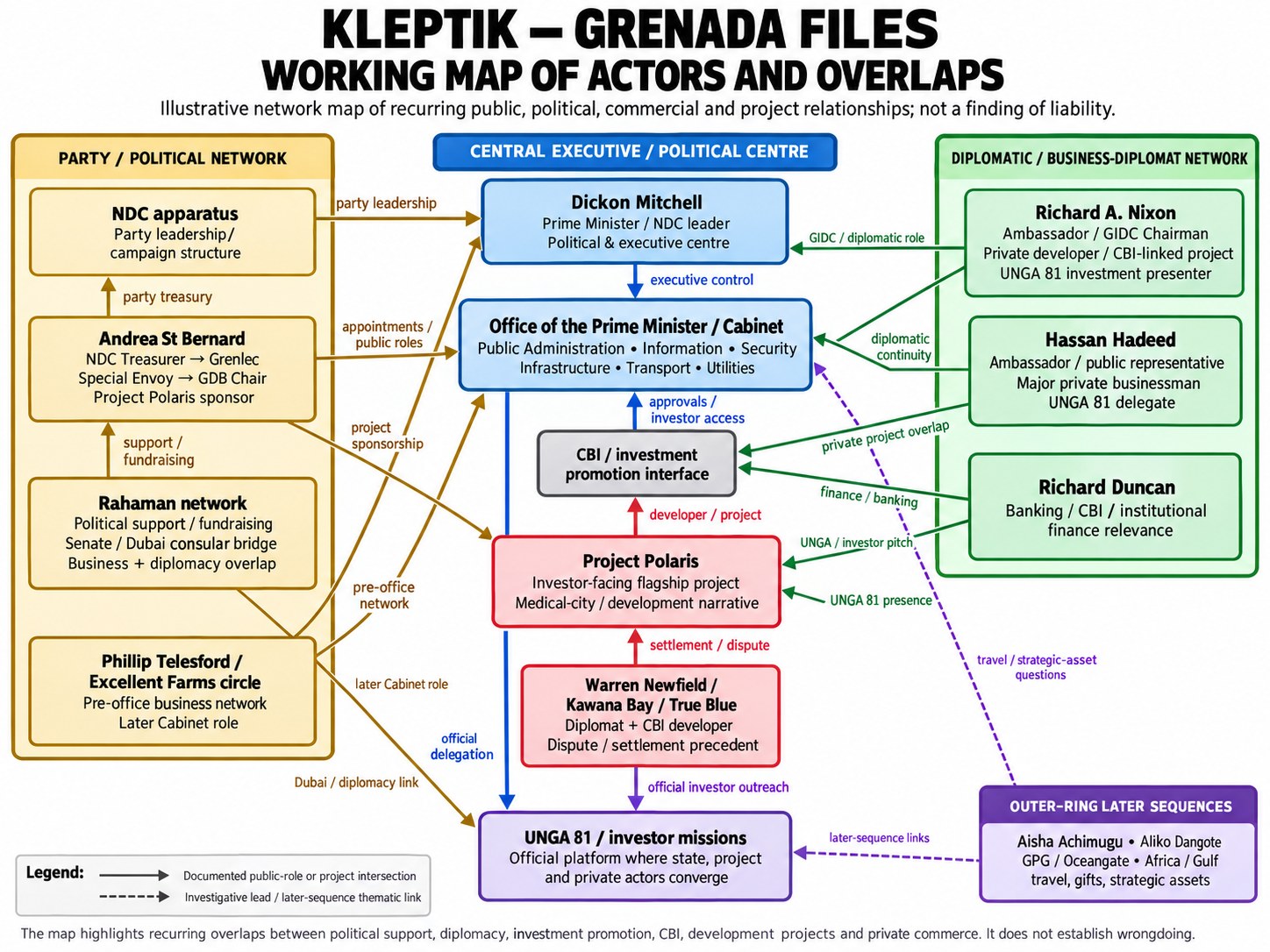
Figure 1 — Working map of actors, institutions, projects and outer-ring investigative themes. Solid lines = documented public-role or project intersection; dashed lines = investigative lead / later-sequence thematic link.
The map highlights recurring overlaps between political support, diplomacy, investment promotion, CBI, development projects and private commerce.
ADDITIONAL FINDINGS THAT SHAPE THE SERIES
1. The undisclosed-backer thesis
The first unresolved question concerns the political project that preceded Mitchell's formal emergence as NDC leader. Reporting said his backers had been doing quiet preparatory work for roughly a year, but KLEPTIK has not located a complete public account of the identities and forms of support behind that reported effort. That does not prove a hidden financier existed. It identifies a gap in the materials located by KLEPTIK and available to the public: a complete record would be needed to establish who funded, organised or materially supported the pre-convention rise, and in what form.
2. Excellent Farms and the pre-office commercial circle
Excellent Farms is more than an agricultural story. It was used as a case study in how a pre-political commercial network can later reappear around public power. Reporting placed Mitchell among financiers associated with Excellent Farms alongside Phillip Telesford, Derek Steele and Osbert Hood. Telesford later entered Cabinet. The question is whether pre-office financing relationships became politically relevant once participants acquired public office or influence over sector policy, subsidies, import controls or development priorities. None of this proves self-dealing. It does create a legitimate need to reconstruct ownership, lending, security, foreclosure pressure, public-support flows and what became of any farm-linked assets after the venture’s difficulties.
3. The party-to-state pipeline around Andrea St Bernard
The published record already makes Andrea St Bernard one of the clearest structural conflict-risk case studies in the series: NDC Treasurer, Grenlec appointee, Special Envoy for Development and Investment, Grenada Development Bank chair, and Project Polaris sponsor. The research has gone further by arguing that St Bernard was the most visible embodiment of a broader question: when does trusted party stewardship become a route into state investment governance, and what documentary safeguards show that this transition was based on transparent criteria rather than insider proximity? Her background in the investment-migration sector makes the question more sensitive because the same person sits near party finance, investor outreach and a flagship project.
4. The business-diplomat state: Richard Nixon and Hassan Hadeed
Richard Nixon and Hassan Hadeed represent the clearest recurring examples of the business-diplomat model examined in this series. Nixon combines senior diplomatic and GIDC investment-facing roles with active private development and a current CBI-project presence. Hadeed combines long-standing private commercial interests with ambassadorial and government-linked responsibilities. The issue is not that businesspeople became diplomats; it is whether the same actor can attract investors through official channels while remaining economically positioned to benefit from private deals in adjacent sectors without transparent referral, recusal and disclosure rules.
5. UNGA 81, Project Polaris and the investor-platform problem
UNGA 81 provides the clearest single scene in which the wider architecture becomes visible. Andrea St Bernard, Richard Nixon and Hassan Hadeed appeared within the same official investment-facing delegation while carrying separate political, project and private-business significance. Source material also alleges that private opportunities were discussed in proximity to official activity. The public record confirms the official roles and the overlapping private interests; the precise content of private meetings remains to be established through attendee lists, correspondence and pitch materials.
6. Newfield, Kawana Bay and the post-election reset
Warren Newfield is not only a historical figure in this record; his case is a precedent for how political change can reshape a stalled investment dispute. His rupture with the previous administration, the arbitration posture, the new government’s willingness to seek alternatives, and the eventual settlement context made Kawana Bay a template for asking who benefits when a politically salient developer’s file is reopened under a new prime minister.
7. Travel, benefactors, gifts and the private-aircraft question
One of the most revealing money trails may not be campaign donations at all, but travel, hospitality and access. The record already contains the publicly acknowledged Dangote-supported Nigeria travel and the documented opacity around the January 2025 Dubai/Hengsheng stop. Source material also raises broader claims that private aircraft and privately funded travel may have played a role in elite political and investment networking. The stronger present-tense argument is that a prime minister’s travel ecosystem should be fully transparent because unofficial hospitality, upgrades, private aviation or event sponsorship may create influence relationships that ordinary disclosure practices fail to capture.
8. The international outer ring: Dubai, Africa and strategic-asset questions
The wider network extends beyond the actors examined in detail here: the Rahaman Dubai bridge; Aisha Achimugu's Grenadian connections; Aliko Dangote's travel and gift links; the disputed Nwaneri appointment trail; and the GPG/Oceangate hydrocarbon question. These are later-sequence subjects because their significance depends on specific transactions. Their relevance to Sequence One is structural: citizenship, philanthropy, diplomacy, investment promotion, private hospitality, political proximity and strategic assets repeatedly intersect, making beneficial ownership, procurement and disclosure the decisive tests.
About Kleptik
KLEPTIK is an investigative intelligence newsroom covering corruption, kleptocracy, illicit finance, sanctions evasion and market fraud. Its website identifies the publisher as the Global Corruption Investigative Reporting Project (GCIRP).
Its stated mission is to trace money and power across borders through public records, court filings, corporate information and original reporting. Its published editorial standards distinguish established facts from allegations, call for corroboration and provide for a meaningful opportunity for named subjects to respond.
The Grenada Files is an ongoing investigative series. Documented facts, attributed allegations and unresolved questions are distinguished throughout. Findings may be expanded, clarified or corrected as additional evidence and substantive responses become available.
- Read more
- KLEPTIK | www.kleptik.com
- About and editorial standards
- Responses and corrections: newsroom@kleptik.com