FEDERAL MONEY FOR SALE

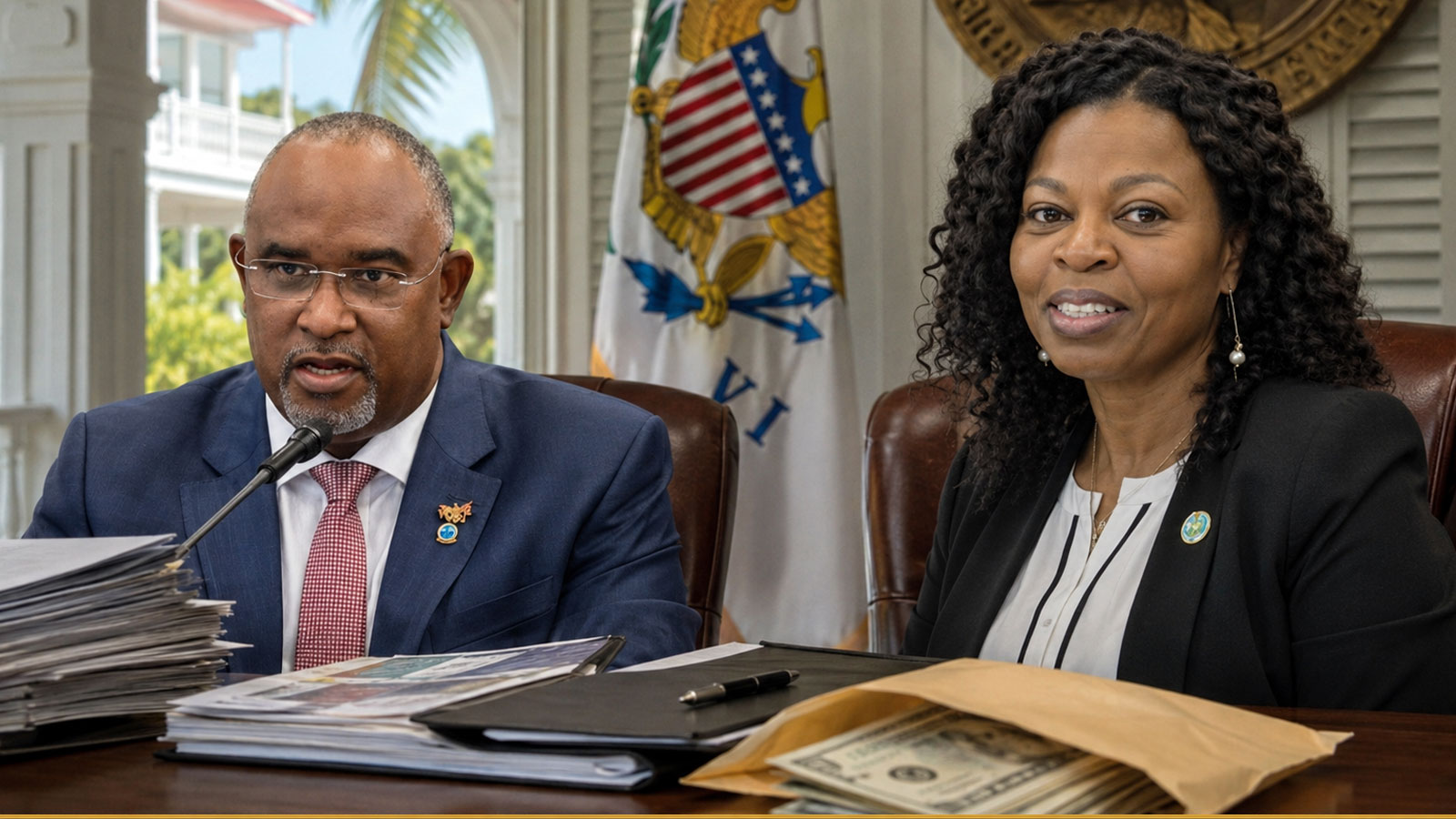
- The verdict was publicly announced the following day.
- The scheme was built around government contractor David Whitaker.
- According to evidence accepted by the jury, Martinez received nearly:
- In return, Martinez used his authority as Police Commissioner to approve invoices and helped Whitaker obtain a government contract worth approximately:
- funded by money from the federal American Rescue Plan Act — ARPA.
EXECUTIVE FINDING
On 10 December 2025, a federal jury in the U.S. Virgin Islands convicted two of the territory’s former senior public officials in a corruption scheme involving government contracting, federal recovery money, private benefits and an attempted cover-up.
The verdict was publicly announced the following day.
Ray Martinez, former Commissioner of the Virgin Islands Police Department, and Jenifer O’Neal, former Director of the Virgin Islands Office of Management and Budget, were convicted on all counts after a one-week federal trial.
Their offences included:
- honest-services wire fraud
- federal program bribery
- conspiracy to commit money laundering
- and, in Martinez’s case,
obstruction of justice.
The scheme was built around government contractor David Whitaker.
According to evidence accepted by the jury, Martinez received nearly:
$100,000 IN BRIBES
from Whitaker.
The benefits were not confined to cash.
They included:
- luxury travel
- personal expenses
- private-school tuition
- restaurant equipment
and other personal benefits.
In return, Martinez used his authority as Police Commissioner to approve invoices and helped Whitaker obtain a government contract worth approximately:
$1.4 MILLION
funded by money from the federal American Rescue Plan Act — ARPA.
O’Neal occupied an equally sensitive position.
As Director of the Virgin Islands Office of Management and Budget, she was effectively the territory’s senior budget official.
The jury found that she knowingly approved a government invoice inflated by approximately:
$70,000
under the same contractor relationship.
She later accepted a:
$17,730 LEASE PAYMENT
for her private business, Java Grande, using money derived from that inflated federally funded invoice.
The corruption therefore connected two of the most important control points in territorial government:
THE OFFICIAL REQUESTING OR APPROVING THE CONTRACT
and
THE OFFICIAL CONTROLLING PUBLIC MONEY.
One controlled the police department.
The other controlled the budget.
The private contractor sat between them.
That is the central Kleptik finding.
This was not simply a corrupt official accepting money from a vendor.
It was a corruption architecture in which the same contractor allegedly gained influence over multiple independent stages of the public-spending process.
And the money funding part of that process was not ordinary territorial revenue.
It came from a federal emergency programme created to help communities recover from the economic consequences of COVID-19.
The public therefore paid twice.
Once when government money was diverted.
Again when corruption compromised the institutions responsible for spending it.
The central question of this dossier is:
WHAT HAPPENS WHEN THE PERSON BUYING THE GOVERNMENT CONTRACT ALSO BUYS ACCESS TO THE PEOPLE WHO APPROVE BOTH THE WORK AND THE MONEY?
THE FINDING
Public procurement is designed around separation.
One person identifies need.
Another prepares specifications.
Vendors compete.
A committee evaluates.
An agency approves.
Finance verifies.
Budget approves funding.
Auditors review later.
The structure exists because no single individual should control:
NEED + VENDOR + PRICE + PAYMENT.
Corruption attacks this separation.
The contractor does not need to corrupt the entire government.
He needs influence at the right nodes.
THE CONTROL-NODE MODEL
Imagine a procurement chain:
- AGENCY
- identifies need
- ↓
- PROCUREMENT
- runs process
- ↓
- COMMISSIONER
- approves contract
- ↓
- VENDOR
- submits invoice
- ↓
- BUDGET / FINANCE
- approves payment
- ↓
- TREASURY
disburses.
A corrupt vendor asks:
Which two or three people matter most?
That is where the bribe goes.
RAY MARTINEZ
POSITION
Commissioner of the Virgin Islands Police Department.
This is not merely an administrative role.
The Police Commissioner controls or influences:
- law-enforcement resources
- departmental procurement
- security infrastructure
- vendor relationships
and expenditure priorities.
That makes the office a high-value public corruption target.
THE BRIBES
The jury found that Martinez accepted nearly $100,000 in benefits from contractor David Whitaker.
The form of those benefits is particularly important.
They were not simply:
wire transfer from contractor to commissioner.
They included:
cash.
Luxury travel.
Private-school tuition.
Restaurant equipment.
Personal expenses.
This is a recurring theme across Kleptik’s PEP investigations.
The bribe changes form.
The economic benefit remains.
THE ECONOMIC-BENEFIT MODEL
Cash is only the most obvious form of corruption.
A public official becomes economically better off if someone else pays:
school tuition.
Hotel bills.
Airline tickets.
Business equipment.
Rent.
Mortgage.
Credit-card bills.
The anti-corruption question must therefore be:
WHO PAID AN EXPENSE THE OFFICIAL WOULD OTHERWISE HAVE HAD TO PAY PERSONALLY?
PRIVATE-SCHOOL TUITION
School tuition is a particularly powerful form of concealed economic benefit.
A parent has an existing obligation.
Contractor pays it.
No money necessarily enters the official’s personal bank account.
Yet the official has received real financial value.
This means source-of-funds review must extend beyond deposits.
It should also examine third-party settlement of liabilities.
THIRD-PARTY PAYMENT AS BRIBE
The structure:
From an accounting perspective, there may be no incoming cash.
Economically:
the official has received the full value of the payment.
LUXURY TRAVEL
Travel is another common corruption mechanism.
Flight.
Hotel.
Entertainment.
Ground transportation.
Vacation expenses.
These can be disguised as:
business hospitality;
conference travel;
vendor relationship management.
The correct test is:
- Was there a legitimate governmental purpose?
- Was the expense proportionate?
- Was it disclosed?
- Who paid?
- What government action followed?
RESTAURANT EQUIPMENT
The inclusion of restaurant equipment among Martinez’s benefits is especially revealing because it suggests value moving into a private commercial context rather than merely personal consumption.
An official or associated person may possess private business interests.
A contractor supplying equipment to that business is effectively transferring capital.
That creates:
BUSINESS ENRICHMENT THROUGH PUBLIC RELATIONSHIP.
THE PRIVATE-BUSINESS PROBLEM
Public officials may lawfully own businesses.
But the risk increases when government contractors:
- pay expenses
- buy equipment
- pay rent
- provide customers
or finance those businesses.
The economic relationship becomes inseparable from the public one.
THE PEP BUSINESS MAP
For every senior official:
Any overlap deserves enhanced review.
Not because overlap proves corruption.
Because it creates a channel through which value can be transferred.
THE $1.4 MILLION CONTRACT
In exchange for the bribes, Martinez used his official authority to approve invoices and awarded Whitaker a government contract worth approximately $1.4 million funded with federal ARPA money.
That creates the basic quid-pro-quo structure:
The leverage is substantial.
THE CORRUPTION LEVERAGE RATIO
Approximate public contract:
$1.4 million.
Approximate benefits:
$100,000.
Very roughly:
14 TO 1
Again, this is not a legal measure.
It is an analytical illustration of corruption economics.
A relatively small private expenditure can unlock a much larger flow of public money.
PROCUREMENT AS LEVERAGE
A contractor does not need to steal $1.4 million directly.
If a $100,000 bribe secures a profitable $1.4 million contract, the corruption may produce a far larger legitimate-looking revenue stream.
That is why the contract itself becomes the vehicle of enrichment.
THE CLEAN-MONEY EFFECT
Once government pays the vendor, the money arrives as:
CONTRACT REVENUE.
It appears legitimate.
The corruption happened earlier.
At contract acquisition.
This is an important distinction from conventional laundering.
The proceeds may be “clean” in accounting form because government actually paid for a contract.
The illegality lies in how the contract was obtained or invoiced.
PROCUREMENT CORRUPTION VERSUS MONEY LAUNDERING
Procurement corruption can transform improper influence into formally documented revenue.
Purchase order.
Contract.
Invoice.
Government payment.
Bank deposit.
Every document appears normal.
The bribe sits outside the paperwork.
That makes procurement corruption difficult to detect through transaction monitoring alone.
FOLLOW THE PROCUREMENT PROCESS
A serious investigation should reconstruct:
- Who proposed the project?
- Who wrote specifications?
- Who identified Whitaker?
- Who else bid?
- What were the bid scores?
- Who approved the award?
- What were competitor prices?
- What was delivered?
- Who approved invoices?
- What did the government ultimately receive?
That is how a legitimate-looking contract becomes auditable.
JENIFER O’NEAL
POSITION
Director of the Virgin Islands Office of Management and Budget.
This role is institutionally critical.
The budget office exists partly to ensure government spending follows:
- authorisation
- appropriation
- financial control
and public priorities.
O’Neal therefore sat on the control side of the transaction.
WHEN THE CONTROL FUNCTION IS CORRUPTED
The procurement agency may be compromised.
Normally budget or finance review provides a second line of defence.
But if the second line is also compromised, segregation of duties collapses.
The scheme then becomes:
That is far more dangerous than one dishonest official.
THE $70,000 INFLATED INVOICE
The jury found O’Neal knowingly approved a contractor invoice inflated by approximately:
$70,000.
This introduces a different corruption mechanism.
Not contract award.
Invoice inflation.
INVOICE INFLATION
Suppose legitimate work is worth:
$200,000.
Contractor submits:
$270,000.
Difference:
$70,000.
The overpayment becomes a pool that can potentially finance:
- bribes
- kickbacks
- private expenses
or profit.
The legitimate work provides cover.
THE EMBEDDED-BRIBE MODEL
Rather than contractor paying bribe from its own money:
This means:
THE GOVERNMENT FINANCES THE BRIBE.
That is one of the most destructive forms of procurement corruption.
THE $17,730 LEASE PAYMENT
The jury found that O’Neal subsequently accepted a $17,730 payment toward lease obligations for her business Java Grande, and that the money came from federal funds generated through the inflated invoice.
This makes the money trail unusually direct.
The public money left government and reappeared as payment of a public official’s private commercial obligation.
FOLLOW THE FEDERAL DOLLAR
This is the core money trail:
That is why the case became both:
bribery
and
money laundering.
ARPA
The American Rescue Plan Act was enacted in 2021 as a massive federal response to the economic effects of the COVID-19 pandemic.
Funds flowed to states and territories to support:
- public health
- economic recovery
- government services
and infrastructure.
Emergency programmes create special corruption risk.
Why?
Because money moves quickly.
EMERGENCY MONEY
During crises, government priorities change from:
slow and controlled
to
fast and responsive.
That is often necessary.
But faster spending can weaken:
- competition
- documentation
- oversight
and audit.
Fraudsters understand this.
THE EMERGENCY-FUNDS RISK MODEL
This does not mean emergency spending is inherently corrupt.
It means controls must strengthen as money accelerates.
COVID MONEY AS A CORRUPTION TARGET
Across jurisdictions, pandemic-related funding created enormous fraud exposure.
The Virgin Islands case is particularly serious because the alleged—and now convicted—wrongdoing involved senior government officials rather than merely private fraudsters applying for relief.
The public gatekeepers themselves were involved.
THE DOUBLE BETRAYAL
The money had a defined social purpose:
help communities recover from crisis.
Corruption redirected part of that money into:
private benefits.
That is why emergency-fund corruption creates both:
financial loss
and
public-trust loss.
DAVID WHITAKER
Whitaker was the contractor at the center of the scheme.
The January 2025 indictment identified him as a then-government contractor whose payments and relationships formed the basis of charges against Martinez and O’Neal.
By trial, his role provided the link between:
- government contract
- official benefits
- inflated invoices
and private payments.
THE CONTRACTOR AS SYSTEMIC NODE
The same private contractor allegedly interacted with:
Police Commissioner.
Budget Director.
Other territorial officials in separate proceedings.
This matters because repeated influence across agencies may indicate something larger than one corrupt bilateral relationship.
It raises the possibility of:
CONTRACTOR-DRIVEN CORRUPTION NETWORKS.
ONE VENDOR, MULTIPLE OFFICIALS
A contractor who develops relationships with several officials can reduce dependence on any one person.
Commissioner helps with contract.
Budget official helps with payment.
Another official may help with specifications.
The private actor becomes the common node.
That can be more important than any individual public official.
THE NETWORK INVESTIGATION
Kleptik should therefore ask:
- What other Virgin Islands agencies contracted with Whitaker?
- What companies did he control?
- How much public money did those companies receive?
- Which officials approved contracts?
- Which officials received benefits?
- What dates overlap?
The contractor network may reveal the true scale.
THE MON ETHOS QUESTION
Subsequent DOJ materials identify Whitaker’s company as Mon Ethos in relation to the government payments.
A complete Kleptik investigation should reconstruct:
legal entity.
jurisdiction.
ownership.
contracts.
government revenue.
employees.
subcontractors.
equipment.
profit margins.
Public records should determine whether the company possessed the operational capacity corresponding to the contracts.
CONTRACTOR CAPACITY
A company receiving a $1.4 million government contract should possess:
staff.
equipment.
insurance.
technical capability.
prior work.
Relevant licences.
If not, the contract may require further scrutiny.
Capability is independent from bribery.
Both should be tested.
THE FEDERAL PROGRAM BRIBERY CHARGE
Martinez and O’Neal were convicted under federal program bribery provisions.
These laws protect organisations receiving significant federal assistance from corruption involving their agents.
That matters in U.S. territories, where local government functions frequently involve federal funding.
Local corruption can therefore become federal criminal jurisdiction.
THE JURISDICTIONAL BRIDGE
The source of the money creates a direct federal interest.
CARIBBEAN, BUT NOT OFFSHORE
The U.S. Virgin Islands is geographically Caribbean but legally part of the United States.
This makes the case useful for comparative Kleptik reporting.
BVI.
Sint Maarten.
Barbados.
U.S. Virgin Islands.
Different constitutional arrangements.
Similar corruption risks:
- small administrative systems
- political-business overlap
- high-value public contracts
- limited procurement pools
and concentrated decision-making.
SMALL-JURISDICTION GOVERNANCE
Small jurisdictions create unique advantages.
Officials know local businesses.
Government can act quickly.
But the same closeness increases:
- conflicts
- informal access
- repeat-vendor concentration
and political dependence.
The correct response is not assuming everyone knows everyone corruptly.
It is stronger documentation.
THE RELATIONSHIP NORMALISATION PROBLEM
Where officials and vendors interact socially, unusual contact may not look unusual.
Lunch.
Travel.
Favors.
Family assistance.
The compliance system must distinguish ordinary local familiarity from economic benefits that compromise public judgment.
GIFTS POLICY
A strong government gifts framework should answer:
- Can contractor pay for official’s travel?
- School tuition?
- Business equipment?
- Dinner?
- Hotel?
- What thresholds apply?
- What disclosures are required?
- What happens if a vendor offers prohibited benefit?
Rules should be simple enough that “I did not know” becomes difficult to claim.
PRIVATE-BUSINESS DISCLOSURE
O’Neal’s Java Grande business demonstrates why senior officials should disclose:
companies.
Landlord relationships.
Creditors.
Business partners.
Leases.
A contractor paying a business obligation should immediately trigger a conflict alarm.
THE BENEFICIAL-INTEREST REGISTER
Governments often require disclosure of share ownership.
That may be insufficient.
A public official’s economic interests include:
- leases
- debts
- guarantees
- loans
- franchise interests
equipment financing.
A broader beneficial-interest register may capture these exposures.
PROCUREMENT DATABASE
The Virgin Islands should be auditable through a public-contract database containing:
vendor.
Owner.
Contract value.
Funding source.
Agency.
Procurement method.
Bid count.
Award date.
Invoice total.
Change orders.
Final payment.
Such data allows journalists and auditors to detect:
- repeat awards
- contract splitting
- inflated invoices
and concentration.
FOLLOW THE INVOICE
The O’Neal conviction makes invoice-level review essential.
For each Whitaker contract:
Original contract value.
Invoice amount.
Supporting documentation.
Approver.
Payment date.
Variance.
Actual work.
Subsequent transfers.
The corruption can be reconstructed line by line.
THE INVOICE-TO-BENEFIT TIMELINE
The shorter the interval, the stronger the transaction becomes as an investigative lead.
Here, the jury ultimately found sufficient evidence to convict.
MONEY LAUNDERING
Martinez and O’Neal were both convicted of conspiracy to commit money laundering.
The O’Neal lease payment illustrates the laundering concept clearly.
Public money, obtained through an inflated invoice, moved into a transaction that appeared on its face to be:
A NORMAL BUSINESS LEASE PAYMENT.
The economic origin was concealed inside an ordinary commercial obligation.
MONEY LAUNDERING THROUGH ORDINARY EXPENSES
Criminal proceeds do not need to purchase yachts.
They can pay:
rent.
Tuition.
Restaurant equipment.
Travel.
Mortgage.
The mundane nature of the expense can make the laundering less visible.
THE ORDINARY-EXPENSE PROBLEM
Investigators focus naturally on luxury.
But a criminal network may prefer:
school fees.
Lease.
Utilities.
Business supplier.
These payments integrate illicit value directly into everyday finances.
FOLLOW THE CREDITORS
For a PEP corruption investigation, identify:
mortgage company.
School.
Landlord.
Equipment seller.
Travel agency.
A bribe may never enter the official’s account because the contractor pays these parties directly.
MARTINEZ’S OBSTRUCTION
The corruption case did not end when the federal investigation became known.
The jury found Martinez guilty of obstruction.
DOJ said he directed Whitaker to destroy evidence and created a fraudulent promissory note intended to conceal bribe payments.
This introduces a familiar theme:
DOCUMENTARY LAUNDERING.
THE PROMISSORY NOTE
Once suspicious payments are discovered, participants may attempt to assign them a legitimate legal identity.
Gift becomes:
loan.
Bribe becomes:
reimbursement.
Kickback becomes:
consulting payment.
The promissory note can create a retroactive explanation.
THE RETROACTIVE-DOCUMENT TEST
Whenever documents appear after investigators begin asking questions:
- When was document created?
- When was it signed?
- Does metadata match?
- Was money ever repaid?
- Did contemporaneous communications describe a loan?
- Did accounting records treat it as a loan originally?
A legitimate loan should generally exist before investigation.
Not appear because of it.
DOCUMENT METADATA
Digital files can reveal:
creation date.
Modification date.
Author.
Previous versions.
The document itself can therefore undermine the cover story.
DESTROYING EVIDENCE
DOJ said Martinez attempted to persuade Whitaker to destroy evidence.
Evidence destruction is especially damaging because it can demonstrate:
knowledge;
consciousness of wrongdoing;
and intent to interfere with investigation.
It also deprives the public of the ability to reconstruct government decision-making.
THE POST-INVESTIGATION BEHAVIOR TEST
After law enforcement becomes visible:
- Do records disappear?
- Are phones replaced?
- Do participants coordinate stories?
- Are “loan” documents created?
- Are invoices modified?
- Do assets move?
Post-investigation behavior can become some of the strongest evidence in a corruption case.
THE OMB CONTROL FAILURE
The Office of Management and Budget should function as a financial gatekeeper.
A budget director approving an inflated invoice raises a fundamental design question:
- Who checks the checker?
- Independent controller?
- Treasury?
- Inspector General?
- External auditor?
No public financial system should rely on one senior budget official’s personal integrity.
THE THIRD LINE OF DEFENSE
Corporate governance often uses:
First line — operations.
Second line — compliance / finance.
Third line — internal audit.
Government needs similar architecture.
If first and second lines are corrupted, the third line becomes crucial.
VIRGIN ISLANDS OFFICE OF INSPECTOR GENERAL
The DOJ credited the Virgin Islands Office of Inspector General with assisting the FBI investigation.
That illustrates the value of independent local oversight.
Federal enforcement arrived.
But local audit and investigative capacity remained important.
LOCAL OVERSIGHT + FEDERAL ENFORCEMENT
This is an effective layered model.
THE POLICE-COMMISSIONER PROBLEM
Corruption involving the head of police creates another institutional concern.
Law enforcement normally investigates corruption.
What happens when its own leader is implicated?
Independent jurisdiction becomes essential.
FBI.
Inspector General.
Federal prosecutors.
Without outside institutions, internal investigation may be compromised.
WHO POLICES THE POLICE?
This question is structural.
A Police Commissioner has:
- authority over investigators
- access to sensitive information
- control of personnel
department contracts.
A corruption allegation involving that person cannot depend solely on subordinates.
Independent investigative channels are essential.
INFORMATION RISK
A corrupt police leader may potentially access:
investigative intelligence;
witness information;
internal complaints.
The DOJ case focused on procurement and bribery, not misuse of all such information.
Kleptik should not imply additional misconduct without evidence.
But the office’s access makes integrity controls especially important.
PUBLIC-PROCUREMENT SECURITY CONTRACTS
The contract associated with Martinez concerned services for the police department.
Government security and surveillance contracts deserve heightened scrutiny because they may involve:
- cameras
- technology
- restricted facilities
- sensitive data
law-enforcement operations.
A corrupt procurement can therefore create both financial and security risks.
CONTRACTOR ACCESS
A vendor supplying police technology may obtain:
network access.
Facilities access.
Security architecture.
Operational knowledge.
Thus vendor due diligence must examine:
ownership.
Background.
Cybersecurity.
Conflicts.
Political relationships.
Not merely price.
THE BROADER USVI CORRUPTION PATTERN
The same January 10, 2025 DOJ enforcement announcement period included a separate case charging then-Sports, Parks and Recreation Commissioner Calvert White and businessman Benjamin Hendricks in another alleged bribery scheme involving contractor David Whitaker.
That separate case concerned a government contract valued at approximately $1.43 million and allegations that confidential bid information was supplied to Whitaker.
This is highly significant.
THE COMMON CONTRACTOR
David Whitaker appears at the centre of more than one public-corruption prosecution involving different territorial departments.
That does not mean every Whitaker government contract was corrupt.
It means the vendor itself becomes an investigative hub.
CONTRACTOR-CENTRIC INVESTIGATION
Traditional corruption reporting asks:
Which officials are corrupt?
A better approach can ask:
WHICH CONTRACTORS REPEATEDLY APPEAR AROUND CORRUPT OFFICIALS?
Map vendor across government.
Contracts.
Officials.
Benefits.
Invoices.
Agencies.
Funding sources.
This can reveal corruption architecture that department-by-department analysis misses.
THE VENDOR NETWORK MAP
The unanswered question is how wide the network extended.
CONFIDENTIAL BID INFORMATION
In the separate Sports, Parks and Recreation case, prosecutors alleged White supplied Whitaker confidential bid information.
This is a different form of corruption.
Not payment approval.
Not inflated invoice.
Information advantage.
PROCUREMENT INFORMATION AS VALUE
Knowing competitors’ bids or confidential specifications can be worth more than a direct subsidy.
It allows a bidder to:
undercut competitor.
tailor proposal.
meet hidden criteria.
gain unfair advantage.
The government loses genuine competition.
THE BID-RIGGING ADJACENCY
Providing confidential bid information does not necessarily constitute classic bid rigging by itself.
But it destroys equality among bidders.
A procurement can remain formally competitive while being substantively corrupted.
FORMAL COMPETITION VERSUS REAL COMPETITION
Three vendors submit bids.
Looks competitive.
But Vendor A received confidential information.
The tender exists.
Competition does not.
This is why auditors must test information access, not only bid count.
THE PUBLIC-CONTRACT NETWORK
A future Kleptik data investigation should scrape or obtain:
all Virgin Islands contracts awarded to Whitaker-associated entities.
For each:
agency.
year.
amount.
funding source.
procurement method.
bid competitors.
change orders.
invoice totals.
official approvers.
Then overlay criminal-case dates.
FEDERAL RECOVERY MONEY
ARPA funding deserves a separate dataset.
- How much did the U.S. Virgin Islands receive?
- Which agencies spent it?
- Which vendors received the largest contracts?
- How many were competitively procured?
- How many were audited?
The Martinez-O’Neal case provides a reason to examine the entire emergency-spending ecosystem.
THE ARPA CONTRACT TEST
For every large ARPA-funded procurement:
- Was the expenditure eligible?
- Was competition required?
- Was emergency procurement invoked?
- Who approved?
- Was work completed?
- What was original contract?
- What was final spend?
- Were any invoices inflated?
This can create a systematic accountability project.
EMERGENCY DOES NOT CANCEL ACCOUNTABILITY
Crisis can justify speed.
It should not justify:
- hidden ownership
- personal gifts
- inflated invoices
or no audit.
Indeed, emergency spending often needs more retrospective audit precisely because ex ante controls were relaxed.
THE RETROSPECTIVE AUDIT MODEL
Emergency:
spend quickly.
Afterward:
audit deeply.
Every emergency procurement above threshold should receive post-award review.
THE CONTRACTOR-PROFIT QUESTION
How profitable were Whitaker’s government contracts?
If a company receives:
$1.4 million contract.
Actual costs:
$500,000.
Profit:
$900,000.
Then a $100,000 bribe could still produce enormous return.
The corruption economics require actual margin analysis.
BRIBE-TO-PROFIT RATIO
Not:
bribe ÷ contract.
Better:
bribe ÷ expected profit.
The contractor’s incentive depends upon profit, not gross revenue.
THE OFFICIAL’S RISK CALCULATION
Official receives:
$100,000.
Risks:
career.
pension.
public office.
criminal sentence.
reputation.
The rationality of corruption often depends on perceived probability of detection.
Strong oversight changes that probability.
DETERRENCE EQUATION
Expected value of bribe
minus
probability of detection × expected penalty.
Anti-corruption controls seek to make the equation negative.
VISIBILITY AS DETERRENCE
Public procurement databases.
Financial disclosure.
Independent audits.
Whistleblower systems.
Inspector General.
They increase perceived detection probability.
Transparency is therefore not merely informational.
It is preventative.
WHISTLEBLOWERS
A future Kleptik investigation should determine whether insiders raised concerns before federal charges.
Procurement fraud often leaves clues visible to employees:
unusual invoice.
favored vendor.
override.
luxury relationship.
Whistleblower channels can surface these earlier.
RETALIATION RISK
In small jurisdictions, reporting a senior official may carry personal and professional risk.
Confidentiality and independent reporting channels are therefore especially important.
THE PEP FINANCIAL-DISCLOSURE QUESTION
Were Martinez and O’Neal required to disclose:
- gifts?
- private businesses?
- travel?
- business interests?
- If so, were relevant benefits reported?
- If not, should disclosure rules be expanded?
The conviction provides a real-world stress test for the ethics framework.
GIFTS FROM GOVERNMENT CONTRACTORS
A particularly simple rule may be justified:
senior officials should not accept material personal benefits from active government contractors.
The compliance logic is straightforward.
The conflict is inherently difficult to manage.
THE VENDOR-GIFT REGISTER
All government vendors above a threshold should disclose:
gifts.
travel.
hospitality.
business relationships
involving relevant officials.
This creates two-sided transparency.
GOVERNMENT OFFICIAL + VENDOR BUSINESS RELATIONSHIP
If official owns private business, vendors should disclose any commercial dealings with that business.
This would have made a lease payment like the one involving Java Grande highly visible.
THE PRIVATE-BUSINESS CONFLICT MATRIX
Official.
Private company.
Government vendor.
Transaction.
Date.
Government decision.
This is a simple but powerful anti-corruption tool.
FOLLOW THE SCHOOL PAYMENT
For tuition benefit:
school.
student.
amount.
payer.
date.
government action nearby.
These third-party records can independently confirm economic benefits.
FOLLOW THE TRAVEL
Airline.
Hotel.
Booking account.
Travel companion.
Purpose.
Payer.
A travel itinerary can become a corruption timeline.
FOLLOW THE RESTAURANT EQUIPMENT
Vendor.
Invoice.
Delivery location.
Purchaser.
Beneficial user.
Business ownership.
Again, physical property creates documentation.
CORRUPTION LEAVES RECEIPTS
Even cash corruption interacts with:
travel booking.
school billing.
merchant invoice.
lease.
Government contractor payments.
The financial trail may be distributed, but it exists.
THE COVER-UP ECONOMICS
Once investigation begins, participants face a new decision.
Cooperate.
Or conceal.
Destroying evidence and manufacturing a promissory note can transform an underlying bribery case into additional obstruction exposure.
The cover-up can become more damaging than the original attempt to explain the payments.
THE FAKE-LOAN TEMPLATE
A recurring corruption cover story:
“It wasn’t a bribe.”
“It was a loan.”
Investigators should require:
agreement predating payment.
interest.
maturity.
repayment history.
collateral.
tax treatment.
Contemporaneous communication.
If these appear only after investigation, the loan explanation weakens.
THE MONEY-LAUNDERING ELEMENT
O’Neal’s lease transaction is especially instructive.
The payment itself looked commercially ordinary.
Rent.
But money laundering often works precisely because the final use is normal.
The criminality lies in the source.
LEGITIMATE END USE, ILLEGITIMATE SOURCE
Dirty money can pay a perfectly legitimate bill.
That does not clean the source.
It integrates the proceeds into ordinary economic life.
SMALL-JURISDICTION CORRUPTION NETWORKS
Caribbean corruption is often discussed through the lens of offshore finance.
This case is different.
The mechanism was direct public procurement.
Yet the structural themes are familiar:
- concentrated power
- repeat contractors
- personal relationships
- limited institutional distance
and high-value discretionary decisions.
That is why Kleptik’s Caribbean coverage should not be limited to offshore companies or CBI.
CARIBBEAN PUBLIC-MONEY INDEX
Kleptik should eventually create a regional database of:
government contracts.
public officials.
SOEs.
CBI agents.
public land.
grants.
federal / international aid.
contractors.
Corruption themes can then be compared across jurisdictions.
THE PUBLIC-CONTRACT BENEFICIAL OWNER
Every major government vendor should have a verified beneficial owner.
This prevents:
front companies.
official-linked nominee ownership.
hidden related parties.
The same AML principles used by banks belong in procurement.
PROCUREMENT KYC
Before government pays a vendor:
Know Your Contractor.
Identity.
Ownership.
Tax status.
Capabilities.
Conflicts.
Official relationships.
Litigation.
This is procurement’s equivalent of bank KYC.
TRANSACTION MONITORING FOR GOVERNMENT
Governments can also monitor payments.
Examples:
invoice above contract.
multiple payments just below approval threshold.
same vendor across agencies.
invoice followed by official-linked payment.
large change orders.
Procurement analytics can detect patterns automatically.
GOVERNMENT AML
The concept sounds unusual.
But public treasury systems can use the same techniques banks use:
network analysis.
anomaly detection.
beneficial ownership.
transaction clustering.
Government should monitor its own outgoing money with similar seriousness.
THE CONTRACTOR-CONCENTRATION RATIO
Measure:
top 10 vendors
÷
total agency procurement.
High concentration is not automatically corrupt.
But it increases dependency and deserves scrutiny.
THE REPEAT-AWARD TEST
Same contractor.
Different agency.
Different official.
Same period.
That can be legitimate.
Or it can identify a network.
The Whitaker cases make this especially relevant.
THE OTHER USVI CASE
On the same day Martinez and O’Neal were originally charged in January 2025, federal prosecutors also announced a separate bribery case involving another Virgin Islands commissioner and Whitaker.
This coincidence reinforces the value of contractor-centric analysis.
The contractor appears to have been more than a passive recipient of individual corrupt requests.
The full record should be investigated.
NETWORK VERSUS SERIES OF CASES
Law enforcement often prosecutes:
Case A.
Case B.
Case C.
Journalism can ask:
Are these independent?
Or manifestations of one network?
That is where Kleptik can add value beyond court reporting.
THE CONTRACTOR MASTER FILE
For Whitaker:
Personal background.
Companies.
Government contracts.
Public officials.
Bank accounts.
Federal funds.
Gifts.
Travel.
Business relationships.
Court cases.
Timeline.
One master file could reveal connections hidden across separate indictments.
CHRONOLOGY
November 2022
According to the original federal indictment, the Martinez corruption scheme begins no later than this period.
2022–2023
Whitaker provides benefits to Martinez while performing government work.
October 2023
Martinez assists Whitaker in obtaining a police-related contract worth approximately $1.48 million, according to the original indictment.
December 2023
A separate alleged Whitaker bribery relationship begins involving Sports, Parks and Recreation Commissioner Calvert White, according to a different federal case.
January 2024
O’Neal joins the Martinez/Whitaker scheme no later than this period, according to the original indictment.
2024
A government invoice under the Whitaker contract is inflated by approximately $70,000.
O’Neal approves it.
A $17,730 payment derived from those funds is applied to her Java Grande business lease.
June 2024
Federal investigation becomes public.
Martinez subsequently attempts to obstruct the investigation by encouraging destruction of evidence and creating a fraudulent promissory note, according to the evidence accepted at trial.
10 January 2025
Federal prosecutors unseal charges against Martinez and O’Neal.
They are charged with honest-services wire fraud, federal program bribery and money-laundering conspiracy.
Martinez also faces obstruction charges.
10 January 2025
Separate federal charges are also announced against Commissioner Calvert White and businessman Benjamin Hendricks concerning another alleged Whitaker bribery arrangement.
10 December 2025
Following a one-week trial, a federal jury finds Martinez and O’Neal guilty on all counts.
11 December 2025
DOJ publicly announces the verdict.
Sentencing remains pending as of the archive date.
DOCUMENTARY RECORD
DOJ — 10 JANUARY 2025
The original indictment announcement establishes the government’s charging theory concerning:
- Martinez
- O’Neal
- Whitaker
- the $1.48 million contract
- inflated invoices
- the Java Grande payment
- money laundering
and obstruction allegations.
DOJ — 11 DECEMBER 2025
The verdict announcement establishes the jury convictions and trial findings concerning:
- nearly $100,000 in benefits to Martinez
- the approximately $1.4 million ARPA-funded contract
- the $70,000 inflated invoice
- the $17,730 Java Grande lease payment
and Martinez’s obstruction conduct.
SEPARATE WHITAKER-RELATED CASE
The January 2025 charges involving Sports, Parks and Recreation Commissioner Calvert White provide evidence that the same government contractor appeared in a separate public-corruption investigation involving a different territorial agency.
This does not prove all Whitaker contracts were corrupt.
It establishes a legitimate basis for contractor-centric investigation.
WHAT THE AUTHORITIES SAY
Federal prosecutors say Martinez and O’Neal abused senior positions of public trust to benefit a government contractor in exchange for personal financial benefits.
The jury accepted that case.
DOJ emphasised that corruption interferes with the delivery of public services and erodes confidence in government.
The case is therefore no longer based merely on indictment allegations.
Martinez and O’Neal were convicted at trial.
WHAT REMAINS UNRESOLVED AS OF THE ARCHIVE DATE
Sentencing had not yet occurred.
Kleptik should therefore not retrospectively insert prison sentences or later judicial outcomes into this December 2025 dossier.
The correct status is:
CONVICTED — SENTENCING PENDING
WHAT THIS DOSSIER DOES NOT ESTABLISH
This dossier does not establish that:
- every Virgin Islands public official participated in corruption
- every contract awarded to Whitaker or an associated company was improper
- every ARPA-funded Virgin Islands contract involved fraud
every employee of the Virgin Islands Police Department knew of Martinez’s conduct;
- every employee of OMB knew of O’Neal’s conduct
- all government payments to Whitaker lacked legitimate services
- every business expense paid by a government contractor constitutes bribery
or the separate corruption case involving another territorial commissioner proves a single overarching conspiracy.
Each contract and defendant requires its own evidence.
RIGHT OF REPLY
Before publication, Kleptik should seek comment from:
- Ray Martinez and counsel
- Jenifer O’Neal and counsel
- David Whitaker and counsel
- Mon Ethos or relevant Whitaker-controlled entities
- Virgin Islands Police Department
- Virgin Islands Office of Management and Budget
- Government of the U.S. Virgin Islands
- Virgin Islands Office of Inspector General
For any additional agency, vendor or official identified through independent contract research, transaction-specific right of reply should be provided before material criticism is published.
UNANSWERED QUESTIONS
The jury answered whether Martinez and O’Neal participated in the charged scheme.
The network remains larger than the verdict.
1. ALL WHITAKER CONTRACTS
How many Virgin Islands government contracts did Whitaker-controlled entities receive?
2. TOTAL PUBLIC REVENUE
How much territorial and federal money flowed to those companies?
3. AGENCY SPREAD
How many separate departments contracted with them?
4. CONTRACT METHOD
- Competitive tender?
- Emergency award?
- Sole source?
5. BID INFORMATION
Did any other officials provide confidential procurement information?
6. CONTRACT CAPACITY
Did the contractor possess the staff and infrastructure required for each award?
7. INVOICE INFLATION
Were other invoices inflated?
8. CHANGE ORDERS
Did contract values materially increase after award?
9. MARTINEZ BENEFITS
What is the exact transaction history behind every item making up the nearly $100,000?
10. PRIVATE-SCHOOL PAYMENT
Who paid, when, and from which account?
11. TRAVEL
Which trips were funded?
12. RESTAURANT EQUIPMENT
Which private business ultimately received it?
13. JAVA GRANDE
What was O’Neal’s ownership and lease structure?
14. ARPA
How much total ARPA money reached Whitaker-related contracts?
15. BANKING
Which accounts received the inflated invoice payment and later funded the $17,730 lease?
16. OMB CONTROLS
Who else reviewed the $70,000 inflation?
17. POLICE PROCUREMENT
Who participated in the $1.4 million contract process?
18. INSPECTOR GENERAL
When did local oversight first identify irregularities?
19. OTHER OFFICIALS
Did Whitaker provide gifts or benefits to anyone else in territorial government?
20. THE CENTRAL QUESTION
Was Whitaker buying isolated favors from individual officials—or had he developed a repeatable system for converting private benefits into public contracts across multiple Virgin Islands agencies?
That is the next investigation.
KLEPTIK INTELLIGENCE ASSESSMENT
ASSESSMENT: ESTABLISHED
Ray Martinez and Jenifer O’Neal were convicted on all counts following a federal jury trial in December 2025.
ASSESSMENT: ESTABLISHED
Martinez accepted nearly $100,000 in benefits from government contractor David Whitaker, including cash, luxury travel, private-school tuition, personal expenses and restaurant equipment.
ASSESSMENT: ESTABLISHED
Martinez used his official authority to approve invoices and award Whitaker an approximately $1.4 million ARPA-funded contract.
ASSESSMENT: ESTABLISHED
O’Neal knowingly approved a $70,000 inflated invoice and subsequently accepted a $17,730 lease payment for her private business derived from those funds.
ASSESSMENT: ESTABLISHED
Martinez attempted to obstruct the federal investigation by directing destruction of evidence and creating a false promissory note intended to conceal the bribe payments.
ASSESSMENT: HIGH CONFIDENCE
The scheme is particularly serious institutionally because the contractor obtained influence at both an operating agency and the territory’s central budget-control function.
That undermined segregation of duties across the procurement chain.
ASSESSMENT: HIGH CONFIDENCE
The use of federally supplied ARPA funds magnified the public interest because emergency recovery money became part of the corruption and laundering architecture.
ASSESSMENT: HIGH CONFIDENCE
Third-party payment of personal and business obligations is a central PEP-risk indicator and should be analysed alongside direct transfers to officials.
ASSESSMENT: HIGH CONFIDENCE
The appearance of the same contractor in a separate territorial bribery prosecution involving another commissioner justifies a broader contractor-centric review of Virgin Islands government procurement.
It does not by itself establish a single criminal conspiracy.
ASSESSMENT: HIGH CONFIDENCE
Emergency and federally supported procurement systems should include retrospective data analysis for vendor concentration, invoice inflation, official-vendor relationships and payment anomalies.
THE KLEPTIK VIEW
The money in this case was supposed to repair damage.
Instead, some of it became part of the damage.
ARPA was created during an extraordinary national crisis.
Federal money moved quickly because communities needed help quickly.
That urgency created a public trust:
spend it where it is needed.
The Virgin Islands corruption case demonstrates what happens when that trust meets a contractor willing to buy access.
The bribes were almost mundane.
School tuition.
Travel.
Restaurant equipment.
Personal expenses.
A business lease.
That mundanity is the point.
Political corruption does not always arrive as a suitcase full of cash.
Sometimes it arrives as:
“I’ll take care of that bill.”
And the economic effect is exactly the same.
Martinez’s office controlled law-enforcement procurement.
O’Neal’s office controlled the budget.
A contractor linked those two control points.
That is the structural danger.
If a vendor can influence the official approving the contract and the official approving the money, internal controls become ceremonial.
The invoice still exists.
The contract still exists.
The budget approval still exists.
The government still writes the check.
Everything looks properly documented.
But the documents are recording a process whose integrity has already been compromised.
That is why bribery and procurement fraud are so difficult to detect from accounting records alone.
The accounting system sees:
government vendor.
Invoice.
Approval.
Payment.
The corruption sits in the relationship.
And in one transaction, the government did something even more extraordinary:
it allegedly financed the economic benefit paid back to the public official.
The invoice was inflated by $70,000.
Government paid the invoice.
The contractor had the excess.
$17,730 then paid a private business lease associated with the budget director.
The structure is almost circular:
PUBLIC MONEY → CONTRACTOR → PUBLIC OFFICIAL’S PRIVATE OBLIGATION.
At that point, corruption becomes self-financing.
The taxpayer is effectively supplying the money used to reward the person who approved the taxpayer’s own overpayment.
That is why investigators should stop treating bribery as simply:
businessman pays politician.
The more sophisticated question is:
WHO FUNDED THE BRIBE?
Sometimes the contractor.
Sometimes a foreign principal.
Sometimes criminal proceeds.
And sometimes, indirectly:
THE GOVERNMENT ITSELF.
The second lesson is about contractors.
Law enforcement prosecutes officials because officials hold public trust.
But private contractors can become the organising nodes of corruption systems.
One contractor.
Multiple agencies.
Different officials.
Different contract mechanisms.
That possibility changes how investigative journalism should approach public spending.
Do not only map:
official → contract.
Map:
CONTRACTOR → EVERY OFFICIAL → EVERY AGENCY → EVERY PAYMENT.
That is where a pattern becomes visible.
The Virgin Islands cases therefore deserve to become a larger Kleptik project.
Not merely:
“Former police commissioner convicted.”
But:
WHO SOLD PUBLIC ACCESS TO THE SAME CONTRACTOR, ACROSS HOW MANY GOVERNMENT OFFICES, AND FOR HOW MUCH?
That is the question the individual criminal cases cannot answer on their own.
And it leads directly to Kleptik’s broader rule for public corruption:
FOLLOW THE CONTRACT.
FOLLOW THE INVOICE.
FOLLOW THE PRIVATE BILL THAT GETS PAID AFTER THE GOVERNMENT PAYS THE CONTRACTOR.
Because somewhere between those three documents, public money can become private loyalty.
KLEPTIK METHODOLOGY
This dossier is dated 11 December 2025 and is intentionally fixed to the legal and evidentiary position existing on that date.
Later sentencing proceedings or subsequent developments are not retrospectively incorporated into the historical narrative.
The principal evidentiary sources are:
- the U.S. Department of Justice’s December 2025 trial-verdict announcement
- the January 2025 indictment announcement concerning Martinez and O’Neal
- and
the separate January 2025 federal charging record involving another Virgin Islands official and the same government contractor.
Because Martinez and O’Neal were convicted by a federal jury before the archive date, Kleptik describes conduct established through that verdict as adjudicated.
Where the report discusses separate defendants or contracts in other proceedings, their legal status is treated independently.
Kleptik does not infer corruption merely because:
- a contractor received several government contracts
- an official knew a vendor personally
- a business accepted payment from a government contractor
- an invoice increased
or federal emergency funds were used.
For public-procurement investigations, Kleptik reconstructs:
- PROCUREMENT ORIGIN Who identified the need?
- SPECIFICATIONS Who wrote the requirements?
- COMPETITION Who bid?
- OWNERSHIP Who ultimately owns each bidder?
- DECISION Who scored and approved?
CONTRACT VALUE
Original and amended amounts.
- INVOICING What was billed?
- DELIVERY What was actually supplied?
- PAYMENT Who approved and when?
- PRIVATE BENEFITS Did any relevant official receive value from the vendor?
For invoice-inflation analysis, Kleptik distinguishes:
- contracted amount
- legitimate invoice amount
- inflated portion
- payment
and subsequent disposition of the excess.
For third-party benefits, the absence of a direct payment to the public official is not treated as evidence that no economic benefit occurred.
Relevant payments include direct settlement of:
- tuition
- rent
- mortgages
- business obligations
- travel
or other liabilities.
For contractor-centric investigations, appearance in multiple criminal cases creates an investigative lead but not proof that every contract involving the contractor was corrupt.
Each procurement must be independently tested.
For emergency funding, Kleptik should distinguish:
rapid spending authorised by emergency policy
from
actual circumvention of procurement law.
Speed alone is not misconduct.
For obstruction allegations, documents created after an investigation begins should be authenticated through metadata, financial records and contemporaneous communications before being described as fabricated outside an adjudicated record.
Any official, vendor, company or institution facing material criticism beyond established trial findings should receive a specific right of reply.
EVIDENTIARY LABELS
ESTABLISHED — JURY VERDICT
Conduct proven at federal trial.
ORIGINAL INDICTMENT ALLEGATION
Claim charged before trial but not necessarily included in the final adjudicated factual record unless proven.
SEPARATE-CASE ALLEGATION
Matter arising in another prosecution and not evidence of guilt in this case.
PUBLIC-FUNDS TRACE
Documented movement of government or federal programme money.
ECONOMIC BENEFIT
Cash, travel, tuition, equipment, lease payment or other measurable private value.
PROCUREMENT-INTEGRITY INDICATOR
Relationship or event potentially undermining fair government purchasing.
INVOICE-INFLATION INDICATOR
Difference between legitimate cost and billed amount requiring explanation.
CONTRACTOR-NETWORK INDICATOR
Repeated vendor relationships across public offices warranting further analysis.
KLEPTIK VERIFIED
Fact independently corroborated through primary records.
KLEPTIK ASSESSMENT
Analytical conclusion derived from identified evidence.
INVESTIGATIVE LEAD
Matter requiring additional contracting, banking or relationship-level verification.
UNVERIFIED
Information not sufficiently corroborated for factual publication.
DOCUMENT STATUS
KLTK-2025-018
Subject: U.S. Virgin Islands / Ray Martinez / Jenifer O’Neal / David Whitaker / ARPA Procurement Corruption
Archive date: 11 December 2025
Status at archive date: Martinez and O’Neal convicted; sentencing pending
Historical treatment: Fixed to report date
© KLEPTIK — Investigations into Power, Money and the Systems Designed to Hide Both