CASH, CRYPTO AND THE VOICE OF EUROPE

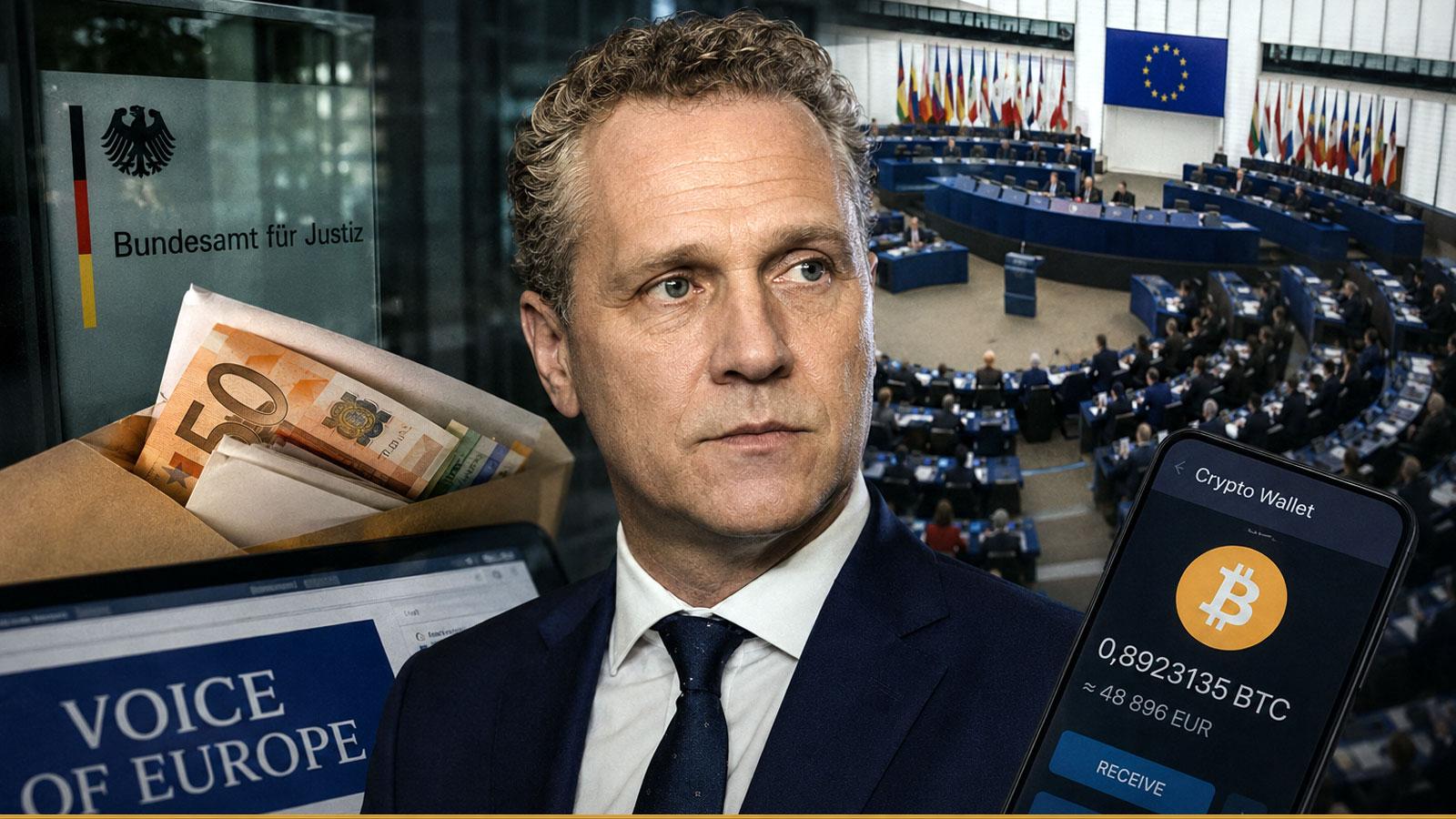
- The request transmitted by German authorities concerned alleged offences including:
- The corruption allegations centred on Voice of Europe, a pro-Russian media and political platform that European authorities had already scrutinised as part of a wider influence network.
- According to the official European Parliament decision summarising the Munich Public Prosecutor’s allegations, Bystron may have received:
- from the operator of Voice of Europe in return for a commitment to:
- in ways favourable to the interests of the Russian Government while he was serving as a member of Germany’s Bundestag.
EXECUTIVE FINDING
On 6 May 2025, the European Parliament voted to waive the parliamentary immunity of German MEP Petr Bystron, allowing German prosecutors to continue criminal proceedings involving allegations that reached directly into one of Europe’s most sensitive political vulnerabilities:
FOREIGN MONEY FOR DOMESTIC POLITICAL INFLUENCE.
The request transmitted by German authorities concerned alleged offences including:
- at least six counts of passive corruption
- money laundering
- fraud
- and
at least five counts of tax evasion.
The corruption allegations centred on Voice of Europe, a pro-Russian media and political platform that European authorities had already scrutinised as part of a wider influence network.
According to the official European Parliament decision summarising the Munich Public Prosecutor’s allegations, Bystron may have received:
- cash payments
- and
- cryptocurrency transfers
from the operator of Voice of Europe in return for a commitment to:
- speak
- and
- vote
in ways favourable to the interests of the Russian Government while he was serving as a member of Germany’s Bundestag.
The allegations did not stop with the suspected receipt of money.
German prosecutors pointed to a pattern of unusual cash activity.
According to the immunity-waiver decision, Bystron allegedly deposited considerable cash sums into an account belonging to a company of which he was sole shareholder and manager.
On 17 and 20 March 2023, he allegedly deposited money through an ATM and then on 20 March withdrew the same amount again in €200 notes.
When the bank sought an explanation for the suspicious movements, prosecutors alleged that no satisfactory explanation was supplied.
Authorities also alleged additional cash deposits during:
- July 2021
- April 2022
- September 2022
- June 2023
- and
July 2023.
German prosecutors said bank records allowed them to identify patterns they believed were consistent with earlier bribe payments and attempts to conceal their origin.
The investigation therefore sits at the intersection of five systems:
FOREIGN STATE INTEREST
↓
MEDIA / INFLUENCE PLATFORM
↓
POLITICIAN
↓
POLITICAL SPEECH AND VOTING
↓
CASH / CRYPTO / FINANCIAL CONCEALMENT
This is exactly the kind of influence architecture modern democratic institutions are poorly designed to detect.
A foreign government does not need to wire money from an embassy account to a parliamentarian.
It can potentially operate through:
- media platforms
- consultants
- former politicians
- businessmen
- cryptocurrency
- cash
and intermediaries.
Every additional layer creates plausible distance.
And that produces the central Kleptik question:
WHAT DOES A BRIBE LOOK LIKE WHEN THE PRODUCT BEING PURCHASED IS NOT A CONTRACT — BUT A POLITICAL POSITION?
THE FINDING
Political corruption usually involves a measurable governmental outcome.
Contract awarded.
Licence granted.
Prosecution stopped.
Land transferred.
But foreign-influence corruption can purchase something less tangible:
THE MESSAGE.
A speech.
A parliamentary question.
A vote.
An interview.
A television appearance.
A social-media post.
A political narrative.
The economic value is difficult to calculate.
The political value may be enormous.
THE POLITICAL PRODUCT
If a foreign actor wants:
a military contract,
it may seek a procurement official.
If it wants:
a favourable court decision,
it may seek judicial influence.
But if it wants:
European public opinion to shift,
it needs something else.
Credible domestic voices.
A local politician saying:
this is my opinion.
That is far more persuasive than a foreign government saying the same thing directly.
POLITICAL AUTHENTICITY AS AN ASSET
Foreign propaganda has an obvious weakness.
Everyone knows where it comes from.
Domestic political speech has greater credibility because the audience assumes the politician speaks independently.
If that independence is secretly purchased, the foreign actor has acquired something exceptionally valuable:
AUTHENTICITY.
The politician becomes an influence conduit.
THE VOICE OF EUROPE MODEL
The alleged structure can be visualised as:
If payment is hidden, the audience believes the message is politically authentic.
That is the deception.
PETR BYSTRON
POSITION
Bystron was elected to the European Parliament in 2024.
Before that, he served in Germany’s Bundestag.
The conduct investigated by Munich prosecutors largely concerned the period before he became an MEP.
His subsequent election to the European Parliament created the immunity issue.
IMMUNITY
Members of the European Parliament enjoy parliamentary immunity under applicable EU and national rules.
That protection exists to preserve legislative independence.
It is not designed to create immunity from ordinary criminal conduct.
German authorities therefore requested that Parliament waive Bystron’s immunity so proceedings could continue.
WHAT PARLIAMENT DECIDED
On 6 May 2025, Parliament agreed to waive his immunity.
The institution concluded that the alleged offences were not protected parliamentary opinions or votes within the meaning of the EU privileges framework and found no evidence that the criminal proceedings had been brought simply to damage his political activity.
This is an important distinction.
The vote did not establish guilt.
It removed a procedural obstacle.
WAIVER ≠ CONVICTION
Parliamentary immunity proceedings ask:
Can prosecutors proceed?
They do not ask:
Is the politician guilty?
Therefore:
IMMUNITY WAIVED
does not mean
CORRUPTION PROVEN.
At the archive date, the allegations remained allegations.
THE CASH
German prosecutors alleged Bystron received cash payments connected with Voice of Europe.
Cash is particularly useful in covert political financing because:
no sender name appears in bank wire;
no transaction purpose is recorded;
no correspondent institution sees origin.
But the problem appears when cash enters the banking system.
THE CASH-DEPOSIT PATTERN
The European Parliament decision recorded allegations that Bystron deposited substantial sums in cash into his company account on multiple occasions.
This creates a classic source-of-funds problem.
Bank sees:
cash.
Customer has:
political exposure.
Question becomes:
WHERE DID THE CASH COME FROM?
THE ATM ROUND TRIP
One alleged transaction pattern is particularly unusual.
According to the immunity-waiver record:
cash was deposited into a company account.
Then the same amount was withdrawn again in large-denomination banknotes.
Economically, little appears to have changed.
But the transaction may change the money’s documentary appearance.
CASH CYCLING
A possible generic model:
This does not automatically constitute laundering.
But circular movement with no clear commercial purpose is a recognised risk indicator.
MONEY LAUNDERING AS PROVENANCE MANAGEMENT
The purpose of laundering is often not to hide the money completely.
It is to improve its story.
Unexplained envelope becomes:
withdrawal from company account.
The money can now be described as:
company funds.
The underlying source may remain unchanged.
THE BANK QUESTION
The European Parliament decision notes that the bank asked Bystron for an explanation concerning suspicious movements and alleged that he failed to provide an adequate one.
That is important because banks are often the first institutions to see anomalies invisible to voters or parliamentary ethics bodies.
BANKS AS POLITICAL-INTELLIGENCE NODES
A bank can see:
- cash deposits
- crypto-related transfers
- company accounts
unusual withdrawals.
But it may not know:
what parliamentary speech followed.
Political institutions see:
speech.
Vote.
Interview.
But may not know:
what happened in the bank account.
The corruption becomes visible only when both datasets are combined.
THE DATA-FUSION PROBLEM
Financial system sees:
money.
Political system sees:
message.
Law enforcement must combine:
MONEY + MESSAGE.
That is the analytical core of foreign-influence corruption.
THE CRYPTOCURRENCY ALLEGATION
German prosecutors also alleged that Bystron may have received cryptocurrency transfers from the Voice of Europe operator.
Crypto introduces another layer of complexity.
A wallet can receive value without:
bank account;
cash courier;
traditional payment processor.
But the blockchain may preserve the transfer indefinitely.
CASH VERSUS CRYPTO
CASH
Harder to trace electronically.
Easy to move privately.
Hard to transport at scale.
CRYPTO
Easy to move internationally.
Pseudonymous.
Recorded permanently on blockchain.
Each has different advantages and forensic weaknesses.
Using both can diversify risk.
THE HYBRID PAYMENT MODEL
A covert influence network may use:
cash for local payment.
Crypto for international payment.
Company account for integration.
This combination creates a flexible financial architecture.
FOLLOW THE WALLET
For any alleged crypto payment:
wallet address.
transaction hash.
timestamp.
asset.
exchange used.
funding wallet.
subsequent destination.
Attribution must be precise.
A wallet address is not a person until independent evidence connects them.
BLOCKCHAIN ATTRIBUTION
Kleptik should classify wallet evidence as:
CONFIRMED
Court or exchange record identifies owner.
STRONGLY ATTRIBUTED
Multiple independent sources support ownership.
PROBABLE
Analytics suggest common control.
UNKNOWN
No reliable identity.
Never convert probability into certainty.
THE COMPANY ACCOUNT
The immunity decision says alleged cash movements involved an account belonging to a company of which Bystron was sole shareholder and manager.
This matters because companies can provide a legitimate-looking financial wrapper around personal economic activity.
PERSONAL MONEY INSIDE COMPANY
A company account should normally reflect:
business revenue.
Business expenses.
Capital.
If unexplained political money enters, investigators should ask:
- What business activity generated it?
- Was it invoiced?
- Was tax paid?
- Was it recorded as shareholder loan?
- Revenue?
- Capital contribution?
The accounting description becomes part of the evidence.
THE COMPANY-AS-INTEGRATION-VEHICLE MODEL
This is a classic reason investigators examine closely held businesses in PEP cases.
Again:
the structure alone is not criminal.
The source and purpose determine significance.
PASSIVE CORRUPTION
German prosecutors sought to investigate multiple counts of passive corruption.
Conceptually, passive corruption concerns the public official receiving or accepting an improper benefit in connection with public duties.
It is the recipient side of the bribery transaction.
ACTIVE VERSUS PASSIVE CORRUPTION
ACTIVE CORRUPTION
Person offers or pays bribe.
PASSIVE CORRUPTION
Official solicits, accepts or receives bribe.
Two sides.
One transaction.
A complete investigation requires both.
WHO WAS THE ALLEGED PAYER?
The European Parliament decision refers to the operator of Voice of Europe.
The full beneficial architecture behind the platform is therefore critical.
- Who owned it?
- Who financed it?
- Who directed editorial activity?
- Who controlled payment accounts?
- What Russian political relationships existed?
These questions must be answered from independent records.
VOICE OF EUROPE
Voice of Europe positioned itself as a media organisation.
Media entities are legitimate participants in democratic debate.
But if a media platform secretly pays politicians to repeat particular political narratives, the relationship fundamentally changes.
The outlet stops being merely:
publisher.
It becomes:
POLITICAL INFLUENCE INTERMEDIARY.
MEDIA AS AN INFLUENCE VEHICLE
A foreign government openly operating a propaganda outlet has limited credibility.
A nominally independent media organisation interviewing European politicians offers greater legitimacy.
The politician appears to be speaking voluntarily.
The outlet appears journalistic.
That distinction matters.
THE INTERVIEW PIPELINE
Potential architecture:
The foreign narrative is repackaged as local political debate.
THE PAID-SPEECH PROBLEM
If prosecutors prove that payments were made specifically for parliamentary speech or voting behaviour, the political product becomes measurable.
Payment.
↓
speech.
Vote.
But establishing causation requires more than ideological alignment.
PRO-RUSSIAN OPINION IS NOT EVIDENCE OF BRIBERY
This distinction is essential.
A politician may sincerely support positions favourable to Russia.
That is political speech.
It becomes corruption only if prosecutors prove:
money or benefit
was exchanged for
official conduct.
Political opinion cannot itself become evidence of guilt.
THE VOTE AS EVIDENCE
The European Parliament decision noted prosecutors’ allegation that Bystron had voted since 2022 on Russia-related matters in ways clearly favourable to Russian government interests and had delivered at least two Bundestag speeches defending pro-Russian positions.
These political actions may form part of the prosecution’s circumstantial case.
But they must never be treated independently as proof of corruption.
IDEOLOGY VERSUS QUID PRO QUO
Two competing explanations:
EXPLANATION A
Politician sincerely believes policy.
EXPLANATION B
Politician is paid to advocate policy.
Identical vote.
Different motive.
The financial evidence determines the difference.
THE TIMELINE TEST
Investigators should synchronise:
Repeated temporal relationships can strengthen or weaken the quid-pro-quo theory.
THE POLITICAL-MESSAGE LEDGER
For each alleged benefit:
Date.
Amount.
Form.
Then record:
speech.
vote.
interview.
social media.
The two timelines should be built independently before being compared.
This reduces confirmation bias.
FOREIGN INFLUENCE AS A SERVICE
The broader Voice of Europe story suggests the possible emergence of something like:
INFLUENCE-AS-A-SERVICE.
A political network may provide:
- media platform
- payments
- audience
- policy messaging
politician access.
The foreign sponsor does not need to build individual relationships with every politician.
The intermediary platform does it.
THE PLATFORM MODEL
This scales better than direct bribery.
WHY EUROPE IS VULNERABLE
The European political system is fragmented.
27 EU member states.
National parliaments.
European Parliament.
Political groups.
Media ecosystems.
Different campaign-finance rules.
Different corruption laws.
Foreign influence can exploit these differences.
JURISDICTIONAL ARBITRAGE IN POLITICS
A payment may originate in:
Country A.
Platform operates from:
Country B.
Politician sits in:
Country C.
Media distributes across:
EU.
This creates an enforcement problem resembling cross-border money laundering.
THE CZECH CONNECTION
Voice of Europe had been based in the Czech Republic before Czech authorities took action against the network.
A serious Kleptik investigation should map:
corporate ownership.
Hosting.
Banking.
Editorial leadership.
Payments.
Political guests.
Sanctions.
The media entity should be treated like any other potentially high-risk corporate structure.
MEDIA BENEFICIAL OWNERSHIP
- Who owns the outlet?
- Who funds it?
- Who controls editorial decisions?
- Who purchases advertising?
- Who pays guests?
A media company’s formal shareholders may not reveal its ultimate political sponsor.
THE ADVERTISING PROBLEM
Foreign influence can hide in:
sponsorship.
Advertising.
Consulting.
Speaking fees.
Research grants.
Media appearances.
The label is less important than economic substance.
POLITICIAN COMPENSATION
Payments to politicians can be disguised as:
consulting.
Speaker fees.
Media compensation.
Company revenue.
Book payments.
Travel reimbursement.
The investigator must determine whether compensation corresponds to genuine commercial work or official political conduct.
THE EMPLOYMENT-FRAUD ALLEGATION
The Bystron immunity request also included allegations unrelated to Voice of Europe.
Prosecutors alleged that Bystron used parliamentary funds to employ his lawyer under arrangements where the work either lacked sufficient connection to parliamentary duties or was not performed as represented.
The alleged loss to the German state was approximately:
€97,400.
This should be analytically separated from the foreign-influence allegations.
ONE DEFENDANT, MULTIPLE SCHEMES
A criminal case can contain:
bribery.
Money laundering.
Tax.
Payroll fraud.
Investigators must resist creating one blended narrative where every allegation proves the others.
Each scheme needs independent evidence.
THE LAWYER EMPLOYMENT QUESTION
According to the Parliament decision, Bystron entered an employment contract with his lawyer in October 2021 and later amended hours and compensation multiple times.
Prosecutors alleged parliamentary allowance money was used improperly.
Again:
allegation.
Not conviction.
PUBLIC MONEY FOR PRIVATE WORK
If proven, the architecture would be:
Public money becomes private subsidy.
This resembles the assistant-fraud mechanisms seen elsewhere in European politics.
THE TAX ALLEGATIONS
German prosecutors also alleged incorrect VAT returns involving private expenditure treated as business expenses.
The alleged improper VAT refund totalled approximately:
€9,949.17.
These allegations are materially smaller than the foreign-influence issue but may be relevant to understanding use of the closely held company.
PRIVATE EXPENSE THROUGH COMPANY
A common financial-integrity problem:
This is tax misconduct if proven.
It should not automatically be treated as laundering.
Separate offence.
Separate analysis.
WHY THE COMPANY MATTERS
The same closely held company allegedly appears in:
cash movements
and
tax issues.
That makes it an important investigative node.
Kleptik should obtain:
company registry.
Financial statements.
VAT records where public.
Banking evidence from court filings.
Business purpose.
Clients.
Revenue.
The company may explain or contradict the cash narrative.
THE PEP-COMPANY INTERFACE
Closely held companies controlled by politicians deserve enhanced scrutiny because they can receive:
legitimate private income
and
potentially political money.
The challenge is distinguishing the two.
SOURCE OF FUNDS
For every company deposit:
client.
Invoice.
Service.
Contract.
Payment method.
If cash has no corresponding customer or invoice, the source becomes difficult to explain.
SOURCE OF WEALTH
Separately:
Could Bystron’s legitimate income explain the total cash activity?
Public salary.
Private business.
Investments.
Prior wealth.
Source-of-wealth analysis must precede any claim of unexplained enrichment.
THE BANK’S ROLE
The immunity decision specifically indicates bank concern over suspicious activity.
This demonstrates why bank AML can intersect directly with political corruption.
A politically exposed customer making repeated large cash movements through a company account creates multiple risk indicators.
WHAT SHOULD THE BANK ASK?
- Why cash?
- Where sourced?
- Why company account?
- Why immediate withdrawal?
- What business generated revenue?
- Who are counterparties?
- Is customer a PEP?
- Does cash pattern correspond with declared business?
These are standard AML questions.
SAR CONFIDENTIALITY
Whether the bank filed a suspicious activity report may be confidential and should not be guessed.
The fact that a bank asked questions does not establish a SAR.
Kleptik should preserve that boundary.
BANK RECORDS AS CORRUPTION EVIDENCE
The immunity decision states prosecutors possessed transaction records for Bystron’s accounts and company from 2020 onward.
This allowed them to reconstruct patterns retrospectively.
Financial history can survive even when cash origins are disputed.
THE MONEY-LAUNDERING ALLEGATION
German prosecutors allege Bystron attempted to conceal the origin of cash.
To establish money laundering, prosecutors will need to prove the relevant legal elements.
Kleptik should not independently label the transactions laundering merely because they appear unusual.
SUSPICIOUS ≠ CRIMINAL
Cash cycling.
Company account.
No explanation.
These are red flags.
Not convictions.
That evidentiary discipline is essential in politically sensitive reporting.
PARLIAMENTARY IMMUNITY
The case also illustrates why immunity exists.
Politicians should not face criminal prosecution simply because government dislikes their votes.
That protection is foundational to democracy.
But immunity should not shield ordinary bribery.
The waiver process therefore asks whether prosecution appears politically motivated.
FUMUS PERSECUTIONIS
European parliamentary immunity analysis includes consideration of whether proceedings may be designed to damage political activity.
Parliament stated that it found no evidence suggesting the German proceedings were initiated for that purpose.
This was central to the waiver decision.
SPEECH PROTECTION
Parliament also concluded that the alleged offences did not concern protected parliamentary opinion or votes in the sense required to bar waiver.
Again, important distinction:
The content of speech is protected.
Payment for official conduct may not be.
THE DEMOCRATIC PARADOX
Democracy must simultaneously protect:
politicians from politically motivated prosecution
and
the public from politicians selling political influence.
Immunity rules attempt to balance those risks.
FOREIGN INTERFERENCE
The allegations against Bystron belong to a broader European concern over covert Russian influence.
European governments have increasingly scrutinised:
- political funding
- disinformation platforms
- proxy media
- covert payments
and political intermediaries.
The Voice of Europe case sits at the intersection.
OPEN PROPAGANDA VERSUS COVERT INFLUENCE
OPEN PROPAGANDA
Audience knows sponsor.
COVERT INFLUENCE
Audience believes message is independent.
The second may be more effective precisely because sponsorship is hidden.
BENEFICIAL OWNERSHIP OF POLITICAL SPEECH
Kleptik proposes:
BENEFICIAL OWNERSHIP OF POLITICAL SPEECH
- Who ultimately paid for the message?
- Who requested it?
- Who benefits?
A politician may legally own the words.
A foreign principal may economically own the incentive behind them.
If payment is proven, this becomes central.
THE SPEECH-MONEY MATRIX
| Financial event | Political event | Evidence status |
|---|---|---|
| Alleged cash payment | Bundestag speech | Requires causal proof |
| Alleged crypto payment | Russia-related vote | Requires causal proof |
| Company cash deposit | Political activity | Financial red flag only |
| Voice of Europe relationship | Media appearances | Influence indicator |
The table must never imply that timing alone proves quid pro quo.
FOLLOW THE EDITORIAL CALENDAR
For Voice of Europe:
- Which politicians appeared?
- When?
- Which issues?
- What compensation?
- Who arranged appearance?
- Did appearances follow payments?
This dataset can reveal whether Bystron was isolated or part of a wider paid influence network.
THE MULTI-POLITICIAN QUESTION
The most important question may ultimately be:
WHO ELSE WAS PAID?
If Voice of Europe compensated multiple European politicians, the story changes from one corruption case into an influence infrastructure investigation.
THE NETWORK DATABASE
Kleptik should build:
Politician.
Country.
Party.
Voice of Europe appearances.
Financial allegations.
Russia-related votes.
Known meetings.
Sanctions actions.
The objective is not ideological profiling.
It is identifying financial connections.
DO NOT SCORE POLITICIANS BY “PRO-RUSSIANNESS”
That would be analytically irresponsible.
A politician may legitimately oppose sanctions or NATO policy.
Political positions must never become proxy evidence of bribery.
Only financial or documentary links justify inclusion in a corruption map.
THE PAYMENT-FIRST RULE
Kleptik’s foreign-influence investigations should begin with:
payment.
Contract.
Company.
Financial benefit.
Then ask whether political conduct follows.
Never begin with unpopular opinion and search backward for evidence.
That is confirmation bias.
THE €97,400 PUBLIC-FUNDS CASE
The employment allegation should become a separate sidebar because it shows another way political office can be monetised.
The mechanism resembles fictitious parliamentary assistant cases elsewhere in Europe.
EU PUBLIC MONEY RISK
European legislatures provide budgets for:
staff.
Travel.
Office.
Communications.
If political parties or private businesses use these resources for non-parliamentary work, public funding can indirectly subsidise private activity.
That is distinct from foreign bribery but part of the same public-integrity ecosystem.
TAX AS A SECONDARY SIGNAL
Tax irregularities can sometimes expose corruption proceeds because unexplained income creates reporting problems.
But tax violations may also be entirely unrelated.
Kleptik should avoid assuming tax evasion proves bribery.
Use it as an independent financial-integrity track.
FOLLOW THE CASH TAX TREATMENT
If prosecutors allege bribe cash:
- Was it declared as income?
- Business revenue?
- Loan?
- Nothing?
Tax treatment can reveal how recipient understood the payment.
FOREIGN MONEY AND TAX
A secretly received bribe may generate two exposures:
corruption.
Tax evasion.
The second can sometimes be easier to prove.
Historical organised-crime cases often use tax law for this reason.
THE MONEY-SPEECH PROBLEM FOR DEMOCRACIES
Campaign donations are regulated because money can influence politics.
But covert foreign payments fall outside ordinary campaign-finance transparency.
They may be:
cash.
Crypto.
Consulting fee.
Media payment.
The current disclosure architecture may not capture them until law enforcement intervenes.
THE POLITICAL KYC CONCEPT
Kleptik proposes an institutional analogue to banking:
KNOW YOUR POLITICAL FUNDER
Politicians should disclose significant:
foreign consulting income.
Foreign-sponsored travel.
Media compensation.
Third-party speaking payments.
Beneficial owners of paying entities.
Not because foreign contact is improper.
Because hidden foreign economic interests create vulnerability.
THE FOREIGN-PAYMENT REGISTER
A transparent register could include:
Payer.
Beneficial owner.
Country.
Amount.
Service.
Date.
Politician.
This would make covert influence significantly harder.
CRYPTO DISCLOSURE
Political disclosure systems increasingly need to capture cryptocurrency.
A wallet is an asset.
A transfer is a payment.
A digital form should not escape disclosure because older ethics laws were written for bank accounts.
THE CRYPTO-POLITICS PROBLEM
Crypto can move:
cross-border.
24/7.
without correspondent bank.
That makes it attractive for covert influence.
But the permanent blockchain can also make later forensic reconstruction possible.
THE EXCHANGE CHOKEPOINT
Eventually many crypto recipients need:
fiat.
Exchange.
Bank.
That is where KYC can link wallet to identity.
A strong exchange compliance system therefore contributes to political-integrity enforcement.
FOREIGN-INFLUENCE AML
Banks and crypto exchanges should consider foreign political funding as a financial-crime risk category.
PEP receives funds from:
foreign media platform.
Foreign company.
Foreign politically connected intermediary.
That may warrant enhanced review.
THE RUSSIA-RELATED VOTING ALLEGATION
The Parliament decision says prosecutors alleged Bystron’s voting and speeches aligned strongly with Russian government interests.
Again:
This is context.
Not independent proof.
The correct question is whether prosecutors can connect:
financial benefit
to
specific official conduct.
THE CAUSATION CHALLENGE
If politician held pro-Russian views before alleged payments, defence may argue payment did not cause opinion.
Prosecution may argue payment purchased continued or amplified advocacy.
The timeline of beliefs, statements and payments becomes critical.
BASELINE POLITICAL POSITION
Investigators should establish:
What did politician say before alleged payment?
What changed afterward?
This prevents treating longstanding ideology as evidence of purchase.
AMPLIFICATION AS THE PRODUCT
A foreign actor may not need to change a politician’s belief.
It may pay someone who already agrees.
The product becomes:
more speeches.
More interviews.
More visibility.
More votes.
This is common in influence operations.
BUYING THE WILLING
The most efficient influence operation does not convert opponents.
It finds allies and subsidises them.
That can be more difficult to detect because the message remains ideologically authentic.
CORRUPTION WITHOUT POLICY CHANGE
Thus a politician can be corruptly paid even if payment does not alter position.
If official action is exchanged for value, pre-existing belief may not eliminate corruption.
The legal question depends on applicable law.
THE MEDIA ECOSYSTEM
Voice of Europe should be mapped not merely as a website but as a network.
Corporate entity.
Owners.
Editors.
Advertisers.
Guests.
Political contacts.
Bank accounts.
Hosting.
Social channels.
Content syndication.
A modern media influence platform may operate like a political consultancy disguised as journalism.
THE FUNDING QUESTION
- Who funded operating losses?
- Advertising revenue?
- Subscriptions?
- Foreign capital?
Opaque funding is a major red flag where media outlet repeatedly serves one geopolitical narrative.
Again:
editorial bias alone does not prove foreign control.
Funding evidence matters.
THE CZECH SANCTIONS TRAIL
Czech government actions against Voice of Europe and related figures form an important supporting investigation.
Kleptik should reconstruct the Czech sanctions record and company structure separately.
This dossier focuses on the German parliamentary case.
EUROPE AFTER QATARGATE
Dossier 003 showed that Brussels responded to Qatargate by strengthening transparency around lobbying and foreign access.
The Bystron allegations reveal another vulnerability:
Payments may occur before politician reaches the European Parliament, through national politics and media platforms.
EU reforms cannot solve every national-level influence channel.
THE MULTI-LEVEL DEMOCRACY PROBLEM
Foreign influence can target:
local politics.
National parliament.
European Parliament.
Media.
Political party.
Think tank.
NGO.
Different transparency systems apply at each level.
The attacker only needs the weakest one.
FOREIGN-INFLUENCE ARBITRAGE
A network can route influence through whichever jurisdiction has:
weakest disclosure.
weakest lobbying law.
weakest political finance rules.
This resembles financial regulatory arbitrage.
DEMOCRATIC REGULATORY ARBITRAGE
Kleptik defines:
DEMOCRATIC REGULATORY ARBITRAGE
using differences among political transparency regimes to hide the ultimate sponsor of political activity.
This should become a recurring EU investigative theme.
CHRONOLOGY
2020
According to German prosecutors, the period of suspected corrupt payments involving Voice of Europe may begin around this time.
July 2021
Bystron allegedly deposits significant cash that prosecutors later view as connected to suspected bribe money.
October 2021
Bystron enters an employment agreement with his lawyer funded from parliamentary allowances, according to prosecutors.
2022
German prosecutors later allege Bystron repeatedly takes positions on Russia-related Bundestag matters favourable to Russian government interests.
He allegedly receives or deposits additional unexplained cash during the year.
17 and 20 March 2023
Prosecutors allege Bystron deposits considerable cash into his company account and withdraws the same amount in €200 notes.
June–July 2023
Additional alleged cash deposits occur.
2024
Bystron is elected to the European Parliament.
23 July 2024
The Munich Public Prosecutor requests waiver of Bystron’s parliamentary immunity.
27 August 2024
Germany’s Federal Ministry of Justice transmits the request to the European Parliament.
16 September 2024
The request is formally announced in Parliament.
13 February 2025
Bystron is heard by the European Parliament’s Committee on Legal Affairs.
6 May 2025
European Parliament votes to waive Bystron’s immunity.
The Parliament concludes that the proceedings do not relate to protected parliamentary speech or votes and finds no evidence of politically motivated prosecution.
As of the archive date, the criminal allegations remain unresolved.
DOCUMENTARY RECORD
EUROPEAN PARLIAMENT — 6 MAY 2025
The Parliament’s formal immunity decision is the core primary source.
It records German prosecutors’ allegations concerning:
- cash
- cryptocurrency
- Voice of Europe
- suspected corruption
- money laundering
- company-account movements
- employment-funds fraud
- tax allegations
and Russia-related political activity.
EUROPEAN PARLIAMENT LEGISLATIVE OBSERVATORY
The Parliament’s case summary confirms the immunity waiver and summarises the alleged corruption and money-laundering offences.
WHAT GERMAN PROSECUTORS ALLEGE
According to the European Parliament’s official record, Munich prosecutors suspect that Bystron received cash or cryptocurrency from the operator of Voice of Europe in exchange for political speech and voting favourable to Russian government interests.
They also allege:
- cash deposits
- attempts to conceal the origin of funds
- improper parliamentary employment spending
and tax violations.
These allegations had not been adjudicated as of 6 May 2025.
WHAT THE EUROPEAN PARLIAMENT DECIDED
The European Parliament did not decide whether Bystron was guilty.
It decided that his parliamentary immunity should be waived so the German proceedings could continue.
The institution found no evidence that the criminal process had been initiated merely to undermine his political work.
WHAT BYSTRON SAYS
Bystron has publicly disputed allegations surrounding the Voice of Europe affair and has rejected claims that he accepted improper payments.
Before publication, Kleptik should obtain his current position or a statement from counsel and reproduce the substance fairly.
The dossier should not imply guilt before adjudication.
WHAT THIS DOSSIER DOES NOT ESTABLISH
This dossier does not establish that:
- Petr Bystron accepted bribes
- he committed money laundering
- he committed tax fraud
- every pro-Russian speech he gave was purchased
- Voice of Europe paid every politician who appeared on its platform
- the Russian Government directly transferred money to Bystron
- every cryptocurrency transaction connected to the investigation was illicit
or political positions favourable to Russia are evidence of corruption.
The criminal case remained unresolved as of the archive date.
RIGHT OF REPLY
Before publication, Kleptik should seek comment from:
- Petr Bystron
- Bystron’s legal counsel
- Voice of Europe / responsible corporate representatives
- German public prosecutor where appropriate
- European Parliament
For any individual, company, bank, media employee or political actor identified through original Kleptik research, specific allegations and documentary evidence should be provided before publication.
UNANSWERED QUESTIONS
The immunity record gives unusually detailed clues.
But the full influence network remains hidden.
1. WHO PAID?
What individual or entity allegedly supplied the cash?
2. WHICH WALLET?
What cryptocurrency addresses are involved?
3. HOW MUCH?
What total alleged benefit did prosecutors identify?
4. WHICH ASSET?
- Bitcoin?
- Stablecoin?
- Another cryptocurrency?
5. EXCHANGE?
Which exchange or wallet service touched the crypto?
6. SOURCE WALLET
Who funded the alleged payer?
7. VOICE OF EUROPE OWNERSHIP
Who beneficially controlled the platform during the relevant period?
8. FUNDING
Who financed the platform?
9. OTHER POLITICIANS
Were comparable payments made elsewhere?
10. CASH ORIGIN
Can alleged cash deposits be linked forensically to a payer?
11. BANK
What questions did Bystron’s bank ask?
12. COMPANY ACCOUNT
What legitimate business activity explains the deposits?
13. TAX
How were the funds reported?
14. SPEECHES
Which speeches prosecutors allege were connected to payments?
15. VOTES
Which Bundestag votes form part of the case?
16. TIMING
Did payments immediately precede political actions?
17. BASELINE
What were Bystron’s Russia-related views before the alleged payments?
18. MEDIA APPEARANCES
How frequently did he appear on Voice of Europe?
19. FOREIGN DIRECTION
What evidence connects the alleged payer to Russian state interests?
20. THE CENTRAL QUESTION
Was Voice of Europe simply an ideologically aligned media organisation—or did it operate as a financial intermediary through which foreign interests could covertly purchase political amplification inside Europe?
That is the investigation.
KLEPTIK INTELLIGENCE ASSESSMENT
ASSESSMENT: ESTABLISHED
The European Parliament waived Petr Bystron’s immunity on 6 May 2025 in connection with criminal proceedings requested by the Munich Public Prosecutor.
ASSESSMENT: OFFICIAL ALLEGATION
German prosecutors suspect Bystron received cash payments or cryptocurrency transfers from the operator of Voice of Europe in return for political actions favourable to Russian government interests.
ASSESSMENT: OFFICIAL ALLEGATION
Prosecutors identified suspicious cash movements through a company account controlled by Bystron and alleged attempts to conceal the origin of cash.
ASSESSMENT: OFFICIAL ALLEGATION
Separate aspects of the German proceedings concern alleged misuse of parliamentary staffing funds causing approximately €97,400 in losses and alleged tax irregularities generating approximately €9,949 in improper VAT refunds.
ASSESSMENT: HIGH CONFIDENCE
The case demonstrates that modern foreign-influence operations can use both physical cash and cryptocurrency, allowing the payment architecture to move outside conventional campaign-finance systems.
ASSESSMENT: HIGH CONFIDENCE
Media platforms can function as political influence intermediaries where they combine audience access, politician relationships and opaque financing.
That possibility requires transaction-specific proof and should not be inferred from ideological editorial content alone.
ASSESSMENT: HIGH CONFIDENCE
Foreign-influence investigations must distinguish the political position from the financial relationship.
A pro-Russian vote is not evidence of corruption without an independent payment or quid-pro-quo link.
ASSESSMENT: HIGH CONFIDENCE
The most important investigative opportunity is to reconstruct Voice of Europe’s complete financial and political network across European jurisdictions rather than treating the Bystron case as an isolated national prosecution.
ASSESSMENT: OPEN
No criminal conviction establishing Bystron’s guilt existed as of 6 May 2025.
The prosecution’s corruption and money-laundering theories remained to be tested in the German judicial process.
THE KLEPTIK VIEW
A foreign government does not need to convince Europe.
It only needs Europeans to do the convincing.
That is the strategic advantage of covert political influence.
A statement issued directly by Moscow is understood as Russian messaging.
A similar statement delivered by a German parliamentarian enters the democratic marketplace as domestic political opinion.
The words may be identical.
Their credibility is not.
That credibility is what a covert influence operation would seek to acquire.
And that is why the Bystron case matters.
German prosecutors are not merely alleging:
money changed hands.
They are alleging the product purchased with that money was:
POLITICAL AUTHENTICITY.
A speech from a real parliamentarian.
A vote from an elected legislator.
A position that appears to originate inside German democracy.
If the allegations are proven, the corruption mechanism was not primarily about changing legislation.
It was about changing who the audience believed was speaking.
That is a different kind of political asset.
The alleged payment architecture is equally modern.
Cash.
Cryptocurrency.
A closely held company.
A media platform.
No suitcase travelling from an embassy to Parliament is necessary.
No campaign contribution needs to appear in public records.
The money can arrive as something else.
The message can appear entirely legitimate.
That is why foreign influence increasingly resembles money laundering.
Money laundering asks:
How do we conceal the true origin of the funds?
Covert political influence asks:
HOW DO WE CONCEAL THE TRUE ORIGIN OF THE MESSAGE?
The answer to both is layering.
By the time the message reaches the audience, its origin has been transformed.
The Russian interest, if prosecutors prove it, has become a German political opinion.
That is political laundering.
But this case also requires discipline.
A politician can oppose sanctions on Russia.
Criticise NATO.
Challenge aid to Ukraine.
Speak on Voice of Europe.
None of that proves corruption.
Democracy protects unpopular opinions precisely because government cannot criminalise viewpoint.
The line is money.
If prosecutors prove that political conduct was purchased, it becomes corruption.
If they cannot, the political speech remains political speech.
That distinction is non-negotiable.
Which is why the real investigation should not begin with Bystron’s speeches.
It should begin with:
THE CASH.
Where did it come from?
Then:
THE CRYPTO.
Which wallet sent it?
Then:
THE COMPANY.
Why did the money enter there?
Then:
VOICE OF EUROPE.
- Who owned it?
- Who financed it?
- Who else received money?
Only after those questions are answered should investigators compare the financial timeline with speeches and votes.
Because in political investigations, ideology can mislead.
Money is harder to argue with.
And if Voice of Europe operated as prosecutors suspect, the real story is much bigger than one German politician.
It would mean Europe was confronting a new commercial market:
POLITICAL INFLUENCE FOR HIRE.
Media distribution.
Crypto settlement.
Cash integration.
Domestic politician.
Foreign beneficiary.
The twenty-first-century influence operation may no longer look like espionage.
It may look like a perfectly ordinary political interview.
FOLLOW THE MONEY IN.
FOLLOW THE MESSAGE OUT.
THEN ASK WHO REALLY PAID FOR THE POLITICS IN BETWEEN.
KLEPTIK METHODOLOGY
This dossier is dated 6 May 2025 and is intentionally fixed to the procedural and evidentiary position existing on that date.
The principal evidentiary sources are:
the European Parliament’s formal decision waiving Petr Bystron’s parliamentary immunity;
and
the European Parliament Legislative Observatory record summarising the German prosecution request.
Kleptik distinguishes strictly between:
- immunity waiver
- criminal allegation
- suspicious financial activity
- political speech
- and
criminal conviction.
An immunity waiver does not establish guilt.
A suspicious transaction does not establish money laundering.
A political position favourable to a foreign government does not establish foreign control.
For foreign-influence investigations, Kleptik follows a payment-first methodology.
Investigators should independently establish:
PAYMENT
Cash, cryptocurrency, fee or other benefit.
PAYER
Identity and beneficial owner.
INTERMEDIARY
Media company, consultant or other entity.
POLITICAL ACTION
Speech, vote, interview or other official conduct.
FOREIGN BENEFICIARY
State, political organisation or commercial interest.
Only after those layers are separately verified should a quid-pro-quo theory be assessed.
For cryptocurrency evidence, wallet ownership should be assigned a confidence level and independently corroborated wherever possible.
For cash evidence, bank deposits should be traced against:
- legitimate income
- company revenue
- withdrawals
and contemporaneous communications.
For political speech, Kleptik should establish the politician’s pre-existing position before alleging that payment altered behaviour.
For media entities, ideological alignment alone is not proof of foreign control.
Ownership and funding must be documented.
For closely held companies, corporate ownership alone does not establish laundering. The relevant issues are:
- source of funds
- economic purpose
- accounting treatment
and beneficial use.
For parliamentary staffing allegations, Kleptik should distinguish work actually performed from contractual description and identify the precise public-money loss.
Any individual, company, media organisation, bank or political actor facing material criticism beyond official allegations should receive detailed right of reply.
EVIDENTIARY LABELS
ESTABLISHED — IMMUNITY WAIVER
Formal European Parliament decision permitting criminal proceedings to continue.
OFFICIAL ALLEGATION
Claim made by German prosecutors and recorded in the parliamentary waiver decision.
SUSPICIOUS FINANCIAL ACTIVITY
Transaction pattern raising compliance concerns but not establishing criminality.
POLITICAL-ACTION INDICATOR
Speech, vote or public position relevant to an alleged quid pro quo but not evidence of corruption by itself.
FOREIGN-INFLUENCE INDICATOR
Financial, media or political relationship potentially connecting a foreign interest with domestic political activity.
CRYPTO PAYMENT INDICATOR
Digital-asset transfer requiring ownership attribution and economic-purpose analysis.
MEDIA-INTERMEDIARY INDICATOR
Media organisation potentially functioning as a financial or political conduit; requires independent proof.
KLEPTIK VERIFIED
Fact independently corroborated through primary records.
KLEPTIK ASSESSMENT
Analytical conclusion derived from identified evidence.
INVESTIGATIVE LEAD
Matter requiring additional financial, corporate, media or political verification.
UNVERIFIED
Information insufficiently corroborated for factual publication.
DOCUMENT STATUS
KLTK-2025-020
Subject: Petr Bystron / Voice of Europe / Alleged Russian Influence / Cash and Cryptocurrency
Archive date: 6 May 2025
Status at archive date: Parliamentary immunity waived; German criminal proceedings ongoing; allegations unresolved
Historical treatment: Fixed to report date
© KLEPTIK — Investigations into Power, Money and the Systems Designed to Hide Both